


Artificial Intelligence is no longer just a tool for startups. It is becoming a way of working. Many startups use AI for marketing, customer support, analytics, or automation, but only a few truly build an AI-first culture. The difference between using AI occasionally and building an AI-first startup culture is massive.
An AI-first startup culture means AI is not added later as a shortcut. It is built into daily decisions, workflows, mindset, and long-term strategy. Teams think in terms of data, automation, and continuous learning. Founders encourage experimentation, not fear. Decisions are guided by insights, not assumptions.
In the coming years, startups without an AI-first culture will struggle to compete with lean, fast, and data-driven companies. Building this culture early helps startups scale faster, reduce costs, and avoid burnout.
This article explains how to build an AI-first startup culture, why it matters, common mistakes to avoid, and practical steps founders can take to prepare their teams for an AI-driven future.
What Is an AI-First Startup Culture?
An AI-first startup culture means AI is considered from the beginning, not added later.
It includes:
- Data-driven thinking
- Automation mindset
- Comfort with AI tools
- Continuous learning
- Human + AI collaboration
AI becomes part of how the startup thinks and operates.
Why AI-First Culture Matters for Startups
Startups operate with limited resources.
An AI-first culture helps because:
- Teams work faster
- Fewer people do more work
- Decisions are clearer
- Costs stay under control
Culture decides whether AI succeeds or fails.
AI-First Culture vs AI Tools
Many startups confuse tools with culture.
Using AI tools:
- Is tactical
- Depends on individuals
- Can stop anytime
Building AI-first culture:
- Is strategic
- Involves everyone
- Grows over time
Culture creates long-term advantage.
The Role of Founders in Building AI-First Culture
Culture always starts at the top.
Founders must:
- Lead by example
- Use AI themselves
- Encourage experimentation
- Remove fear
If founders resist AI, teams will too.
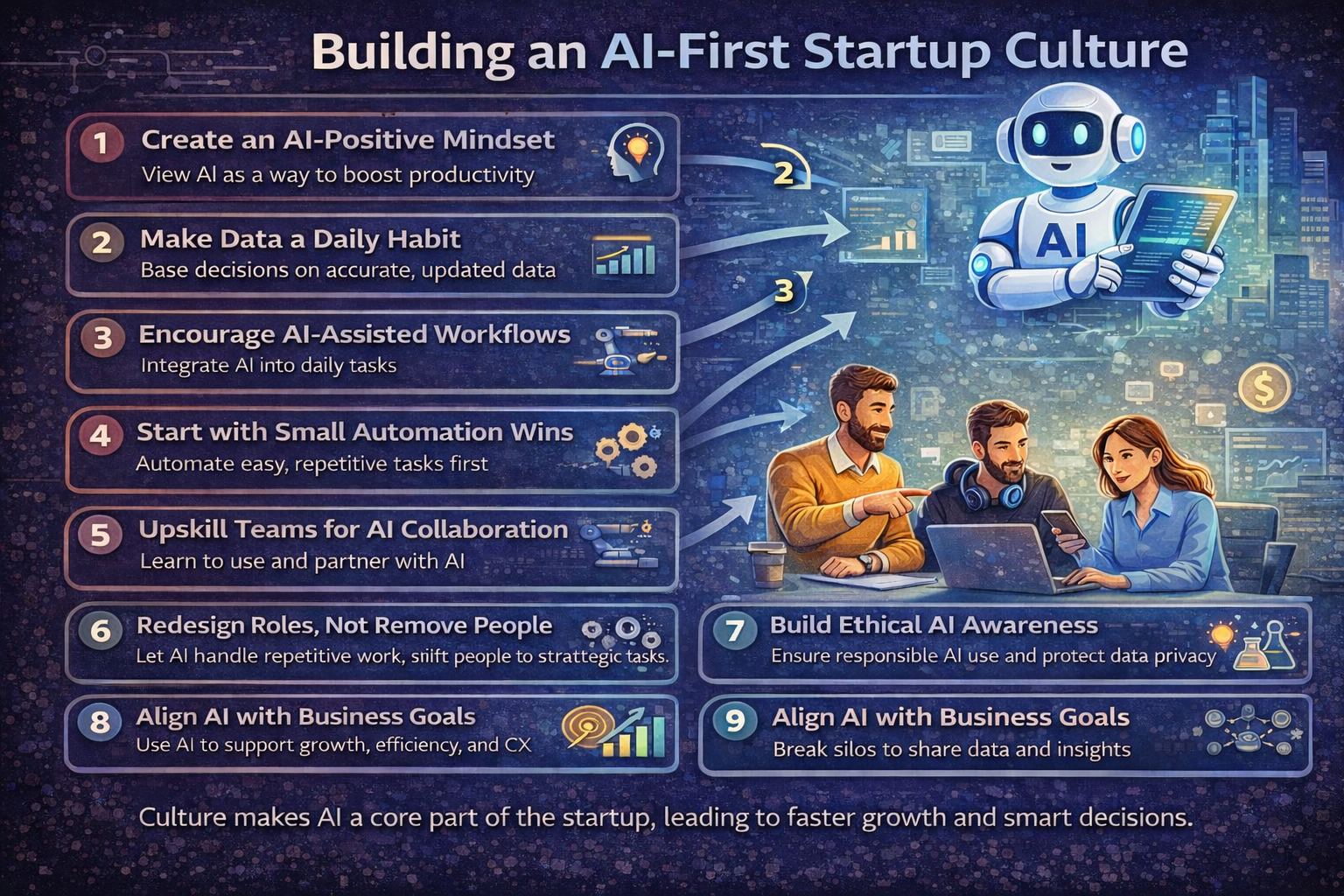
Step 1: Create an AI-Positive Mindset
The first step is mindset, not tools.
Teams must see AI as:
- A helper, not a threat
- A productivity booster
- A learning opportunity
Fear blocks adoption. Curiosity drives it.
How to Reduce Fear Around AI
Fear usually comes from job insecurity.
Founders should:
- Communicate clearly
- Explain AI’s role
- Show how AI reduces workload
- Highlight new skill opportunities
Transparency builds trust.
Step 2: Make Data a Daily Habit
AI needs data to work.
An AI-first culture values:
- Data accuracy
- Regular tracking
- Insight-based discussion
Decisions without data become rare.
How to Build Data Discipline
Data culture improves when:
- Teams track simple metrics
- Reports are reviewed regularly
- Opinions are supported by data
Small habits create strong foundations.
Step 3: Encourage AI-Assisted Workflows
AI should be part of daily tasks.
Examples include:
- Writing drafts
- Analysing reports
- Automating follow-ups
- Summarising meetings
This makes AI normal, not special.
Why Daily Use Matters
When AI is used daily:
- Learning happens naturally
- Resistance reduces
- Productivity increases
AI becomes invisible but essential.
Step 4: Start with Small Automation Wins
Automation builds confidence.
Startups should:
- Automate repetitive tasks
- Reduce manual reporting
- Simplify workflows
Small wins create momentum.
Examples of Easy Automation
Common starting points:
- Customer support replies
- Data entry
- Email sorting
- Lead qualification
These save time immediately.
Step 5: Upskill Teams for AI Collaboration
AI-first culture requires learning.
Upskilling does not mean coding.
It means:
- Understanding AI outputs
- Asking better questions
- Using AI responsibly
Learning keeps teams relevant.
How to Upskill Without Pressure
Upskilling works when:
- Learning is encouraged
- Mistakes are allowed
- Training is simple
Growth should feel safe.
Step 6: Redesign Roles, Not Remove People
AI changes roles, not human value.
Founders should:
- Remove repetitive work
- Shift people to strategic tasks
- Encourage creative thinking
People grow with AI.
Human Strengths Become More Important
AI increases the value of:
- Creativity
- Critical thinking
- Communication
- Leadership
Culture must protect these strengths.
Step 7: Build Ethical AI Awareness
AI-first culture must be ethical.
Teams should understand:
- Data privacy
- Bias risks
- Transparency importance
Ethics protects trust and brand value.
Why Ethics Belongs in Culture
Ethical habits:
- Prevent misuse
- Reduce risk
- Build customer trust
Ethics is easier to build early.
Step 8: Encourage Experimentation and Curiosity
AI improves through experimentation.
Founders should:
- Allow tool testing
- Support pilot projects
- Celebrate learning
Innovation grows in safe environments.
Failure Is Part of AI Learning
AI experiments may fail.
That is normal.
Learning comes from:
- Testing
- Feedback
- Improvement
Culture decides response to failure.
Step 9: Align AI with Business Goals
AI should not be used randomly.
AI initiatives must support:
- Growth
- Efficiency
- Customer experience
- Decision-making
Strategy gives AI direction.
How to Keep AI Aligned
Alignment improves when:
- Goals are clear
- Results are measured
- AI outcomes are reviewed
Purpose drives success.
Step 10: Build Cross-Team AI Collaboration
AI affects all departments.
AI-first culture:
- Breaks silos
- Shares insights
- Encourages collaboration
Data flows across teams.
Benefits of Cross-Team AI Culture
Collaboration leads to:
- Better decisions
- Faster execution
- Shared ownership
AI becomes a company asset.
Common Mistakes While Building AI-First Culture
Many startups struggle due to mistakes.
Mistake 1: Forcing AI Too Fast
Culture needs time.
Mistake 2: Treating AI as a Threat
Fear kills adoption.
Mistake 3: Ignoring Ethics
Shortcuts create long-term damage.
Mistake 4: Using AI Without Clear Goals
Tools without purpose fail.
Long-Term Benefits of AI-First Startup Culture
AI-first culture delivers lasting value.
Faster Growth
Data-driven execution accelerates progress.
Lower Costs
Automation reduces operational expense.
Better Decisions
Insights replace guesswork.
Happier Teams
Less burnout, more impact.
Strong Competitive Advantage
AI-ready startups move ahead.
AI-First Culture and Investors
Investors value maturity.
AI-first culture signals:
- Scalability
- Efficiency
- Future readiness
Culture increases confidence.
The Future of AI-First Startups
In the future:
- AI will be everywhere
- Culture will decide success
- Tools will be similar
Mindset will be the differentiator.
Final Thoughts
Building an AI-first startup culture is not about technology alone. It is about how people think, work, and grow. Founders who build this culture early create teams that are adaptable, confident, and future-ready.
AI will continue to evolve, but culture remains. Startups that combine human creativity with AI intelligence will lead the next generation of innovation. The best time to build an AI-first culture is not tomorrow. It is today.
Read More Blog-Will AI Replace Jobs or Create New Startup Opportunities?
Frequently Asked Questions (FAQs)
1. What does AI-first startup culture mean?
It means AI is integrated into mindset, workflows, and decisions.
2. Do startups need technical teams for AI-first culture?
No. Strategy and understanding matter more than coding.
3. Will AI-first culture reduce jobs?
No. It changes roles and increases impact.
4. How long does culture building take?
It is gradual and continuous.
5. Is AI-first culture only for tech startups?
No. Every startup can benefit.