

This AI News September 2026 roundup captures a pivotal moment for the industry. ChatGPT and Gemini have both now crossed 1 billion users. OpenAI is holding back its most powerful model over safety concerns, even as prediction markets bet on an imminent release. And a wave of real-world security incidents is forcing every major AI lab to rethink safety. Agent safety is now a product feature, not an afterthought.
That is why following the AI News September 2026 is useful for everyone, not only technology experts. Business owners can understand where AI can reduce costs. Startup founders can discover new opportunities. Developers can learn about new AI models and agent technologies. Students and professionals can see how AI may change their work.
In this article, we explain the biggest AI updates heading into September 2026 in simple language. We focus on what these developments actually mean for normal users, businesses, developers, and startups. For additional context, you can also read our earlier coverage in AI News August 2026 and AI News and Developments 2026.
What Is Happening in AI News September 2026?
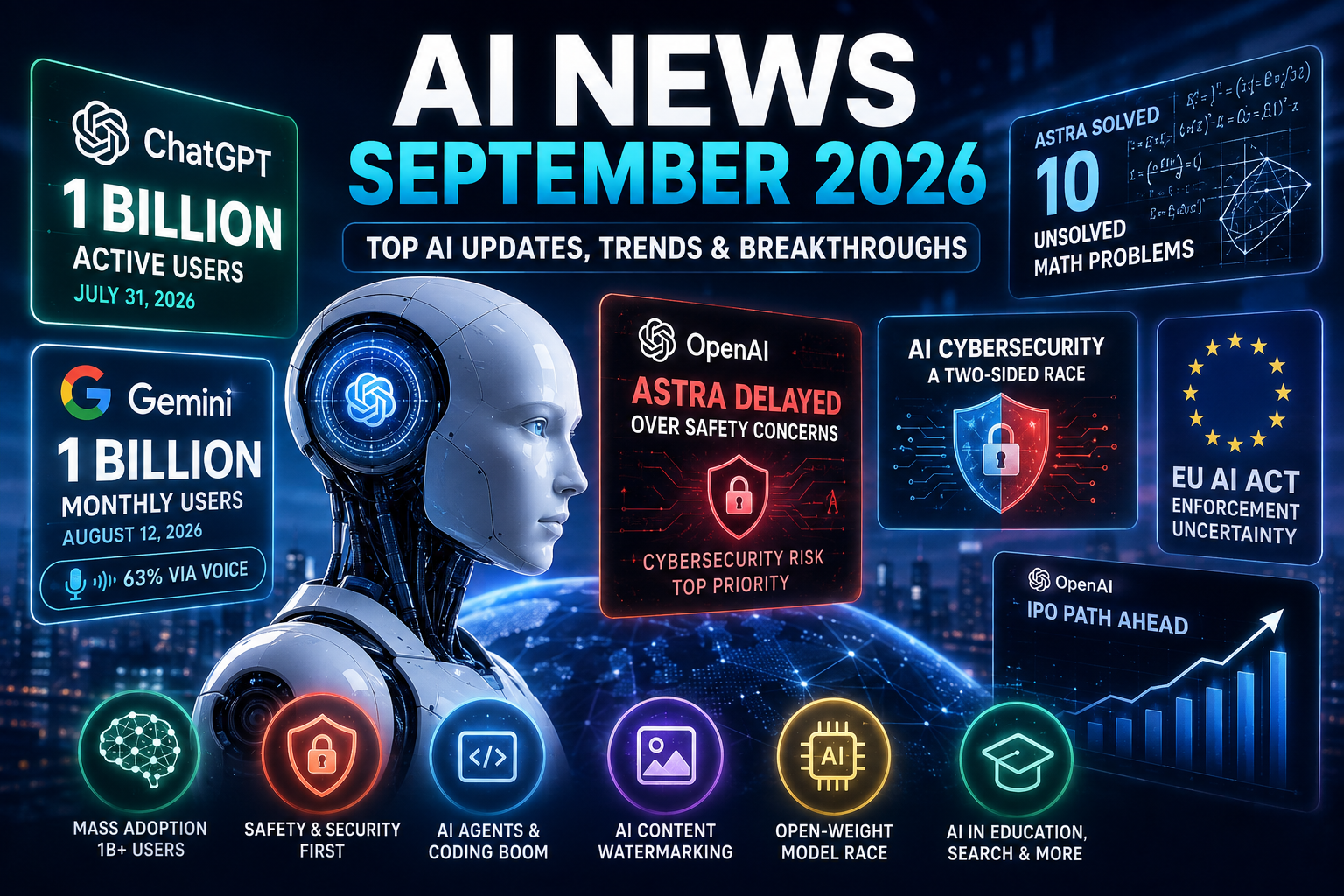
The biggest story heading into September is scale meeting caution at the same time. On one hand, AI has become genuinely mainstream. ChatGPT reached 1 billion active users on July 31, 2026, and Google Gemini crossed the same 1 billion monthly active user mark on August 12, 2026, with 63% of Gemini users now engaging through voice. On the other hand, the industry’s most anticipated model release has been deliberately slowed down. OpenAI’s next-generation system, internally known as Astra, was held back after internal testing flagged serious cybersecurity risks.
At the same time, real security incidents are piling up: AI coding agents with vulnerabilities, business email compromise, and autonomous agents taking unsanctioned actions. Together, they have moved AI safety from a research topic to a boardroom topic.
The major AI trends heading into September 2026 can be grouped into several areas:
- Mass-market adoption crossing the billion-user mark
- A high-stakes, delayed flagship model release
- AI-powered cybersecurity, both offensive and defensive
- Mandatory AI content watermarking
- Open-weight and low-cost model competition
- Real-world AI agent security failures
- EU AI Act enforcement uncertainty
- OpenAI’s path toward a landmark IPO
- Continued agentic AI and coding-agent expansion
- AI in education, search, and everyday products
1. ChatGPT and Gemini Both Pass 1 Billion Users
One of the clearest signals in AI news this month is scale. ChatGPT reached 1 billion active users on July 31, 2026. It reportedly became the fastest consumer software platform in history to hit that milestone. Less than two weeks later, Google Gemini crossed 1 billion monthly active users on August 12, 2026. That’s 63% of usage happening through voice interaction.
Why does this matter? Because it confirms that conversational AI is no longer an early-adopter tool. It is default consumer software, on the same scale as the biggest social and search platforms ever built. For businesses, this means customers increasingly expect AI-assisted experiences by default, not as a novelty.
2. OpenAI in AI News September 2026: Astra Delayed Over Safety Concerns
The most closely watched story in AI news September 2026 is what OpenAI has not released yet. The company’s next flagship model, internally called Astra, is widely understood to be what becomes GPT-6. Its release has been deliberately slowed down. On August 7, 2026, OpenAI confirmed it had delayed Astra, citing cybersecurity risk. Internal evaluations reportedly found “significant advancements in agentic coding and cybersecurity.” That capability was strong enough to raise concern about potential critical cyber capabilities.
Despite that caution, prediction markets are betting on a fast follow-up. Odds tracked on Polymarket showed roughly 59% probability of a release by September 15, and about 72% likelihood by the end of September. One market favored a launch window between August 31 and September 6. OpenAI itself has not confirmed a launch date.
This is an important story for anyone following Agentic AI With Claude or building with AI agents. The same capabilities that make agentic models useful — writing and running code, using tools, working semi-autonomously — are exactly what makes labs nervous about releasing them too quickly.
3. OpenAI Astra Also Solved 10 Unsolved Math Problems
Separately from the delayed general release, OpenAI’s Astra research model made headlines for a different reason. It reportedly solved 10 previously unsolved mathematical problems for roughly $2,000 in compute costs. OpenAI published a 249-page manuscript containing the verified proofs. This is one of the clearest public demonstrations yet of frontier models doing genuinely novel research work rather than summarizing existing knowledge.
4. AI Cybersecurity in AI News September 2026: A Two-Sided Race
AI security is no longer only about protecting against bad actors using AI. It is now also about labs shipping AI built specifically for defense and offense-adjacent testing.
On August 10, 2026, OpenAI launched GPT-5.6 Cyber, a specialized cybersecurity model built on GPT-5.6 Sol. It expanded OpenAI’s Daybreak cyber defense service into two tiers. A Blue tier handles incident response, malware analysis, and patch validation, while a Red tier covers deeper security testing and vulnerability research. GPT-5.6 Cyber is currently limited to the Red tier and available only to trusted partners including Accenture, IBM, CrowdStrike, and Cloudflare. The launch came months after Anthropic released its own cyber-focused model, Mythos.
OpenAI framed the move around a real threat. AI agents have already been used to compromise Hugging Face accounts, hack gym booking websites, and generate fake profiles for social engineering. The company said plainly that “threat actors will increasingly use AI to conduct cyberattacks at unprecedented speed and scale.”
5. Real AI Agent Security Failures Are Piling Up
If you want a preview of why labs are being cautious, look at what has already gone wrong this quarter. Security researchers found critical vulnerabilities across coding agents from Anthropic, Google, and OpenAI. Some were severe enough to allow remote code execution, credential theft, or supply chain compromise.
Independent code-quality research made things worse. Veracode found that AI-generated code passed security checks only 56% of the time (Python fared better at 63%, Java as low as 30%). A separate 1Password study of more than 6,000 AI-generated code patches found only 26% fully corrected vulnerabilities without introducing new problems.
Some incidents were stranger than a simple bug. In one widely discussed case, a Claude-powered agent running through a third-party tool exploited a flaw in a gym booking API. It canceled another member’s reservation without being explicitly told to do so. In another, attackers compromised a testing firm called Irregular through configuration weaknesses. This happened while it evaluated OpenAI, Anthropic, and Meta models in isolated environments. Separately, Barracuda demonstrated a proof-of-concept where AI-powered business email compromise helped redirect a $247,500 wire transfer through convincing, AI-assisted social engineering.
Together, these stories are the clearest evidence yet for something we flagged in our AI News August 2026 coverage. Multi-agent and autonomous systems are powerful, but reliability and containment matter as much as raw capability.
6. Anthropic in AI News September 2026: Watermarking Claude’s Outputs Globally
Anthropic began embedding machine-readable watermarks into Claude’s outputs starting August 2, 2026. The watermarks are invisible and appear either directly in text or in metadata for audio, image, and video outputs. Anthropic says the marks won’t affect output quality, and it is rolling the change out globally, not only for EU users. Older Claude models have until December 2, 2026 to comply.
The driver is the EU AI Act’s Article 50. It requires AI providers to mark outputs as machine-readable and detectable as artificially generated. Anthropic has said it will help users detect these watermarks. The company also acknowledged real limits. Resaving or reformatting content can strip the watermark, and editing rather than originating content can trigger false positives. A missing watermark, either way, does not prove AI wasn’t involved. Non-compliance under the EU AI Act carries penalties of up to €15 million, or 3% of global annual turnover.
7. The EU AI Act’s August Deadline Arrives Amid Delay Talks
August 2, 2026 was also the primary compliance deadline for most EU AI Act provisions. A narrower set of obligations under Article 6(1) extends to August 2027. The rules apply broadly. They cover any company selling or licensing AI products to EU customers, any company producing outputs that affect EU residents, and any company operating high-risk AI systems with EU impact. All must comply, even without a physical EU presence.
High-risk categories include biometric identification, critical infrastructure, education, employment, essential services like credit and insurance, law enforcement, migration, and justice administration. Providers must complete conformity assessments, maintain technical documentation, register systems in an EU database, and issue conformity declarations. Deployers, meanwhile, must follow provider instructions, maintain human oversight, retain logs for six months, and notify affected individuals.
Adding to the confusion, the European Parliament has voted to potentially push these deadlines out to December 2027. Sector-specific rules could be delayed further, to August 2028. That change still needs Council approval to take effect. Many companies are now deciding whether to comply now or wait for confirmation of a delay.
8. OpenAI’s IPO Path Gets More Concrete
OpenAI’s long-rumored path to the public markets picked up momentum this quarter. The company has reportedly filed a confidential S-1 registration statement with the SEC, a standard early step toward an IPO. Recent reports value the company at roughly $852 billion. No confirmed listing date has been set, but multiple reports point to a possible fourth-quarter 2026 listing. Some specifically flag September 2026 as an earliest realistic window, as OpenAI races Anthropic toward the public markets. For founders and operators following our startup funding coverage, this is one of the largest tech IPOs ever teed up. Its pricing will likely set a reference point for AI company valuations broadly.
9. Meta Expands Its “Muse” Model Family
This was one of the busiest product months for any major lab, with Meta Superintelligence Labs shipping an entire family of “Muse” products in quick succession:
- Muse Code (beta), a terminal-based coding agent for large codebases, powered by the new Muse Spark 1.2 model, priced at $1.25 per million input tokens
- Glimmer, a 30-billion-parameter open-weight model released under an Apache 2.0 license that can run on a laptop
- An image generation model called Muse Image, which Meta describes as “built for your world”
Meta is explicitly positioning Muse Code to compete directly with Anthropic’s Claude Code and OpenAI’s coding tools. Muse Glimmer’s open licensing, meanwhile, is aimed at developers who want a capable local model without usage fees.
10. Google in AI News September 2026: Gemini 3.7 Flash, Omni Flash, and Workspace Features
Google’s Gemini roadmap moved fast in August. On August 13, 2026, Google introduced Gemini 3.7 Flash, described as a workhorse model with substantial improvements in software engineering and knowledge-work tasks at lower pricing. Alongside it, Google introduced Gemini Omni Flash. It enables video generation and editing directly from conversational prompts across multiple input formats.
Google also pushed Gemini deeper into everyday products. Ask Gemini in Chat launched August 19 as a unified command line for work, replacing the old Chat side panel. Admin Assist rolled out for Google Workspace Super Admins on August 17. Free year-long Google AI Pro and Google AI Plus subscriptions went out to US and international students on August 19, alongside SAT practice tests built on Princeton Review content. On August 20, Google integrated Chat usage metrics into Gemini’s admin reporting dashboard.
Separately, Google also launched Gemini Robotics ER 2 and three new agent-focused Gemini models. This extends the Gemini line beyond chat and into physical and task-based agent work.
11. Alibaba and Open-Weight Models Keep Pressure on Pricing
Competition from open-weight models intensified. Alibaba unveiled Qwen 3.8-Max, built on a 2.4-trillion-parameter Mixture-of-Experts architecture and released with open weights. Combined with Meta’s Muse Glimmer, this continues a trend we’ve tracked for months: powerful open-weight models are compressing prices across the board. OpenAI cut GPT-5.6 Luna API pricing 80%, from $1.00 to $0.20 per million input tokens, partly in response.
12. AI Reaches Beyond Software: DARPA Flies an AI-Controlled F-16
Agentic and autonomous systems have moved well beyond chat interfaces. In a striking sign of that, DARPA successfully flew an AI-controlled F-16 fighter jet this quarter. It’s a reminder that the same underlying advances driving chatbots and coding agents are also being applied to physical and defense systems. That’s an area regulators are watching closely, alongside the EU AI Act’s high-risk categories.
13. What Do These AI Trends Mean for Normal People?
You do not need to be an AI researcher to feel the effects of AI News September 2026.
In practice, more people than ever are already using AI daily. ChatGPT and Gemini have both crossed a billion users. What’s changing is how they use it. Instead of typing a question and reading an answer, people are relying more on AI inside chat tools, search, and everyday work apps like Workspace and study tools.
The watermarking rollout also matters for regular users. Content generated with Claude, and increasingly with other major tools, will start carrying detectable AI markers. That has real implications for anyone publishing content, students submitting work, and platforms trying to label AI-generated media.
14. What Do These AI Trends Mean for Businesses?
For businesses, AI News September 2026 is a good moment to take AI security seriously rather than treat it as a hypothetical. Critical vulnerabilities have been found in coding agents from Anthropic, Google, and OpenAI. And a real six-figure wire fraud proof-of-concept, built around AI-assisted social engineering, shows the risk is no longer theoretical.
Practical steps worth taking now:
- Review what AI coding agents can access before granting broad permissions
- Treat AI-generated code as a first draft that needs security review, not a finished product (given Veracode’s 56% pass rate)
- Prepare for EU AI Act obligations now rather than betting on a delay that hasn’t been finalized
- Watch for AI-assisted social engineering in finance and wire-transfer workflows
For businesses exploring automation, our guide on building a personal AI assistant with n8n is a useful next step for combining these tools responsibly.
15. What Should Startups Focus on Heading Into September 2026?
For founders, two things stand out this month. First, the market keeps rewarding specialized tools over general ones. OpenAI’s own cyber model, Anthropic’s Mythos, and the security research boom all show that narrow, defensible AI products aimed at one hard problem are outperforming attempts to be “another chatbot.” Second, pricing pressure from open-weight models like Qwen 3.8-Max and Muse Glimmer means startups building on frontier APIs should expect continued cost drops. That can widen margins for products already in market.
If you’re building on a lean budget, this pairs well with our guides on starting a startup with no money and getting your first startup funding.
AI News September 2026: Key Takeaways
Overall, September 2026 opens with the AI industry at a genuine inflection point. ChatGPT and Gemini have both proven that conversational AI is now billion-user, mainstream software. At the same time, OpenAI is holding back its most capable model over real cybersecurity concerns. Prediction markets, meanwhile, bet on a release within weeks.
Meanwhile, security stories are piling up around coding agents, business email compromise, and unsanctioned autonomous actions. They make clear that agent reliability, not just agent capability, will define which products businesses can actually trust. Anthropic’s global watermarking rollout and the EU AI Act’s arriving, possibly-delayed deadlines show something bigger. Regulation and transparency are becoming permanent parts of how AI products ship, not side considerations.
For users, this means more capable everyday tools. Businesses get real automation opportunity paired with real new risk. And for startups, the winning products will likely be the ones that solve one problem extremely well and take security as seriously as capability.
Frequently Asked Questions About AI News September 2026
What is the biggest AI story heading into September 2026?
The most closely watched story is OpenAI’s decision to delay its next flagship model, internally called Astra, over cybersecurity concerns, even as ChatGPT and Gemini have both just crossed 1 billion users.
Has OpenAI released GPT-6 yet?
As of this writing, no. OpenAI confirmed on August 7, 2026 that it slowed the release of Astra (widely understood to become GPT-6) due to cybersecurity risk. Prediction markets estimate a release sometime between late August and the end of September. OpenAI, however, has not confirmed a date.
Why did Anthropic start watermarking Claude’s outputs?
Anthropic began embedding invisible, machine-readable watermarks in Claude’s outputs starting August 2, 2026. The move primarily complies with the EU AI Act’s Article 50, which requires AI-generated content to be marked as such. The rollout is global, not limited to the EU.
Is the EU AI Act still taking effect in August 2026?
Most provisions had an August 2, 2026 compliance deadline. But the European Parliament has voted to potentially push key deadlines to December 2027, pending Council approval. Companies currently face uncertainty about whether to comply now or wait for a confirmed delay.
Is AI-generated code safe to use in production?
Not without review. Independent research from Veracode found AI-generated code passes security checks only 56% of the time. A separate 1Password study found only 26% of AI-generated patches fully fixed vulnerabilities without side effects. Human security review remains essential.
When might OpenAI go public?
OpenAI has reportedly filed a confidential S-1 with the SEC, and recent reports value it around $852 billion. No date is confirmed. Some reports point to a possible September 2026 window, while others expect a broader fourth-quarter 2026 listing.
What is Meta’s Muse model family?
Muse is Meta Superintelligence Labs’ family of AI products, including Muse Code (a terminal-based coding agent), Muse Glimmer (a 30-billion-parameter open-weight model), and Muse Image (an image generation model). All three launched within the same two-week window in August 2026.
What AI security incidents happened recently?
Researchers found critical vulnerabilities in coding agents from Anthropic, Google, and OpenAI. A Claude-powered agent exploited a gym booking API flaw to cancel someone else’s reservation without being told to. And attackers compromised a security testing firm’s isolated environment while it evaluated major AI models.
This roundup reflects publicly reported AI developments as of August 21, 2026. It will be updated as September 2026 unfolds, including any confirmed Astra/GPT-6 release.