


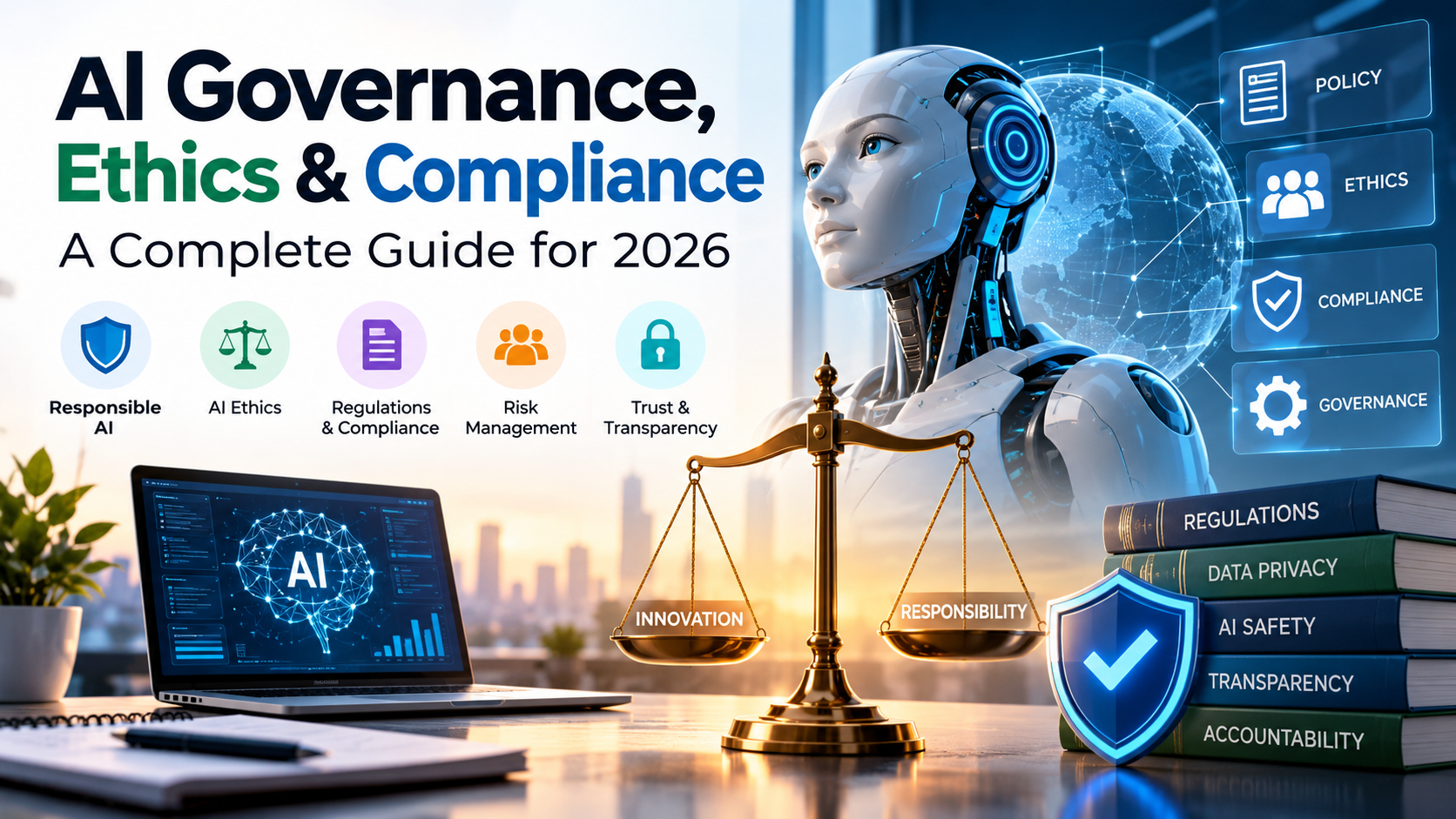
Artificial intelligence (AI) is changing the way people work, learn, communicate, and run businesses. From chatbots and AI writing tools to medical systems and financial services, AI is becoming an important part of everyday life. However, as AI becomes more powerful, it also creates serious questions about safety, privacy, fairness, and responsibility. Who is responsible when an AI system makes a harmful decision? How can businesses protect customer information? What rules should companies follow when using AI? These questions make AI governance, ethics, and compliance more important than ever. Whether you are a business owner, startup founder, employee, developer, or student, understanding these topics can help you use AI more safely and responsibly. In this guide, we will explain AI governance, ethical AI principles, compliance requirements, common risks, and practical solutions in simple language. You will also learn how organizations can build trust while using AI to improve their work.
What Is AI Governance?
AI governance is the process of creating rules, policies, responsibilities, and controls for developing and using artificial intelligence.
In simple words, AI governance helps organizations decide how AI should be used, who can use it, what risks must be checked, and who is responsible for its results.
For example, imagine a company uses AI to review job applications. Without proper governance, the system might unfairly reject qualified candidates because of biased training data. A good AI governance system helps the company test the tool, check its decisions, protect applicant information, and involve human reviewers when necessary.
AI governance is not only for large technology companies. Small businesses, startups, schools, hospitals, financial institutions, and government departments can also benefit from it.
A strong AI governance framework usually includes clear policies, risk assessments, data protection measures, human oversight, regular testing, and proper documentation.
The main purpose is to make sure AI systems are useful, safe, fair, transparent, and aligned with applicable laws.
Why Is AI Governance Important?
AI systems can make decisions quickly and process large amounts of information. However, speed does not always mean accuracy, fairness, or safety.
Without proper governance, organizations may face financial losses, legal problems, customer complaints, security incidents, and damage to their reputation.
AI governance provides a structured way to identify these problems before they become serious.
Its importance can be understood through the following points.
1. Reduces AI risks: Organizations can identify errors, security weaknesses, and harmful outcomes before they cause significant damage.
2. Protects personal information: Clear rules help prevent the misuse of customer, employee, and business data.
3. Improves trust: Customers and employees are more likely to trust organizations that explain how AI is used.
4. Supports legal compliance: AI governance helps businesses understand and meet relevant legal and regulatory requirements.
5. Improves decision-making: Human oversight and regular testing can help identify mistakes and improve AI results.
6. Defines responsibility: Employees and managers understand who is responsible for approving, monitoring, and correcting AI systems.
AI governance is therefore not simply a technical requirement. It is also an important part of responsible business management.
What Is AI Ethics?
AI ethics refers to the moral principles that guide how artificial intelligence should be developed and used.
It asks an important question: just because we can use AI to do something, does that mean we should?
For example, a business might have the technical ability to collect large amounts of customer information. However, using that information without proper permission or a valid legal basis could violate people’s privacy and damage their trust.
AI ethics helps organizations think about the effect of their decisions on real people.
Ethical AI focuses on fairness, honesty, privacy, safety, transparency, human rights, and respect for individuals.
These principles are important because AI systems can influence employment opportunities, financial services, education, healthcare, and access to information.
Ethical AI does not mean avoiding technology. It means using technology in a way that respects people and reduces unnecessary harm.
Main Principles of AI Ethics
Organizations can use several important principles to guide ethical AI development and deployment.
1. Fairness: AI systems should be tested for unfair discrimination and should not disadvantage people because of characteristics such as gender, race, disability, or other protected traits.
2. Transparency: Organizations should explain when AI is being used and provide understandable information about important decisions whenever appropriate.
3. Accountability: A responsible person or organization should be answerable for how an AI system is designed, deployed, and managed.
4. Privacy: Personal information should be collected, processed, and stored appropriately, with suitable safeguards and a lawful basis.
5. Safety: AI systems should be tested to reduce errors, misuse, security weaknesses, and other foreseeable harms.
6. Human control: People should have meaningful oversight of important AI-supported decisions, especially when those decisions can significantly affect someone’s life.
7. Reliability: AI systems should perform consistently for their intended purpose and be monitored when conditions change.
8. Inclusiveness: AI products should consider the needs of different users, including people with disabilities and people from different backgrounds.
These principles should guide the entire AI lifecycle, from planning and development to deployment, monitoring, and retirement.
What Is AI Compliance?
AI compliance means following the laws, regulations, standards, and internal policies that apply to the development and use of artificial intelligence.
In simple terms, AI compliance helps an organization make sure that its AI activities follow the rules that apply to its business, customers, location, and industry.
For example, a company that uses AI to process customer information may need to follow data protection laws. A business selling AI services in Europe may also need to understand the requirements of the European Union’s AI Act.
AI compliance is different from AI ethics. Ethics helps an organization decide what is fair and responsible, while compliance focuses on meeting applicable legal and regulatory requirements. Both are important because following the law alone may not address every ethical concern.
Why Do Businesses Need AI Compliance?
Businesses use AI for customer service, marketing, recruitment, data analysis, software development, and many other activities. Each use can create different legal and operational responsibilities.
AI compliance helps businesses understand these responsibilities before they introduce new tools or services.
The main reasons businesses need AI compliance include:
- Legal protection: Organizations can identify relevant legal obligations and reduce the risk of violations.
- Data security: Businesses can establish controls for handling confidential and personal information.
- Customer confidence: Clear AI policies help customers understand how their information is used.
- Risk reduction: Compliance checks can reveal problems with AI-generated content, automated decisions, and third-party tools.
- Business continuity: Proper records and procedures can help an organization respond to audits, complaints, and incidents.
- Market access: Companies operating across different countries may need to meet several regulatory requirements to sell their products or services.
Compliance requirements depend on the type of AI system, its purpose, the location of the organization, and the people affected by its use. Businesses should not assume that one policy will satisfy every legal requirement.
Difference Between AI Governance, AI Ethics, and AI Compliance
AI governance, AI ethics, and AI compliance are closely related, but they serve different purposes.
Understanding the difference helps businesses create a complete responsible AI strategy.
| Area | Main purpose | Simple example |
|---|---|---|
| AI governance | Establish rules, roles, and oversight | Appointing a manager to approve AI tools |
| AI ethics | Encourage fair and responsible decisions | Checking whether an AI hiring tool discriminates |
| AI compliance | Meet applicable laws and regulations | Following relevant data protection requirements |
| AI risk management | Identify, assess, and reduce possible harm | Testing a chatbot before releasing it |
| Responsible AI | Apply these principles throughout AI use | Using AI with transparency, safety, and human oversight |
These areas work best together. Governance creates the system, ethics guides responsible choices, compliance addresses legal obligations, and risk management helps identify and control potential problems.
For example, a company introducing an AI customer support chatbot needs governance to define who manages it, ethical principles to protect customers, compliance checks to meet relevant legal requirements, and risk management to reduce incorrect or harmful responses.
Common Risks Associated With Artificial Intelligence
AI can improve productivity and help people solve complex problems. However, it can also create risks when systems are poorly designed, incorrectly used, or left without proper supervision.
Businesses should understand these risks before introducing AI into important operations.
1. AI Bias and Discrimination
AI bias happens when an AI system produces unfair results for certain people or groups.
This may happen because of biased training data, poor system design, incomplete information, or unsuitable evaluation methods.
For example, an AI recruitment tool trained on historical hiring data might prefer candidates who resemble people hired in the past. This could unfairly disadvantage other qualified applicants.
Organizations should test systems using relevant data, check outcomes across different groups, and provide human review where appropriate.
2. Data Privacy and Confidentiality
AI tools may process names, addresses, financial details, business documents, customer records, or employee information.
If this information is shared with an unapproved AI service, it could create privacy and confidentiality problems.
Businesses should establish rules about which information employees can enter into AI tools. They should also check data retention policies, access permissions, security controls, and applicable legal requirements.
Sensitive information should never be shared with an AI tool without proper authorization and safeguards.
3. Incorrect Information and AI Hallucinations
AI systems can generate information that sounds correct but is actually false. This is often called an AI hallucination.
For example, an AI tool might create a false statistic, invent a research citation, or provide an incorrect explanation of a legal requirement.
These mistakes can cause problems if people publish the information or use it to make important decisions.
Organizations should verify important AI-generated information against reliable sources, particularly when it involves health, finance, law, safety, or public information.
4. Cybersecurity Threats
AI systems can introduce new security risks. Attackers may try to manipulate model outputs, expose confidential data, misuse automated agents, or exploit weaknesses in connected systems.
A poorly secured AI assistant connected to business software could create risks beyond incorrect answers.
Businesses should use strong access controls, security testing, approved integrations, activity monitoring, and incident response procedures.
5. Lack of Transparency
People may not know when they are interacting with AI or when AI has influenced an important decision.
This can reduce trust and make it difficult to challenge mistakes.
Organizations should communicate AI use clearly when appropriate and explain important decisions in a way that affected people can understand.
6. Copyright and Intellectual Property Issues
AI-generated text, images, code, and other materials can raise questions about copyright, ownership, licensing, and permitted use.
For example, a marketing agency might use AI to create an image for a client without checking whether the output resembles protected material or violates a license.
Businesses should review relevant licenses, contractual terms, and intellectual property requirements before using AI-generated content commercially.
7. Overdependence on AI
Employees may trust AI outputs too much and stop checking the results themselves.
This can be dangerous when AI makes mistakes or fails to understand the full situation.
Businesses should train employees to use AI as a support tool rather than treating every output as automatically correct.
Major AI Regulations and Compliance Frameworks in 2026
AI laws and standards vary across countries. Some establish legal obligations, while others provide voluntary guidance for managing AI risks.
Businesses should identify the rules that apply to their activities instead of assuming that every AI regulation applies to every organization.
European Union AI Act
The European Union AI Act is a major legal framework that regulates artificial intelligence according to its risks and intended uses.
It includes rules concerning prohibited AI practices, transparency, general-purpose AI models, and certain high-risk AI systems.
As of October 2026, the Act is being implemented in stages. The main transparency requirements and enforcement for several applicable provisions began on August 2, 2026. Under the updated implementation timeline, certain high-risk AI system obligations are scheduled to apply from December 2, 2027, while certain AI systems embedded in regulated products have a later date of August 2, 2028. Businesses should check the official timeline for their specific obligations.
Companies using AI in recruitment, education, financial services, healthcare, or other sensitive areas should carefully assess whether their systems fall into regulated categories.
NIST AI Risk Management Framework
The National Institute of Standards and Technology (NIST) developed the AI Risk Management Framework, commonly called the NIST AI RMF.
It provides guidance to help organizations identify, assess, and manage AI risks throughout the system lifecycle. The framework emphasizes trustworthy AI characteristics such as reliability, safety, security, transparency, privacy, accountability, and fairness.
The NIST AI RMF is intended for voluntary use. It can help organizations build a structured risk management process, but using it does not automatically prove compliance with every law.
OECD AI Principles
The Organisation for Economic Co-operation and Development (OECD) provides principles for developing and using AI in a responsible and trustworthy way.
These principles promote human rights, fairness, transparency, safety, accountability, and inclusive growth. They were updated in 2024 to reflect developments in AI technology and policy.
The OECD AI Principles can help governments and businesses develop responsible AI policies, although they are not a replacement for applicable national laws.
AI Compliance in India
Businesses in India should consider applicable Indian laws when developing or using AI systems.
Depending on the activity, relevant requirements may include the Digital Personal Data Protection Act, 2023, applicable rules and commencement notifications, information technology laws, cybersecurity directions, consumer protection requirements, and sector-specific regulations.
For example, a business using AI to process personal data should assess its applicable data protection responsibilities. A financial services company may also need to consider requirements issued by the relevant financial regulator.
Not every requirement applies to every business in the same way. Organizations should review the current legal position, relevant commencement dates, and their specific activities before making compliance decisions.
How to Build an AI Governance Framework
A practical AI governance framework helps a business manage AI use from the planning stage to the end of a system’s life.
Small businesses do not always need a large compliance department. They can begin with clear policies, assigned responsibilities, and regular reviews that match the level of risk.
Here are the main steps to build an effective AI governance framework.
Step 1: Identify All AI Tools and Systems
The first step is to understand where AI is being used in the organization.
Businesses may use AI writing assistants, chatbots, customer relationship management software, recruitment systems, image generators, analytics tools, or automated agents.
Create a list of these tools and record their purpose, users, data access, suppliers, and business importance.
This list is often called an AI inventory. It helps organizations avoid overlooking AI tools that employees have started using independently.
Step 2: Assess the Risks
Once the AI tools have been identified, evaluate the risks associated with each system.
Consider what could happen if the tool makes a mistake, exposes information, treats people unfairly, or produces harmful content.
A chatbot that suggests social media captions may require fewer controls than an AI system that supports medical decisions or evaluates job applicants.
Risk assessments should consider the likelihood of harm, its possible impact, the people affected, and the controls needed to reduce it.
Step 3: Create an AI Use Policy
An AI use policy explains how employees and contractors can use AI at work.
It should provide practical instructions instead of vague statements about responsible use.
A useful policy should cover:
- Approved AI tools and permitted business uses.
- Information that employees must not enter into unapproved tools.
- Rules for reviewing AI-generated content.
- Requirements for human approval of important decisions.
- Copyright, licensing, and confidentiality considerations.
- Procedures for reporting errors, security incidents, or harmful outputs.
- Training and accountability expectations.
The policy should be easy for employees to understand and should be updated when business needs, technology, or applicable laws change.
Step 4: Assign Clear Responsibilities
AI governance works better when everyone understands their role.
Senior management should approve the overall approach and provide the resources needed to manage risks. Technical teams should test and maintain AI systems. Legal, privacy, and compliance specialists should review relevant obligations. Employees should follow internal policies and report concerns.
A small business may assign several responsibilities to one person, but the duties should still be clearly defined.
Step 5: Protect Data and Privacy
Organizations should examine what information an AI tool collects, how it uses that information, and whether it shares data with third parties.
Practical safeguards include restricting access, removing unnecessary personal information, encrypting sensitive data where appropriate, and checking vendor privacy and security terms.
Businesses should also determine whether they have a valid legal basis and appropriate permissions for the processing they carry out.
Step 6: Test AI Systems Before Launch
Testing helps organizations discover problems before AI tools are used in real situations.
Testing should examine accuracy, reliability, security, fairness, privacy, and performance under realistic conditions.
For example, a business deploying an AI customer service chatbot should test whether it gives correct answers, protects customer details, handles unusual questions, and directs difficult cases to a human employee.
High-impact systems may require more detailed testing and independent evaluation.
Step 7: Maintain Human Oversight
AI should not automatically replace human judgment in every situation.
Organizations should decide which tasks can be automated, which require approval, and which should remain under direct human control.
For important decisions, reviewers need enough information, authority, and time to question an AI recommendation.
Human oversight must be meaningful. Asking someone to approve every result without giving them the ability to review or challenge it is not an effective safeguard.
Step 8: Monitor AI Performance
An AI system that performs well today may become less reliable when data, users, business processes, or external conditions change.
Organizations should monitor performance, collect feedback, investigate incidents, and repeat testing when necessary.
They should also define when a system must be restricted, corrected, replaced, or temporarily disabled.
Step 9: Keep Records and Documentation
Good documentation helps businesses understand how AI systems work and demonstrate the controls they have put in place.
Records may include the purpose of the system, risk assessments, test results, data sources, approvals, vendor agreements, incident reports, and changes made over time.
The type and amount of documentation should match the risks and legal requirements of the system.
Step 10: Train Employees Regularly
Employees need to understand both the benefits and limitations of AI.
Training should explain how to verify outputs, protect confidential information, recognize misleading content, identify bias, and report problems.
Organizations should also teach employees how to use approved tools effectively.
Regular training can reduce accidental misuse and help create a workplace culture where people question AI outputs when necessary.
Benefits of AI Governance for Businesses
AI governance is not only about avoiding risks. It can also help businesses improve their operations, build stronger customer relationships, and use AI more effectively.
When AI systems are managed properly, organizations can make better decisions about where automation is useful and where human judgment is still necessary.
1. Better Business Decisions
AI governance encourages organizations to check the quality of AI-generated information before using it. This can help managers make decisions based on more reliable information.
For example, a company using AI to analyze sales data can review the results before changing prices or launching a new product.
2. Improved Customer Trust
Customers want to know that businesses handle their information responsibly.
When organizations explain how AI is used, protect personal information, and provide ways to resolve problems, they can build stronger customer relationships.
3. Increased Productivity
AI can help employees complete repetitive tasks, prepare reports, organize information, and answer common questions.
Governance helps organizations introduce these tools with suitable checks, reducing the chances that productivity improvements will create new problems.
4. Reduced Legal and Financial Risks
Identifying risks early can help businesses avoid expensive mistakes, regulatory problems, and damage to their reputation.
However, governance cannot eliminate every risk. It provides a structured way to identify problems and respond to them.
5. Stronger Business Reputation
Customers, partners, and investors may consider how an organization manages AI when deciding whether to work with it.
Responsible AI practices can demonstrate that a business takes safety, fairness, privacy, and accountability seriously.
6. Easier Business Growth
A company with clear AI policies can introduce new tools more consistently across different teams.
Instead of evaluating every new AI project from the beginning, employees can use established procedures for approvals, testing, and risk assessment.
This makes it easier to expand AI use while maintaining appropriate controls.
Best AI Governance Tools and Resources
Businesses can use specialized software and established frameworks to manage AI risks. The right choice depends on the organization’s size, industry, technical requirements, and regulatory responsibilities.
The following resources are useful starting points.
1. NIST AI Risk Management Framework
Purpose: AI risk management
This framework helps organizations identify and manage AI risks through structured processes. It is especially useful for developing an internal AI governance program.
2. EU AI Act Resources
Purpose: European AI regulatory compliance
Official resources explain the AI Act, its implementation timeline, and the responsibilities that may apply to providers and users of AI systems.
Read the official EU AI Act guidance
3. OECD AI Principles
Purpose: Responsible and trustworthy AI
These principles help organizations understand important values such as fairness, transparency, accountability, and respect for human rights.
Explore the OECD AI Principles
In addition to these resources, businesses can consider AI risk management platforms, data governance software, model monitoring tools, cybersecurity systems, and compliance management solutions. Before purchasing software, they should check whether it supports their specific AI systems and legal obligations.
Challenges in AI Governance, Ethics, and Compliance
Although AI governance offers important benefits, implementing it can be difficult. Organizations need to balance innovation with safety, fairness, and regulatory responsibilities.
Understanding these challenges helps businesses prepare realistic solutions.
1. Rapid Changes in AI Technology
AI tools change quickly, and new capabilities can introduce new risks.
A policy written several months ago may not address the latest features of an AI system.
Solution: Review AI policies regularly and reassess risks whenever important changes are made to a system.
2. Lack of AI Knowledge
Some organizations do not have employees with enough technical, legal, or ethical knowledge to evaluate AI risks.
Solution: Provide regular training, use reliable guidance, and seek specialist advice when dealing with complex or high-impact AI systems.
3. High Implementation Costs
Advanced AI governance software, external audits, security testing, and specialist staff can be expensive.
This may be difficult for startups and small businesses.
Solution: Begin with an AI inventory, a simple written policy, basic risk assessments, and approved tools. Add stronger controls as the organization’s AI use and risks grow.
4. Difficulty Explaining AI Decisions
Some AI systems are difficult to interpret, making it challenging to explain exactly why a particular result was produced.
Solution: Choose systems with suitable documentation and explanation features. For important decisions, record the relevant inputs, checks, and human review.
5. Conflicting Business Priorities
Teams may want to introduce AI quickly to save time or reduce costs, while compliance teams may need more testing before approval.
Solution: Establish a clear approval process that evaluates business benefits and risks together. Use faster review procedures for low-risk applications and more detailed checks for higher-risk systems.
6. Managing Third-Party AI Vendors
Many businesses depend on AI tools provided by external companies. They may not control how those systems are trained, updated, or maintained.
Solution: Review vendor security practices, data handling, contractual terms, service limitations, incident reporting, and available technical documentation before adopting a tool.
Real-World Examples of Responsible AI Governance
AI governance becomes easier to understand when we look at common business situations.
The following examples show how organizations can apply governance, ethics, and compliance in practical ways.
Example 1: AI in Recruitment
A company uses AI to screen hundreds of job applications.
Without proper checks, the tool might unfairly rank candidates based on patterns in historical hiring data.
A responsible approach includes testing for unfair outcomes, reviewing relevant employment laws, limiting access to applicant information, and giving qualified human reviewers authority to assess recommendations.
The company should also maintain appropriate records and provide required information to applicants where applicable.
Example 2: AI in Healthcare
A healthcare provider uses AI to help identify patterns in medical images.
The system may help medical professionals work more efficiently, but incorrect predictions could affect patient care.
Responsible governance includes clinical validation, privacy safeguards, security testing, appropriate professional oversight, and monitoring for errors.
The AI system should be used within its validated purpose and should not be assumed to replace qualified medical judgment.
Example 3: AI in Digital Marketing
A marketing agency uses AI to create blog posts, social media captions, advertising copy, and images.
AI can reduce production time, but it may also generate false claims, inaccurate statistics, unsuitable content, or material that raises copyright concerns.
The agency can introduce a review process that checks facts, brand guidelines, image permissions, originality, and advertising requirements before publication.
It should also avoid entering confidential client information into unapproved AI tools.
Example 4: AI in Customer Service
An online store uses an AI chatbot to answer customer questions about orders, returns, and products.
If the chatbot provides incorrect refund information, customers may lose trust in the business.
The company should use approved information sources, test common and unusual questions, monitor responses, and offer a clear way to contact a human representative.
These examples demonstrate that responsible AI is not limited to technology companies. Any organization using AI can benefit from suitable governance measures.
The Future of AI Governance in 2026 and Beyond
AI governance is likely to become increasingly important as organizations use more advanced AI systems, including autonomous agents that can perform multiple tasks with limited human intervention.
These systems may interact with software, process customer information, write code, or carry out business workflows. As a result, organizations will need stronger controls over permissions, actions, data access, and human supervision.
Several developments deserve attention.
More focus on AI accountability: Businesses may face greater expectations to document AI decisions, identify responsible teams, and investigate harmful outcomes.
Stronger transparency practices: Organizations will need to consider when users should be informed about AI-generated content or AI-supported decisions.
Better AI risk monitoring: Companies will increasingly need processes to detect changes in accuracy, security, reliability, and fairness after deployment.
Greater attention to AI agents: Systems that can take actions rather than simply generate text will require careful permission management and safeguards against unauthorized actions.
More AI governance skills: Employees with knowledge of AI risk management, privacy, compliance, auditing, and responsible AI development may become increasingly valuable.
More international regulatory complexity: Businesses operating across borders will need to understand how different laws and standards interact.
These developments do not mean that every organization needs an expensive governance department. The best approach is to build controls that match the risks, business needs, and applicable legal requirements.
Conclusion
AI governance, ethics, and compliance are essential parts of responsible artificial intelligence. They help organizations understand how AI should be developed, where it can be used, what risks need attention, and who is responsible for its results.
AI governance creates the rules and oversight needed to manage AI systems. AI ethics encourages fairness, transparency, privacy, and respect for people. AI compliance helps organizations meet applicable legal and regulatory obligations.
Together, these practices can help businesses reduce risks, improve customer trust, and use AI more effectively.
The best starting point is simple: identify the AI tools your organization uses, create clear policies, protect sensitive information, test important systems, train employees, and monitor performance over time.
You do not need to solve every AI challenge at once. Begin with the risks that matter most to your business and improve your approach as your AI use grows.
Ultimately, successful AI adoption is not just about using the newest technology. It is about using that technology responsibly, safely, and in a way that benefits both businesses and people.
Will AGI Replace Human Jobs? Jobs Most at Risk
Frequently Asked Questions (FAQs)
Common questions about AI governance, ethics, and compliance
1. What is AI governance in simple words?
AI governance is a system of rules, responsibilities, and controls that guides how artificial intelligence is developed and used. It helps organizations manage risks, protect information, and ensure that AI systems are used responsibly.
2. What is the difference between AI governance and AI ethics?
AI governance focuses on policies, responsibilities, oversight, and decision-making processes. AI ethics focuses on moral principles such as fairness, privacy, transparency, and respect for human rights. Governance helps put ethical principles into practice.
3. What does AI compliance mean?
AI compliance means following the laws, regulations, and applicable standards that govern an organization’s AI activities. Requirements depend on the country, industry, AI system, and intended use.
4. Why is AI governance important for businesses?
AI governance helps businesses identify risks, protect customer information, reduce the chances of harmful mistakes, improve trust, and manage their legal responsibilities. It also supports the responsible expansion of AI across business operations.
5. What are the main principles of ethical AI?
The main principles include fairness, transparency, accountability, privacy, safety, reliability, human oversight, and inclusiveness. Their importance may vary depending on how an AI system is used.
6. What are the biggest risks of artificial intelligence?
Common AI risks include bias, discrimination, privacy violations, incorrect information, cybersecurity threats, copyright concerns, lack of transparency, and overdependence on automated decisions.
7. What is an AI governance framework?
An AI governance framework is a structured set of policies, procedures, roles, and controls used to manage AI systems throughout their lifecycle. It may include an AI inventory, risk assessments, approval procedures, testing, monitoring, and documentation.
8. What is the NIST AI Risk Management Framework?
The NIST AI Risk Management Framework is guidance developed by the US National Institute of Standards and Technology to help organizations manage AI risks. It supports the development and use of trustworthy AI systems and is intended for voluntary use.
9. What is the EU AI Act?
The EU AI Act is a European Union regulation that establishes requirements for artificial intelligence based on its risks and intended uses. Its provisions are being implemented in stages, with different dates for transparency requirements, general-purpose AI, and certain high-risk systems.
10. Does every business need an AI governance policy?
Not every business needs the same level of governance, but a written AI use policy is a useful starting point for organizations using AI. It can explain approved tools, data protection rules, human review, and procedures for reporting problems.
11. How can small businesses implement responsible AI?
Small businesses can start by listing their AI tools, approving trusted services, restricting sensitive data sharing, checking important AI outputs, training employees, and reviewing risks before introducing AI into high-impact activities.
12. How can companies prevent AI bias?
Companies can examine training data, test outcomes across relevant groups, use suitable evaluation methods, involve diverse perspectives, and monitor systems after deployment. Human review can help identify and correct unfair outcomes.
13. Is AI-generated content legally compliant?
AI-generated content is not automatically legally compliant. Businesses should check factual accuracy, privacy, copyright, licensing, advertising rules, and other requirements relevant to the content and its intended use.
14. Who is responsible when an AI system makes a mistake?
Responsibility depends on the circumstances, the organization’s role, applicable laws, contractual arrangements, and the nature of the mistake. Organizations should assign clear internal responsibilities and establish procedures for investigating and correcting AI-related problems.
15. What is the future of AI governance?
AI governance is likely to place greater emphasis on AI accountability, autonomous agents, data security, transparency, ongoing monitoring, and compliance with evolving regulations. Organizations that develop good governance practices can be better prepared to manage these changes.