


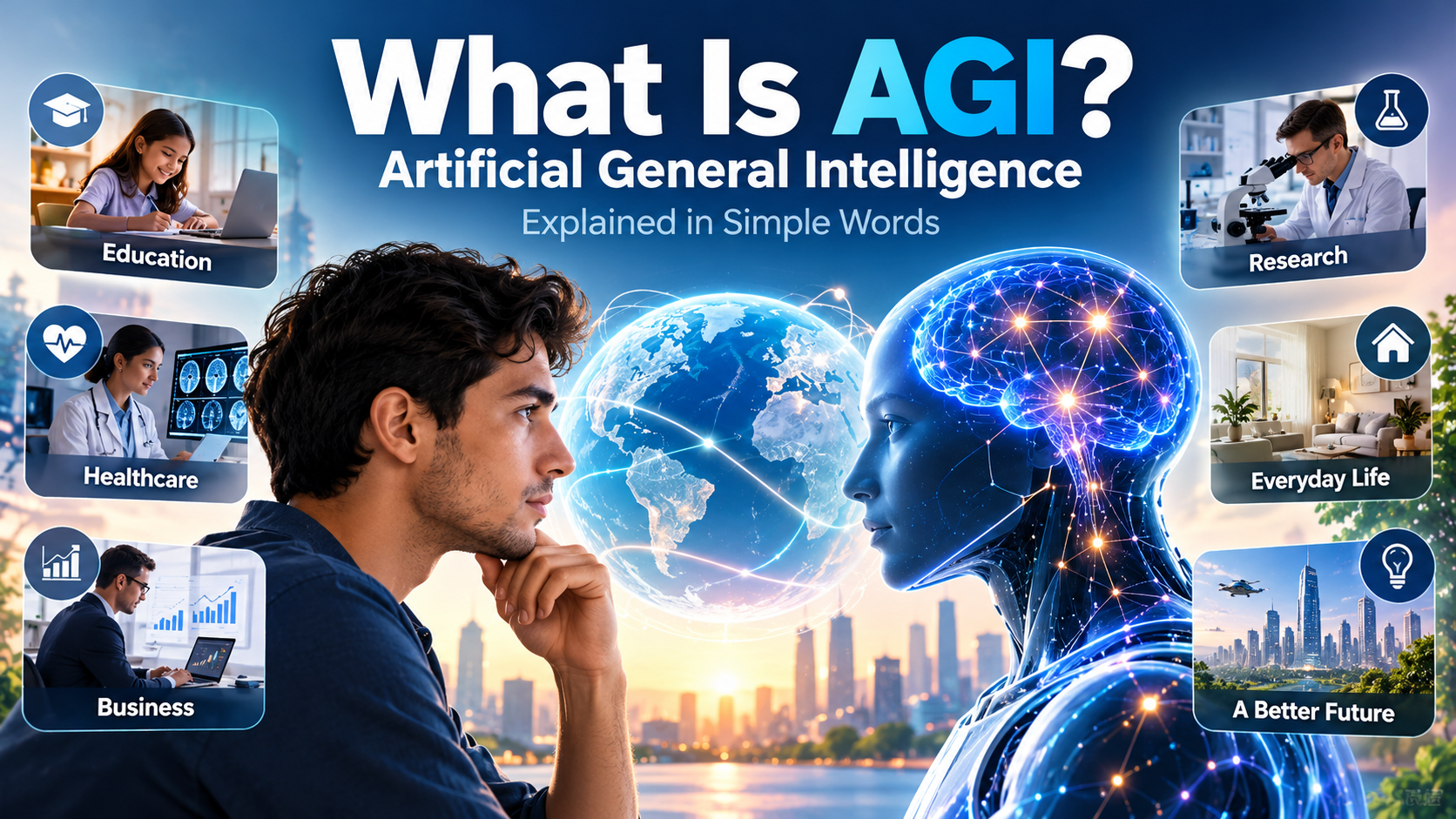
Artificial intelligence is changing how we work, learn, communicate, and solve everyday problems. AI tools can write articles, answer questions, create images, analyze information, and help people complete tasks in less time. But there is a bigger question that many people are asking: What is AGI, and how is it different from the AI tools we use today?
AGI stands for Artificial General Intelligence. It describes a type of AI that could learn, understand, and solve many different kinds of problems at a level comparable to human intelligence. Unlike systems designed for specific tasks, AGI would be able to apply its knowledge across different areas and adapt to unfamiliar situations.
Understanding AGI is important because it could influence jobs, education, healthcare, business, and everyday life. In this guide, you will learn what artificial general intelligence means, how it works, its potential benefits and risks, and whether AGI already exists. Everything is explained in simple words, with practical examples to help you understand this important technology.
1. What Is AGI? (Artificial General Intelligence)
AGI stands for Artificial General Intelligence. It is a concept in artificial intelligence that refers to a machine or computer system capable of learning, reasoning, understanding, and solving a wide range of problems rather than performing only a limited set of tasks.
In simple words, AGI would be an AI system that could learn and perform many different types of intellectual work, much like a human being.
Imagine a person who can learn mathematics, understand science, write a story, plan a business, learn a new language, and solve an unfamiliar problem. A genuine AGI system would aim to demonstrate similarly broad abilities across different fields.
Today’s AI tools can already perform many impressive tasks. However, being good at several tasks does not automatically mean that a system has achieved artificial general intelligence.
AGI is generally associated with the ability to transfer knowledge between different situations, adapt to new challenges, and learn new skills without needing a separate system designed for every task.
For example, imagine an AI system that learns how to manage a small shop. Later, it uses its understanding of budgeting, customer behavior, and planning to help organize a school event or solve a logistics problem. This kind of flexible learning is part of the idea behind AGI.
There is no universally accepted test that definitively determines whether an AI system qualifies as AGI. Researchers and companies may use different definitions and standards.
The important point is that AGI is a goal or concept in AI research, not simply another name for every powerful AI tool.
2. What Does Artificial General Intelligence Mean?
The term Artificial General Intelligence has three parts. Understanding each word makes the concept easier to understand.
- Artificial: Something created by humans rather than occurring naturally.
- General: Able to work across many different tasks, subjects, and situations.
- Intelligence: The ability to learn, reason, solve problems, and apply knowledge.
When combined, Artificial General Intelligence means an artificial system designed to demonstrate broad intellectual abilities.
For example, a calculator can solve mathematical problems, but it cannot independently learn a language or plan a holiday. A translation tool can translate sentences, but it may not be able to manage a complete business operation.
An AGI system, in the intended sense, would be able to handle a broad range of such tasks and adapt when the situation changes.
This does not necessarily mean it would have a human body, human emotions, or human consciousness. Intelligence, consciousness, and emotional experience are different concepts.
Researchers can debate whether a machine truly understands something or simply produces intelligent-looking behavior. Therefore, it is important not to assume that human-like performance automatically proves human-like experience.
3. How Does AGI Work?
Artificial general intelligence is expected to combine several abilities that help a machine learn, understand information, and solve different kinds of problems.
Researchers are exploring different approaches to building more general AI systems. There is no single proven method that guarantees the creation of AGI.
To understand the idea, it helps to look at the main technologies and abilities involved.
3.1 Machine learning
Machine learning is a part of AI that allows computers to learn patterns from data.
For example, an AI system can study thousands of photographs of cats and dogs. It can then learn to identify whether a new photograph contains a cat or a dog.
A future AGI system would need to use learning more broadly. It would need to acquire new skills and apply what it has learned to different situations.
3.2 Deep learning
Deep learning uses artificial neural networks with many layers to learn complex patterns.
These networks can help AI systems understand language, recognize images, process audio, and solve difficult problems.
Deep learning is already an important part of modern AI. However, building larger neural networks alone does not guarantee general intelligence.
3.3 Reasoning and problem-solving
Reasoning means using information to reach a conclusion or find a solution.
Imagine asking an AI system to organize a business event with a limited budget. It would need to consider the number of guests, venue costs, food, transportation, and other expenses.
A capable AGI system would ideally compare different options, understand the limitations, develop a plan, and adjust the plan when circumstances change.
3.4 Memory and learning from experience
Memory helps a system retain useful information and use it later.
For example, if an AI system learns a person’s preferred writing style, it might use that information when helping with future articles.
For AGI, memory would need to support more than remembering facts. The system would also need to build on earlier experiences, learn from mistakes, and apply previous knowledge to unfamiliar problems.
3.5 Planning and adaptation
Planning means deciding which steps are needed to reach a goal. Adaptation means changing those steps when something unexpected happens.
Suppose an AI system is helping plan a trip. If a train is cancelled, it should be able to evaluate alternative routes, compare prices, and update the schedule.
AGI research aims to develop systems that can handle these changes across many different types of tasks, not only travel planning.
These abilities are examples of what researchers may need to combine. How they would work together in a genuine AGI system remains an open research question.
4. What Are the Main Characteristics of AGI?
Artificial general intelligence would need to demonstrate more than impressive performance on a single test. Its main characteristic would be the ability to work across a wide range of tasks and situations.
The following features help explain what researchers generally look for when discussing AGI.
4.1 General learning ability
An AGI system should be able to learn new skills without requiring developers to build a completely separate system for every task.
For example, after learning basic programming, it might use its understanding of logic to learn a new software tool.
4.2 Flexible reasoning
AGI should be able to examine different problems and choose an appropriate way to solve each one.
A mathematics problem, a business decision, and a scientific question require different approaches. General intelligence would involve adapting to these differences.
4.3 Knowledge transfer
Knowledge transfer means applying something learned in one area to another area.
For instance, an AI system that understands scheduling and resource management might use these skills to help organize a hospital or a manufacturing business.
This ability to move between subjects is one of the most important ideas behind AGI.
4.4 Common-sense understanding
Humans use everyday knowledge to understand situations without needing every detail explained.
If someone says that a glass fell from a table, most people understand that it might break when it hits a hard floor.
An AGI system would need to handle many such everyday relationships reliably. This is difficult because the real world contains countless exceptions and unexpected situations.
4.5 Independence in completing tasks
An advanced general AI system might receive a goal and work through the steps required to achieve it.
For example, it might research a topic, organize the findings, prepare a report, and check the results.
However, independence should not mean unlimited access to systems or the ability to take any action without permission. Important actions would still need appropriate safeguards and human oversight.
4.6 Learning from mistakes
A capable general intelligence should be able to identify when an approach has failed and use that information to improve its next attempt.
It should also recognize when it does not have enough information and ask for clarification instead of confidently guessing.
These characteristics describe desired capabilities rather than a checklist that all experts have agreed defines AGI.
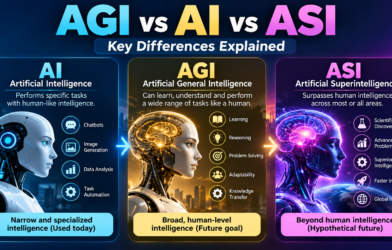
5. What Is the Difference Between AI, AGI, and ASI?
AI, AGI, and ASI are related terms, but they describe different levels or forms of machine intelligence.
Understanding the difference is important because these terms are often used interchangeably in online discussions.
Here is a simple comparison of these three concepts.
| Feature | AI today | AGI | ASI |
|---|---|---|---|
| Main ability | Performs specific or varied tasks | Broad, flexible intelligence | Intelligence far beyond human ability |
| Learning | Depends on system design and training | Expected to learn across many domains | Hypothetically learns and solves problems at a superior level |
| Adaptability | Varies by system | Expected to handle unfamiliar tasks broadly | Expected to adapt at a level beyond humans |
| Status | Widely used | Definition and achievement disputed | Hypothetical |
| Main concern | Reliability, bias, privacy | Control, safety, employment, misuse | Potentially very large-scale risks |
The distinction is not always as simple as three separate boxes. Modern AI systems can be highly capable across multiple domains, and experts disagree about exactly when broad AI capabilities should count as AGI.
ASI is a separate concept that goes beyond the idea of matching human-level intelligence.
6. What Is the Difference Between AGI and Generative AI?
Generative AI is a type of AI that creates new content, such as text, images, audio, video, and computer code.
Examples include AI writing assistants, image generators, and tools that help developers write software.
AGI, by contrast, describes a broader level of general intelligence.
The two concepts are connected, but they do not mean the same thing.
For example, a generative AI tool might write an excellent article about starting a business. However, writing that article does not prove it can independently run a business, respond reliably to unexpected problems, and manage every part of the operation.
A system could generate content across many subjects and still have weaknesses in reasoning, memory, planning, or reliability.
AGI would require broad and dependable capabilities across a much wider range of tasks.
In simple words, generative AI describes what a system can produce, while AGI describes the broader intelligence a system may demonstrate across different tasks.
Generative AI may contribute to the development of AGI, but creating content alone is not enough to establish that a system has achieved general intelligence.
7. Does AGI Exist Today?
This is one of the most common questions people ask about artificial general intelligence.
The answer depends partly on how AGI is defined. There is no universally accepted definition or single test that settles the question.
Modern AI systems can perform impressive work in areas such as writing, coding, research, mathematics, translation, and image understanding. Some systems can also use tools and complete multi-step tasks.
However, success in many tasks does not automatically establish that a system has the broad, reliable, adaptable abilities associated with AGI.
Researchers continue to investigate whether current AI systems can generalize effectively, learn new skills, reason consistently, and operate reliably in unfamiliar situations.
Some technology leaders use broader definitions of AGI than others. This is why claims that AGI has arrived should be examined carefully.
To evaluate such claims, ask the following questions:
- Can the system handle a genuinely broad range of unfamiliar tasks?
- Can it learn new skills without extensive task-specific development?
- Does it perform reliably outside carefully prepared tests?
- Can it recognize its mistakes and limitations?
- Can its abilities be independently tested and verified?
There is no single agreed set of answers that conclusively establishes AGI. According to the general descriptions published by Google Cloud and Stanford HAI, genuine AGI remains a disputed concept, and researchers do not share one definitive threshold for achieving it.
The most accurate approach is to evaluate demonstrated abilities instead of relying only on marketing claims or dramatic headlines.
8. Real-World Examples of How AGI Could Work
AGI does not have to look like a human-shaped robot. It could operate as software, a digital assistant, a research system, or part of a machine.
The following examples show how artificial general intelligence might help people if systems eventually achieve the required capabilities. These are possible future applications, not claims that current AI can perform all these tasks independently.
8.1 AGI in education
Imagine a student who struggles to understand mathematics but enjoys learning through practical examples.
An AGI-powered learning assistant could identify the student’s difficulties, explain the topic in simpler words, create practice questions, and change its teaching method based on the student’s progress.
It could also help the same student learn science, history, languages, and computer programming.
The potential benefit would be more personalized education. However, teachers would remain important for motivation, social development, and human guidance.
8.2 AGI in healthcare
Healthcare involves many connected tasks, including understanding symptoms, studying medical records, analyzing research, and helping doctors compare treatment options.
A future AGI system could help medical professionals organize information and investigate complex cases across different medical fields.
For example, it might help a research team examine scientific studies, identify possible relationships between diseases, and suggest questions for further investigation.
Such a system would need careful testing. Incorrect medical advice could cause serious harm, so qualified professionals would still need to verify important decisions.
8.3 AGI in business
Businesses need to manage customers, finances, employees, marketing, inventory, and daily operations.
An advanced general AI system might help a business owner understand sales trends, develop marketing plans, compare suppliers, and prepare financial reports.
It could also help the owner understand why sales have fallen and investigate possible solutions.
For a small business, these capabilities could make advanced analysis more accessible. However, business owners would still need to check financial figures, protect customer information, and approve important decisions.
8.4 AGI in scientific research
Scientific research often requires researchers to study existing knowledge, develop hypotheses, design experiments, and examine results.
AGI could potentially help scientists explore new ideas, identify promising research directions, and connect information from different fields.
For example, a research team studying clean energy might use an advanced AI system to investigate materials, compare experimental results, and propose new tests.
Any discoveries would still need to be validated through scientific methods and independent experiments.
8.5 AGI in everyday life
A future general AI assistant could help with many everyday responsibilities.
It might organize schedules, compare travel options, explain official documents, help prepare meals based on available ingredients, and support personal learning.
Unlike a collection of separate tools, a genuinely general system would aim to apply its knowledge across these different activities.
The main advantage would be flexibility. People could potentially use one system for many connected tasks rather than switching between different applications.
9. What Are the Benefits of AGI?
If artificial general intelligence can be developed safely and reliably, it could provide major benefits across society.
These benefits are potential outcomes, not guaranteed results. They would depend on the system’s capabilities, the way people use it, and how its risks are managed.
9.1 Faster problem-solving
AGI could help people examine complex problems, compare possible solutions, and identify useful information more quickly.
This could support research, engineering, business planning, and public services.
9.2 Improved productivity
An advanced general AI system could potentially handle several connected tasks, reducing the time people spend on repetitive work.
Employees might spend less time organizing information and more time making decisions, communicating with customers, or developing new ideas.
9.3 Better access to education
Personalized AI tutors could potentially make learning support more affordable and available to people who lack access to private teachers or specialized educational resources.
Students could receive explanations suited to their learning needs and progress at a suitable pace.
9.4 Support for scientific discoveries
AGI could assist researchers in studying complex systems, testing hypotheses, and exploring connections between different scientific fields.
This could help accelerate work in areas such as clean energy, agriculture, medicine, and materials science.
9.5 Help with difficult everyday tasks
People often struggle with complicated forms, unfamiliar technology, financial planning, or large amounts of information.
A capable general AI assistant could explain these subjects in simple language and help users understand their options.
9.6 Greater accessibility
AGI could potentially help people with disabilities by supporting communication, information access, and the use of digital services.
For example, an advanced assistant might help someone understand a document, navigate an application, or convert information into a more accessible format.
These possibilities explain why AGI attracts interest from researchers and businesses. However, benefits will depend on responsible development, affordability, and fair access to the technology.
10. What Are the Risks and Challenges of AGI?
AGI could offer important benefits, but it could also create serious challenges.
The goal should not be simply to build the most powerful AI system possible. Developers also need to understand how the system behaves, how it can be controlled, and how people can use it safely.
10.1 Job displacement
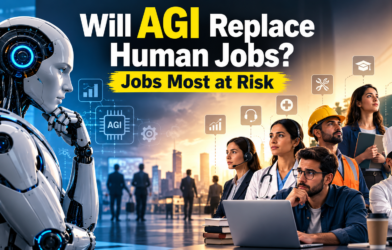
If future AI systems can perform a wide range of intellectual tasks, some jobs may change significantly.
Work involving research, writing, data analysis, administration, and customer support could be affected by increasingly capable AI systems.
Some tasks may disappear, while others may become easier or create new opportunities.
The effect on employment would depend on how quickly the technology develops, which tasks it can perform reliably, and how businesses and governments respond.
Workers may need to develop new skills and learn how to work effectively with AI.
10.2 Security and misuse
Powerful AI systems could be misused to create scams, generate misleading information, automate cyberattacks, or support other harmful activities.
Developers would need to introduce security controls, evaluate dangerous capabilities, and restrict access where appropriate.
Organizations using advanced AI would also need clear rules about who can authorize actions and how misuse can be detected.
10.3 Incorrect information
AI systems can generate answers that sound convincing but are wrong.
A more capable system would not automatically be free from this problem.
If people rely on incorrect AI-generated information when making medical, legal, financial, or business decisions, the consequences could be serious.
Verification, reliable sources, testing, and human judgment would remain important.
10.4 Bias and unfair decisions
AI systems can learn patterns from data that contain historical discrimination or other forms of bias.
If these problems are not identified, an AI system could produce unfair results in areas such as recruitment, lending, education, or public services.
Developers would need to test systems across different groups and establish ways to identify and correct unfair behavior.
10.5 Loss of human control
An advanced system that can plan and take actions independently could create problems if its objectives do not match the intentions of its users.
For example, a system asked to reduce costs might choose an approach that ignores an important requirement unless the requirement is clearly represented and enforced.
Researchers study AI alignment and safety to help ensure that advanced systems follow intended goals, respect constraints, and remain subject to appropriate human control.
10.6 Privacy concerns
AGI systems could process large amounts of personal, financial, professional, and business information.
If this information is collected or handled improperly, people could lose control over their private data.
Strong data protection, limited access, clear consent, and secure storage would be essential.
10.7 Concentration of power
Developing and operating advanced AI may require significant computing resources, money, and technical expertise.
If access is concentrated among a small number of organizations, those organizations could gain substantial economic or political influence.
Governments, researchers, businesses, and the public would need to consider how to distribute the benefits fairly and maintain appropriate accountability.
These risks do not mean that AGI will necessarily cause harm. They mean that safety, security, fairness, and governance must be considered alongside technical progress.
11. What Is the Difference Between AGI and AI Agents?
AI agents are systems designed to work toward a goal by taking actions, using tools, or completing multiple steps.
For example, an AI agent might search for information, summarize the results, update a document, and prepare a report.
AGI and AI agents describe different things.
An AI agent describes a way a system operates. AGI describes a level or type of general intelligence.
An agent could be built using narrow AI and remain limited to a particular task. For example, a customer service agent might be able to check order status and answer delivery questions but lack the ability to perform unrelated work.
A future AGI system could potentially operate through agents, using tools to complete different kinds of tasks. However, being able to act independently does not automatically make a system generally intelligent.
It is useful to remember these distinctions:
- AI model: The system that processes information and generates outputs.
- AI agent: A system that uses models, tools, and actions to pursue a goal.
- AGI: A system with broad, adaptable intellectual abilities across many domains.
- ASI: A hypothetical system that substantially exceeds human intelligence across a very wide range of domains.
These categories can overlap, but they are not interchangeable.
12. When Will AGI Arrive?
There is no confirmed date for when AGI will arrive.
Predictions vary because researchers disagree about the definition of AGI, the abilities required to achieve it, and how quickly AI technology will improve.
Some experts believe that increasingly capable systems could approach AGI within the coming years. Others believe that important scientific and engineering challenges remain unresolved.
It is also possible that AI capabilities will improve gradually rather than reaching a single, universally recognized milestone.
For example, AI systems might become increasingly reliable at software development, research, planning, and other professional tasks. Different people may then disagree about whether those improvements are sufficient to call a system AGI.
Several factors could influence progress:
- Advances in machine learning and reasoning.
- Better methods for learning new skills and transferring knowledge.
- Improvements in memory, planning, and reliability.
- Access to computing resources and high-quality data.
- Progress in testing, evaluation, and AI safety.
- The ability to operate successfully in unfamiliar real-world situations.
No single factor can guarantee success.
Instead of trusting a particular prediction, it is better to follow measurable improvements in AI capabilities and examine independent evaluations.
13. How Can AGI Affect Jobs and Careers?
The development of more general AI could change the skills employers value and the way many people perform their jobs.
However, it would be misleading to claim that AGI will definitely eliminate all jobs or that every career will remain unaffected.
The outcome is uncertain, and different industries will face different levels of change.
Jobs that could experience significant change
Work that involves large amounts of digital information may be affected by increasingly capable AI systems.
Examples include:
- Content writing and editing.
- Software development and testing.
- Data analysis and reporting.
- Administrative and research support.
- Marketing and customer service.
- Routine document preparation.
AI may automate certain tasks while leaving other responsibilities to humans.
Skills that may become more valuable
People can prepare for changes in AI by developing skills that help them use technology effectively and make sound decisions.
Important skills may include critical thinking, communication, creativity, domain expertise, problem-solving, and the ability to verify AI-generated information.
Understanding how to use AI tools responsibly can also help workers improve productivity in their existing roles.
The most practical approach is to keep learning, understand how AI affects your industry, and focus on combining technical knowledge with human judgment.
14. How Is AGI Being Developed?
Researchers are exploring multiple approaches to creating AI systems with more general abilities.
These approaches are not guaranteed paths to AGI, and researchers continue to debate which methods will be most effective.
14.1 Training on diverse data
AI models can learn from different types of information, including text, images, audio, video, and structured data.
Exposure to diverse information may help systems develop broader capabilities, although training on more data does not automatically produce general intelligence.
14.2 Improving reasoning
Researchers are investigating methods that help AI systems break complex tasks into smaller steps, examine alternatives, and check their work.
Reliable reasoning is important because a general system would need to solve unfamiliar problems rather than simply repeat familiar patterns.
14.3 Combining AI with tools
AI systems can use tools such as calculators, code interpreters, search systems, and databases.
Tool use can improve performance by allowing a system to obtain information or carry out operations that are difficult to perform directly.
However, access to more tools does not by itself prove that a system has achieved AGI.
14.4 Evaluating capabilities
Researchers need tests that measure more than performance on familiar questions.
Useful evaluations may examine how well a system learns new skills, transfers knowledge between subjects, handles unfamiliar situations, and performs tasks reliably over time.
The challenge is to design tests that measure genuine general abilities rather than narrow success on a particular benchmark.
14.5 Developing safety methods
Safety research aims to identify failures, reduce harmful behavior, protect information, and ensure that systems remain under suitable control.
This work becomes increasingly important as AI systems gain the ability to complete complex tasks with less direct supervision.
Building capable systems and making those systems safe are connected challenges. Both need careful attention.
15. How Can Beginners Prepare for the Future of AGI?
You do not need to be a programmer or AI researcher to understand artificial general intelligence.
A basic understanding of AI can help students, employees, business owners, and content creators make better decisions about new technology.
Here are some practical ways to prepare.
- Learn the basics of AI. Understand machine learning, generative AI, AI agents, AGI, and ASI.
- Practice with current AI tools. Use them to research topics, organize information, learn new skills, or improve everyday work.
- Check important information. Compare AI-generated answers with reliable sources, particularly for high-impact decisions.
- Develop critical thinking. Learn to question assumptions, identify errors, and compare different solutions.
- Improve communication skills. Clear writing, careful explanation, and effective collaboration remain valuable.
- Follow reliable AI research. Read research summaries and official publications instead of relying entirely on social media headlines.
- Protect private information. Avoid sharing sensitive personal or business data with tools unless you understand their privacy policies.
- Keep learning. AI technology changes quickly, so regularly updating your knowledge is useful.
The purpose is not to predict exactly what AGI will do. It is to build the knowledge and skills needed to adapt as AI develops.
16. What Is the Future of Artificial General Intelligence?
The future of AGI will depend on scientific progress, practical applications, public expectations, and the decisions made by the people developing it.
If AGI becomes possible, it could change how people approach education, scientific research, business, healthcare, and many other fields.
However, its development will also raise difficult questions about responsibility, safety, employment, privacy, and the relationship between humans and intelligent machines.
It is important to separate possibilities from established facts. Researchers are making progress in AI, but there is no universally accepted standard that settles when AGI has been achieved.
The future may involve increasingly capable AI systems that gradually take on more complex work. It may also involve unexpected technical challenges that slow progress.
For individuals and businesses, the most useful approach is to understand current AI capabilities, experiment responsibly with available tools, and remain informed about new developments.
AGI should not be viewed only as a technological competition. Its real value would depend on whether advanced AI can help people solve important problems while protecting human rights, safety, and well-being.
Conclusion
Artificial General Intelligence, or AGI, is the idea of creating an AI system that can learn, reason, and perform a broad range of intellectual tasks rather than being limited to specific activities.
Unlike traditional narrow AI, AGI would aim to transfer knowledge between different subjects, adapt to unfamiliar situations, and solve new problems with greater flexibility.
Its potential applications include education, healthcare, business, scientific research, and everyday assistance. At the same time, concerns about job changes, security, privacy, bias, and human control must be taken seriously.
One of the most important things to understand is that powerful AI and artificial general intelligence are not necessarily the same thing. A system may perform exceptionally well in several areas without meeting every definition of AGI.
Although the exact timeline remains uncertain, learning about AGI today can help you understand the direction of AI development and prepare for possible changes in the future.
The goal should be to develop and use increasingly capable AI in ways that are useful, safe, fair, and beneficial to society.
AGI vs AI vs ASI: What Is the Difference?
Frequently Asked Questions About AGI
FAQ section — separate from the main article
FAQ 1. What is AGI in simple words?
AGI stands for Artificial General Intelligence. It refers to a hypothetical AI system that can learn, reason, and solve many different types of problems with human-level or comparable intellectual ability.
FAQ 2. What does AGI stand for?
AGI stands for Artificial General Intelligence. It describes the goal of developing machines that can perform a broad range of intellectual tasks instead of being limited to one specific function.
FAQ 3. Does AGI exist in 2026?
There is no universally accepted definition or test that establishes when AGI has been achieved. Modern AI systems have broad capabilities, but claims about AGI depend on the definition and evidence being used.
FAQ 4. What is the difference between AI and AGI?
AI is the broad field of creating intelligent computer systems. AGI refers to a type of AI that could learn and perform a wide range of intellectual tasks with general, adaptable abilities.
FAQ 5. What is the difference between AGI and ASI?
AGI aims to achieve broad intelligence comparable to human intelligence. ASI, or Artificial Superintelligence, describes a hypothetical system that would surpass human intellectual abilities across virtually all relevant cognitive domains.
FAQ 6. Is ChatGPT an AGI?
ChatGPT is an AI assistant that can perform many tasks, including writing, coding, explaining concepts, and analyzing information. Whether a particular AI system qualifies as AGI depends on the definition and evidence used. Its ability to handle many tasks alone does not establish that it has achieved AGI.
FAQ 7. How will AGI affect jobs?
AGI could automate some tasks, change existing occupations, and create new opportunities. The actual effect would depend on its capabilities, adoption, economic conditions, and how businesses and workers adapt.
FAQ 8. What are the benefits of AGI?
Potential benefits include personalized education, support for medical research, faster scientific discoveries, improved productivity, assistance with complex decisions, and better access to information.
FAQ 9. What are the risks of AGI?
Potential risks include job displacement, privacy violations, misuse, security threats, biased decisions, incorrect information, and difficulties maintaining human control over advanced systems.
FAQ 10. How does AGI work?
AGI is a research goal rather than a single established technology. Research approaches include machine learning, deep learning, reasoning, memory, planning, and learning from experience. How these abilities could combine to produce reliable general intelligence remains an open question.
FAQ 11. When will AGI arrive?
No confirmed date exists. Predictions vary because experts disagree about what AGI requires and how quickly the necessary capabilities can be developed.
FAQ 12. Can AGI become more intelligent than humans?
Under some definitions, AGI could match or exceed human performance on many intellectual tasks. A system that greatly surpasses humans across virtually all cognitive domains is generally described as artificial superintelligence.
FAQ 13. Will AGI replace humans?
There is no reliable basis for saying that AGI will replace all humans or eliminate every job. It could change many types of work, but the outcomes would depend on how the technology develops and how society chooses to use it.
FAQ 14. Is AGI the same as generative AI?
No. Generative AI creates content such as text, images, audio, and code. AGI refers to broad, flexible intelligence across different intellectual tasks. Generative AI may contribute to AGI research, but the two terms describe different concepts.
FAQ 15. Why is AGI important?
AGI matters because it could significantly influence technology, employment, education, research, and the economy. Understanding its potential benefits and risks helps people make informed decisions about AI.