

Artificial intelligence is changing how people work, how businesses operate, and how companies serve their customers. Until recently, many people used AI mainly to ask questions, write content, generate images, or summarize documents. But a new development is taking AI to the next level. It is called Agentic AI.
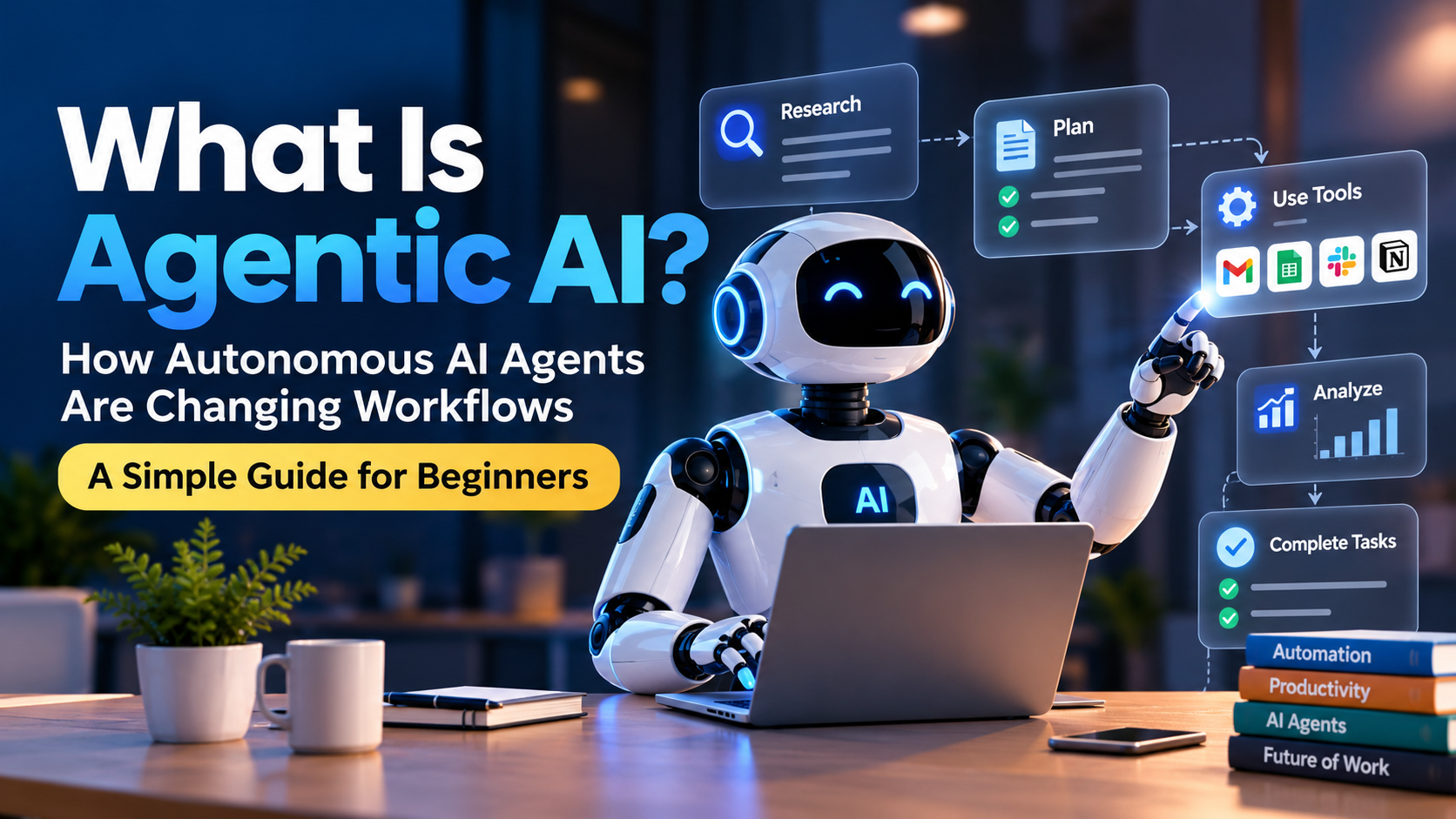
Agentic AI can do more than provide answers. It can understand a goal, create a plan, use available tools, complete tasks, check results, and take further steps when needed. For example, instead of simply writing an email, an AI agent could help research a customer, prepare a personalized email, update a customer management system, and request approval before sending it.
This technology is attracting attention because businesses want to save time, reduce repetitive work, and improve productivity. However, Agentic AI also brings questions about safety, accuracy, cost, and human control.
In this guide, you will learn what Agentic AI is, how autonomous AI agents work, where businesses can use them, which frameworks beginners can explore, and how to get started.
1. What Is Agentic AI?
Agentic AI is a type of artificial intelligence designed to work toward a goal by making decisions, planning steps, using tools, and adjusting its actions based on results.
Traditional AI systems often respond to a specific instruction. For example, you ask an AI chatbot to write a blog introduction, and it generates the text. The task usually ends when the answer is provided.
An Agentic AI system can work through several connected steps to achieve a larger goal. Depending on its permissions and design, it may search for information, organize data, use software, perform calculations, and check whether the task is complete.
Imagine asking an AI system to help organize a business meeting. A basic chatbot might suggest an agenda. An AI agent could potentially check calendar availability, suggest suitable times, prepare an agenda, draft invitations, and wait for your approval before sending them.
The important difference is that the agent works toward an outcome rather than producing only one response.
Agentic AI does not mean that a machine has human feelings, consciousness, or unlimited intelligence. It means the system has been designed to perform goal-directed tasks with some degree of independence.
Key features of Agentic AI
Agentic AI systems can include several important capabilities.
- Goal understanding: They interpret the task they need to complete.
- Planning: They divide a larger goal into smaller steps.
- Tool usage: They use approved tools, APIs, databases, or software.
- Decision-making: They select actions based on available information and rules.
- Memory: They may retain relevant information during a task or across tasks, depending on their design.
- Feedback: They evaluate results and change their approach when necessary.
- Autonomy: They perform some actions without requiring a human to approve every step.
Not every AI agent has all these capabilities. Some agents can perform only simple tasks, while others can manage longer workflows with multiple tools.
2. What Is the Difference Between AI, Agentic AI, and AI Agents?
These terms are related, but they do not mean exactly the same thing.
Artificial intelligence is the broader field of creating systems that perform tasks associated with human intelligence. It includes machine learning, language models, computer vision, recommendation systems, and many other technologies.
Agentic AI describes AI systems designed to pursue goals through planning and action. An AI agent is a software component or system that carries out those actions.
For example, a language model may generate a response to a question. An agent can use a language model along with tools, instructions, and feedback to complete a task that requires several steps.
| Feature | Traditional AI tool | Agentic AI system |
|---|---|---|
| Main purpose | Answer or perform a specific task | Work toward a broader goal |
| Planning | Often limited | Can plan multiple steps |
| Tool usage | May be limited or user-directed | Can select approved tools |
| Workflow | Usually follows a direct request | Can manage connected actions |
| Feedback | Often requires a new prompt | Can evaluate results and continue |
| Human involvement | Often required for each task | Depends on permissions and risk |
| Example | Summarizing a report | Researching, summarizing, and organizing a report |
The distinction is not always absolute. Modern AI assistants can also use tools, and some automation systems include decision-making. Agentic AI is best understood as a spectrum rather than a completely separate category.
3. How Do Autonomous AI Agents Work?
Autonomous AI agents combine an AI model with instructions, tools, and a process for deciding what to do next.
A typical agent starts with a goal. It then identifies the actions needed to achieve that goal. After taking an action, it examines the result and decides whether another step is necessary.
For example, imagine a company wants to prepare a weekly report about its website performance.
The agent might collect analytics data, compare it with the previous week, identify important changes, create a summary, and prepare recommendations. If the required data is missing, it may ask for clarification instead of inventing information.
The main stages of an AI agent workflow
Step 1: Understand the goal
The agent receives a task, such as preparing a sales report or finding qualified leads. It identifies the expected result and relevant constraints.
Step 2: Create a plan
The system breaks the goal into smaller tasks and decides which steps should happen first.
Step 3: Use tools
The agent may access approved search tools, spreadsheets, databases, email systems, or business applications.
Step 4: Review the results
The agent checks whether the action worked and whether the output meets the task requirements.
Step 5: Complete or escalate
It finishes the task if the goal is achieved. If something goes wrong or approval is required, it can retry within defined limits or ask a human for help.
This process is often described as a goal-plan-act-observe cycle. The exact design depends on the AI model, software tools, instructions, and safety controls.
What makes an AI agent autonomous?
An agent is autonomous when it can choose and perform certain actions without receiving a new human instruction for every step.
However, autonomy has limits. A business can allow an agent to prepare documents automatically while requiring approval before it sends emails, spends money, changes customer records, or publishes content.
This approach makes it easier to benefit from automation without giving the AI unnecessary control.
4. How Autonomous AI Agents Are Replacing Standard Workflows
Many businesses still use workflows that depend on people completing repetitive steps manually. An employee may copy information from emails into a spreadsheet, prepare reports, send follow-up messages, and update customer records.
Traditional workflow automation can already handle many of these tasks. It follows predefined rules, such as sending an email when a form is submitted. Agentic AI adds the ability to interpret information, make limited decisions, and respond to situations that do not always follow the same pattern.
For example, a traditional automation system may send the same confirmation email to every new customer. An AI agent could classify the customer’s request, draft a suitable response, identify missing information, and route unusual cases to a human employee.
Traditional automation vs Agentic AI
| Area | Traditional workflow | Agentic AI workflow |
|---|---|---|
| Instructions | Predefined rules | Goals, instructions, and constraints |
| Decisions | Mostly rule-based | Can use context and model reasoning |
| Unexpected situations | Often needs a new rule | May adapt or ask for help |
| Content handling | Structured data works best | Can also interpret unstructured text |
| Workflow changes | Usually require configuration | May adjust steps within permitted limits |
| Reliability | Predictable when rules fit the task | Needs testing because outputs can vary |
Traditional automation is still valuable. In fact, the best business systems often combine both approaches. Fixed rules handle predictable steps, while AI agents deal with tasks that require interpretation.
Examples of workflows that AI agents can improve
Customer support: An agent can classify a customer request, search approved help documents, draft a response, and escalate complicated complaints.
Sales follow-ups: An agent can organize leads, summarize previous conversations, suggest the next action, and prepare personalized messages.
Content marketing: An agent can research a topic, develop an outline, prepare a draft, suggest keywords, and create social media variations for human review.
Business reporting: An agent can gather data from connected sources, compare performance, and prepare a summary of important changes.
Administrative work: An agent can extract information from documents, organize records, identify missing fields, and prepare forms for approval.
These examples show the potential of autonomous AI workflows. However, an agent can perform only the actions supported by its tools, access permissions, and configuration. It should not be assumed that every AI system can safely complete every step without supervision.
5. Real-World Applications of Agentic AI
Agentic AI is useful when a task involves several steps, different sources of information, and decisions based on context. The following examples explain how businesses can apply AI agents in practical situations.
1. Agentic AI for digital marketing
Digital marketing agencies handle SEO research, content planning, social media publishing, reporting, and lead management. Many of these activities require repeated research and coordination.
An AI marketing agent can help research keywords, group search terms by topic, analyze existing content, prepare blog outlines, and draft social media posts. It can also organize campaign information and prepare performance summaries when connected to the relevant tools.
For example, a marketing agency could create a workflow that collects keyword data, groups related topics, prepares a content calendar, and sends drafts to an editor.
The human editor should still check factual accuracy, originality, search intent, brand voice, and compliance before publishing. AI-generated content does not automatically achieve good search rankings.
2. Agentic AI for sales and lead generation
Sales teams often spend significant time researching prospects and updating customer relationship management systems.
An AI sales agent can help organize incoming leads, summarize company information, identify missing details, and recommend suitable follow-up actions. With approved integrations, it can also prepare CRM updates and draft personalized emails.
A human salesperson can review the recommendations before contacting a prospect. This helps save time while keeping communication relevant and professional.
3. Agentic AI in customer service
Customer service agents can handle common questions by searching a company’s approved knowledge base. They may help users understand product features, find order information, or follow troubleshooting steps.
When a request involves a refund, sensitive account information, or an unusual complaint, the system should follow clear rules about when to transfer the case to a human.
This approach can improve response times, but businesses should measure answer accuracy, customer satisfaction, and the rate of incorrect resolutions.
4. Agentic AI for software development
Software development involves writing code, running tests, finding errors, and updating documentation.
AI coding agents can assist with these tasks. Depending on their environment and permissions, they may inspect a codebase, suggest changes, run tests, and prepare a proposed update for review.
However, generated code can contain security weaknesses or introduce bugs. Code review, testing, access restrictions, and version control remain important.
5. Agentic AI in finance and accounting
Finance teams work with invoices, expenses, transaction records, and reports. AI agents can extract information from documents, compare records, identify possible discrepancies, and prepare summaries.
For example, an agent might flag an invoice whose amount does not match a purchase order. A finance employee can investigate the difference before approving payment.
High-impact decisions, money transfers, and changes to financial records should have appropriate controls and human approval.
6. Agentic AI in education
AI agents can help students organize learning materials, create practice questions, explain difficult concepts, and build revision plans.
Teachers may use them to prepare draft lesson materials or organize learning resources. However, educational institutions should protect student information and ensure that AI does not replace appropriate teacher judgment.
7. Agentic AI in e-commerce
Online stores receive questions about products, orders, delivery, returns, and availability.
An AI agent can search product information, explain delivery policies, classify support requests, and prepare responses. With secure access, it may also retrieve order details or prepare a return request.
Refunds, purchases, account changes, and other consequential actions should follow clear authorization rules.
6. What Are Multi-Agent Systems?
A multi-agent system is a setup in which two or more AI agents work together to complete a task or solve a larger problem.
Instead of assigning every activity to one agent, a business can divide the work among agents with different responsibilities.
Imagine a content marketing workflow. One agent researches the topic, another organizes the SEO structure, another prepares a draft, and a review agent checks the content against a quality checklist.
A coordinating agent may assign tasks, collect the results, and prepare the final output for a human editor.
Main coordinator agent
Receives the goal and assigns tasks
Research agent
Finds useful information
Writing agent
Creates the first draft
SEO agent
Checks topic and keyword coverage
Review agent
Checks quality and requirements
Human review and final approval
This is an example architecture, not a requirement for every project. The agents could be separate systems or different roles managed within one application.
Benefits of multi-agent AI
Multi-agent systems can divide complex tasks, use specialized instructions, and allow different stages to operate in parallel. This can make certain workflows easier to manage.
However, adding more agents does not automatically improve results. Multiple agents may repeat the same mistakes, disagree with one another, or increase the cost and time needed to complete a task.
For simple workflows, a single agent or traditional automation may be more efficient.
7. Top Multi-Agent Frameworks for Beginners
An AI agent framework provides software components that help developers build, connect, manage, or evaluate agents. The right choice depends on technical skills, workflow complexity, integrations, and budget.
Here are several frameworks and tools worth exploring.
1. LangGraph
LangGraph is designed for building stateful agent workflows with defined steps, branching, and control over how a process runs. It is useful when developers need to manage longer tasks, checkpoints, and human approval.
Best for: Developers who need control over complex workflows.
2. CrewAI
CrewAI focuses on coordinating agents with different roles and responsibilities. It can help developers organize tasks that require multiple specialized agents.
Best for: Role-based multi-agent workflows.
3. Microsoft AutoGen
AutoGen is a framework for building applications that use multiple AI agents. Developers should check the current project documentation and recommended development path before starting a new project.
Best for: Learning about agent collaboration and conversational agent systems.
4. OpenAI Agents SDK
The OpenAI Agents SDK supports the development of applications with agents, tools, handoffs, and workflow controls. It is an option for developers building AI-powered applications using supported models and integrations.
Best for: Building tool-using AI applications and coordinated agent workflows.
5. n8n
n8n is a workflow automation platform that connects applications, APIs, and AI capabilities. It is especially useful for visualizing automation steps and connecting business tools.
Best for: Beginners and teams building practical business automations.
These options serve different purposes, so they are not direct replacements for one another. A framework designed for code-heavy agent orchestration may offer more control, while a visual workflow platform may be easier for connecting existing business applications.
Before choosing one, check its current documentation, licensing, integrations, security features, and maintenance status.
8. Benefits of Agentic AI for Businesses
Agentic AI can create business value when it handles suitable tasks reliably and reduces unnecessary manual work.
The most useful benefits include the following.
- Time savings: Agents can handle repeated research, information gathering, and document preparation.
- Improved productivity: Employees can focus more on planning, customer relationships, and complex decisions.
- Faster workflows: Connected tasks may be completed without waiting for a person to start each step.
- Consistent processes: Agents can follow approved instructions and checklists.
- Better information handling: Agents can help organize information from different sources.
- Scalability: A well-designed workflow can handle additional tasks when sufficient system capacity is available.
- Continuous operation: Some agents can run on a schedule or respond to events outside normal working hours.
These benefits are not guaranteed. Poorly designed agents can create more work by producing inaccurate results, making unnecessary tool calls, or requiring frequent human correction.
Businesses should measure actual performance rather than assuming that automation always saves money.
9. Challenges and Risks of Agentic AI
Autonomous AI agents can take actions, so their mistakes may have effects beyond an incorrect chatbot answer. A poorly configured agent could update a record incorrectly, send an unsuitable message, expose sensitive information, or repeat an action unexpectedly.
The National Institute of Standards and Technology provides a voluntary AI Risk Management Framework that organizations can use to think about trustworthiness and manage AI risks throughout the system lifecycle.
Main risks to understand
Incorrect information: AI agents can misunderstand instructions or produce false information. Important results should be checked against reliable sources.
Data privacy: Agents may access customer information, company files, or internal systems. Only the information needed for the task should be available.
Security problems: An agent with broad permissions may cause damage if it is manipulated or behaves unexpectedly. Strong access controls and monitoring are important.
Unwanted actions: An agent might send a message, delete a file, or change a record when it should have asked for approval.
High operating costs: Complex workflows can use significant model resources, especially when agents repeatedly retry tasks or delegate work to other agents.
Unclear accountability: Businesses need to decide who is responsible for reviewing outcomes, handling failures, and authorizing important actions.
How can businesses use Agentic AI safely?
A responsible deployment should include practical safeguards.
- Start with a low-risk task and test it with realistic examples.
- Give the agent only the permissions it needs.
- Require human approval for sensitive or irreversible actions.
- Set limits on spending, retries, execution time, and the number of actions.
- Record important tool calls and decisions for later review.
- Test how the system responds to incorrect data, confusing instructions, and unexpected situations.
- Monitor quality, security, cost, and performance after launch.
These safeguards help businesses keep useful autonomy without handing over unlimited control.
10. How to Build Your First AI Agent Without Coding
You do not need to be an experienced programmer to start learning about Agentic AI. Many visual automation tools allow beginners to connect applications and add AI steps to their workflows.
The best approach is to begin with a small problem instead of trying to build a fully autonomous business system immediately.
Follow these steps to get started
Step 1: Choose one repetitive task.
Identify a task that takes time every day or week. Examples include organizing leads, preparing reports, summarizing emails, or collecting information for blog posts.
Step 2: Define the expected result.
Explain what the agent should produce, what information it can use, and what it must not do. Clear instructions make testing easier.
Step 3: Choose an appropriate tool.
Beginners can explore visual workflow tools such as n8n. Developers can explore agent frameworks such as LangGraph, CrewAI, or the OpenAI Agents SDK.
Step 4: Connect the required applications.
Depending on the task, the agent may need access to a spreadsheet, an approved database, a search tool, or a customer management system. Use secure connections and limited permissions.
Step 5: Test with sample data.
Check whether the agent follows instructions, produces accurate results, and handles missing information correctly. Do not immediately allow it to make important changes to live systems.
Step 6: Add approval and safety rules.
Decide which tasks the agent can complete automatically and which tasks require human review.
Step 7: Measure the results.
Compare the time saved, output quality, error rate, and total operating cost with the previous workflow. Improve the system based on actual results.
For example, a small marketing agency could start with an agent that collects information about a blog topic, prepares a draft outline, and saves it for review. After the workflow performs reliably, the agency can add keyword analysis or content quality checks.
This gradual approach is safer and more practical than automating every business process at once.
11. Agentic AI vs. Generative AI
Generative AI creates new content, such as text, images, audio, video, or code. Agentic AI focuses on completing goals through decisions and actions.
The two concepts can work together. An agent may use a generative AI model to write an email, summarize a document, or interpret a customer’s question. It can then use other tools to complete the workflow.
For example, a generative AI tool can draft a product description. An agentic workflow might gather product information, create the description, check it against a content checklist, and save it in a product management system.
The distinction is about how the technology is used, not simply which model powers it. Generative AI can be part of an agent, and an AI agent can use several different models and non-AI tools.
12. Is Agentic AI the Future of Work?
Agentic AI is likely to become an important part of business automation as organizations improve the way AI systems connect with software and perform multi-step tasks.
However, this does not mean that every job or workflow will be replaced by autonomous agents. Many tasks require human judgment, communication, creativity, responsibility, and an understanding of real-world situations.
The more realistic future is a combination of AI agents, traditional automation, and human workers.
Businesses may use agents for routine information gathering and administrative tasks while employees handle complex decisions, relationships, strategy, and quality control.
Workers can prepare by learning how to use AI tools, design workflows, check AI-generated results, and understand basic data security. These skills can be useful even when a company does not build its own AI agents.
The organizations most likely to benefit are those that identify suitable problems, measure outcomes, and introduce automation responsibly rather than adopting AI simply because it is popular.
13. Frequently Asked Questions About Agentic AI
1. What is Agentic AI in simple words?
Agentic AI is artificial intelligence that can work toward a goal by planning steps, using tools, making limited decisions, and checking results. It can complete connected tasks instead of only answering a single question.
2. What is an autonomous AI agent?
An autonomous AI agent is a software system that can perform certain tasks without needing a person to approve every step. Its independence depends on its instructions, tools, permissions, and safety limits.
3. How is Agentic AI different from a chatbot?
A traditional chatbot mainly responds to user messages. An AI agent can go further by planning actions, using connected applications, and working through several steps to complete a task. Some modern chatbots also have agent-like capabilities.
4. Can Agentic AI replace traditional workflow automation?
Agentic AI can improve workflows that require interpreting information or handling different situations. Traditional automation remains useful for predictable, rule-based tasks. Many effective business systems combine both technologies.
5. What are the best AI agent frameworks for beginners?
Beginners can explore n8n for visual automation, CrewAI for role-based multi-agent workflows, and LangGraph for more controlled agent processes. The OpenAI Agents SDK is another option for developers building tool-using AI applications. The best choice depends on the project and technical experience.
6. Can I build an AI agent without coding?
Yes. Visual automation platforms can help you create simple AI workflows without writing much code. However, advanced integrations, custom logic, and production-level security may require technical knowledge.
7. What are some examples of Agentic AI?
Examples include AI systems that research information, prepare reports, organize sales leads, classify customer requests, assist with software testing, and coordinate content production. Their actual capabilities depend on the tools and permissions available.
8. Is Agentic AI safe to use?
Agentic AI can be used responsibly, but it is not automatically safe or accurate. Businesses should restrict permissions, protect sensitive information, test the system, monitor its actions, and require human approval for high-impact tasks.
9. What is a multi-agent AI system?
A multi-agent AI system uses two or more AI agents that cooperate or coordinate to complete a task. Each agent may have a different responsibility, such as research, writing, analysis, or quality checking.
10. Will Agentic AI replace human jobs?
Agentic AI may automate parts of some jobs, particularly repetitive digital tasks. It may also change how people work and create new responsibilities. The overall impact will depend on the technology, industry, adoption rate, and decisions made by businesses.
11. How can small businesses benefit from Agentic AI?
Small businesses can use AI agents to assist with customer support, lead organization, content preparation, document processing, and reporting. Starting with a single, low-risk workflow makes it easier to evaluate the benefits before expanding.
12. Does Agentic AI need human supervision?
Not every action needs direct supervision, but appropriate oversight is important. Low-risk, repeatable tasks may be automated after testing, while sensitive decisions and irreversible actions should have suitable approval controls.
13. What is the difference between single-agent and multi-agent AI?
A single-agent system uses one agent to manage a task or workflow. A multi-agent system divides work between several agents. Multi-agent systems can help with complex tasks, but they may also increase cost and coordination requirements.
14. What is the biggest limitation of Agentic AI?
One major limitation is that an agent can make incorrect decisions or take unsuitable actions while trying to achieve its goal. Reliable tools, clear instructions, restricted permissions, testing, and human oversight help reduce these risks.
15. How do I start learning Agentic AI in 2026?
Start by understanding how AI models, tools, instructions, and workflows work together. Experiment with a simple automation, learn to evaluate its output, and then explore agent frameworks or multi-agent systems as your needs become more advanced.
Conclusion
Agentic AI represents an important development in artificial intelligence because it enables systems to work toward goals, use tools, and complete multiple connected tasks. Instead of limiting AI to writing answers or generating content, businesses can use agents to assist with research, reporting, customer support, sales, marketing, and other workflows.
However, autonomy alone does not guarantee accuracy, safety, or better results. The best solutions combine suitable AI capabilities with reliable automation, clear permissions, careful testing, and human oversight.
If you are new to Agentic AI, begin with one repetitive task, build a small workflow, and measure its performance. You can then improve it gradually as you understand its strengths and limitations.
As AI technology develops, understanding autonomous AI agents and how to use them responsibly can help individuals and businesses prepare for the changing world of work.
For more practical guides on artificial intelligence, automation, AI tools, and startup technology, explore AI Startup Edge.