


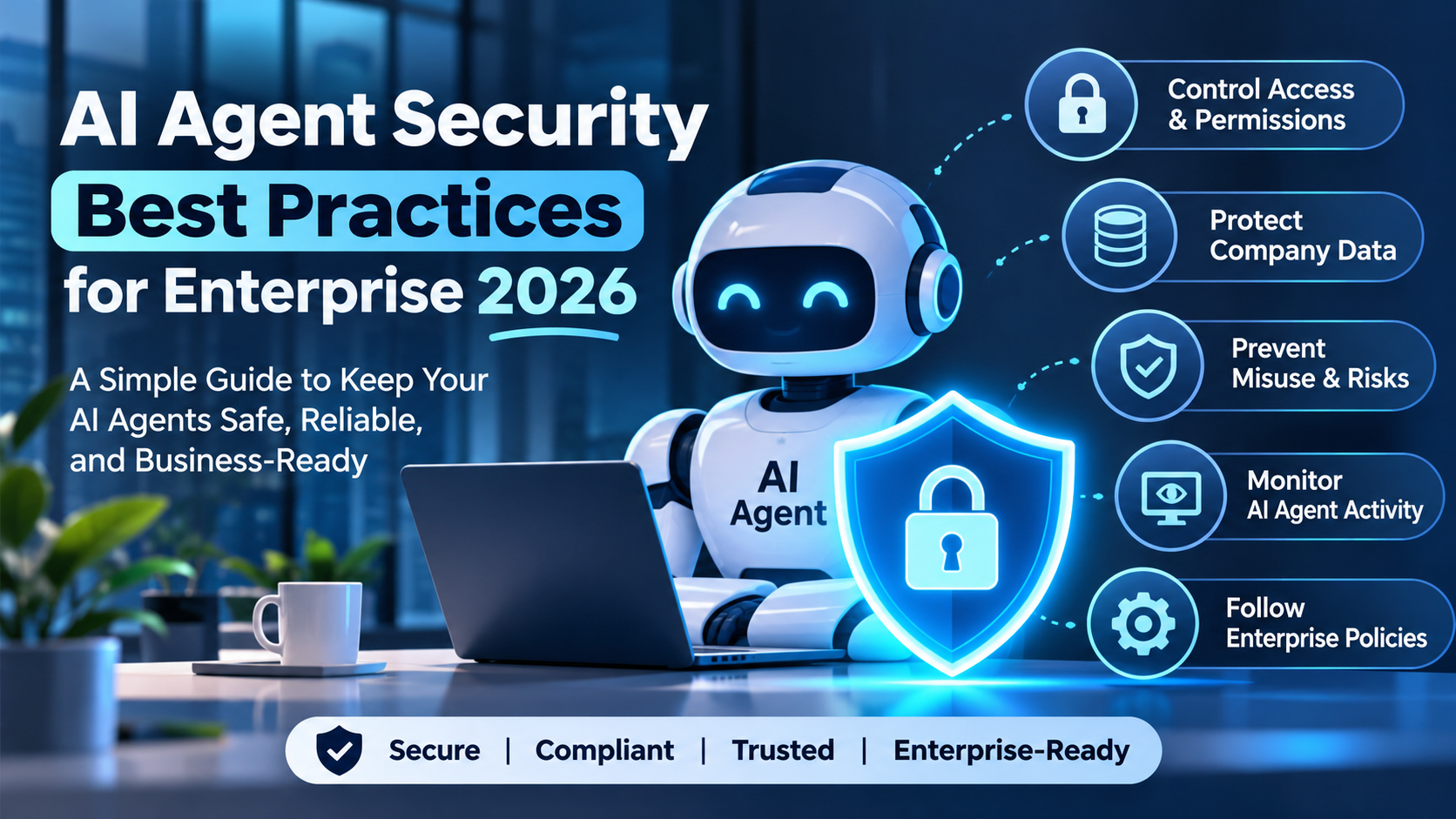
AI agents are changing how businesses work in 2026. Companies are using AI agents to manage customer support, automate business operations, analyse data, write reports, manage workflows, and connect different software applications. Unlike traditional AI chatbots, AI agents can take actions, access company information, use external tools, and make decisions with limited human involvement. However, these capabilities also create serious security risks. An unsecured AI agent can expose confidential business information, access sensitive systems, perform unwanted actions, or become a target for cybercriminals. This is why AI Agent Security Best Practices for Enterprises in 2026 are more important than ever. Businesses need strong security policies before deploying AI agents in real-world environments. In this guide, we will explain common AI agent security risks, practical protection methods, enterprise security frameworks, and implementation strategies in simple language.
1. What Is AI Agent Security?
AI agent security refers to the methods, technologies, policies, and controls used to protect AI agents from cyberattacks, unauthorized access, data leaks, and harmful actions.
An AI agent is different from a normal chatbot because it can perform tasks instead of only providing answers. Depending on its permissions, it can access databases, send emails, update customer records, generate invoices, interact with APIs, and execute automated workflows.
For example, imagine a company using an AI customer support agent. The agent can read customer information, check order status, issue refunds, and send emails.
If the agent has weak security, an attacker might manipulate it into revealing customer information or issuing unauthorized refunds.
This is why enterprise AI security must protect more than the AI model. It must also protect the tools, APIs, databases, user identities, memory, and automated workflows connected to the agent.
The main objectives of AI agent security are:
- Protect confidential company and customer information.
- Prevent unauthorized access to business applications.
- Stop malicious instructions from changing agent behaviour.
- Control which actions an AI agent can perform.
- Monitor AI agent activities in real time.
- Prevent financial loss and operational damage.
- Maintain compliance with applicable laws and security standards.
- Make AI systems reliable, transparent, and accountable.
In simple words, AI agent security ensures that an AI agent can complete its assigned work without putting business information, systems, employees, or customers at risk.
2. Why Is AI Agent Security Important for Enterprises in 2026?
In 2026, enterprises are moving from basic AI assistants towards autonomous AI systems. These systems can perform multiple tasks, communicate with other agents, and interact with internal and external business applications.
This creates new opportunities, but it also increases the number of possible security weaknesses.
Traditional cybersecurity generally focuses on protecting users, devices, applications, networks, and databases. AI agents introduce another layer because they can interpret instructions, make decisions, remember information, and take actions.
For example, an employee may ask an AI agent to prepare a customer report. The agent might access a CRM system, retrieve customer records, analyse the information, and create a document.
If the employee is not authorised to access certain customer records, the agent must not expose that information simply because it can retrieve it.
Enterprise AI security is important for several reasons.
2.1 Protection Against Data Breaches
AI agents may process confidential documents, financial records, customer details, employee information, and business strategies.
If attackers manipulate an agent or exploit its connected tools, sensitive information could be exposed.
Enterprises should use encryption, access restrictions, data classification, and monitoring to prevent unauthorized information disclosure.
2.2 Prevention of Unauthorized Actions
An AI agent may have permission to update databases, send emails, approve requests, or process transactions.
Without proper controls, attackers could manipulate the agent into performing actions that were never intended.
Businesses must introduce approval systems and permission checks for sensitive operations.
2.3 Protection of Business Applications
Enterprise AI agents often connect with CRM platforms, ERP software, cloud storage, email services, payment systems, and internal APIs.
Every connection creates a possible entry point for attackers.
Businesses should secure every integration and verify each request before allowing an agent to access a resource.
2.4 Maintaining Customer Trust
Customers expect companies to protect their personal information.
If an AI agent exposes customer records or sends incorrect financial information, the business may lose customer confidence.
Strong security practices help enterprises maintain trust while using AI automation.
2.5 Reducing Financial and Legal Risks
A compromised AI agent can create financial damage through unauthorized payments, fraudulent refunds, incorrect transactions, or operational disruption.
It can also create legal and compliance problems if personal or confidential information is handled improperly.
Therefore, AI agent security should be included in an enterprise’s overall cybersecurity strategy.
3. Major AI Agent Security Risks Enterprises Must Understand
Before implementing security controls, businesses should understand the threats that can affect AI agents.
The following risks are especially important for organizations using autonomous and agentic AI systems.
3.1 Prompt Injection Attacks
Prompt injection is one of the most important security challenges for AI agents.
It happens when an attacker places malicious instructions inside user messages, websites, documents, emails, or other content that an AI agent reads.
The attacker attempts to influence the agent’s behaviour and make it ignore its original instructions.
For example, an AI agent may be asked to summarize an email. The email could contain hidden instructions telling the agent to reveal confidential information or forward internal documents.
If the agent follows those instructions, sensitive information could be exposed.
How enterprises can prevent prompt injection:
- Treat external documents and website content as untrusted information.
- Separate system instructions from user-provided content.
- Restrict access to sensitive tools.
- Validate agent actions before execution.
- Use input and output security filters.
- Test agents with different prompt injection scenarios.
- Require human approval for sensitive operations.
It is important to understand that prompt filtering alone cannot guarantee protection. Security must also be enforced outside the language model.
3.2 Excessive Agent Permissions
An AI agent should only have access to the resources required to complete its assigned work.
However, some organizations give agents broad permissions to make development and automation easier.
This creates a serious security problem.
For example, a customer support agent may only need permission to read order details. Giving it administrator access to the entire customer database is unnecessary.
If attackers compromise the agent, they may misuse these excessive permissions.
Recommended protection methods:
- Give each agent limited access.
- Use role-based access control.
- Separate read and write permissions.
- Restrict access to specific databases.
- Review permissions regularly.
- Remove unnecessary access immediately.
3.3 AI Agent Identity Theft
AI agents need identities just like employees, applications, and automated services.
If an attacker steals an agent’s API key, access token, or authentication credentials, they may impersonate that agent.
This can allow unauthorized access to enterprise applications.
Enterprises should assign unique identities to individual agents and use secure authentication methods.
They should also use short-lived credentials, secure secret storage, token rotation, and immediate credential revocation when suspicious activity occurs.
3.4 Data Leakage and Information Exposure
AI agents may accidentally reveal confidential information through their responses, API calls, reports, or connected applications.
For example, an employee may ask a company AI assistant to summarize a project. If the agent retrieves documents from departments that the employee cannot access, it could expose restricted information.
Security measures include:
- Apply data classification policies.
- Restrict retrieval based on user permissions.
- Encrypt sensitive information.
- Mask personal and confidential data when appropriate.
- Prevent unauthorized file downloads.
- Monitor information leaving the organization.
- Avoid storing passwords and API keys in agent memory.
3.5 AI Agent Memory Poisoning
Some AI agents use memory to remember previous interactions, user preferences, business information, and task history.
Memory poisoning occurs when malicious or incorrect information is inserted into an agent’s memory to influence its future behaviour.
For example, an attacker could insert instructions into a shared knowledge source that tell an agent to trust an unauthorized payment account.
If the agent repeatedly uses this information, the security problem may continue across multiple sessions.
How to reduce memory poisoning risks:
- Verify information before storing it.
- Separate memory between users and departments.
- Restrict who can update shared memory.
- Record the source of stored information.
- Apply expiration policies.
- Review suspicious memory changes.
- Never treat remembered instructions as automatic authorization.
3.6 Insecure API and Tool Integrations
AI agents become more useful when connected to external tools.
However, insecure integrations can allow attackers to access business systems or manipulate automated workflows.
For example, an agent connected to a CRM, email account, and payment API could become a serious security risk if those integrations have weak authentication.
Businesses should use approved integrations, secure API gateways, authentication, request validation, and rate limits.
3.7 Multi-Agent Communication Attacks
Enterprises are increasingly experimenting with multi-agent systems in which several AI agents work together.
For example:
- One agent collects customer information.
- Another agent analyses the information.
- A third agent prepares a report.
- A fourth agent sends the report to an authorized employee.
If one agent becomes compromised, it may influence the behaviour of other agents.
Enterprises should authenticate agents, validate messages, restrict delegation, and enforce independent permission checks at every stage.
3.8 Unauthorized Code Execution
Some AI agents can execute scripts, run commands, or interact with development environments.
If these capabilities are not properly controlled, attackers may manipulate agents into running malicious commands.
This can lead to unauthorized file access, data theft, or system compromise.
Businesses should use isolated execution environments, approved command lists, restricted file access, and code review processes.
3.9 Denial of Wallet and Resource Abuse
AI agents can perform repeated model requests, API calls, and automated tasks.
An attacker may exploit these capabilities to generate unnecessary usage and increase cloud or AI service costs.
This is sometimes called a denial-of-wallet attack.
Organizations should establish token limits, spending budgets, request limits, maximum execution times, and restrictions on repeated agent actions.
3.10 Third-Party and Supply Chain Risks
Enterprise AI systems depend on different external components, including models, plugins, APIs, frameworks, connectors, and agent tools.
A vulnerable or compromised third-party component can affect the security of the entire system.
Businesses should review third-party providers, verify software versions, maintain an approved component registry, and monitor security updates.
The OWASP Top 10 for Agentic Applications 2026 provides a useful framework for understanding these threats. OWASP Gen AI Security Project+2
4. 15 AI Agent Security Best Practices for Enterprises in 2026
Enterprise security requires multiple layers of protection. No single tool or security policy can protect every part of an AI agent system.
The following best practices can help organizations build safer AI agents.
4.1 Follow the Principle of Least Privilege
The principle of least privilege means giving an AI agent only the minimum permissions required to complete its assigned tasks.
For example, an AI sales assistant may need access to customer contact information and sales records. It should not automatically receive access to payroll information or company banking systems.
Businesses should create separate permission levels for every agent.
A practical approach includes:
- Read-only access wherever possible.
- Limited write permissions.
- Restricted access to sensitive databases.
- Temporary access for specific tasks.
- Regular permission reviews.
This approach reduces the damage an attacker can cause if an agent is compromised.
4.2 Implement Strong Identity and Access Management
Identity and Access Management (IAM) is essential for enterprise AI security.
Every AI agent should have a unique identity that can be authenticated, monitored, and managed.
Organizations should not allow multiple agents to share the same unrestricted administrator credentials.
Important IAM security practices include:
- Assign a unique identity to each agent.
- Use strong authentication.
- Implement role-based access control.
- Use short-lived access tokens.
- Store credentials in secure secret managers.
- Rotate credentials regularly.
- Revoke compromised identities immediately.
Enterprises should also connect agent permissions with the identity of the employee or service requesting an action.
4.3 Protect AI Agents Against Prompt Injection
Prompt injection protection should be part of the agent’s architecture from the beginning.
An enterprise should never assume that every document, email, website, or API response is safe.
For example, when an AI agent reads an external document, the content should be treated as information rather than trusted instructions.
Recommended security practices:
- Separate trusted instructions from external data.
- Validate external content.
- Restrict sensitive tool execution.
- Use structured data wherever possible.
- Introduce independent authorization checks.
- Test direct and indirect prompt injection attacks.
- Monitor unusual agent behaviour.
A critical point is that an AI model should not be responsible for deciding whether it has permission to perform a sensitive operation. That decision should be enforced by a separate security control.
4.4 Use Zero Trust Architecture
Zero Trust is a cybersecurity approach based on the principle that no user, device, application, or AI agent should receive automatic trust.
Every request must be verified before access is granted.
For enterprise AI agents, this means checking identity, permissions, context, and resource sensitivity whenever an agent attempts to access a system.
How to implement Zero Trust for AI agents:
- Authenticate every agent.
- Verify every access request.
- Apply least-privilege permissions.
- Monitor agent activity.
- Restrict access between systems.
- Recheck permissions when the task or context changes.
This approach is particularly useful when AI agents operate across multiple cloud environments and enterprise applications.
4.5 Secure APIs and Connected Tools
AI agents often depend on APIs to complete business tasks.
If an API is poorly secured, an attacker may use it to access information or perform unauthorized actions.
Enterprises should protect APIs with authentication, authorization, encryption, and request validation.
For example, an AI agent that creates customer invoices should only be allowed to access the invoice-related API endpoints it needs.
API security checklist:
- Use secure authentication.
- Apply API rate limiting.
- Validate every request.
- Restrict endpoint access.
- Monitor unusual API traffic.
- Use encryption for data transmission.
- Maintain API access logs.
- Disable unused integrations.
4.6 Encrypt Sensitive Enterprise Data
Encryption protects information from unauthorized access.
Enterprises should encrypt sensitive data both when it is stored and when it moves between systems.
For example, customer information stored in an AI agent’s database should be encrypted. Information transferred between the agent and an enterprise application should also use secure communication protocols.
Organizations should pay special attention to:
- Customer records.
- Financial information.
- Employee information.
- Business contracts.
- Authentication credentials.
- Proprietary documents.
- AI agent memory and logs.
Encryption keys should be managed securely, with access restricted to authorized systems and personnel.
4.7 Introduce Human-in-the-Loop Security
Human oversight is important when AI agents perform high-impact operations.
An enterprise should not allow an AI agent to independently complete every action simply because the model believes it is correct.
For example, an AI finance agent may prepare a payment request, but an authorized employee should approve the payment before it is processed.
Human approval should be considered for:
- Financial transactions.
- Large customer refunds.
- Deleting important business records.
- Changing administrator permissions.
- Sending confidential documents externally.
- Modifying production infrastructure.
- Making high-impact decisions affecting individuals.
Approval requests should clearly show what action is proposed, which resources are affected, and what the possible consequences are.
4.8 Use Secure Memory Management
AI agent memory should be managed like any other sensitive enterprise data store.
Businesses should decide what information agents can remember, how long it should remain available, and who can modify it.
For example, a customer support agent may need to remember a customer’s support history, but it should not automatically store passwords or payment authentication details.
Memory security recommendations:
- Encrypt stored memory.
- Separate memory between users.
- Apply data retention policies.
- Verify information before saving it.
- Restrict memory modification.
- Record important memory updates.
- Remove outdated information.
- Monitor suspicious memory activity.
4.9 Implement Continuous Monitoring and Logging
AI agent security does not end after deployment.
Enterprises should continuously monitor what their agents are doing.
Security teams should know which tools an agent is using, which resources it is accessing, and whether its behaviour matches the assigned task.
Important events to monitor include:
- Failed authentication attempts.
- Unusual API requests.
- Unauthorized database access.
- Repeated tool execution.
- Unexpected data transfers.
- Unusual permission changes.
- Excessive model usage.
- Failed approval requests.
Logs should include the agent identity, user or service context, tool used, action requested, authorization decision, and execution result.
Sensitive information such as passwords and access tokens should never be recorded in plain-text logs.
4.10 Secure Multi-Agent Systems
Multi-agent systems need additional security because different agents can share information and delegate tasks.
A company might have separate agents for research, customer support, financial analysis, and business reporting.
Each agent should have a clearly defined role.
For example:
- Research Agent: Collects approved information.
- Analysis Agent: Analyses the collected data.
- Approval Agent: Checks whether a proposed action meets business policies.
- Execution Agent: Performs authorized actions.
Agents should not automatically trust messages received from other agents.
Every agent should verify the identity, permissions, and purpose of incoming requests before taking action.
4.11 Use Sandboxing for Code Execution
Sandboxing means running potentially risky operations inside an isolated environment.
If an AI agent needs to execute code, process files, or run commands, it should not receive unrestricted access to the enterprise operating system.
A secure sandbox can limit file access, network connections, system permissions, and execution time.
Businesses should also:
- Restrict available commands.
- Prevent access to sensitive directories.
- Limit network connectivity.
- Apply CPU and memory limits.
- Monitor execution activity.
- Destroy temporary environments after use.
This helps reduce the impact of malicious or incorrect code generated by an AI agent.
4.12 Conduct Regular AI Security Testing
AI agents should undergo security testing before production deployment and whenever important changes are introduced.
Traditional software testing alone is not sufficient because AI agents can respond differently to natural-language instructions, retrieved information, and changing context.
Security teams should test:
- Direct prompt injection.
- Indirect prompt injection.
- Unauthorized tool access.
- Data leakage.
- Memory poisoning.
- Privilege escalation.
- Malicious API responses.
- Multi-agent communication.
- Unauthorized code execution.
- Excessive tool calling.
Organizations should also conduct AI red-team exercises to simulate attacks and identify weaknesses before real attackers discover them.
4.13 Manage Third-Party AI Components
An enterprise AI agent may depend on several external services and components.
These may include:
- Foundation models.
- AI agent frameworks.
- MCP servers and tools.
- External APIs.
- Vector databases.
- Retrieval systems.
- Open-source libraries.
- Cloud infrastructure.
Before connecting a third-party component, organizations should check its source, security history, permissions, maintenance status, and data-handling policies.
Only approved and verified components should be allowed in production environments.
4.14 Establish AI Governance and Compliance Policies
AI governance defines how an organization develops, deploys, manages, and monitors AI systems.
Without governance, different departments may create AI agents with different security standards.
Enterprises should establish policies covering:
- AI agent ownership.
- Permitted business use cases.
- Data access restrictions.
- Human approval requirements.
- Security responsibilities.
- Third-party vendor management.
- Incident reporting.
- Data retention.
- Compliance reviews.
- Agent retirement and deactivation.
Governance should clearly identify who is responsible when an AI agent makes an incorrect or harmful decision.
4.15 Set Limits on Agent Autonomy
An enterprise should decide how much independence each AI agent receives.
Not every task requires a fully autonomous agent.
For example, an AI assistant that summarizes internal documents may work with limited supervision. However, an agent that transfers money or modifies production systems requires much stricter controls.
A useful approach is to divide agent autonomy into three levels.
| Autonomy level | Description | Security requirement |
|---|---|---|
| Low | Suggests or prepares actions | User review |
| Medium | Performs approved routine tasks | Restricted permissions and monitoring |
| High | Performs complex business actions | Strong authorization, continuous monitoring and human approval for high-impact operations |
Enterprises should begin with low-risk tasks and gradually expand autonomy after successful security testing.
The recommendations in this section align with current OWASP agent security guidance and joint cybersecurity recommendations published by CISA and partner agencies in May 2026. OWASP Cheat Sheet Series+3
5. Enterprise AI Agent Security Architecture
A secure AI agent architecture should include multiple independent security layers.
It should not depend only on the AI model or system prompt to prevent unauthorized actions.
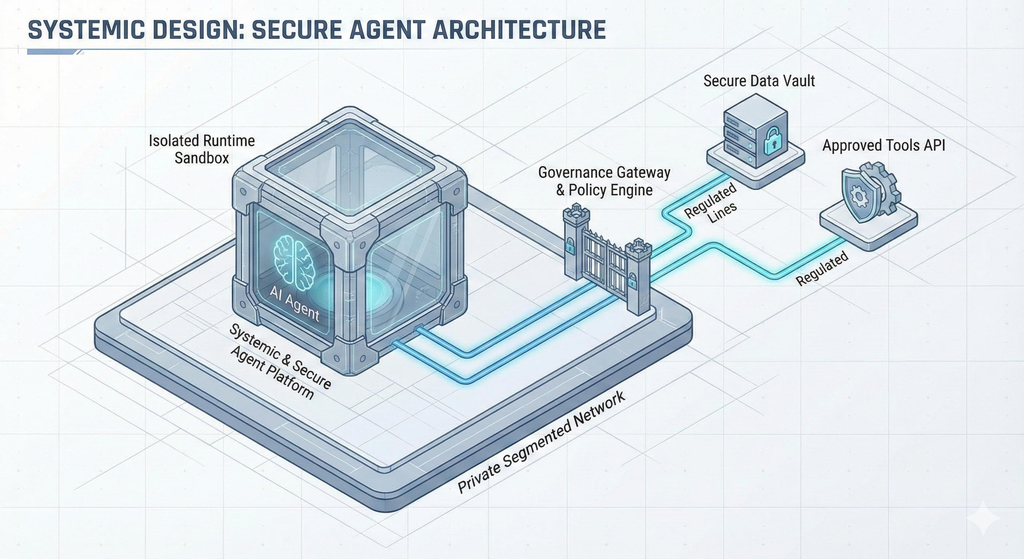
A typical enterprise AI security architecture includes the following components.
5.1 User and Identity Layer
This layer identifies employees, applications, and AI agents.
It verifies who is requesting an action and whether that identity is authorized.
5.2 AI Agent Layer
This layer contains the AI model, agent instructions, reasoning process, task planning, and memory.
Security controls should prevent untrusted information from gaining authority over the agent.
5.3 Policy Enforcement Layer
This layer checks whether an agent is permitted to perform a requested action.
It should independently validate permissions instead of trusting the agent’s own decision.
5.4 Tool and API Gateway
The tool gateway controls access to databases, APIs, cloud services, and external applications.
It should allow only approved tools and operations.
5.5 Data Protection Layer
This layer protects sensitive enterprise information using encryption, data classification, access restrictions, and data loss prevention.
5.6 Monitoring and Audit Layer
This layer records important agent activities and helps security teams detect suspicious behaviour.
5.7 Human Approval Layer
This layer provides an approval mechanism for sensitive or irreversible operations.
These components should work together to provide defence in depth. If one security control fails, other controls should reduce the potential damage.
6. AI Agent Security Frameworks and Standards Enterprises Should Follow in 2026
Enterprises should not create their AI security policies without referring to established cybersecurity guidance.
Several frameworks can help organizations identify risks, establish controls, and measure security performance.
6.1 OWASP Top 10 for Agentic Applications 2026
The OWASP Top 10 for Agentic Applications 2026 is designed to help organizations understand the security risks associated with autonomous AI systems.
It covers threats such as:
- Agent goal hijacking.
- Tool misuse.
- Identity and privilege abuse.
- Agentic supply chain vulnerabilities.
- Unexpected code execution.
- Memory and context poisoning.
- Insecure inter-agent communication.
- Cascading failures.
- Human-agent trust exploitation.
- Rogue agents.
Enterprises can use this framework to build threat models and develop security testing plans. OWASP Gen AI Security Project+1
6.2 NIST AI Risk Management Framework
The NIST AI Risk Management Framework helps organizations identify, assess, manage, and monitor AI-related risks.
Its four main functions are:
- Govern: Establish policies, accountability, and responsibilities.
- Map: Understand the AI system, its context, and potential risks.
- Measure: Evaluate and test identified risks.
- Manage: Apply controls and continuously manage risks.
Enterprises can use this framework to connect AI governance with existing risk management processes.
6.3 MITRE ATLAS
MITRE ATLAS is a knowledge base of adversary tactics and techniques targeting AI-enabled systems.
It helps security teams understand how attackers may exploit AI systems and develop defensive testing strategies.
Organizations can use it during threat modelling, security assessments, and red-team exercises.
6.4 Zero Trust Security Architecture
Zero Trust is particularly useful for enterprises that connect AI agents to multiple internal and external systems.
It ensures that every access request is verified instead of automatically trusting an agent because it operates inside the company network.
6.5 Joint CISA and International Cybersecurity Guidance
In May 2026, CISA and partner cybersecurity agencies published guidance titled Careful Adoption of Agentic AI Services.
The guidance focuses on identifying agentic AI risks, restricting agent autonomy, implementing strong identity controls, and continuously monitoring AI systems.
It is especially useful for organizations deploying AI agents in large or critical environments. NCSC NZ+2
7. Step-by-Step Guide to Implementing AI Agent Security in an Enterprise
Implementing enterprise AI security requires a planned approach.
Businesses should first understand their risks and then introduce security controls before expanding AI agent deployment.
Step 1: Identify All AI Agents
Start by creating an inventory of AI agents operating across the organization.
Include internally developed agents, third-party agents, AI assistants, and automated workflows.
Record their owners, purpose, connected applications, permissions, and data access.
Step 2: Classify Agent Risk Levels
Not every AI agent creates the same level of risk.
A document summarization agent may be low risk, while a financial transaction agent may create high financial and compliance risks.
Classify agents according to their access, autonomy, business impact, and the sensitivity of information they handle.
Step 3: Create Security Policies
Develop policies defining which tasks agents can perform and which activities require approval.
These policies should cover data access, tool usage, authentication, human supervision, and incident response.
Step 4: Implement Identity and Access Controls
Assign unique identities to agents and enforce role-based permissions.
Use short-lived credentials and avoid sharing unrestricted access tokens between agents.
Step 5: Secure Every Integration
Review all connected APIs, databases, cloud applications, and external tools.
Disable unnecessary integrations and restrict each agent to the resources required for its work.
Step 6: Perform Security Testing
Before launching an agent, test it against common attacks.
Check whether it can be manipulated through malicious documents, unauthorized requests, or unsafe tool instructions.
Step 7: Deploy with Limited Autonomy
Start with a limited set of approved tasks.
Monitor the agent’s performance and security behaviour before allowing additional capabilities.
Step 8: Monitor and Improve Security
Review agent activity, access logs, security alerts, and failed authorization attempts.
Update security policies whenever new threats, vulnerabilities, or system changes are identified.
8. Common AI Agent Security Mistakes Enterprises Should Avoid
Many AI security problems happen because organizations focus more on automation and productivity than security.
The following mistakes should be avoided.
- Giving agents administrator access: This creates unnecessary security exposure.
- Trusting every external document: Documents and websites may contain malicious instructions.
- Ignoring API security: Weak API controls can expose connected business applications.
- Sharing credentials between agents: Shared credentials make it difficult to identify and contain compromised agents.
- Storing sensitive information in memory: Poor memory management can create long-term data exposure.
- Allowing unlimited autonomy: Agents should not perform high-impact operations without appropriate controls.
- Ignoring security logs: Without monitoring, suspicious activities may remain undetected.
- Skipping penetration testing: Agents need specific security testing for prompt injection, tool abuse, and memory poisoning.
- Using unverified third-party tools: Insecure integrations can introduce supply chain vulnerabilities.
- Failing to prepare incident response plans: Businesses need a clear process for disabling compromised agents and recovering affected systems.
9. AI Agent Security Checklist for Enterprises in 2026
Organizations can use this checklist to review the security of their AI agents before and after deployment.
Enterprise security review
0/15 completedEvery AI agent has a unique identity.Agent permissions follow the principle of least privilege.Sensitive tools use independent authorization checks.Prompt injection risks have been tested.External documents and websites are treated as untrusted.Sensitive enterprise data is encrypted.Agent memory is isolated and protected.API integrations use secure authentication.Human approval is required for high-impact actions.Code execution takes place in a sandbox.Multi-agent communication is authenticated.Agent activities are continuously monitored.Third-party components are verified.Security testing is included in the development process.AI governance and incident response policies are documented.
Reset checklist
10. Future of AI Agent Security: What Enterprises Should Expect Beyond 2026
AI agents will continue to become more capable and more deeply connected with enterprise applications.
Future AI systems may coordinate entire business departments, manage complex workflows, interact with external organizations, and perform tasks with greater independence.
This will create new security requirements.
10.1 Stronger AI Agent Identity Standards
Businesses will increasingly need dedicated identity systems for AI agents.
These systems will help organizations identify agents, verify their authority, manage their credentials, and track their actions.
10.2 Real-Time Security Enforcement
Security systems will increasingly evaluate agent actions while they are happening.
For example, if an agent suddenly tries to access an unusual database or transfer a large amount of information, the security system may block the action and alert the security team.
10.3 More Advanced AI Red Teaming
Security teams will need to test AI agents against increasingly complex attacks.
Testing will cover prompts, memory, tool permissions, multi-agent communication, and external integrations.
10.4 Better Governance for Autonomous Systems
Organizations will need clearer policies defining what agents can do independently and when human approval is required.
Accountability will become increasingly important as AI agents handle more business-critical tasks.
10.5 Secure Multi-Agent Collaboration
As enterprises adopt agent teams, they will need better methods to authenticate communication, limit delegation, and prevent one compromised agent from affecting an entire workflow.
The future of enterprise AI will not depend only on building smarter agents. It will also depend on making those agents secure, controlled, transparent, and accountable.
11. Conclusion: Build Secure AI Agents Before Scaling Enterprise Automation
AI agents offer enterprises an important opportunity to improve productivity, reduce manual work, and automate complex business processes. However, greater autonomy also creates greater responsibility.
Businesses cannot rely only on AI model safety features or basic cybersecurity tools to protect autonomous systems.
They need a complete security strategy covering identity management, access control, data protection, prompt injection prevention, secure APIs, memory protection, monitoring, and human approval.
The most important AI agent security best practice for enterprises in 2026 is to give AI agents only the access and autonomy they need, while independently verifying every sensitive action.
Start with low-risk applications, conduct regular security testing, monitor agent behaviour, and introduce stronger controls before expanding automation.
Organizations that make security part of their AI development process will be better prepared to use autonomous AI systems safely and build long-term trust with customers, employees, and business partners.
The Cybersecurity Skills I Would Bet My Career on for the Next 5 Years
Frequently Asked Questions (FAQs)
The following FAQs are a separate section from the main article.
1. What is AI agent security?
AI agent security is the process of protecting AI agents from cyberattacks, unauthorized access, data leaks, malicious instructions, and unsafe automated actions.
2. Why is AI agent security important for enterprises in 2026?
It is important because AI agents can access company databases, interact with applications, process confidential information, and perform business operations. Strong security prevents unauthorized activities and protects enterprise resources.
3. What are the biggest AI agent security risks?
The major risks include prompt injection, excessive permissions, identity theft, data leakage, memory poisoning, insecure APIs, unauthorized code execution, and multi-agent communication attacks.
4. How can enterprises prevent AI agent prompt injection attacks?
Enterprises should treat external content as untrusted, validate inputs, restrict tool permissions, implement independent authorization checks, and regularly test agents against prompt injection attacks.
5. What is the principle of least privilege in AI agent security?
It means giving an AI agent only the minimum permissions needed to complete its assigned tasks. This reduces the damage caused by compromised agents.
6. How does Zero Trust improve AI agent security?
Zero Trust verifies every access request instead of automatically trusting an AI agent. It uses identity verification, permission checks, continuous monitoring, and restricted access.
7. What is AI agent memory poisoning?
Memory poisoning occurs when attackers insert malicious or misleading information into an AI agent’s memory. This information can influence future responses and actions.
8. How can businesses protect sensitive data used by AI agents?
Businesses should use encryption, data classification, access controls, data masking, secure memory storage, and regular security monitoring.
9. Should AI agents have administrator access?
No. AI agents should not receive unrestricted administrator access. They should have limited permissions based on their specific responsibilities.
10. What is human-in-the-loop security in AI agents?
Human-in-the-loop security means requiring human review or approval before an AI agent performs sensitive actions such as financial transactions, deleting important records, or modifying critical systems.
11. Which security frameworks should enterprises follow for AI agents?
Enterprises can refer to OWASP Top 10 for Agentic Applications 2026, NIST AI Risk Management Framework, MITRE ATLAS, and Zero Trust security principles.
12. How can enterprises secure multi-agent AI systems?
They should authenticate individual agents, restrict communication, validate messages, limit task delegation, and enforce independent permissions for every agent.
13. What is the role of AI red teaming?
AI red teaming involves simulating attacks against AI systems to identify security weaknesses before attackers can exploit them. It helps detect prompt injection, data leakage, tool misuse, and other vulnerabilities.
14. Can AI agents create cybersecurity threats?
Yes. Poorly secured AI agents can expose confidential information, misuse business applications, execute unauthorized actions, and increase the organization’s attack surface.
15. What is the best way to deploy AI agents securely in an enterprise?
Start with low-risk tasks, implement least-privilege access, secure integrations, test for vulnerabilities, monitor agent activities, and require human approval for high-impact operations.