


Introduction
Many people have great business ideas, but not all ideas become successful businesses. The biggest mistake most beginners make is building a product without checking if people really want it. This leads to wasted time, money, and effort. That is why validating your business idea is very important before starting.
If you are a startup founder, student, or entrepreneur, this guide will help you understand how to test your idea in just 30 days. You do not need a big budget or advanced skills. You only need the right process.
In this article, you will learn step-by-step how to validate your business idea in 30 days. From market research to customer feedback, from building a simple product to testing demand, everything is explained in very simple language. This guide will help you make smarter decisions and reduce risk.
What Is Business Idea Validation?
Before going deeper, let us understand the meaning.
Business idea validation means testing whether your idea can work in the real market.
It answers one important question:
Will people pay for your product or service?
Validation helps you avoid failure by testing before building.
Why Validation Is Important
Many startups fail because they skip validation.
Importance of Validation
Validation helps you in many ways.
It saves time
It saves money
It reduces risk
It gives clarity
It improves success chances
Without validation, you are guessing. With validation, you are testing.
Common Mistakes Without Validation
Many founders make mistakes.
Mistakes
They build full products too early
They assume people will buy
They ignore customer feedback
They focus only on idea, not problem
These mistakes lead to failure.
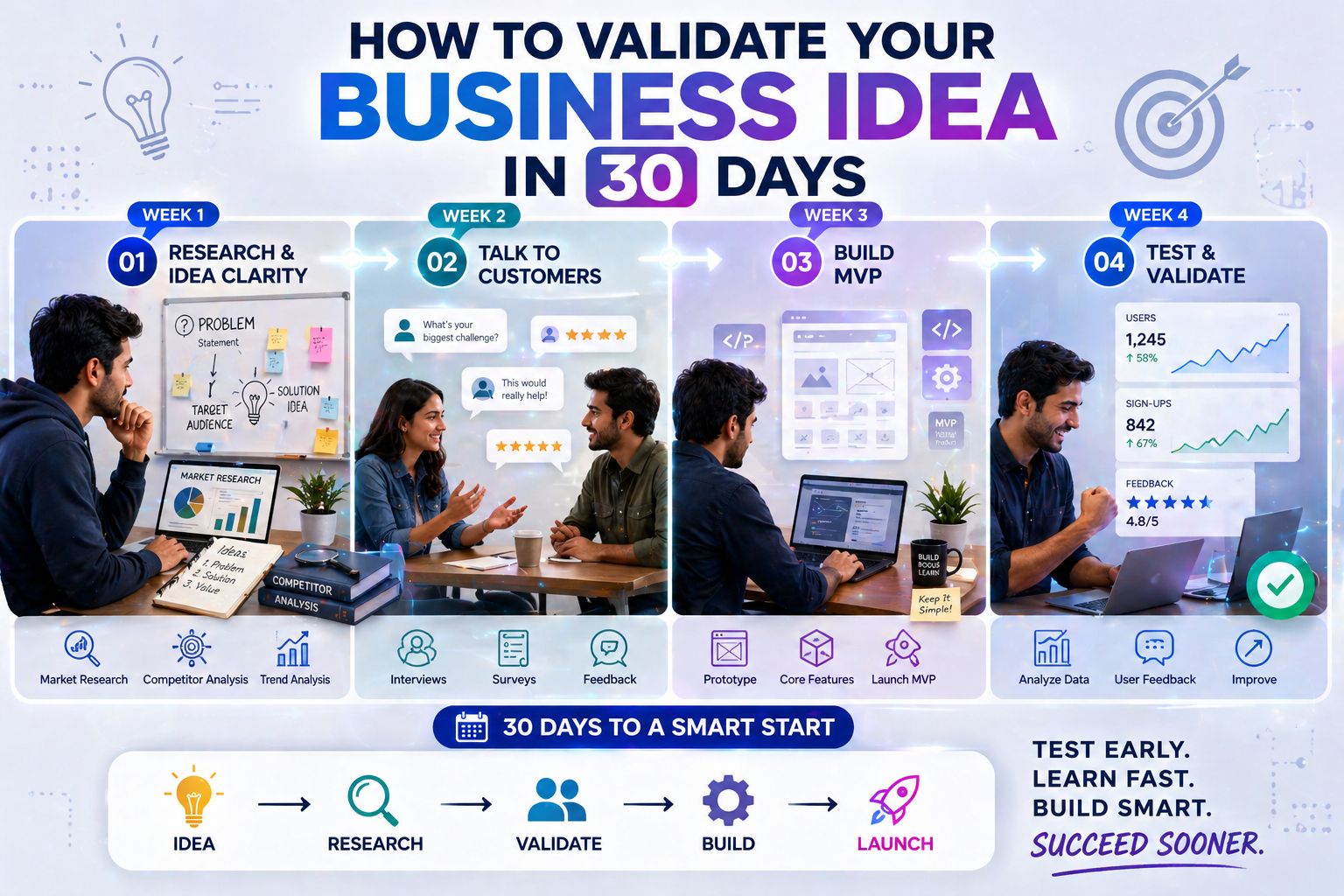
Overview of 30-Day Validation Plan
You do not need months to validate an idea.
You can do it in 30 days.
Weekly Plan
Week 1 – Idea clarity and research
Week 2 – Customer validation
Week 3 – MVP creation
Week 4 – Testing and improvement
This simple plan works for most startups.
Week 1: Idea Clarity and Market Research
The first step is understanding your idea clearly.
Step 1: Define the Problem
Every business solves a problem.
What You Should Do
Write the problem clearly
Identify who faces this problem
Understand why it matters
If there is no problem, there is no business.
Step 2: Identify Target Audience
You must know your customers.
What You Should Do
Define age group
Define location
Define needs
Define behavior
Clear audience means better validation.
Step 3: Analyze Competitors
Competition is not bad. It is proof of demand.
What You Should Do
Search similar businesses
Study their products
Check pricing
Read customer reviews
Learn what works and what does not.
Step 4: Define Your Unique Value
Your idea must be different.
What You Should Do
Identify what makes your idea unique
Solve problem better or faster
Offer something new
This is your value proposition.
Week 2: Customer Validation
Now you test your idea with real people.
Step 5: Talk to Potential Customers
This is the most important step.
What You Should Do
Ask questions about their problems
Understand their needs
Do not sell, just learn
Real feedback is more valuable than assumptions.
Step 6: Conduct Surveys
Surveys help collect data.
What You Should Do
Use simple questions
Keep it short
Focus on problem and solution
This gives you insights.
Step 7: Validate Willingness to Pay
People may like your idea but not pay.
What You Should Do
Ask if they will pay
Ask how much they will pay
Test pricing
If no one pays, the idea is weak.
Week 3: Build MVP (Minimum Viable Product)
Now you build a simple version of your idea.
What Is MVP?
MVP is a basic version of your product.
It solves the main problem.
Step 8: Create Simple Product
You do not need perfection.
What You Should Do
Build basic features
Focus on core solution
Keep it simple
This saves time and money.
Step 9: Create Landing Page
A landing page helps test interest.
What You Should Do
Explain your idea
Show benefits
Add sign-up form
This helps measure demand.
Step 10: Start Marketing
You need visibility.
What You Should Do
Use social media
Share in communities
Run small ads
This brings users.
Week 4: Test and Improve
Now you test your MVP.
Step 11: Track User Behavior
You must understand how users interact.
What You Should Do
Track sign-ups
Track usage
Track feedback
Data helps in decisions.
Step 12: Collect Feedback
Feedback is gold.
What You Should Do
Ask users what they like
Ask what they do not like
Ask what to improve
Use feedback to improve.
Step 13: Analyze Results
Now review everything.
What You Should Do
Check demand
Check user interest
Check revenue potential
This shows if your idea works.
Step 14: Decide Next Step
After validation, take a decision.
Possible Decisions
Proceed with idea
Improve idea
Change idea
Drop idea
This is the final outcome.
Tools You Can Use for Validation
You do not need expensive tools.
Useful Tools
Google Forms for surveys
Social media for feedback
Landing page builders
Analytics tools
Email marketing tools
These tools are simple and effective.
Signs Your Idea Is Validated
You need clear signals.
Validation Signs
People show interest
Users sign up
Customers are ready to pay
Positive feedback
Repeat usage
These signs show success.
Signs Your Idea Is Not Working
Sometimes ideas fail.
Warning Signs
No interest
No sign-ups
Negative feedback
No willingness to pay
In such cases, change your idea.
How to Improve Your Idea
If your idea is weak, improve it.
Improvement Tips
Focus on real problem
Simplify solution
Improve value
Adjust pricing
Listen to customers
Iteration is key.
Business Idea Validation Examples
Let us understand with examples.
Example 1: Online Course
Test demand with landing page
Collect emails
Launch course if interest is high
Example 2: SaaS Tool
Build simple version
Offer free trial
Check user engagement
Example 3: Service Business
Offer service manually
Get feedback
Automate later
Benefits of Validating Your Idea
Validation gives many advantages.
Benefits
Reduces failure risk
Saves resources
Builds confidence
Improves product
Increases success rate
Challenges in Validation
Validation is not always easy.
Challenges
Getting honest feedback
Finding right audience
Limited data
Time pressure
But these can be managed.
Why 30-Day Validation Works
You do not need long time.
Advantages
Fast decision making
Low cost
Quick feedback
Early learning
Speed is important in startups.
Mistakes to Avoid
Avoid these mistakes.
Common Mistakes
Skipping customer research
Building full product early
Ignoring feedback
Overthinking
Not testing pricing
These can harm your startup.
Future of Idea Validation
Validation methods are evolving.
Future Trends
AI-based validation tools
Data-driven decisions
Faster testing methods
Automation
Validation will become easier.
Why Entrepreneurs Must Validate Ideas
Validation is not optional.
Importance
It protects investment
It increases success
It builds strong foundation
Every successful startup validates ideas.
Conclusion
Validating your business idea in 30 days is possible if you follow the right steps. You do not need a big budget or complex tools. You only need clarity, feedback, and testing.
By following this guide, you can reduce risk and increase your chances of success. Always focus on solving real problems and understanding your customers.
Do not build first. Validate first.
This is the smartest way to build a successful startup.
Read More Blog–Topics in AI & Machine Learning (2026 Guide)
Frequently Asked Questions (FAQs)
1. What is business idea validation?
It is testing whether your idea will work in the market.
2. Can I validate in 30 days?
Yes, with the right process.
3. Do I need money for validation?
No, you can start with low cost.
4. What is MVP?
It is a basic version of your product.
5. How do I know my idea is good?
If people show interest and are ready to pay.
6. What if my idea fails?
You can improve or change it.
7. Why is validation important?
It reduces risk and increases success chances.