


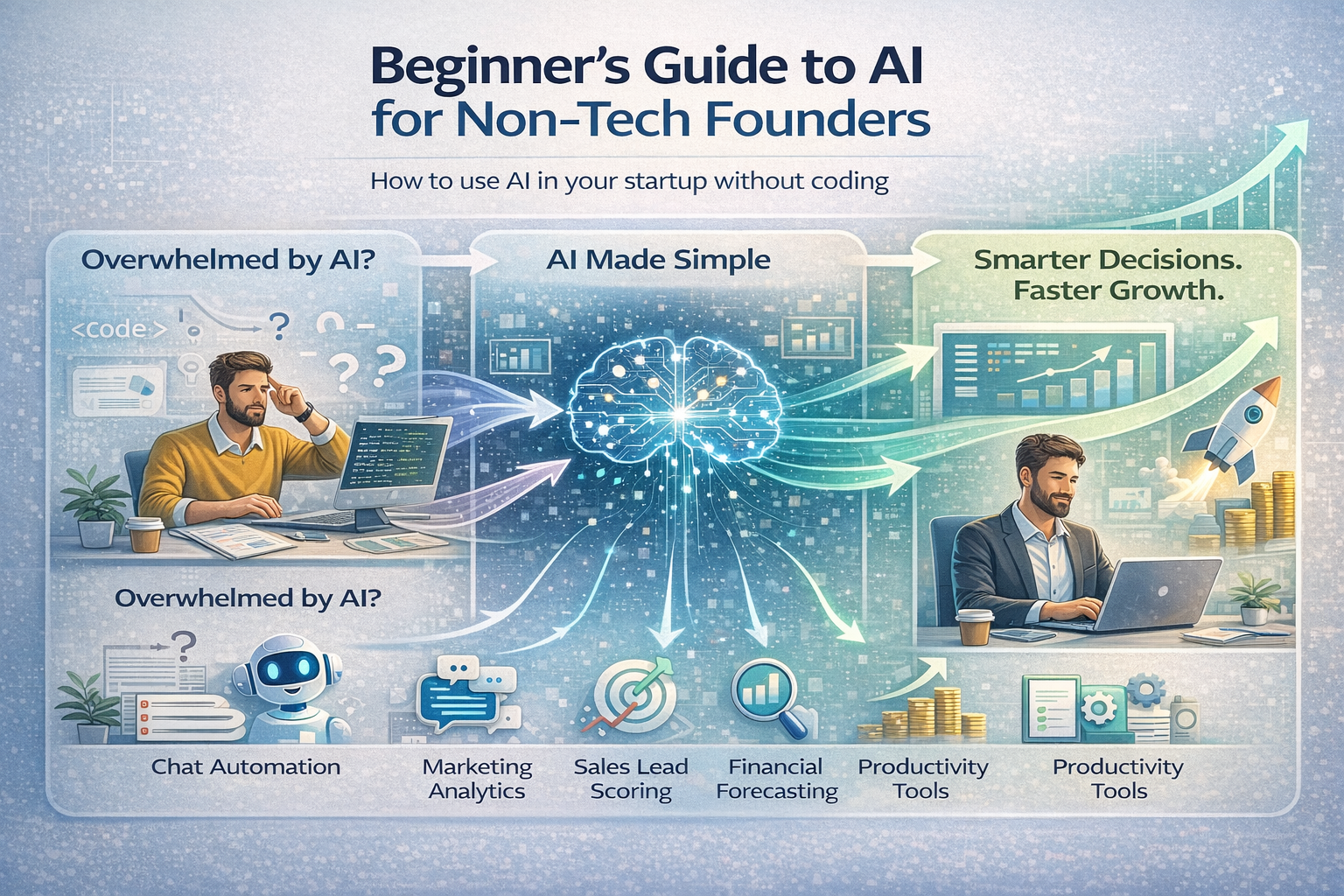
Many startup founders come from business, marketing, finance, or creative backgrounds. They have strong ideas and leadership skills, but they often feel confused when it comes to artificial intelligence. AI sounds complex, technical, and expensive. Because of this, many non-tech founders believe AI is only for developers or large tech companies.
The truth is different. AI is becoming simple, practical, and accessible. You do not need to know coding to use AI in your startup. Today, AI tools can automate tasks, improve decision-making, increase productivity, and reduce costs without requiring technical expertise.
This beginner’s guide to AI for non-tech founders explains everything in simple language. You will learn what AI really means, how it works in business, where to use it first, common mistakes to avoid, and how to start without feeling overwhelmed. By the end, you will understand how AI can help you grow smarter, not harder.
What Is Artificial Intelligence in Simple Terms?
Artificial Intelligence, or AI, is technology that allows machines to perform tasks that normally require human thinking.
These tasks include:
- Understanding language
- Analysing data
- Recognising patterns
- Making predictions
- Automating decisions
AI does not mean robots replacing people. In startups, AI mostly works behind the scenes through software tools.
Why Non-Tech Founders Should Care About AI
AI is no longer optional in modern business.
Non-tech founders should care about AI because it helps:
- Save time
- Reduce manual work
- Improve decisions
- Lower costs
- Increase efficiency
AI gives small teams the power of larger organisations.
Common Myths About AI
Many founders avoid AI because of misunderstandings.
Myth 1: You Need Coding Skills
You do not need programming knowledge to use most AI tools today.
Many AI platforms are:
- No-code
- User-friendly
- Designed for business users
Myth 2: AI Is Too Expensive
Many AI tools offer:
- Free plans
- Affordable monthly subscriptions
- Pay-as-you-grow pricing
AI often reduces costs instead of increasing them.
Myth 3: AI Will Replace Your Team
In startups, AI supports teams by handling repetitive work.
It helps people:
- Focus on creative tasks
- Improve productivity
- Reduce burnout
How AI Actually Works in a Startup
AI works by analysing data and learning patterns.
For example:
- AI studies customer behaviour
- It identifies trends
- It predicts future actions
- It suggests improvements
The more data AI processes, the smarter it becomes.
Key Areas Where Non-Tech Founders Can Use AI
AI can support almost every part of a startup.
1. Marketing Automation
Marketing requires constant effort.
AI can help by:
- Generating content ideas
- Optimising ads
- Personalising emails
- Analysing campaign performance
Marketing becomes more efficient and measurable.
2. Sales Support
Sales teams spend time on follow-ups and lead qualification.
AI helps by:
- Scoring leads
- Prioritising prospects
- Automating follow-up emails
This increases conversion rates.
3. Customer Support
Startups often receive repetitive questions.
AI chat systems can:
- Answer FAQs
- Handle simple queries
- Route complex issues to humans
Response time improves instantly.
4. Data and Reporting
Many founders struggle with scattered data.
AI dashboards:
- Combine data from multiple tools
- Provide real-time insights
- Highlight performance trends
Decision-making becomes faster.
5. Financial Planning
Financial clarity is essential.
AI tools can:
- Forecast revenue
- Track expenses
- Predict cash flow
- Monitor burn rate
This reduces financial stress.
6. Productivity and Task Management
Founders often feel overwhelmed.
AI tools help:
- Organise tasks
- Automate reminders
- Summarise meetings
- Improve workflow efficiency
Time is used more wisely.
Step-by-Step Plan to Start Using AI
Starting with AI does not need to be complicated.
Step 1: Identify Repetitive Tasks
Look at tasks that:
- Repeat daily
- Take too much time
- Do not require creativity
These are ideal for AI automation.
Step 2: Choose One Area Only
Do not try to automate everything at once.
Start with:
- Marketing
- Sales
- Support
- Reporting
Focus on one area first.
Step 3: Use Simple AI Tools
Choose tools that:
- Have clear dashboards
- Offer tutorials
- Provide customer support
- Do not require coding
Keep it simple.
Step 4: Measure Results
Track:
- Time saved
- Cost reduction
- Increased output
- Better performance
Small improvements build confidence.
Step 5: Expand Gradually
Once you see success:
- Automate another process
- Improve data usage
- Introduce predictive tools
AI adoption should be gradual.
Benefits of AI for Non-Tech Founders
When used correctly, AI offers clear advantages.
These include:
- Reduced operational workload
- Better decisions
- Faster growth
- Improved team productivity
- Lower customer acquisition cost
AI acts as a smart assistant.
Common Mistakes to Avoid
AI can fail if implemented poorly.
Avoid these mistakes:
Mistake 1: Using Too Many Tools
Too many tools create confusion.
Focus on tools that solve real problems.
Mistake 2: Ignoring Data Quality
AI depends on clean data.
Ensure your data is:
- Accurate
- Updated
- Structured
Mistake 3: Expecting Instant Results
AI improves over time.
Be patient and optimise gradually.
Mistake 4: Not Training Your Team
AI adoption requires:
- Awareness
- Training
- Clear communication
Team support is critical.
How AI Supports Founder Decision-Making
AI helps founders:
- See real-time performance
- Identify risks early
- Forecast growth
- Prioritise actions
It reduces decision fatigue.
Building an AI-First Mindset
AI is not only about tools. It is about mindset.
Non-tech founders should:
- Stay curious
- Experiment safely
- Focus on learning
- Embrace data-driven thinking
Mindset determines success.
The Future of AI for Non-Tech Founders
AI will become even more accessible.
In the future:
- AI will be integrated into most software
- Automation will be standard
- Data-driven growth will be expected
Founders who learn early will lead.
Final Thoughts
Artificial intelligence is not only for engineers or large corporations. It is a practical tool for everyday startup operations. Non-tech founders can use AI to automate repetitive work, improve marketing, support sales, manage finances, and make smarter decisions.
The key is to start small, stay focused, and grow gradually. AI should support your vision, not complicate it. With the right approach, AI becomes a powerful partner in building a smarter, more efficient, and more scalable startup.
Read More Blog-AI Startup Edge Playbook: From Automation to Growth
Frequently Asked Questions (FAQs)
1. Do I need technical knowledge to use AI?
No. Many AI tools are designed for non-technical users.
2. Is AI safe for startups?
Yes, if data privacy and security are managed properly.
3. How much does AI cost?
Costs vary, but many tools are affordable.
4. Can AI replace employees?
AI supports teams by handling repetitive tasks.
5. What is the best way to start?
Begin with one small automation project.






Comments are closed