

Artificial intelligence is changing how people work, build software, manage businesses, and solve difficult problems. Google has introduced Gemini 4 Argon, a powerful AI model designed to handle complex tasks that require more than a quick answer. It focuses on areas such as software development, scientific research, cybersecurity, financial analysis, and legal work. Unlike a basic chatbot that mainly answers questions, Gemini 4 Argon is designed to work through multiple steps, understand large amounts of information, and help complete demanding projects. This makes it an important development for developers, startups, researchers, and business owners who want to use AI in practical ways. In this article, you will learn what Gemini 4 Argon is, how it works, its main features, pricing, availability, benefits, and limitations. You will also discover how businesses and everyday users may benefit from this new generation of artificial intelligence.
1. What Is Gemini 4 Argon?
Gemini 4 Argon is an advanced artificial intelligence model developed by Google DeepMind. It belongs to Google’s Gemini family of AI models and is designed for demanding professional and technical tasks.
Google announced the model in September 2026 and expanded its availability globally on October 13, 2026. It is intended to help people solve problems that need careful reasoning, technical knowledge, and several connected steps.
For example, a simple AI tool may help you write a short email. Gemini 4 Argon is designed for more complicated work, such as understanding a large software project, identifying a programming issue, suggesting a fix, and helping test the result.
It can also work with documents, images, audio, and video as inputs, depending on the task and the application being used.
The model is especially relevant to people who need AI to do more than generate text. It is built to support complete workflows, where different tasks depend on earlier information and decisions.
Why Is Gemini 4 Argon Important?
The main reason is its focus on complex, real-world work.
Many businesses already use AI to write content, answer customer questions, and summarize documents. However, more advanced work often requires an AI system to understand context, compare information, identify problems, and follow a process from beginning to end.
Gemini 4 Argon aims to improve this type of work.
Its potential benefits include the following:
- Helping developers understand and improve large codebases.
- Supporting researchers who need to analyze complicated scientific information.
- Helping businesses process documents and organize information.
- Assisting cybersecurity professionals with finding software weaknesses.
- Supporting financial and legal research.
- Helping AI agents complete longer, multi-step tasks.
These capabilities do not mean that the model is always correct or can replace qualified professionals. They mean it can act as a powerful assistant for work that normally takes considerable time and effort.
2. Key Features of Gemini 4 Argon
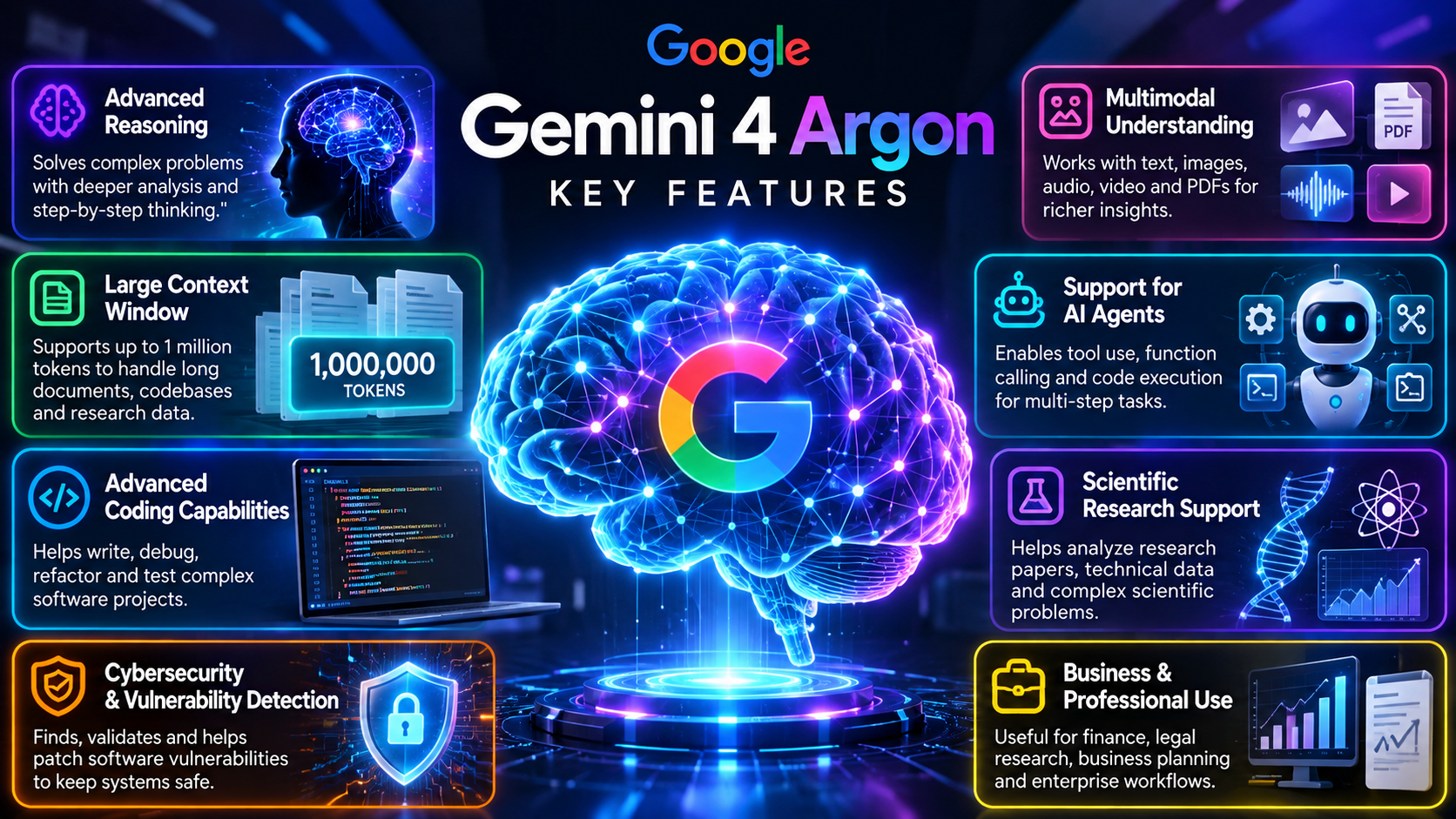
Gemini 4 Argon includes several capabilities that make it useful for technical work, research, and business operations. Its most important features focus on reasoning, understanding large amounts of information, working with different media types, and supporting AI-powered tools.

2.1 Advanced Reasoning
Reasoning means working through information step by step to reach a useful answer or solution.
Gemini 4 Argon is designed to handle problems that require deeper analysis than a simple question-and-answer task. It can compare different approaches, examine conditions, and help develop a solution.
For example, a startup founder might ask it to analyze why a software product is losing customers. Instead of simply suggesting more marketing, the model could help examine customer feedback, product issues, pricing, and sales information.
Its value depends on the quality of the information provided and how well the task is defined.
2.2 Large Context Window
One of the most notable features of Gemini 4 Argon is its unified context limit of approximately one million tokens. Tokens are small units of text or other information that AI models process.
This large context window helps the model work with extensive information without requiring the user to divide every project into many small pieces.
For example, a developer could provide substantial documentation and code excerpts from a large application. A researcher could work with a collection of papers, while a business team could analyze several long reports.
However, a large context window does not guarantee perfect recall or equal understanding of every detail. The quality of the response still depends on the material, the task, and the model’s reasoning.
2.3 Advanced Coding Capabilities
Gemini 4 Argon is designed to help with complicated programming tasks, including understanding existing software, identifying errors, refactoring code, and improving software systems.
Refactoring means changing the structure of code to make it easier to maintain without unnecessarily changing what the program does.
Developers may use the model to understand unfamiliar projects, review code, create tests, and plan improvements. Google has also reported that its engineering teams used Argon through Antigravity to increase agentic code submissions by more than 35% while reducing code rollbacks by nearly one-third. These are Google’s reported internal results, not a guarantee of the same improvements for every developer.
2.4 Cybersecurity and Vulnerability Detection
Cybersecurity is one of the most important areas for Gemini 4 Argon.
Software vulnerabilities are weaknesses that attackers may use to gain unauthorized access, expose private information, or disrupt a system. Finding these problems before attackers exploit them can help protect businesses and their customers.
Google says Argon can autonomously find, validate, and patch critical software vulnerabilities. It is also available to selected cybersecurity defenders through the Fairwind Program, which provides specialized access for defensive security work.
The model achieved a reported score of 68% on CWE-bench v1, a benchmark for vulnerability remediation. This result indicates strong performance on that evaluation, but it does not mean the model can identify or fix every security problem.
2.5 Multimodal Understanding
Multimodal AI can process more than one type of information.
Gemini 4 Argon supports text, images, audio, video, and PDF inputs. This makes it useful for tasks where information comes from different sources rather than a single text document. Its standard output is text, so users should not assume that it natively generates images or audio.
For example, a user might ask the model to:
- Explain a chart included in a report.
- Summarize a PDF containing technical information.
- Analyze relevant details from a video.
- Compare written notes with information shown in an image.
- Extract important findings from a collection of documents.
These features can reduce the amount of manual work needed to collect and understand information.
2.6 Support for AI Agents
An AI agent is a system that uses AI to perform a sequence of tasks toward a goal. Depending on its configuration, it may use tools, inspect files, execute code, and check results along the way.
Gemini 4 Argon supports agent-related capabilities such as function calling, code execution, and computer use in preview. These capabilities allow developers to build applications that do more than return a single text response.
For example, an AI agent for a software team might review a task, inspect relevant files, suggest a code change, run permitted tests, and prepare a report.
The important point is that an agent’s abilities depend on its tools, permissions, instructions, and safeguards. The model itself does not automatically have access to every application or account.
3. How Does Gemini 4 Argon Work?
Gemini 4 Argon processes the information a user provides and generates responses based on patterns learned during training, the current context, and its reasoning capabilities.
In more advanced applications, it can also use tools to help complete tasks.
The process generally involves several stages.
Step 1: Understand the request. The model receives a question, instructions, documents, or other supported inputs. It identifies the goal and the information needed to work on it.
Step 2: Analyze the available information. It examines relevant details, identifies relationships, and considers possible approaches.
Step 3: Work through the task. Depending on the application, it can develop a plan, write code, call an authorized tool, or perform other supported operations.
Step 4: Produce a result. It returns an answer, a proposed solution, a summary, or other supported output.
Step 5: Review and improve. When tools and suitable instructions are available, the surrounding workflow can test results, identify problems, and request corrections.
This process can make Gemini 4 Argon useful for long tasks that require several connected steps. However, users should understand that AI reasoning is not a guarantee of truth. Important results still need appropriate checking, particularly in security, science, law, and finance.
4. Gemini 4 Argon vs. Traditional AI Chatbots
Traditional chatbots are often designed for relatively simple interactions. They answer questions, generate content, summarize text, and assist with everyday tasks.
Gemini 4 Argon is designed to handle more demanding work, including complex programming, scientific analysis, and longer workflows.
The following table explains the general difference.
| Feature | Traditional AI chatbot | Gemini 4 Argon |
|---|---|---|
| Simple questions | Suitable | Suitable |
| Content writing | Common use | Supported |
| Large documents | Depends on the model | Large context support |
| Complex coding | Varies by model | A major focus |
| Scientific research | Varies by model | A major focus |
| Multi-step workflows | Depends on tools | Designed for complex tasks |
| Cybersecurity analysis | Depends on capabilities | A major focus |
| Tool integration | Depends on the application | Supported through API capabilities |
This is a general comparison, not a claim that every traditional chatbot performs poorly. Other advanced AI models can also handle coding, reasoning, and agentic workflows.
The best choice depends on your requirements, budget, preferred tools, and the results you get from testing.
5. How Gemini 4 Argon Can Help Startups
Startups often work with limited budgets and small teams. Founders may need to handle product development, customer support, marketing, research, and business planning at the same time.
Gemini 4 Argon may help startups reduce some of this workload when it is used carefully.

Software Development
A startup building a website, mobile application, or software product can use the model to explain code, identify potential errors, create tests, and explore technical solutions.
This may help a small development team work more efficiently. However, production code still requires testing, security reviews, and human oversight.
Business Research
Founders need to understand their market before investing time and money. AI can help organize research notes, compare business models, summarize reports, and prepare questions for customer interviews.
The quality of the research depends on the sources provided and whether important claims are independently verified.
Marketing and Content Creation
Startups can use Gemini 4 Argon to organize content plans, draft marketing materials, summarize customer feedback, and develop campaign ideas.
For an AI startup blog, for example, it could help structure an article about emerging AI tools, explain technical terms, and prepare a draft for editorial review.
AI-generated content should still be checked for originality, factual accuracy, usefulness, and brand voice.
Customer Support
Businesses can build AI-powered support systems that classify customer questions, retrieve approved information, and prepare responses.
A well-designed system can handle routine questions more quickly while directing complex or sensitive cases to a human employee.
Business Planning
The model can help organize business goals, identify possible risks, compare options, and prepare planning documents.
It should support decision-making rather than replace it. Founders should verify financial calculations, market assumptions, and important business commitments before acting on them.
6. Gemini 4 Argon for Developers
Developers are among the main audiences for Gemini 4 Argon because of its focus on complex engineering tasks.
The model is available through Google’s developer ecosystem, including the Gemini API and Google AI Studio. It can also be used with Google’s Antigravity development environment under the applicable access arrangements.
Here are some practical ways developers may use it.
1. Code explanation: Understand unfamiliar functions, classes, and software architecture.
2. Debugging assistance: Investigate error messages and explore possible causes.
3. Code refactoring: Improve code organization and maintainability.
4. Test creation: Draft unit tests and suggest additional edge cases.
5. Documentation: Turn technical notes into clearer project documentation.
6. Code review: Identify possible bugs, design problems, and security concerns.
7. Development planning: Break a large feature into smaller tasks and implementation steps.
Before using AI-generated code in a live application, developers should review it, run suitable tests, check dependencies, and examine security implications. AI can speed up development, but it cannot guarantee that code is correct, efficient, or safe.
7. Gemini 4 Argon Pricing
Pricing is an important factor for developers, startups, and businesses that plan to use Gemini 4 Argon regularly.
Google announced introductory API pricing for the public model at $2 per million input tokens and $10 per million output tokens. The introductory prices are scheduled to apply through November 30, 2026. After that period, the announced rates are $4 per million input tokens and $20 per million output tokens. Cached input tokens receive a 95% discount under the announced pricing structure.
Introductory API pricing
$2
Per 1 million input tokens
$10
Per 1 million output tokens
Announced standard rates after November 30, 2026: $4 per million input tokens and $20 per million output tokens.
What Are Input and Output Tokens?
Input tokens represent the information sent to the model, including prompts and supported content processed by the API. Output tokens represent the content the model generates.
For example, if an application sends a long technical report to Gemini 4 Argon and asks for a detailed analysis, the input and generated answer both contribute to usage costs.
The final cost depends on how much information the application processes and how much content the model generates.
How Can Startups Control Costs?
Startups should estimate their expected usage before integrating the model into a product. The following practices can help keep spending under control.
- Use shorter, more focused prompts when possible.
- Avoid repeatedly sending unnecessary background information.
- Use supported caching features where appropriate.
- Monitor token consumption and API spending.
- Test the model on realistic tasks before scaling up.
- Set suitable usage limits and alerts in the surrounding application.
The API price is not the same as the total cost of running an AI product. Infrastructure, storage, other tools, development, monitoring, and human review may create additional expenses.
8. How to Access Gemini 4 Argon
Gemini 4 Argon is available through several Google products, but the access method depends on whether you are an everyday user, a developer, or an enterprise customer.
According to Google’s October 13, 2026 announcement, the model is available globally through supported developer and business services, with access for eligible subscribers in the Gemini app and AI Mode in Search.

Option 1: Use the Gemini App
Everyday users can check the Gemini app to see whether Gemini 4 Argon is available under their account and subscription.
To get started:
- Visit the official Google Gemini website at gemini.google.com.
- Sign in with your Google account.
- Check the available model options.
- Select Gemini 4 Argon if your account has access to it.
- Enter a question or task and review the response.
Availability may depend on the subscription, account, region, and Google’s rollout policies.
Option 2: Use Google AI Studio
Developers can explore the model through Google AI Studio.
This option is useful for experimenting with prompts, testing responses, and exploring how the model might fit into an application.
Developers should check the current usage limits, account requirements, and billing arrangements before using it for substantial workloads.
Option 3: Use the Gemini API
The Gemini API documentation provides technical information for developers who want to integrate the model into software.
The published model ID is gemini-4-argon.
The API can be useful for building applications such as research assistants, coding tools, document-analysis systems, and AI agents.
Option 4: Use Google Cloud
Businesses can explore Gemini 4 Argon through Google Cloud, subject to the supported services and account arrangements.
This route may be appropriate for organizations that need managed infrastructure, enterprise workflows, or integration with existing business systems.
Before choosing an access method, compare pricing, privacy requirements, available tools, and usage limits.
9. Gemini 4 Argon in Cybersecurity
Cybersecurity deserves special attention because advanced AI can help defenders find software weaknesses faster, but it can also create new security challenges.
Google has developed Gemini 4 Argon with a strong focus on defensive cybersecurity. The model is designed to identify vulnerabilities, validate findings, and assist with software fixes. Selected defenders can access a version without cyber guardrails through the Fairwind Program.
How Can It Help Security Teams?
Security teams may use advanced AI to review code, examine suspicious behavior, understand vulnerabilities, and prioritize potential problems.
For example, a security team maintaining a business website could use AI assistance to examine a section of source code and identify patterns that deserve further review.
A developer can then investigate the finding, confirm whether it is a real weakness, and apply a suitable correction.
This can be valuable when a company manages a large application with many dependencies and frequent updates.
Why Human Review Still Matters
Security findings must be validated before a team makes changes to a live system. An incorrect fix may introduce new problems, and an apparently harmless code change can affect other parts of an application.
Organizations should combine AI assistance with controlled testing, access restrictions, code review, backups, and established security procedures.
AI should be used only on systems that the user or organization is authorized to test.
10. Gemini 4 Argon for Science and Research
Scientific research often requires people to examine large amounts of information, compare results, and identify relationships that may not be immediately obvious.
Gemini 4 Argon is designed to support demanding scientific and mathematical tasks. Its ability to process large amounts of context can be useful when researchers need to work with technical documents, experimental observations, or related research materials.
Possible applications include:
- Summarizing scientific papers and technical reports.
- Organizing findings from multiple research documents.
- Helping researchers write and review analysis code.
- Exploring mathematical problems.
- Comparing experimental observations.
- Preparing research notes and explanations.
For example, a researcher could provide several scientific papers and ask the model to compare their methods, findings, and limitations.
The researcher would still need to examine the original sources and confirm every important claim. AI-generated explanations are useful starting points, but they are not a substitute for scientific evidence, controlled experiments, or expert judgment.
In medicine and other high-stakes research fields, outputs should be handled according to the relevant professional, legal, and safety requirements.
11. Gemini 4 Argon for Finance and Legal Work
Finance and legal work often involves lengthy documents, detailed rules, and decisions that can have serious consequences.
Gemini 4 Argon is designed to support knowledge-intensive tasks in both areas.
Finance
Financial teams may use AI to organize reports, summarize business information, compare assumptions, and prepare preliminary analyses.
For example, a business owner could ask the model to organize revenue and expense information into categories before reviewing the company’s performance.
However, users must check calculations, confirm data sources, and protect confidential information. The model should not be treated as a guaranteed source of financial advice or a replacement for qualified professionals.
Legal Work
Legal professionals may use AI assistance to summarize lengthy documents, compare contract clauses, organize research notes, and prepare initial drafts.
A lawyer might ask the model to identify differences between two versions of a contract and highlight clauses that need closer attention.
The lawyer must still verify the wording, applicable law, citations, and legal interpretation. An AI-generated answer can contain errors or overlook important details.
These applications are most useful when the model supports a professional’s work rather than making final decisions independently.
12. Limitations of Gemini 4 Argon
Gemini 4 Argon has advanced capabilities, but no AI model is perfect. Understanding its limitations is important before using it for professional or business tasks.
It Can Make Mistakes
The model may provide incorrect facts, flawed calculations, or code that does not work as expected. A detailed answer can still be wrong.
Users should verify important information against reliable sources.
Advanced Features May Require Payment
API usage can create costs, and access through consumer or business products may require an eligible subscription. The best access option depends on the user’s needs and budget.
It Needs Clear Instructions
Vague requests can produce general or incomplete results. Users often get better outcomes when they explain their goals, provide relevant information, and define the expected format.
It Does Not Automatically Know Everything
A large context window does not mean the model has access to every document, private database, or current event. Access to external information depends on the tools and permissions available in the application.
Sensitive Information Requires Care
Businesses should follow appropriate privacy and security policies when sharing customer records, financial data, confidential documents, or source code.
They should understand the applicable data-handling terms before sending sensitive information to an AI service.
It Does Not Replace Professional Judgment
Legal, financial, scientific, and security decisions may require specialized expertise. The model can support analysis, but important decisions need appropriate human oversight.
These limitations do not make the model useless. They show why AI works best when combined with clear instructions, reliable information, testing, and responsible use.
13. Is Gemini 4 Argon Better Than Other AI Models?
Whether Gemini 4 Argon is better than another AI model depends on the task you want to complete.
Google presents Argon as a frontier model for complex reasoning, software engineering, professional workflows, and cybersecurity. However, competing models may offer different strengths, prices, integrations, and levels of performance.
For example, a developer might compare Gemini 4 Argon with other advanced coding models by testing them on the same software project. A business could compare how accurately different models summarize reports or extract information from contracts.
The most useful comparison should consider several factors:
- Accuracy: Does the model produce correct and useful results?
- Reasoning: Can it handle complex problems?
- Coding: Does it write, explain, and improve code effectively?
- Context: Can it process the information required for the task?
- Speed: Does it respond quickly enough for your workflow?
- Cost: Is the performance worth the total expense?
- Integration: Does it work with your existing applications?
- Security: Does it meet your privacy and safety requirements?
Rather than choosing a model only because of its name or benchmark scores, test it with real tasks from your work. This gives you a more practical understanding of which tool fits your needs.
14. The Future of AI After Gemini 4 Argon
Gemini 4 Argon represents a broader movement toward AI systems that can assist with complete tasks instead of simply generating answers.
In the coming years, AI tools may become more useful for coordinating workflows, analyzing large amounts of information, assisting software teams, and supporting specialized research.
For startups, this could mean faster product development and more efficient business operations. For researchers, it could mean easier access to information and better support for complex analysis. For developers, it could mean spending less time on repetitive tasks and more time on system design and problem-solving.
However, these improvements will depend on how reliably AI systems perform in real situations.
Businesses will need to consider data protection, accountability, accuracy, operating costs, and the possibility of errors. They will also need employees who know how to evaluate AI-generated work rather than accept every response without checking it.
The most successful approach is likely to combine advanced AI capabilities with human expertise, careful testing, and clear business goals.
Conclusion
Gemini 4 Argon is Google’s advanced AI model designed for complex software engineering, scientific research, cybersecurity, and professional knowledge work. Its large context window, reasoning capabilities, multimodal inputs, and support for tool-based workflows make it an important option for developers, startups, researchers, and businesses.
The model can help users analyze information, improve code, organize documents, and build applications that complete multiple connected tasks. Google has also reported promising results in engineering productivity and cybersecurity testing.
However, its capabilities should not be confused with perfect accuracy or complete independence. Human review, testing, privacy protection, and responsible use remain essential.
If you are considering Gemini 4 Argon for your work, begin with a small, well-defined task. Compare its results with your current tools, check the total cost, and expand its use only when it delivers clear value.
For startups and businesses exploring AI automation, the biggest opportunity is not simply using a more powerful model. It is using that model to solve real problems, improve existing processes, and give people more time to focus on meaningful work.
Read More Blogs-AI Startup Edge
Frequently Asked Questions About Gemini 4 Argon
1. What is Gemini 4 Argon?
Gemini 4 Argon is an advanced AI model developed by Google DeepMind. It is designed for complex reasoning, coding, scientific research, cybersecurity, and professional workflows.
2. Is Gemini 4 Argon available now?
Yes. Google announced global availability on October 13, 2026, through supported developer, enterprise, and consumer services. Exact access depends on the product, account, and subscription.
3. Is Gemini 4 Argon free to use?
Access depends on the platform and account. API usage has published per-token charges, while access through the Gemini app and other Google products depends on the applicable subscription and eligibility.
4. How much does Gemini 4 Argon cost?
The announced introductory API price is $2 per million input tokens and $10 per million output tokens through November 30, 2026. The announced standard rates afterward are $4 and $20 per million tokens, respectively.
5. What is the context window of Gemini 4 Argon?
Gemini 4 Argon supports a unified context window of up to 1,048,576 tokens, or approximately one million tokens. This helps it process large amounts of information in supported workflows.
6. Can Gemini 4 Argon write code?
Yes. It is designed to assist with software engineering tasks, including writing code, explaining existing programs, debugging, refactoring, and preparing tests. Developers should review and test its output before deployment.
7. Can Gemini 4 Argon find security vulnerabilities?
Google says the model can find, validate, and patch critical software vulnerabilities. Its cybersecurity capabilities are intended to support defensive security work, but findings and fixes still require appropriate validation.
8. Is Gemini 4 Argon useful for startups?
Yes. Startups can explore it for software development, market research, document analysis, business planning, content creation, and AI-powered workflows. Its usefulness depends on the specific task, implementation cost, and quality of the results.
9. Can Gemini 4 Argon analyze images and PDFs?
Yes. The model supports image and PDF inputs, along with text, audio, and video. The exact features available depend on the application or API integration.
10. How can developers access Gemini 4 Argon?
Developers can explore it through Google AI Studio and the Gemini API documentation. The published model ID is gemini-4-argon.
11. Is Gemini 4 Argon better than other AI models?
It may perform well on particular complex tasks, but no single model is best for every use case. Compare accuracy, speed, pricing, context handling, integrations, and security using tasks that match your requirements.
12. Can Gemini 4 Argon replace human workers?
It can help automate parts of some workflows, but it does not reliably replace human judgment, expertise, or accountability. Many tasks still require people to verify information, make decisions, and take responsibility for the results.
13. Is Gemini 4 Argon suitable for scientific research?
It can assist with scientific documents, research summaries, mathematical problems, and data analysis workflows. Researchers must still validate its conclusions against original evidence and established methods.
14. What are the main limitations of Gemini 4 Argon?
Its limitations include the possibility of incorrect answers, flawed code, incomplete analysis, usage costs, and dependence on available information and tools. Sensitive or high-stakes work requires appropriate safeguards and human review.
15. What makes Gemini 4 Argon different from a basic chatbot?
Gemini 4 Argon is designed for more complex, multi-step tasks, including engineering, research, and tool-assisted workflows. A basic chatbot may be sufficient for everyday questions, while Argon is intended for more demanding work.