



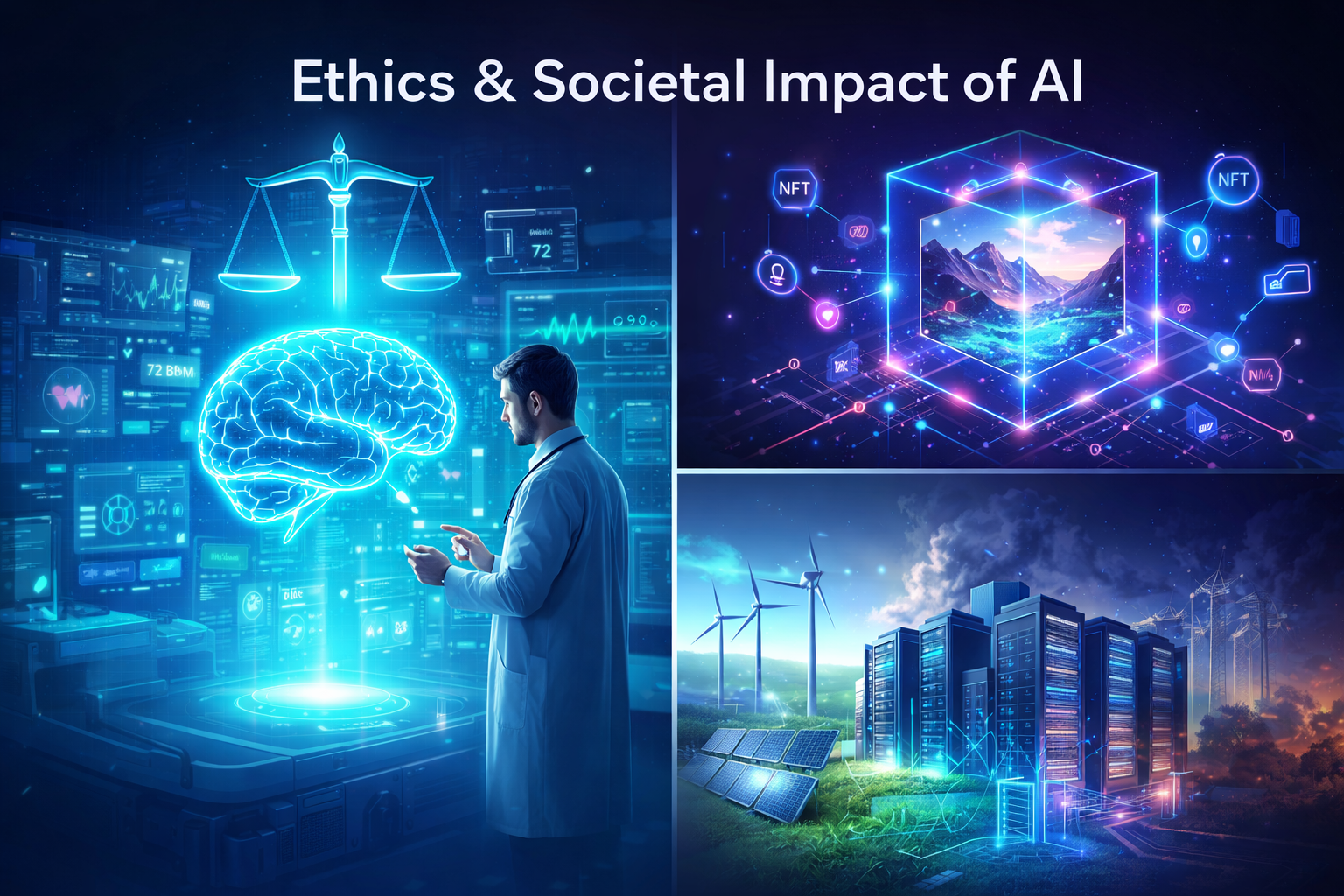
Artificial Intelligence (AI) is changing our world very fast. It is helping doctors, businesses, students, and even governments. But with these new changes, many questions are coming into people’s minds. Is AI safe? Is it fair? Who owns AI-created content? Does AI harm the environment? These questions are not only for experts. They matter to everyone. If you use a smartphone, social media, online banking, or healthcare services, AI is already part of your life.
This article is important because it explains the ethics and societal impact of AI in very simple language. You will understand how AI affects healthcare decisions, digital ownership and NFTs, and the environmental cost of AI. By the end of this article, you will have clear answers to common doubts about AI ethics. You will also learn how AI can be used in a responsible and fair way for society.
Ethics & Societal Impact of AI
Artificial Intelligence is powerful. It can make decisions, analyze data, create art, and even talk like humans. But power always brings responsibility. The ethics and societal impact of AI are becoming important topics around the world.
AI ethics means making sure AI systems are fair, safe, and helpful for humans. Societal impact means how AI affects people, jobs, environment, and laws. Let us explore these topics in detail.
Understanding AI Ethics
Before we discuss specific areas like healthcare or NFTs, we must understand what AI ethics really means. AI ethics focuses on right and wrong use of artificial intelligence. It ensures AI does not harm people or create unfair systems.
AI systems learn from data. If the data is biased, the AI will also be biased. If AI is used without rules, it can harm privacy or security. So ethical AI is about creating systems that are:
AI ethics is not only for developers. It is for companies, governments, and users too.
AI should be:
- Fair to all people
- Transparent in decision-making
- Safe and secure
- Respectful of privacy
- Accountable for mistakes
Now let us explore the major areas where AI ethics and societal impact are clearly visible.
The Ethics of AI in Healthcare
Healthcare is one of the most important areas where AI is used. AI helps doctors detect diseases, analyze reports, and even suggest treatments. It saves time and improves accuracy. But it also creates ethical questions.
Before listing the key concerns, it is important to understand that healthcare decisions affect human life. So AI in healthcare must be very carefully managed.
1. Accuracy in Medical Decisions
AI systems can detect diseases like cancer, diabetes, and heart problems. But what if the AI makes a mistake? Who is responsible? The doctor? The hospital? The software company?
AI should support doctors, not replace them. Final decisions must remain in human hands.
2. Bias in Medical Data
If AI is trained using limited data, it may not work well for all groups of people. For example:
- It may work better for one age group.
- It may not detect diseases properly in certain ethnic groups.
- It may ignore rare medical conditions.
This creates unfair treatment. Ethical AI in healthcare must use diverse and high-quality data.
3. Patient Privacy
AI systems collect huge amounts of medical data. This includes:
- Medical history
- Personal details
- Test results
- Genetic information
If this data is not protected, it can be misused. Data privacy is a serious ethical issue. Hospitals must use secure systems and follow strict rules.
4. Transparency
Patients have the right to know how decisions are made. If AI suggests a treatment, doctors should explain the reason. Black-box AI systems are dangerous in healthcare.
5. Accessibility
AI healthcare tools should be available to everyone, not only rich hospitals. If only wealthy people get access to AI-powered treatment, inequality will increase.
The ethics of AI in healthcare focus on safety, fairness, and trust. Responsible AI can save lives, but careless AI can harm them.
Digital Ownership & NFTs: AI and Copyright Laws
AI is not only used in healthcare. It is also creating art, music, videos, and written content. This brings new questions about digital ownership and NFTs.
NFTs (Non-Fungible Tokens) are digital assets stored on blockchain. They prove ownership of digital art or content. But when AI creates art, who owns it?
Before listing the key concerns, it is important to understand that copyright laws were created for human creators. AI changes this system.
1. Who Owns AI-Generated Content?
If AI creates a painting:
- Does the developer own it?
- Does the user who gave the prompt own it?
- Does no one own it?
Different countries have different rules. This creates confusion.
2. Copyright Infringement
AI models are trained using large datasets from the internet. Sometimes this includes copyrighted material. If AI creates similar content, is it copying?
This creates legal and ethical problems.
3. NFTs and Authenticity
NFTs are used to prove digital ownership. But if AI can create unlimited images, what is the real value?
People must understand:
- Ownership does not always mean originality.
- NFTs do not automatically give copyright.
- AI art may be legally complex.
4. Impact on Human Artists
Many artists worry that AI will replace them. This creates social and economic impact.
Ethical AI development must:
- Respect original creators.
- Avoid copying styles without permission.
- Create fair systems for artists.
5. Need for Updated Laws
Governments must update copyright laws to include AI-generated content. Clear rules are needed to protect both creators and users.
Digital ownership and NFTs are deeply connected to AI ethics. Without proper regulation, conflicts will increase.
The Environmental Cost of AI
AI is powerful, but it uses a lot of energy. Large language models and data centers require huge electricity. This creates environmental cost of AI.
Before listing key impacts, we must understand that training AI models can take weeks or months. During this time, powerful computers run continuously.
1. High Energy Consumption
Training large AI models requires:
- High-performance GPUs
- Large data centers
- Continuous electricity supply
This increases carbon emissions.
2. Carbon Footprint
Many data centers run on non-renewable energy. This increases global warming. The environmental cost of AI is often hidden from users.
3. Water Usage
Data centers need cooling systems. Cooling requires large amounts of water. This affects water resources.
4. Electronic Waste
AI hardware becomes outdated quickly. Old chips and servers create electronic waste. This harms the environment.
5. Sustainable AI Development
To reduce environmental impact, companies should:
- Use renewable energy
- Build energy-efficient models
- Optimize algorithms
- Reduce unnecessary data processing
Green AI is becoming a new trend. Responsible AI must also care for the planet.
Broader Societal Impact of AI
AI does not only affect healthcare, copyright, and environment. It affects society in many other ways.
1. Job Displacement
Automation replaces repetitive jobs. Some workers lose jobs. At the same time, new jobs are created.
Society must focus on:
- Skill development
- AI education
- Reskilling programs
2. Surveillance and Privacy
AI is used in facial recognition and monitoring systems. This can improve security but also reduce privacy.
Governments must balance safety and freedom.
3. Misinformation
AI can generate fake news and deepfakes. This can harm democracy and public trust.
Responsible AI systems must detect and reduce misinformation.
4. Economic Inequality
Big companies control advanced AI systems. Small businesses may struggle to compete.
Policies should support equal access to AI technology.
Why Responsible AI Matters
Responsible AI means designing and using AI systems in a way that benefits society.
It includes:
- Ethical development
- Clear regulations
- User awareness
- Environmental responsibility
Without responsibility, AI can create serious social problems.
How Individuals Can Respond to AI Ethics
You do not need to be a programmer to care about AI ethics.
You can:
- Stay informed about AI policies
- Protect your personal data
- Support ethical companies
- Learn basic AI literacy
- Ask questions about AI use
Awareness is the first step toward responsible AI society.
The Future of AI and Society
AI will continue to grow. It will become more powerful and more common in daily life.
Future developments may include:
- AI-assisted surgery
- Fully autonomous vehicles
- AI judges in legal systems
- Advanced digital ownership systems
But along with growth, ethical responsibility must also grow.
Governments, companies, and citizens must work together to build fair and safe AI systems.
Conclusion
The ethics and societal impact of AI are not small topics. They affect healthcare, digital ownership, environment, jobs, and privacy. AI in healthcare can save lives but must remain fair and transparent. Digital ownership and NFTs raise questions about copyright and originality. The environmental cost of AI reminds us that technology has hidden impacts.
Artificial Intelligence is not good or bad by itself. It depends on how humans design and use it. Responsible AI, ethical frameworks, and updated laws are necessary. Society must balance innovation with safety.
By understanding AI ethics, you become a smarter user of technology. You can protect your rights, support fair systems, and contribute to a better digital future.
Read More Blog–Why AI Startup Edge Is the Growth Partner for Modern Startups
FAQs
1. What is AI ethics?
AI ethics refers to the moral principles that guide the development and use of artificial intelligence to ensure fairness, safety, and transparency.
2. Why is AI ethics important in healthcare?
Because AI systems can influence life-and-death decisions. They must be accurate, unbiased, and secure.
3. Who owns AI-generated content?
Ownership depends on local copyright laws. In many places, laws are still unclear about AI-created works.
4. What are NFTs in simple words?
NFTs are digital tokens that prove ownership of digital items like art, music, or videos.
5. How does AI affect the environment?
AI systems use large amounts of electricity and water. Training large models increases carbon emissions.
6. Can AI replace human jobs?
AI can automate some jobs, but it also creates new opportunities. Skill development is important.
7. What is responsible AI?
Responsible AI means developing and using AI systems that are fair, transparent, safe, and environmentally friendly.
8. How can I protect myself from AI misuse?
Stay informed, protect your personal data, and use trusted platforms.


Comments are closed