


Introduction
Artificial Intelligence is no longer limited to developers and engineers. In 2026, anyone can build powerful AI tools without writing a single line of code. This is possible because of no-code AI agents. These intelligent systems allow entrepreneurs, marketers, startups, and small business owners to automate tasks using visual tools instead of programming.
No-code AI agents can handle customer support, generate leads, answer questions, analyze data, and automate workflows. Businesses are using them to improve productivity and reduce operational costs. The best part is that beginners can build these systems using simple drag-and-drop platforms.
In this article, you will learn what no-code AI agents are, how they work, the best tools to build them, and step-by-step methods to create your own AI agent without programming. This guide will help beginners understand the concept of AI automation and start building intelligent systems quickly.
What Are No-Code AI Agents?
Before understanding how to build them, it is important to understand what no-code AI agents actually are.
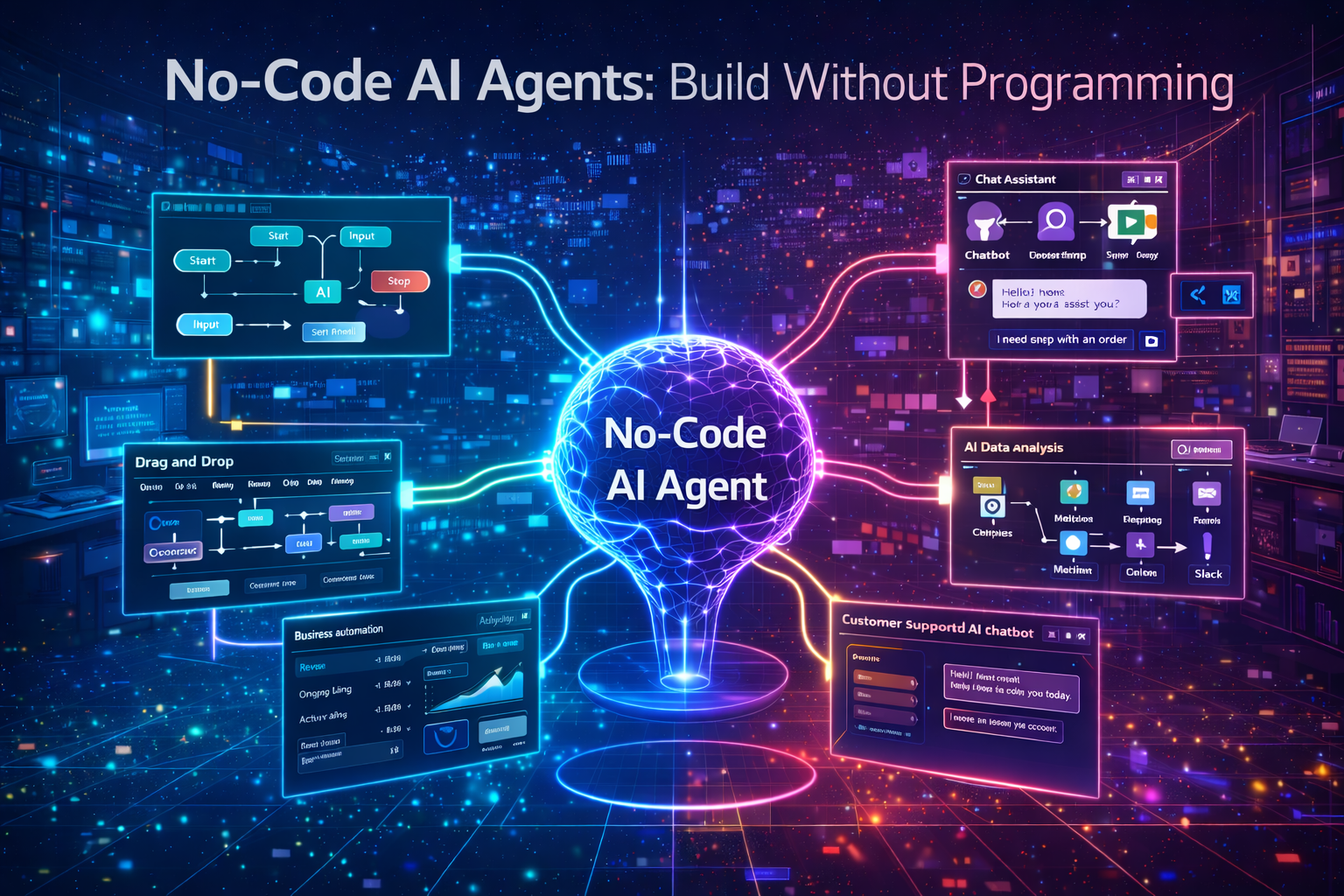
No-code AI agents are intelligent automation systems that can perform tasks, analyze information, and interact with users without requiring programming knowledge. Instead of writing code, users build these systems using visual interfaces.
These platforms provide ready-made components that allow users to connect AI models, workflows, and tools.
No-code AI agents can perform many tasks in business and technology.
Common tasks include:
- answering customer questions
- generating marketing content
- automating business workflows
- analyzing business data
- managing customer support chats
Because of these capabilities, no-code AI agents are becoming popular among entrepreneurs and businesses.
Why No-Code AI Agents Are Becoming Popular
Artificial Intelligence development used to require strong programming skills. However, many businesses do not have technical teams.
No-code platforms solve this problem by making AI accessible to everyone.
These platforms allow users to build automation tools quickly.
There are several reasons why no-code AI agents are becoming popular.
Important reasons include:
- no programming knowledge required
- faster development time
- lower development costs
- easy integration with existing tools
- simple visual interfaces
Because of these benefits, many startups and small businesses are adopting no-code AI automation.
How No-Code AI Agents Work
No-code AI agents work by combining several technologies that allow machines to understand data and perform tasks.
Instead of coding these systems manually, users configure them using visual tools.
A typical no-code AI agent works through several steps.
Before listing them, it is important to understand that each step helps the AI system observe data, process it, and perform actions.
The steps include:
- Data Input
The AI agent receives information from sources such as user messages, forms, or databases. - Processing
The system analyzes the information using artificial intelligence models. - Decision Making
The AI agent decides the best response or action. - Action
The system performs tasks such as sending messages, updating data, or triggering workflows.
This process allows AI agents to automate many business tasks.
Benefits of No-Code AI Agents
No-code AI agents provide many advantages for individuals and businesses.
They make advanced technology accessible to non-technical users.
Before listing the benefits, it is important to understand that automation helps organizations save time and resources.
Major benefits include:
- faster automation development
- reduced technical complexity
- lower operational costs
- improved business efficiency
- easier experimentation with AI tools
These advantages make no-code AI agents a powerful tool for innovation.
Best No-Code Platforms to Build AI Agents
Several platforms allow users to build AI agents without programming.
These platforms provide visual tools and integrations with AI models.
Before listing the platforms, it is important to understand that each platform focuses on different types of AI applications.
Popular platforms include:
- Bubble for building AI-powered web applications
- Zapier for workflow automation
- Make (Integromat) for connecting applications
- Voiceflow for building conversational AI assistants
- Flowise for creating AI workflows visually
These platforms allow users to build intelligent systems quickly.
Types of No-Code AI Agents
No-code AI agents can be used for different purposes depending on business needs.
Understanding these types helps users choose the right approach.
Before listing them, it is important to understand that AI agents can automate many areas of business operations.
Common types include:
- customer support AI agents
- marketing automation agents
- lead generation agents
- data analysis agents
- personal productivity agents
Each type focuses on solving specific problems.
Step-by-Step Guide to Building a No-Code AI Agent
Now let us explore how beginners can create their own AI agent without programming.
The process is simple and can be completed using visual tools.
Step 1: Choose a No-Code AI Platform
The first step is selecting the right platform.
Different platforms provide different features.
Before choosing a platform, consider factors such as ease of use, integrations, and pricing.
Popular options include:
- Flowise
- Voiceflow
- Zapier
- Bubble
Choosing the right platform depends on the project requirements.
Step 2: Define the Purpose of the AI Agent
Before building the AI system, it is important to define its goal.
A clear goal helps design the workflow effectively.
Examples of AI agent purposes include:
- answering customer support questions
- generating leads from websites
- sending automated emails
- analyzing customer feedback
Once the goal is defined, building the AI agent becomes easier.
Step 3: Create the Workflow
No-code platforms allow users to create workflows visually.
A workflow defines how the AI agent processes information and performs actions.
Typical workflows include several steps.
These steps include:
- receiving user input
- analyzing the input using AI
- generating a response
- triggering an automated action
Designing a workflow helps the AI agent perform tasks efficiently.
Step 4: Connect AI Models
Most no-code platforms allow integration with AI models.
These models help the AI agent understand language and generate responses.
Common AI capabilities include:
- text generation
- language understanding
- sentiment analysis
- content summarization
Connecting AI models improves the intelligence of the agent.
Step 5: Test the AI Agent
Testing is an important step before launching the AI agent.
Testing helps identify errors and improve responses.
During testing, users should check several aspects.
Important aspects include:
- accuracy of responses
- workflow logic
- integration performance
- user experience
Testing ensures the AI agent works properly.
Step 6: Deploy the AI Agent
After testing, the AI agent can be deployed.
Deployment allows users and customers to interact with the system.
Common deployment options include:
- website chatbots
- mobile applications
- messaging platforms
- business dashboards
Deployment makes the AI agent accessible to users.
Real World Use Cases of No-Code AI Agents
Many companies are already using no-code AI agents to automate business processes.
These systems improve productivity and customer experience.
Before listing the use cases, it is important to understand that AI automation can be applied across multiple industries.
Common use cases include:
- customer support chatbots
- automated email marketing systems
- e-commerce product recommendation tools
- lead generation chat assistants
- internal workflow automation systems
These applications demonstrate the value of no-code AI agents.
Challenges of No-Code AI Agents
Although no-code AI agents are powerful, they also have some limitations.
Understanding these challenges helps users design better systems.
Before listing them, it is important to understand that no-code platforms simplify development but may limit customization.
Common challenges include:
- limited customization options
- dependency on platform features
- integration limitations
- potential scalability issues
Despite these challenges, no-code AI agents remain very useful for beginners.
Future of No-Code AI Agents
The future of AI automation will include more accessible tools.
No-code platforms will continue evolving.
Future developments may include:
Before listing them, it is important to understand that AI technology is advancing rapidly.
Expected innovations include:
- smarter AI automation systems
- multi-agent collaboration platforms
- improved natural language understanding
- AI-powered business assistants
These technologies will make AI development even easier.
Conclusion
No-code AI agents are transforming the way people build artificial intelligence systems. In the past, developing AI applications required strong programming skills. Today, visual platforms allow beginners and businesses to create intelligent automation tools without writing code.
These systems can automate customer support, marketing workflows, lead generation, and many other tasks. By using no-code platforms, businesses can save time, reduce costs, and improve efficiency.
As artificial intelligence technology continues to evolve, no-code AI agents will become even more powerful and accessible. Learning how to build these systems can provide significant advantages for entrepreneurs, professionals, and organizations looking to leverage AI automation.
Read More Blog–Best Platforms to Build AI Agents in 2026
FAQs
1. What are no-code AI agents?
No-code AI agents are automation systems that allow users to build AI tools without programming.
2. Can beginners build AI agents without coding?
Yes. Many no-code platforms allow beginners to create AI agents using visual interfaces.
3. Which tools are used for no-code AI agents?
Popular tools include Flowise, Voiceflow, Zapier, and Bubble.
4. What can no-code AI agents do?
They can automate customer support, marketing workflows, lead generation, and data analysis.
5. Are no-code AI agents suitable for businesses?
Yes. Many businesses use no-code AI agents to automate operations and improve productivity.