


Introduction
Artificial Intelligence is changing the world very fast. Businesses, governments, schools, hospitals, banks, and even small startups are now using AI tools every day. AI helps people save time, improve work speed, automate tasks, and make smart decisions. But along with these benefits, AI is also creating new cybersecurity threats. Cybercriminals are now using AI to make attacks faster, smarter, and more dangerous than ever before.
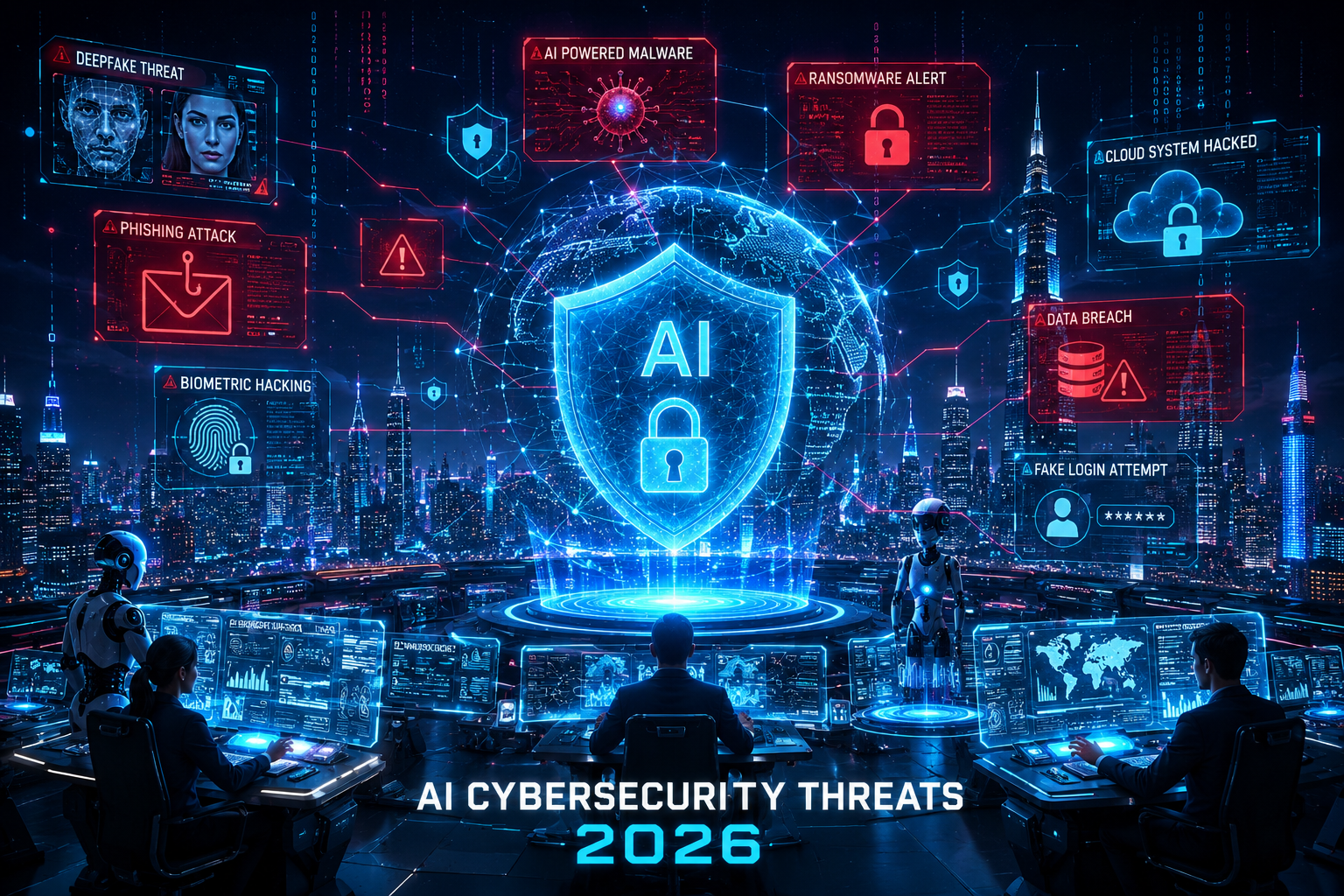
In 2026, AI cybersecurity threats are expected to become one of the biggest digital risks for companies and individuals. Hackers are using AI for phishing attacks, deepfake scams, ransomware, password cracking, data theft, and social engineering attacks. Many people still do not understand how these attacks work or how to protect themselves.
This article is important because it explains AI cybersecurity threats in very simple language. You will learn about the latest cyber risks, future cybersecurity trends, AI-powered hacking methods, and practical ways to stay safe online in 2026. Whether you are a business owner, student, freelancer, startup founder, or normal internet user, this guide will help you understand the future of cybersecurity clearly.
What Are AI Cybersecurity Threats?
AI cybersecurity threats are cyber attacks where hackers use Artificial Intelligence to steal data, damage systems, hack accounts, or trick people online. These attacks are more powerful because AI can analyze huge amounts of data quickly and automate many hacking activities.
Earlier, cybercriminals needed more manual work to attack systems. But now AI tools can automatically create phishing emails, identify weak passwords, copy human voices, and even generate fake videos.
AI-based cyber threats are becoming smarter because machine learning systems improve continuously with more data.
Some common AI cybersecurity threats include:
- AI-powered phishing attacks
- Deepfake scams
- AI ransomware
- Automated hacking bots
- AI-generated malware
- Identity theft using AI
- Fake customer support scams
- Voice cloning attacks
- AI social engineering attacks
- Intelligent password cracking
These threats are expected to grow rapidly in 2026 because AI tools are becoming cheaper and more accessible.
Why AI Cybersecurity Threats Are Growing in 2026
Many experts believe 2026 will be a major year for cybercrime because AI technology is becoming mainstream. Even small cybercriminal groups can now use AI tools.
There are several reasons behind this rapid growth.
1. AI Tools Are Easily Available
Today many AI platforms are publicly accessible. Some tools are free while others are very affordable. Hackers misuse these tools to create automated cyber attacks.
AI can help criminals:
- Write realistic scam messages
- Generate fake images
- Clone voices
- Analyze security systems
- Detect vulnerabilities faster
This makes cybercrime easier than before.
2. Remote Work Is Increasing
Remote work and hybrid work models are increasing worldwide. Employees access company systems from home networks and personal devices. These systems are often less secure.
Hackers target remote workers through:
- Fake meeting links
- Email scams
- Malware downloads
- Fake HR messages
- AI-generated login pages
This increases cybersecurity risks.
3. Businesses Depend More on Digital Systems
Modern companies rely heavily on cloud computing, AI automation, IoT devices, and digital communication.
More digital systems mean:
- More entry points for hackers
- More sensitive data online
- Larger attack surfaces
- Greater cybersecurity complexity
AI attackers exploit these weaknesses.
4. Deepfake Technology Is Improving
Deepfake AI can now create realistic videos, images, and voices. In 2026, deepfakes may become nearly impossible to detect for normal users.
Criminals use deepfakes for:
- Financial fraud
- Political misinformation
- Identity theft
- Fake business approvals
- Social media manipulation
This is becoming a major cybersecurity concern.
Top AI Cybersecurity Threats in 2026
AI cyber threats are evolving very quickly. Below are the most dangerous cybersecurity threats expected in 2026.
AI-Powered Phishing Attacks
Phishing is one of the oldest cyber attacks, but AI is making it much more dangerous.
Traditional phishing emails often had grammar mistakes and looked suspicious. But AI can now create highly professional messages that look real.
AI phishing attacks can:
- Copy company writing styles
- Personalize scam emails
- Analyze social media data
- Generate fake websites
- Create realistic chatbot scams
For example, a hacker may use AI to send an email that looks exactly like your bank or company HR department.
These attacks can trick even experienced users.
How to Stay Safe
People should carefully verify:
- Email addresses
- Website URLs
- Payment requests
- Login pages
- Attachments
Never trust urgent financial requests without confirmation.
Deepfake Scams
Deepfake scams are becoming one of the biggest AI cybersecurity threats in 2026.
Deepfake AI can create fake:
- Videos
- Voice recordings
- Live video calls
- Facial expressions
Cybercriminals use deepfakes to impersonate business leaders, family members, celebrities, and government officials.
For example:
A company employee may receive a video call that appears to be from their CEO requesting an urgent bank transfer. The employee believes the call is real and sends money to scammers.
Deepfake attacks are becoming highly realistic.
How to Stay Safe
Businesses should:
- Use multi-step approval systems
- Verify sensitive requests independently
- Train employees about deepfake risks
- Use AI detection software
Individuals should avoid sharing too much voice and video data online.
AI-Generated Malware
AI-generated malware is another dangerous cyber threat.
Traditional malware required manual coding. But AI can now automatically create malware variants that change behavior to avoid detection.
AI malware can:
- Learn from antivirus systems
- Modify its code automatically
- Hide inside normal software
- Spread faster across networks
- Attack multiple systems simultaneously
This makes cybersecurity defense more difficult.
Common Types of AI Malware
Some dangerous forms include:
- AI ransomware
- Spyware
- Banking trojans
- Data stealing malware
- Self-learning viruses
AI malware may become one of the biggest enterprise cybersecurity risks in 2026.
AI Ransomware Attacks
Ransomware attacks are already causing billions of dollars in losses worldwide.
AI-powered ransomware is even more dangerous because it can:
- Select valuable targets automatically
- Encrypt data faster
- Avoid detection
- Analyze backups
- Negotiate ransom demands
Hackers may use AI chatbots to communicate with victims and demand payments.
Hospitals, banks, schools, and government systems are major targets.
Protection Methods
Organizations should:
- Maintain offline backups
- Use endpoint protection
- Update software regularly
- Train employees
- Implement zero-trust security
Quick response systems are essential.
AI Social Engineering Attacks
Social engineering means manipulating people psychologically to steal information.
AI improves social engineering attacks by analyzing:
- Social media profiles
- Email conversations
- Public business data
- Personal interests
- Online behavior
Hackers use this information to create convincing scams.
Examples include:
- Fake job offers
- Romance scams
- Investment fraud
- Customer support scams
- Cryptocurrency fraud
These attacks feel highly personalized.
Automated Password Cracking
AI systems can crack passwords faster than traditional hacking tools.
AI password attacks use machine learning to:
- Predict password patterns
- Analyze user behavior
- Test billions of combinations
- Identify reused passwords
Weak passwords are highly vulnerable.
Best Security Practices
Users should:
- Use long passwords
- Enable two-factor authentication
- Avoid repeated passwords
- Use password managers
Strong authentication is critical in 2026.
AI Attacks on Smart Devices
Smart homes and IoT devices are increasing rapidly.
Devices include:
- Smart TVs
- Security cameras
- Smart locks
- Wearables
- Smart refrigerators
- Connected cars
Many devices have weak security.
AI attackers can automate attacks against thousands of devices simultaneously.
This can lead to:
- Privacy breaches
- Home surveillance
- Device hijacking
- Botnet attacks
IoT cybersecurity will become very important in the future.
AI Threats to Businesses
Businesses are major targets of AI cyber attacks.
Companies store valuable:
- Customer data
- Financial records
- Employee information
- Business strategies
- Intellectual property
AI attackers target these assets for profit.
Industries Most at Risk
Some industries face higher cybersecurity risks.
Banking and Finance
Banks face threats like:
- Fraud detection bypass
- Fake transactions
- Deepfake approvals
- Account takeovers
Healthcare
Hospitals store sensitive patient data.
Cyber attacks can affect:
- Medical records
- Emergency systems
- Patient privacy
- Medical devices
E-commerce
Online stores face:
- Payment fraud
- Fake reviews
- Account hacking
- AI chatbot scams
Government Systems
Governments face:
- Cyber espionage
- National security threats
- Election manipulation
- Infrastructure attacks
AI cyber warfare is becoming a global concern.
AI and Cyber Warfare
Countries are now investing heavily in AI cybersecurity and cyber warfare systems.
AI may be used for:
- Automated cyber attacks
- Military intelligence
- Digital spying
- Infrastructure disruption
- Information warfare
Critical infrastructure like electricity grids, airports, and communication networks may become future targets.
Cybersecurity is now part of national security.
Role of Artificial Intelligence in Cybersecurity Defense
AI is not only used by hackers. Cybersecurity companies also use AI for protection.
AI security systems help by:
- Detecting suspicious activity
- Monitoring networks 24/7
- Predicting cyber attacks
- Blocking malware automatically
- Identifying unusual behavior
AI-powered cybersecurity tools improve defense speed.
Benefits of AI in Cybersecurity
AI security systems offer several advantages.
Faster Threat Detection
AI can analyze huge data instantly.
This helps organizations detect attacks earlier.
Real-Time Monitoring
AI systems monitor networks continuously without human fatigue.
Better Fraud Prevention
Banks use AI to detect unusual financial activities quickly.
Automated Incident Response
AI tools can automatically isolate infected systems to stop attacks from spreading.
Challenges of AI Cybersecurity
Despite many benefits, AI cybersecurity also has challenges.
False Positives
Sometimes AI security tools block normal activities by mistake.
This can affect business operations.
High Costs
Advanced cybersecurity systems can be expensive for small businesses.
Privacy Concerns
AI security systems collect large amounts of user data.
This creates privacy concerns.
Shortage of Cybersecurity Experts
There is a global shortage of skilled cybersecurity professionals.
Many organizations struggle to manage modern cyber threats.
Future Cybersecurity Trends in 2026
Cybersecurity trends are changing rapidly.
Below are the major trends expected in 2026.
Zero Trust Security
Zero trust means nobody is trusted automatically.
Every user and device must be verified continuously.
This model improves cybersecurity significantly.
Biometric Authentication
Biometric systems include:
- Fingerprints
- Face recognition
- Voice recognition
- Retina scanning
These systems may replace passwords gradually.
AI-Based Security Automation
Organizations will increasingly automate cybersecurity using AI.
This helps reduce response time during attacks.
Quantum Computing Risks
Quantum computing may break traditional encryption systems in the future.
Cybersecurity companies are already developing quantum-safe encryption.
Cybersecurity Regulations
Governments are creating stricter cybersecurity laws and compliance requirements.
Businesses must improve data protection practices.
How Individuals Can Protect Themselves from AI Cyber Threats
Normal internet users also face cybersecurity risks.
Simple safety habits can reduce danger significantly.
Use Strong Passwords
Create passwords with:
- Uppercase letters
- Lowercase letters
- Numbers
- Symbols
Avoid using birthdays or simple names.
Enable Two-Factor Authentication
2FA adds extra security during login.
Even if passwords are stolen, hackers cannot access accounts easily.
Update Devices Regularly
Software updates fix security vulnerabilities.
Always update:
- Mobile phones
- Laptops
- Apps
- Antivirus software
Avoid Suspicious Links
Never click unknown links from:
- Emails
- SMS messages
- Social media
- WhatsApp forwards
Verify Video and Voice Calls
Deepfake scams are increasing.
Always verify urgent requests independently.
Backup Important Data
Regular backups help recover files during ransomware attacks.
Use both:
- Cloud backups
- Offline backups
How Businesses Can Improve Cybersecurity in 2026
Companies must strengthen cybersecurity strategies.
Employee Training
Employees are often the weakest security link.
Organizations should train staff about:
- Phishing attacks
- Password safety
- Social engineering
- AI scams
Awareness reduces risk.
Endpoint Security
All devices connected to company networks should be protected.
This includes:
- Computers
- Smartphones
- Tablets
- Servers
Cloud Security
Cloud systems must use:
- Encryption
- Access control
- Security monitoring
- Backup systems
Incident Response Planning
Businesses should prepare for cyber emergencies.
Plans should include:
- Attack response steps
- Backup recovery
- Communication procedures
- Legal reporting
Quick action reduces damage.
Importance of Cybersecurity Awareness
Technology alone cannot stop cybercrime.
Human awareness is equally important.
People should understand:
- Online scams
- Data privacy
- AI threats
- Fake information
- Social engineering tactics
Cybersecurity education should start early in schools and workplaces.
AI Cybersecurity Threats and Small Businesses
Small businesses are becoming major cyber attack targets because they often have weaker security systems.
Hackers believe small companies are easier to attack.
Common risks include:
- Payment fraud
- Customer data theft
- Website hacking
- Ransomware attacks
Small businesses should invest in:
- Basic cybersecurity training
- Antivirus software
- Secure payment systems
- Regular backups
Even simple protection methods can help greatly.
Impact of AI Cybersecurity Threats on Society
AI cyber threats affect society in many ways.
Financial Losses
Cybercrime causes huge economic damage worldwide.
Mental Stress
Victims often experience fear, stress, and anxiety.
Privacy Violations
Personal information theft can damage reputations and relationships.
Trust Issues
People may lose trust in digital systems and online communication.
Cybersecurity is now essential for digital trust.
Will AI Replace Human Cybersecurity Experts?
AI will assist cybersecurity professionals, but it may not fully replace humans.
Human experts are still needed for:
- Strategic decisions
- Ethical judgment
- Complex investigations
- Security planning
The future will likely involve collaboration between humans and AI systems.
Best AI Cybersecurity Tools in 2026
Many companies are developing AI-powered cybersecurity tools.
Popular technologies include:
- AI antivirus software
- Threat intelligence platforms
- Network monitoring tools
- AI fraud detection systems
- Behavioral analytics systems
Businesses should choose trusted cybersecurity providers.
The Future of AI and Cybersecurity
AI will continue changing cybersecurity in both positive and negative ways.
Future developments may include:
- Fully autonomous cyber attacks
- Advanced AI security systems
- Smarter fraud detection
- AI-powered digital identity verification
- Quantum-safe cybersecurity solutions
The cybersecurity industry will grow rapidly in coming years.
People and businesses must stay informed and prepared.
Conclusion
AI cybersecurity threats in 2026 are becoming more advanced, intelligent, and dangerous. Cybercriminals are using Artificial Intelligence to launch phishing attacks, ransomware campaigns, deepfake scams, password cracking, and automated malware attacks. These threats affect individuals, businesses, governments, and even national security systems.
At the same time, AI is also helping cybersecurity experts improve digital protection. AI-powered security systems can detect threats faster, monitor networks continuously, and automate defense responses. However, technology alone is not enough. Awareness, employee training, strong passwords, software updates, and proper cybersecurity practices are equally important.
The future of cybersecurity will depend on how well society balances innovation with digital protection. As AI technology grows, cybersecurity awareness will become essential for everyone. Whether you are a student, entrepreneur, business owner, or normal internet user, understanding AI cybersecurity threats can help you stay safer in the digital world.
FAQs
1. What are AI cybersecurity threats?
AI cybersecurity threats are cyber attacks where hackers use Artificial Intelligence to steal data, spread malware, scam users, or damage digital systems.
2. Why are AI cyber attacks increasing in 2026?
AI tools are becoming more accessible, powerful, and affordable. Hackers use these tools to automate attacks and create smarter scams.
3. What is a deepfake cyber attack?
A deepfake cyber attack uses AI-generated fake videos or voices to impersonate someone and trick victims into sharing money or sensitive information.
4. How can businesses protect themselves from AI cyber threats?
Businesses should use strong cybersecurity systems, train employees, enable multi-factor authentication, update software regularly, and maintain data backups.
5. What industries face the highest cybersecurity risks?
Banking, healthcare, e-commerce, government, and technology industries face major cybersecurity threats because they store valuable data.
6. Can AI improve cybersecurity?
Yes, AI helps detect cyber threats faster, monitor suspicious activities, automate security responses, and improve fraud detection.
7. What is AI-powered phishing?
AI-powered phishing uses Artificial Intelligence to create highly personalized scam emails, messages, or fake websites to steal information.
8. How important are strong passwords in 2026?
Strong passwords are extremely important because AI tools can crack weak passwords quickly using machine learning algorithms.
9. What is zero trust security?
Zero trust security is a cybersecurity model where every user and device must be verified continuously before accessing systems.
10. Will cyber threats continue growing in the future?
Yes, cyber threats are expected to grow as technology becomes more advanced and connected worldwide.
Read More Blogs–AI Startup Edge