

Introduction
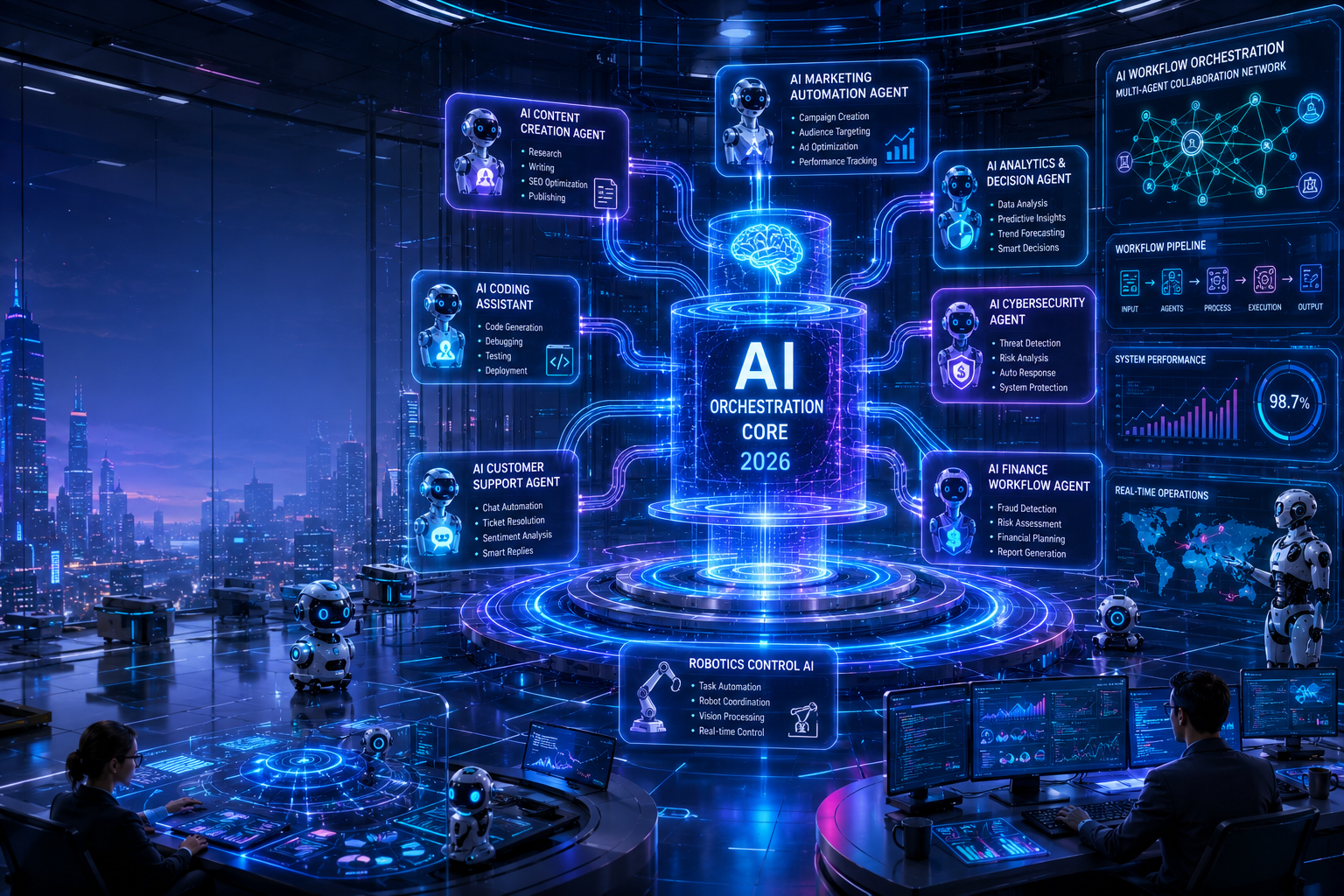
Artificial Intelligence is changing the way businesses and people work. In 2026, AI is no longer limited to simple chatbots or automation tools. Modern AI systems can now think, plan, analyze, make decisions, and complete tasks automatically with very little human help. These advanced systems are called Agentic AI Workflows.
Businesses around the world are using agentic AI workflows to automate customer support, content creation, coding, marketing, sales, healthcare, cybersecurity, and many other operations. Instead of using one AI tool, companies are building multiple AI agents that work together like a digital team.
This technology is becoming extremely important because it helps businesses save time, reduce costs, improve productivity, and scale operations faster. Many people want to understand how agentic AI workflows work, what tools are used, their benefits, risks, and future opportunities. This complete guide explains everything in very simple language so beginners, marketers, startups, and business owners can easily understand the future of AI automation.
What Are Agentic AI Workflows?
Agentic AI workflows are intelligent automation systems where AI agents can independently complete tasks, make decisions, communicate with software, and coordinate with other AI systems.
In simple words, agentic AI works like a smart digital employee that can handle workflows automatically.
Unlike traditional automation, these workflows are dynamic and adaptive. They do not simply follow fixed rules. Instead, they can analyze situations and decide the best action.
Agentic AI workflows usually involve:
- AI agents
- Workflow orchestration
- APIs and integrations
- Large Language Models
- Automation platforms
- Decision-making systems
Why Agentic AI Workflows Are Important in 2026
Businesses are becoming more digital every year. Companies need faster operations, smarter workflows, and better customer experiences.
Agentic AI workflows help organizations:
- Automate repetitive tasks
- Improve productivity
- Reduce operational costs
- Increase scalability
- Improve decision-making
- Operate continuously
- Deliver faster customer service
In 2026, AI systems are becoming powerful enough to manage complete business operations with minimal human involvement.
How Agentic AI Workflows Work
Agentic AI workflows operate through multiple intelligent systems working together.
The process usually follows several steps.
Task Understanding
The AI system first understands the user request or business goal.
Example:
“Create and publish an SEO blog article.”
Workflow Planning
The AI breaks the task into smaller steps.
Example:
- Research topic
- Find keywords
- Create outline
- Write content
- Optimize SEO
- Publish article
Task Distribution
Different AI agents receive different responsibilities.
Tool Usage
AI agents use software tools, APIs, and cloud systems to complete work.
Monitoring and Optimization
The orchestration system monitors progress and improves workflows automatically.
Main Components of Agentic AI Systems
Understanding the main components helps explain how agentic workflows operate.
AI Agents
AI agents are specialized systems designed for specific tasks.
Examples include:
- Writing agents
- Coding agents
- Marketing agents
- Analytics agents
- Customer support agents
AI Orchestration Layer
The orchestration layer coordinates all AI agents and workflows.
Large Language Models
Large Language Models help AI systems understand language, reasoning, and decision-making.
APIs and Integrations
APIs connect AI systems with websites, CRMs, databases, apps, and cloud tools.
Memory Systems
Memory systems help AI agents remember information during workflows.
Decision Engines
Decision systems help AI agents choose the best actions automatically.
Difference Between Traditional Automation and Agentic AI
Traditional automation follows predefined rules.
Agentic AI workflows are much more intelligent and flexible.
Traditional Automation
Traditional systems:
- Follow fixed instructions
- Cannot adapt easily
- Require manual programming
- Have limited intelligence
Agentic AI Workflows
Agentic AI systems:
- Learn dynamically
- Adapt to situations
- Make decisions
- Coordinate with other agents
- Complete complex workflows
This makes agentic AI far more powerful in 2026.
Types of Agentic AI Workflows in 2026
Many industries are adopting different types of AI workflows.
AI Content Creation Workflow
Content marketing is one of the biggest uses of agentic AI.
These workflows can:
- Research keywords
- Generate blog ideas
- Write articles
- Optimize SEO
- Publish content automatically
Workflow Example
Research Agent
Finds trending topics and search keywords.
Writing Agent
Creates articles and marketing content.
SEO Agent
Optimizes readability and search rankings.
Publishing Agent
Uploads content to websites and social platforms.
Analytics Agent
Tracks traffic and engagement.
AI Customer Support Workflow
Customer support is becoming heavily automated.
AI Support Features
These systems can:
- Handle customer queries
- Manage tickets
- Process refunds
- Schedule appointments
- Escalate issues automatically
Benefits
Businesses improve:
- Customer satisfaction
- Response speed
- Operational efficiency
AI Marketing Workflow
Digital marketing agencies are using agentic AI rapidly.
Tasks Managed by AI Marketing Workflows
AI systems automate:
- Social media posting
- Email marketing
- Ad creation
- Audience targeting
- Campaign optimization
Advantages
Marketing teams gain:
- Faster campaign execution
- Better targeting
- Real-time optimization
- Lower costs
AI Coding Workflow
Software development is changing because of AI coding agents.
Coding Workflow Functions
AI coding systems can:
- Generate code
- Debug applications
- Test software
- Review code quality
- Deploy applications
Why Developers Use AI
AI reduces repetitive coding tasks and speeds up development.
AI Sales Workflow
Sales automation is becoming smarter with AI.
AI Sales Tasks
Agentic workflows can:
- Generate leads
- Analyze customer behavior
- Send outreach emails
- Score leads
- Schedule meetings
Benefits
Sales teams increase productivity and conversions.
AI Cybersecurity Workflow
Cybersecurity is becoming more dependent on AI systems.
AI Security Functions
AI security workflows can:
- Detect threats
- Monitor networks
- Analyze suspicious behavior
- Block attacks automatically
- Generate reports
Advantages
AI improves cybersecurity response speed significantly.
AI Financial Workflow
Financial organizations use AI for automation and analysis.
AI Finance Workflow Tasks
AI systems manage:
- Fraud detection
- Risk assessment
- Financial forecasting
- Automated trading
- Customer support
AI Healthcare Workflow
Healthcare organizations are using intelligent AI workflows to improve patient care.
Healthcare Workflow Functions
AI systems assist with:
- Appointment management
- Medical data analysis
- Patient monitoring
- Drug research
- Diagnostic support
AI E-commerce Workflow
E-commerce businesses use AI to automate online operations.
AI E-commerce Automation
AI workflows handle:
- Product recommendations
- Inventory management
- Customer support
- Marketing campaigns
- Order processing
Multi-Agent AI Workflows
One of the biggest trends in 2026 is multi-agent collaboration.
Instead of one AI system performing everything, multiple AI agents specialize in different tasks.
How Multi-Agent Systems Work
Different agents work together through orchestration platforms.
Example:
- Research agent collects information
- Writing agent creates content
- SEO agent optimizes rankings
- Publishing agent uploads content
This creates highly efficient workflows.
Top Tools Used in Agentic AI Workflows
Several advanced tools are leading the AI automation industry.
LangChain
LangChain helps developers build AI-powered applications and workflows.
CrewAI
CrewAI focuses on collaborative AI agents.
AutoGen
AutoGen allows multiple AI agents to communicate and solve tasks together.
Zapier
Zapier integrates AI systems with business tools and applications.
n8n
n8n supports customizable AI workflows.
Microsoft Semantic Kernel
Microsoft provides AI orchestration tools for enterprise workflows.
Benefits of Agentic AI Workflows
Agentic AI workflows offer many advantages for businesses and organizations.
Increased Productivity
AI agents complete tasks much faster than manual workflows.
Lower Operational Costs
Automation reduces the need for repetitive human labor.
24/7 Operations
AI systems can work continuously without breaks.
Faster Decision-Making
AI analyzes data and provides insights in real time.
Better Customer Experience
Customers receive faster responses and personalized support.
Improved Scalability
Businesses can scale operations quickly without large teams.
Reduced Human Errors
Automation improves consistency and accuracy.
AI Agent Orchestration in Workflows
Orchestration is the process of managing multiple AI agents together.
Without orchestration, AI systems cannot collaborate efficiently.
Role of Orchestration Platforms
These systems:
- Assign tasks
- Monitor workflows
- Coordinate communication
- Manage decision-making
- Optimize performance
No Human in the Loop Systems
Many businesses now use fully autonomous workflows.
These systems operate with minimal human supervision.
Examples
Examples include:
- AI content agencies
- Autonomous customer support
- AI trading systems
- Automated SaaS businesses
Human in the Loop vs Fully Autonomous AI
Not all workflows should be fully automated.
Human in the Loop
Humans review or approve AI actions.
Best for:
- Healthcare
- Legal services
- Financial systems
- Sensitive operations
Fully Autonomous AI
AI systems operate independently.
Best for:
- Marketing automation
- Content publishing
- Data analysis
- Customer support
Role of Large Language Models in Agentic AI
Large Language Models are extremely important for agentic workflows.
They help AI systems:
- Understand instructions
- Generate content
- Perform reasoning
- Analyze information
- Make decisions
Modern AI workflows depend heavily on advanced language models.
Security Challenges in Agentic AI Workflows
AI automation also creates security concerns.
Data Privacy Risks
AI systems process large amounts of sensitive information.
Cybersecurity Threats
Hackers may target automated systems.
AI Hallucinations
AI may sometimes generate incorrect outputs.
Workflow Exploitation
Poorly designed systems can create automation vulnerabilities.
How Businesses Can Improve AI Security
Organizations should follow strong security practices.
Access Control
Only authorized users should manage AI systems.
Data Encryption
Sensitive information should be encrypted.
Human Oversight
Critical workflows should include human review.
Continuous Monitoring
Businesses should monitor AI activities regularly.
Ethical Concerns Around Agentic AI
AI automation raises ethical questions worldwide.
Job Replacement Concerns
Some repetitive jobs may become automated.
AI Bias
Improper training data can create biased outputs.
Privacy Issues
AI systems collect and analyze user data.
Transparency Challenges
Some AI decisions are difficult to explain.
Industries Adopting Agentic AI Rapidly
Several industries are adopting AI workflows quickly.
Digital Marketing
AI automates SEO, content, and advertising.
Healthcare
Hospitals use AI for patient care and analysis.
Finance
Banks use AI for fraud detection and automation.
E-commerce
Online businesses automate operations using AI.
Software Development
Developers use AI coding assistants extensively.
Logistics and Supply Chain
AI improves delivery and inventory management.
Future Trends in Agentic AI Workflows
The future of AI automation is evolving rapidly.
Autonomous AI Teams
AI agents may function like full business departments.
AI-to-AI Communication
AI systems will communicate independently.
Hyperautomation
Entire business operations may become automated.
Self-Improving AI Systems
Future AI workflows may optimize themselves automatically.
Personalized AI Ecosystems
Businesses may create custom AI agent environments.
AI Digital Employees
Organizations may use AI employees alongside human teams.
Skills Needed to Build Agentic AI Workflows
Many professionals want to learn AI workflow automation.
Important skills include:
Prompt Engineering
Understanding how to communicate effectively with AI.
Workflow Design
Designing intelligent automation systems.
API Integration
Connecting software platforms together.
Cloud Computing
Managing cloud-based infrastructure.
AI Fundamentals
Understanding machine learning and language models.
Data Analysis
Analyzing workflow data and performance.
How Startups Can Use Agentic AI
Startups are adopting AI workflows because they reduce operational costs.
Startup Applications
AI helps startups with:
- Marketing automation
- Content generation
- Customer support
- Lead generation
- Data analysis
Why Startups Benefit
AI allows small teams to scale faster with fewer resources.
Challenges of Agentic AI Workflows
Despite their advantages, AI workflows still have limitations.
High Setup Costs
Advanced AI infrastructure may require investment.
Complex Integration
Connecting multiple systems can be difficult.
Dependence on AI Providers
Businesses rely heavily on cloud AI services.
Reliability Issues
AI systems may occasionally fail or behave unpredictably.
Why Agentic AI Workflows Will Dominate 2026
Businesses want smarter automation systems that can reduce costs and improve efficiency.
Agentic AI workflows solve major business challenges by providing:
- Intelligent automation
- Faster operations
- Better scalability
- Continuous workflows
- Real-time decision-making
Because of these advantages, agentic AI is becoming one of the most important technology trends of 2026.
Conclusion
Agentic AI workflows in 2026 are transforming businesses by creating intelligent systems that can think, plan, communicate, and execute tasks automatically. These workflows are far more advanced than traditional automation because they involve autonomous AI agents working together through orchestration platforms.
From content creation and digital marketing to healthcare, finance, cybersecurity, and software development, agentic AI workflows are helping organizations increase productivity, reduce costs, and scale operations rapidly.
Although challenges related to security, ethics, and AI reliability still exist, the future of agentic AI looks extremely powerful. Businesses and professionals who understand and adopt these technologies early may gain a major competitive advantage in the coming years.
Read More Blogs-AI Startup Edge
FAQs
1. What are agentic AI workflows?
Agentic AI workflows are intelligent automation systems where AI agents perform tasks, make decisions, and coordinate workflows automatically.
2. Why are agentic AI workflows important in 2026?
They help businesses improve automation, productivity, scalability, and operational efficiency.
3. What industries use agentic AI workflows?
Industries including healthcare, finance, digital marketing, e-commerce, cybersecurity, and software development use these systems.
4. What are multi-agent AI systems?
Multi-agent systems involve multiple AI agents collaborating together to complete workflows.
5. Which tools are used for AI workflows?
Popular tools include LangChain, CrewAI, AutoGen, Zapier, and n8n.
6. Can AI workflows operate without humans?
Yes, some workflows are fully autonomous, while others use human supervision.
7. What are the benefits of agentic AI?
Benefits include automation, lower costs, scalability, faster workflows, and improved productivity.
8. What are the risks of agentic AI workflows?
Risks include cybersecurity threats, privacy concerns, AI hallucinations, and ethical issues.
9. How do AI agents communicate?
AI agents communicate through orchestration systems, APIs, and workflow automation platforms.
10. What is the future of agentic AI workflows?
The future includes autonomous AI teams, hyperautomation, AI-to-AI communication, and self-improving AI systems.