



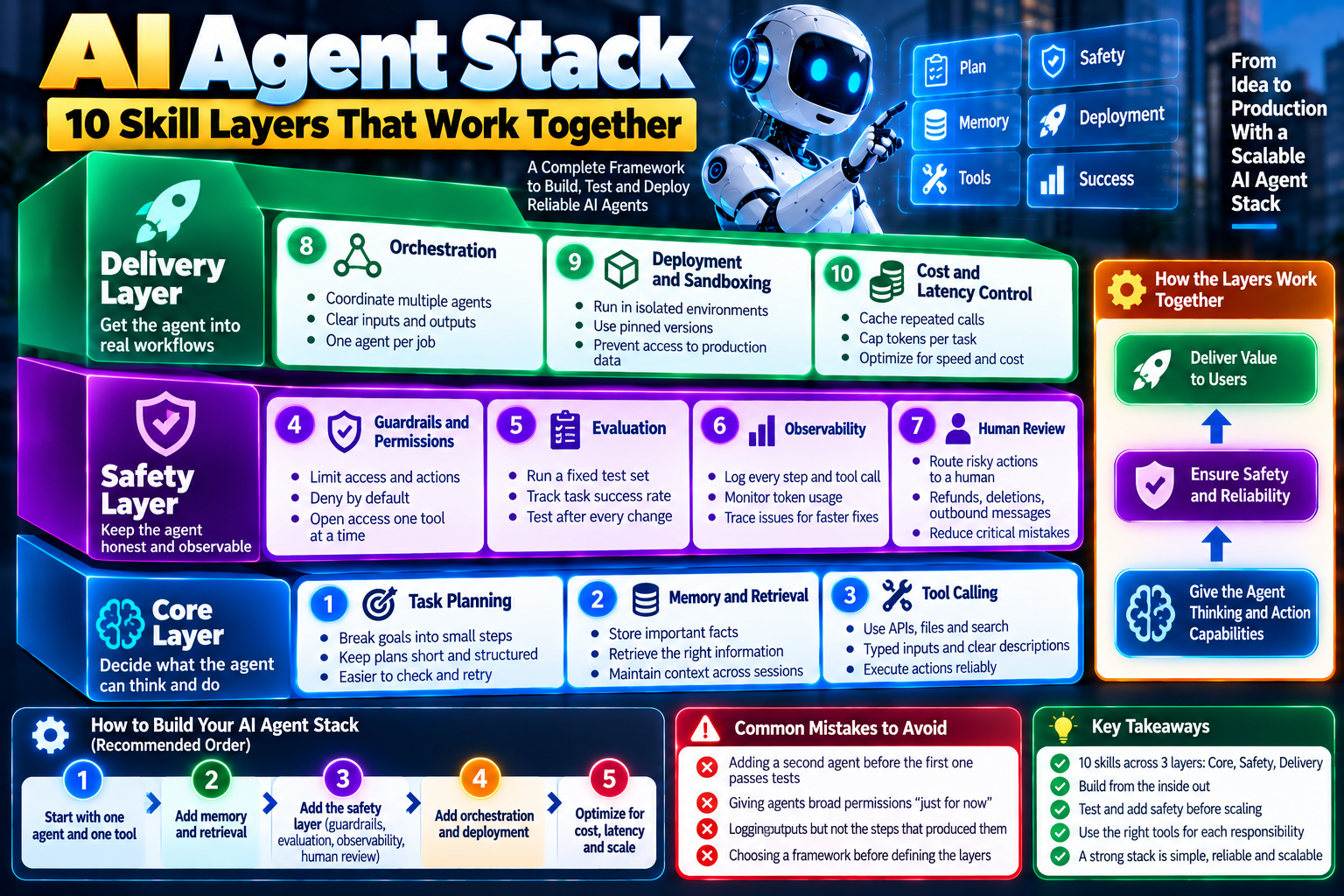
An AI agent stack is the set of skills that lets an agent plan, act, and stay safe in production. Most teams collect tools one at a time. As a result, their agents work in demos and fail under real load.
This guide takes a different route. It arranges ten skills into three layers, so each piece has a clear job. Moreover, it shows the order that keeps risk low while you build.
What Is an AI Agent Stack?
To picture it, think of the stack as a building. The core layer holds the agent’s reasoning and reach. The safety layer keeps it honest and observable. Finally, the delivery layer ships it to users.
However, skip a layer and the whole thing wobbles. For example, an agent with strong tools but no evaluation will fail quietly. Likewise, a well-tested agent with no memory will repeat itself.
If you want the repositories behind these skills, see our list of the best AI agent skills on GitHub. This post focuses on how the skills fit together instead.
Core Layer: Planning, Memory and Tools
First, the core layer decides what the agent can think and do. It needs three skills.
- Task planning. The agent breaks a goal into small, ordered steps. Short plans are easier to check and to retry.
- Memory and retrieval. The agent stores facts and pulls the right ones back. Without it, every session starts from zero.
- Tool calling. The agent uses APIs, files and search through typed inputs. Clear tool descriptions matter more than clever prompts.
Anthropic’s guide to building effective agents makes a similar point. Simple, composable patterns usually beat heavy frameworks.
Safety Layer: Guardrails, Evaluation and Observability
Next comes the layer that protects your users and your budget. It needs four skills.
- Guardrails and permissions. Limit what each agent can read, write and spend. Deny by default, then open access one tool at a time.
- Evaluation. Run a fixed test set after every change. Track task success, not just output quality.
- Observability. Log every step, tool call and token count. Traces turn a mystery failure into a ten-minute fix.
- Human review. Route risky actions to a person before they run. Refunds, deletions and outbound messages are good candidates.
Our agentic AI production checklist covers the testing side in more detail. In short, treat these four skills as required, not optional.
Delivery Layer: Orchestration, Deployment and Cost Control
Finally, the last layer gets the agent into real workflows. It needs three skills.
- Orchestration. Hand work between agents with clear inputs and outputs. One agent per job keeps failures easy to trace.
- Deployment and sandboxing. Run agents in isolated environments with pinned versions. That way a bad run cannot touch production data.
- Cost and latency control. Cache repeated calls and cap tokens per task. Otherwise, a single loop can burn a month of budget overnight.
How to Order Your AI Agent Stack
Build from the inside out. First, get one agent planning and calling one tool. Then add memory, because it changes how you test.
After that, add the safety layer before you add more agents. Many teams do this backwards. As a result, they scale their problems along with their features.
Finally, add orchestration and deployment once a single agent passes its evaluations. At that point, adding agents is cheap and predictable.
Common AI Agent Stack Mistakes
- Adding a second agent before the first one passes its tests.
- Giving agents broad permissions “just for now”.
- Logging outputs but not the steps that produced them.
- Choosing a framework before defining the layers you need.
Overall, each mistake has the same root cause. The team picked tools before it picked responsibilities. Therefore, name the job of each layer first, then choose software to fill it.
Final Thoughts
In the end, a strong stack is boring on purpose. Ten small skills, arranged in three layers, beat one clever agent every time. Start with the core, protect it with the safety layer, and ship through the delivery layer.
Therefore, review your own setup against the list above. Whichever layer is thinnest is where your next sprint belongs.