



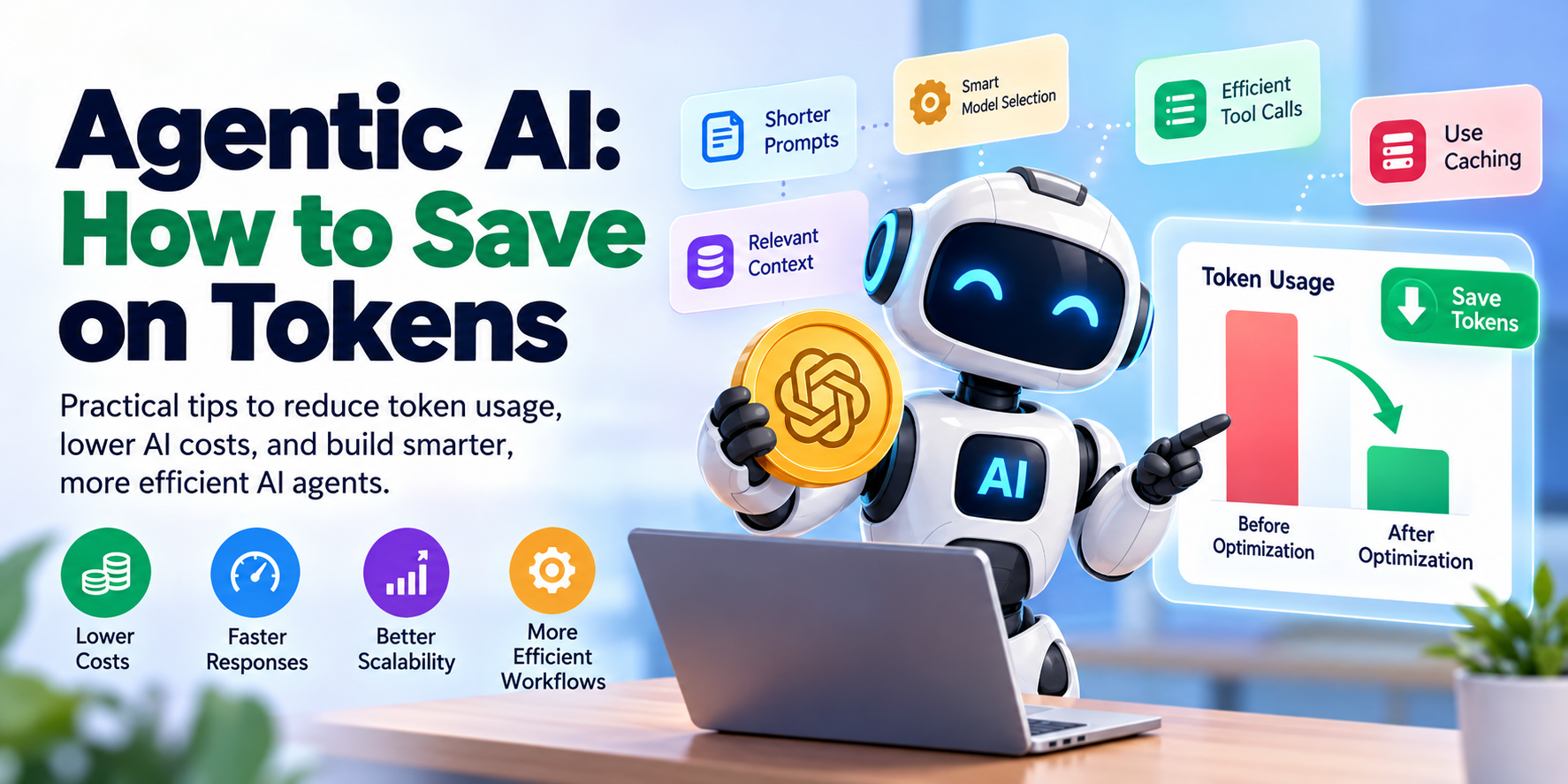
Agentic AI is changing how businesses automate tasks, build intelligent assistants, and manage complex workflows. However, running AI agents can become expensive when they use too many tokens. Every instruction, conversation, tool response, and piece of information sent to an AI model can increase token usage. When an agent performs the same task repeatedly, these costs can grow quickly. The good news is that you do not need to sacrifice quality to reduce your AI expenses. With the right strategies, you can build smarter agents that use fewer tokens, respond faster, and complete tasks more efficiently. In this guide, you will learn how to save tokens in agentic AI through better prompts, shorter context, efficient memory, tool optimization, model selection, and workflow design. Whether you are a startup founder, developer, business owner, or AI beginner, these practical techniques can help you control costs and build more reliable AI agents.
What Is Agentic AI?
Agentic AI is a type of artificial intelligence that can work toward a goal by planning steps, making decisions, using tools, and checking results. Instead of only answering a single question, an AI agent can complete several connected tasks with limited human guidance.
For example, imagine you want to research competitors for your startup. A normal chatbot may explain how to perform competitor research. An AI agent can search for competitors, collect information, compare their products, summarize their pricing, and prepare a report.
Each action may require additional instructions, model responses, tool outputs, or follow-up decisions. These interactions can consume tokens.
Tokens are the small pieces of text that an AI model processes. A token may represent a complete word, part of a word, punctuation, or another text unit. The exact number of tokens depends on the language, text, and tokenizer used by the model.
Understanding tokens is important because many AI services charge based on the number of input and output tokens. Some also charge separately for tools, images, audio, or other features.
Why Does Saving Tokens Matter in Agentic AI?
Token optimization means reducing unnecessary token usage while maintaining the quality and accuracy of an AI agent’s work.
An AI agent may perform multiple reasoning steps before completing a task. It might read a long document, call an external tool, inspect the response, and repeat the process. If every step sends the entire conversation back to the model, token usage can become unnecessarily high.
Saving tokens can help businesses manage AI expenses, improve response times, and run more tasks within a fixed budget.
Here are the main benefits of agentic AI token optimization.
- Lower AI costs: Fewer unnecessary input and output tokens can reduce API expenses.
- Faster responses: Shorter prompts and smaller responses can reduce processing time, although actual speed also depends on the model and system.
- Better scalability: Lower average token usage can make it possible to handle more tasks within the same budget.
- More efficient workflows: Agents can avoid repeating information and performing unnecessary steps.
- Improved reliability: Clear instructions and focused context can reduce confusion and irrelevant responses.
However, saving tokens should not become the only goal. Removing important information may cause an agent to make mistakes, use the wrong tool, or produce an incomplete answer. The goal is to eliminate waste, not useful information.
15 Practical Ways to Save Tokens in Agentic AI
The best way to reduce token consumption is to optimize the entire agent workflow. This includes prompts, context, memory, tool calls, model selection, and the way results are delivered.
1. Write Short and Clear System Prompts
A system prompt tells an AI agent how to behave, what its role is, and which rules it must follow. Long prompts often contain repeated instructions, unnecessary explanations, and rules that do not affect the task.
For example, a lengthy instruction might explain several times that an agent should summarize information in simple language. A shorter instruction can communicate the same requirement.
Example of a long prompt:
“Your responsibility is to read the provided article carefully, understand the main points, identify the most important information, remove unnecessary details, and then create a clear summary that is easy for a beginner to understand.”
Optimized prompt:
“Summarize the article in simple language. Keep the main facts and remove repetition.”
The shorter prompt uses fewer tokens while preserving the main objective.
To improve your system prompts, follow these practices:
- Define the agent’s role in one or two sentences.
- State the expected output format clearly.
- Remove repeated rules and unnecessary background.
- Keep essential safety, privacy, and accuracy instructions.
- Use specific instructions instead of vague descriptions.
Review your prompts regularly. As workflows change, remove outdated instructions that no longer serve a purpose.
2. Send Only Relevant Context to the Model
Context includes the information an AI model receives before generating a response. It can contain user messages, previous answers, documents, tool results, system instructions, and stored memories.
One common mistake in agentic AI development is sending the entire conversation to the model during every step. This can waste tokens when most of the earlier information is no longer relevant.
For example, a customer support agent handling a refund request may need the customer’s latest message, the order status, and the refund policy. It probably does not need the full history of unrelated questions asked by that customer.
You can reduce unnecessary context by:
- Identifying which information is required for the current task.
- Removing unrelated conversation history.
- Keeping only the relevant sections of documents.
- Summarizing older interactions when their details are not essential.
- Passing structured data instead of long narrative descriptions when appropriate.
Context pruning is especially useful for agents that work across long conversations or multi-step workflows.
However, do not remove information that is necessary for accurate decisions. For example, a previous user instruction about a strict spending limit may still matter even if it appeared much earlier in the conversation.
3. Use Summarization Instead of Repeating Long Conversations
Long-running AI agents can accumulate large amounts of conversation history. Repeating all this information in every model request can increase input token consumption.
A useful solution is to create a compact summary of the important information.
For example, instead of sending 20 messages about a marketing campaign, an agent could maintain this summary:
“Campaign: Promote a new SaaS product. Audience: Small business owners. Budget: ₹50,000. Main channels: SEO and LinkedIn. Goal: Generate qualified leads. Tone: Professional and beginner-friendly.”
This summary preserves the information needed for future decisions without including every earlier message.
You can apply summarization at different stages of an agent workflow:
- Summarize completed research before moving to the next step.
- Keep a short record of decisions already made.
- Store unresolved questions separately.
- Preserve important constraints, deadlines, and user preferences.
- Replace outdated summaries when new information changes the task.
The quality of the summary matters. An overly aggressive summary may remove critical facts, conditions, or exceptions. For important decisions, preserve exact values and original source references rather than relying only on a compressed summary.
4. Use Retrieval-Augmented Generation (RAG)
Retrieval-Augmented Generation, commonly called RAG, allows an AI system to retrieve relevant information from a knowledge source before generating an answer.
Instead of sending an entire document library to an AI model, a RAG system searches for relevant passages and supplies only the most useful information.
Imagine your business has 500 pages of product documentation. A customer asks how to reset one particular device. Sending all 500 pages to the model would be wasteful. A retrieval system can find the specific reset instructions and pass those sections to the agent.
A typical RAG workflow includes these steps:
- Divide documents into meaningful sections.
- Create searchable representations of those sections, often using embeddings.
- Retrieve passages related to the user’s question.
- Select the most relevant results.
- Send those results to the model with a focused instruction.
- Generate an answer based on the retrieved information.
RAG can reduce context size and help an agent use current, domain-specific information.
However, retrieval also has costs. Search operations, embeddings, reranking, and additional model calls may consume resources. Poor retrieval can return irrelevant passages and force the agent to make more requests.
For this reason, measure the complete workflow rather than assuming RAG will always be cheaper.
5. Choose the Right AI Model for Each Task
Not every task requires the most capable or expensive model. Using a premium model for simple classification, formatting, or basic extraction can increase costs without delivering meaningful benefits.
A better strategy is to match the model to the complexity of the task.
For example:
| Task | Suitable approach |
|---|---|
| Categorizing support tickets | Small, efficient model |
| Extracting names and dates | Lightweight model or deterministic code |
| Summarizing short text | Efficient general-purpose model |
| Complex research and planning | More capable reasoning model when needed |
| Validating fixed rules | Conventional code where practical |
The exact model choice depends on the provider, task difficulty, accuracy requirements, latency, and pricing.
You can also use a model-routing system. A smaller model handles routine tasks, while a more capable model receives difficult cases or tasks that fail initial checks.
This approach can reduce average costs while preserving quality.
Do not choose a model based only on its price per token. A cheaper model that requires repeated corrections may cost more overall than a stronger model that completes the task successfully in fewer attempts.
6. Limit Unnecessary Reasoning and Repeated Planning
Agentic AI systems often break a task into multiple steps. Planning can improve performance, especially when an agent must coordinate several tools or solve a complex problem.
However, excessive planning can waste tokens. Some agents repeatedly reconsider the same decision, produce lengthy internal plans, or generate multiple alternatives when only one answer is needed.
You can improve efficiency by defining clear stopping conditions and limiting unnecessary planning.
For example, a simple data-extraction task does not need a multi-stage research plan. The agent can extract the requested fields, validate them, and return the result.
Consider these improvements:
- Use direct execution for simple, well-defined tasks.
- Set reasonable limits on planning iterations.
- Avoid asking the agent to reconsider decisions without new evidence.
- Define when a task is complete.
- Use deterministic code for predictable operations.
- Reserve more complex reasoning for tasks that genuinely require it.
Reasoning tokens are handled differently across AI providers and models. Some models expose reasoning-related usage separately, while others do not. Therefore, inspect the provider’s usage metrics rather than assuming all token categories are billed in the same way.
7. Optimize Tool Calls and Tool Responses
AI agents often use tools such as search engines, databases, APIs, browsers, calculators, and code interpreters.
Each tool interaction can add information to the agent’s context. A search tool might return 20 pages when only three are useful. A database query might return hundreds of records when the agent needs only the latest five.
Large tool responses can increase token usage significantly.
To reduce this waste, optimize how the agent requests and processes external information.
- Limit search results: Retrieve a small number of relevant results first.
- Filter at the source: Use database queries to select only the required fields and records.
- Avoid unnecessary page content: Extract relevant sections instead of passing complete pages.
- Use concise tool outputs: Return structured results rather than lengthy explanations.
- Avoid duplicate requests: Reuse valid results when the underlying information has not changed.
- Set output limits: Prevent tools from returning excessively large responses.
For example, an agent checking order status may need only the order ID, delivery status, and expected delivery date. It does not need the complete customer database record.
Better tool design can reduce token usage and make the agent easier to maintain.
8. Use Structured Outputs
Structured outputs allow an agent to return information in a defined format, such as JSON or a fixed set of fields.
This can reduce unnecessary explanations and make it easier for software to process responses.
For example, an unstructured response might contain several paragraphs explaining a customer’s order status. A structured response could contain only the required fields.
{
  "order_id": "ORD-1024",
  "status": "Shipped",
  "delivery_date": "2026-10-12"
}
The example illustrates the format; it is not a real order record.
Structured outputs are especially useful for agents that extract information, classify documents, update databases, or connect multiple APIs.
You can optimize them by:
- Including only fields needed by the next workflow step.
- Avoiding unnecessary descriptive text.
- Using short, clear field names where appropriate.
- Defining allowed values for classification fields.
- Validating outputs programmatically.
Structured output formats may have their own formatting or schema overhead, so they are not automatically cheaper in every situation. Their main advantage is predictable, focused communication between components.
9. Use Prompt Caching Where Available
Prompt caching can reduce the cost or processing time associated with repeatedly sending the same prompt prefix, depending on the provider’s implementation and pricing rules.
This is valuable for agent systems that reuse long system instructions, fixed policy documents, or common task definitions.
For example, a customer support agent may use the same support policy in thousands of requests. If the provider supports caching and the requests meet its requirements, repeated processing of that stable prompt prefix may become more efficient.
To improve caching opportunities:
- Keep stable instructions at the beginning of the prompt.
- Place changing user information after the stable content.
- Avoid unnecessary changes to reusable prompt sections.
- Check the provider’s minimum token requirements and cache rules.
- Monitor cached and uncached token usage separately.
Prompt caching does not necessarily eliminate token charges. Some providers offer discounted rates for cached input, while other conditions may apply. It also does not automatically solve problems caused by sending too much irrelevant context.
Use caching together with prompt optimization for better results.
10. Control Agent Loops and Retry Attempts
AI agents sometimes enter repeated loops. They may call the same tool multiple times, retry a failed action without changing anything, or continue checking a result that has already been confirmed.
These behaviors can increase token usage and make workflows unreliable.
For example, suppose an agent is asked to retrieve a report from an API. The API returns an authentication error. If the agent repeatedly sends the same request without changing the credentials or authentication method, each attempt may waste resources.
A more efficient workflow should define retry conditions and stop when progress is impossible.
Recommended practices include:
- Set a maximum number of attempts.
- Retry only when the error may be temporary.
- Use exponential backoff for appropriate transient failures.
- Stop repeated calls when the same error occurs.
- Track which actions have already succeeded.
- Ask for human intervention when the agent cannot proceed safely.
A retry should have a clear purpose. The agent should change its approach, wait for a temporary problem to resolve, or stop instead of repeating an identical failed action.
11. Reduce Unnecessary Agent-to-Agent Communication
Multi-agent systems use multiple AI agents to complete different parts of a task. One agent may research information, another may analyze it, and a third may prepare the final report.
This approach can improve specialization, but it can also increase token usage because agents exchange messages, repeat context, and sometimes perform overlapping work.
For simple tasks, a single well-designed agent may be more efficient.
When multiple agents are necessary, give each one a clear responsibility and a limited information requirement.
For example, a content research workflow could use:
- Research agent: Collect verified facts and source links.
- Analysis agent: Identify key findings and important limitations.
- Writing agent: Produce the final article using the findings.
The research agent does not need to send its full reasoning to the writing agent. It can send a concise evidence package containing the findings, supporting sources, and relevant caveats.
Good coordination prevents duplicated research and reduces unnecessary communication between agents.
12. Use Code for Simple and Repetitive Tasks
Not every operation needs an AI model. Conventional code can often handle predictable tasks faster and with fewer model tokens.
For example, a software application can calculate totals, format dates, sort records, validate email formats, or filter database entries using ordinary programming logic.
Using an AI model for every small calculation may increase cost and introduce avoidable errors.
A practical division of work looks like this:
| Task | Better starting point |
|---|---|
| Adding numbers | Calculator or code |
| Sorting records | Database or code |
| Checking required fields | Schema validation |
| Formatting dates | Date library |
| Applying fixed business rules | Rule-based logic |
| Understanding an ambiguous request | AI model |
| Summarizing complex documents | AI model |
The best architecture combines AI intelligence with deterministic software.
Let the model handle language understanding, planning, and uncertain decisions. Use code for operations that have clear rules and predictable outcomes.
13. Set Output Token Limits
AI agents may generate longer responses than necessary. This can happen when instructions are vague or the model is allowed to produce unlimited detail.
Setting an appropriate maximum output-token limit can help prevent excessively long responses. However, the limit should match the task.
For example, a task that asks for a three-word category label does not require thousands of output tokens. A long technical report, on the other hand, may need a much higher limit.
To control output length:
- Specify the expected answer length.
- Define the required output format.
- Ask for only the information needed by the next step.
- Set a suitable maximum output-token parameter when supported.
- Monitor incomplete responses caused by limits that are too restrictive.
A token limit is a safeguard, not a replacement for good instructions. If the limit is too low, the model may truncate its response or fail to complete the task.
14. Store Long-Term Memory Efficiently
AI agents may maintain memory about users, projects, previous decisions, and ongoing tasks. This memory can improve continuity, but storing every interaction creates unnecessary overhead.
An efficient memory system stores information that is likely to matter in future tasks.
For example, a business research agent may need to remember the company’s target audience, product category, approved terminology, and reporting preferences. It may not need to retain every temporary search result or completed intermediate calculation.
A useful memory strategy separates information into three groups:
- Long-term memory: Stable facts, preferences, policies, and recurring requirements.
- Task memory: Current objectives, decisions, progress, and unresolved questions.
- Temporary data: Intermediate results that can be discarded after the task finishes.
Retrieve memory only when it is relevant to the current task. Update or remove outdated information instead of continuously adding more.
For sensitive information, apply appropriate access controls, retention policies, and privacy safeguards. Token savings should never be used as a reason to weaken data protection.
15. Measure Token Usage and Optimize Continuously
Token optimization works best when it is based on actual usage data rather than assumptions.
An agent may appear efficient because its prompts are short, but it might make many tool calls or repeatedly request corrections. Another agent may use more tokens per request but finish tasks more reliably in one attempt.
Measure the complete workflow to understand its real cost.
Track these useful metrics:
- Input tokens per task.
- Output tokens per task.
- Cached input tokens, when available.
- Number of model requests.
- Number of tool calls.
- Retry and failure rates.
- Cost per successful task.
- Response time and answer quality.
Run tests on representative tasks before and after making changes. Compare both cost and quality.
For example, if a new prompt reduces average token usage by 25% but doubles the failure rate, it may not be a useful improvement. A slightly longer prompt that prevents expensive retries may deliver better overall value.
The most important metric is often cost per successful task, because it reflects the actual outcome rather than token usage alone.
Best Practices for Agentic AI Token Optimization
The strategies above work best when they are combined into a consistent development process. A business should not optimize only one prompt and ignore the rest of its AI architecture.
Follow these best practices to build an efficient agentic AI system.
- Start with a clear goal: Define what the agent must achieve and which steps are necessary.
- Keep context focused: Send only relevant information to the model.
- Select models carefully: Use capable models when the task requires them and simpler solutions for routine work.
- Reduce unnecessary interactions: Avoid duplicate tool calls, repeated planning, and ineffective retries.
- Use reliable memory: Store important facts and retrieve them when needed.
- Measure performance: Track token usage, costs, response quality, and successful task completion.
- Protect accuracy: Do not remove important instructions, evidence, or safety checks just to reduce token consumption.
These practices help create AI agents that are easier to maintain, more predictable, and more affordable to operate.
Example: How Token Optimization Can Reduce AI Costs
Consider a hypothetical AI agent that processes customer support requests. Initially, it sends a long conversation history, a large policy document, and several unnecessary tool results to the model.
After optimization, the agent sends a short conversation summary, retrieves only the relevant policy sections, and uses a structured response.
The following example illustrates the potential impact. The figures are hypothetical and are not a guarantee of actual savings.
| Metric | Before optimization | After optimization |
|---|---|---|
| Input tokens per task | 8,000 | 3,000 |
| Output tokens per task | 1,000 | 500 |
| Total tokens per task | 9,000 | 3,500 |
| Tasks processed | 1,000 | 1,000 |
| Total tokens | 9 million | 3.5 million |
Illustrative figures assume the same number of tasks and do not account for differences in model prices, caching, retries, or additional service charges.
In this example, total token consumption falls by approximately 61.1%. The actual financial savings would depend on the input and output prices of the selected model and any additional charges.
The example shows why small improvements across prompts, context, and outputs can make a significant difference when an agent handles thousands of requests.
Common Mistakes to Avoid When Saving Tokens
Token optimization can create problems when developers focus only on reducing the size of requests.
Avoid these common mistakes when building AI agents.
Removing important context: An agent may produce incorrect results if it loses important constraints, user preferences, or source information.
Using the cheapest model for everything: A low-cost model may struggle with complex tasks and require additional calls to correct its work.
Compressing prompts too aggressively: Short prompts can become ambiguous if they omit essential instructions.
Ignoring tool costs: Reducing model tokens does not automatically reduce the cost of external APIs, database queries, or other services.
Allowing unlimited retries: Repeated attempts can increase both token consumption and execution time.
Skipping quality checks: A shorter response is not useful if it contains incorrect or incomplete information.
Ignoring provider pricing rules: Different AI providers have different tokenization, caching, and billing policies.
The best approach is to optimize for reliable results at a reasonable cost, rather than pursuing the lowest possible token count.
Frequently Asked Questions (FAQs)
1. What is token optimization in agentic AI?
Token optimization in agentic AI is the process of reducing unnecessary input and output tokens used by AI agents. It involves improving prompts, limiting irrelevant context, optimizing tool calls, using efficient models, and managing memory without reducing answer quality.
2. Why do AI agents use so many tokens?
AI agents may use many tokens because they process system instructions, conversation history, retrieved documents, tool responses, planning steps, and generated answers. Agents that perform multiple actions can repeatedly process overlapping information.
3. How can I reduce token usage in AI agents?
You can reduce token usage by writing concise prompts, sending relevant context only, summarizing long conversations, limiting tool responses, using structured outputs, selecting suitable models, and preventing unnecessary retries.
4. Does a shorter prompt always save money?
A shorter prompt can reduce input-token usage, but it does not always reduce the total cost. If the prompt becomes unclear and causes repeated requests or incorrect results, the overall cost may increase.
5. What is the role of RAG in token optimization?
Retrieval-Augmented Generation helps an AI system retrieve relevant information from a larger knowledge base instead of sending the entire collection to the model. This can reduce context size and improve the relevance of answers when retrieval is configured effectively.
6. Can prompt caching reduce AI token costs?
Yes, prompt caching can reduce costs for repeated prompt content when the AI provider supports it. The amount saved depends on the provider’s pricing, cache requirements, and the number of reusable tokens.
7. Which AI model is best for saving tokens?
There is no single best model for every task. Smaller models may be suitable for classification, extraction, and simple summaries, while more capable models may be better for complex planning or research. Compare total cost, accuracy, latency, and successful task completion.
8. How does memory management help reduce token usage?
Efficient memory management prevents an agent from repeatedly processing long conversation histories. It stores important information, summarizes completed work, and retrieves only the facts needed for the current task.
9. What is the difference between token optimization and context optimization?
Token optimization covers the overall reduction of unnecessary token consumption across an AI workflow. Context optimization is one part of that process and focuses on selecting, organizing, and limiting the information supplied to a model.
10. How can I measure token savings in agentic AI?
Track input tokens, output tokens, model requests, tool calls, retries, total cost, and successful task completion. Compare the same representative tasks before and after optimization to determine whether the changes deliver genuine improvements.
11. Can no-code AI automation tools help save tokens?
Yes. No-code automation platforms can help reduce unnecessary AI calls by using conditional steps, filtering data before sending it to a model, and avoiding repeated operations. However, poorly designed workflows can still waste tokens, so monitoring remains important.
12. What is the biggest mistake in AI token optimization?
The biggest mistake is reducing token usage without considering quality. Removing necessary context or using an unsuitable model may increase errors and retries. Effective optimization balances cost, accuracy, speed, and reliability.
Conclusion
Agentic AI can help businesses automate research, customer support, content creation, data processing, and many other tasks. However, unnecessary token consumption can make these systems expensive and difficult to scale.
The solution is to design efficient workflows from the beginning. Use concise prompts, provide relevant context, summarize long conversations, retrieve information intelligently, choose suitable models, optimize tool responses, and prevent repeated actions. You should also measure token usage and evaluate the quality of completed tasks.
Remember that the objective is not simply to use fewer tokens. It is to help an AI agent achieve the same goal with less waste, fewer unnecessary interactions, and reliable results.
For startups, developers, and businesses building AI-powered products, token optimization is an important step toward creating practical, cost-effective, and scalable agentic AI systems.
Read More Blog–AI Industry News Today: 8 October 2026 Roundup