

Introduction
Artificial Intelligence is changing the way businesses operate. From customer support and marketing to software development and decision-making, AI is becoming a major part of modern organizations. As AI technology grows, two important concepts are gaining attention: Agentic Workflow and No Human in the Loop (NHITL). Many business owners, startup founders, marketers, and technology professionals hear these terms but often struggle to understand their differences.
Choosing the right AI automation approach can significantly impact productivity, costs, efficiency, and risk management. Some businesses prefer AI systems that collaborate with humans, while others want fully autonomous systems that work independently without human intervention. Understanding both approaches is essential before making any investment in AI automation.
This article explains Agentic Workflow vs No Human in the Loop in simple language. You will learn what they are, how they work, their benefits, challenges, use cases, risks, and which approach is best for different business situations. By the end, you will have a clear understanding of how AI automation is evolving and what it means for the future of work.
What Is an Agentic Workflow?
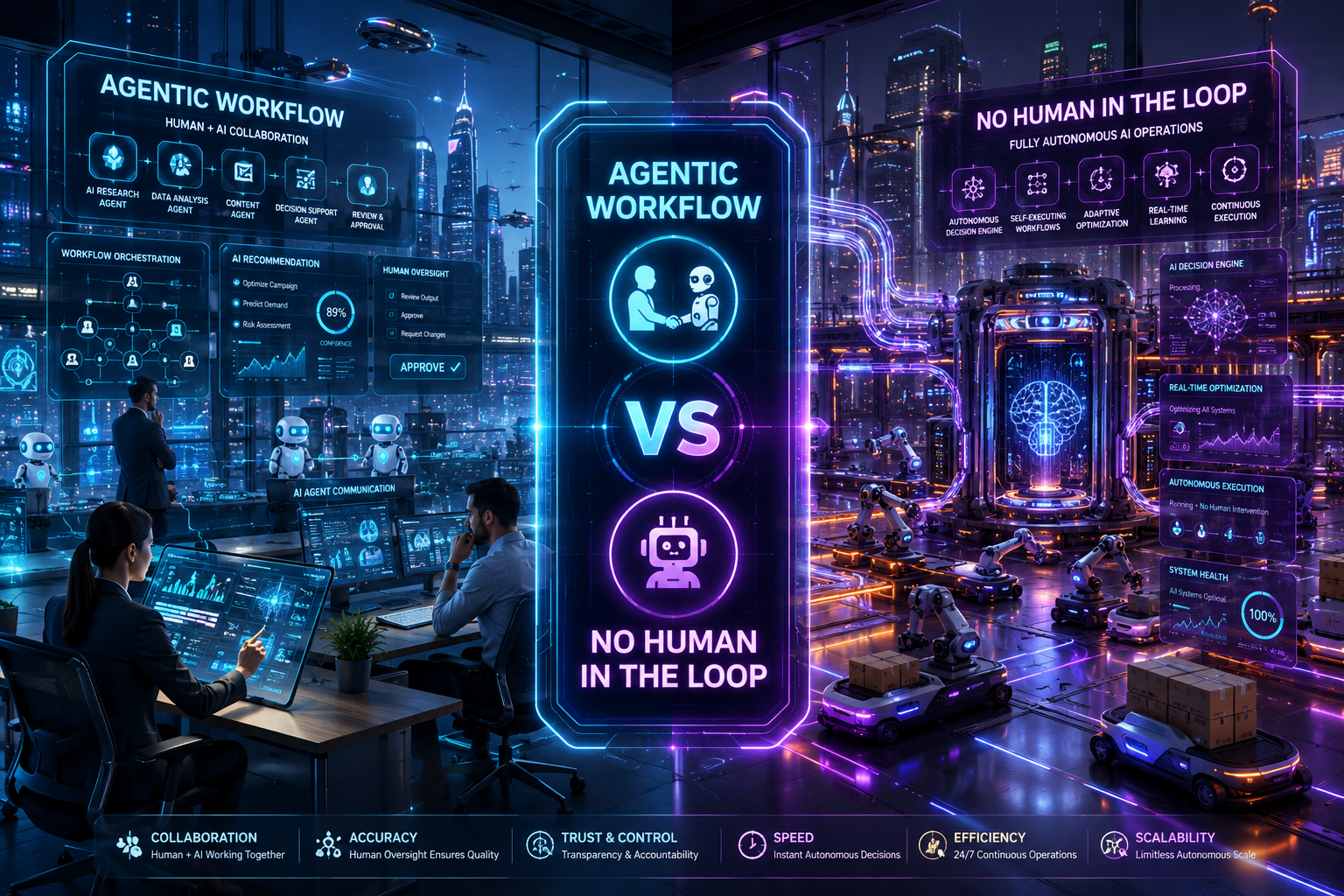
Agentic Workflow refers to an AI-powered system where intelligent AI agents perform tasks, make decisions, communicate with other agents, and work toward achieving a goal. These AI agents can plan, reason, analyze information, and execute actions while still allowing human supervision when needed.
Unlike traditional automation, agentic systems do not simply follow fixed instructions. They can adapt to changing situations and make decisions based on available information.
In simple words, an agentic workflow is like having a team of virtual employees that can think, coordinate, and complete tasks with minimal human guidance.
For example:
- An AI research agent collects information.
- An AI writing agent creates content.
- An AI editing agent improves the content.
- A human reviews the final result before publication.
This is an example of an agentic workflow where AI agents collaborate and humans remain part of the process.
Key Characteristics of Agentic Workflow
Agentic workflows have several unique features that make them different from traditional automation.
Goal-Oriented Behavior
The AI focuses on achieving a specific objective rather than following simple commands.
Autonomous Decision-Making
AI agents can make decisions based on available data and changing conditions.
Multi-Agent Collaboration
Multiple AI agents can work together to complete complex tasks.
Continuous Learning
Many agentic systems improve their performance over time through feedback and experience.
Human Oversight
Humans can monitor, review, and intervene when necessary.
What Is No Human in the Loop?
No Human in the Loop (NHITL) is a fully autonomous AI system that performs tasks, makes decisions, and executes actions without any human involvement during operation.
In this model, once the system is configured and deployed, it operates independently.
The goal is complete automation where human participation is not required for daily activities.
For example:
- An AI system monitors inventory.
- It predicts stock shortages.
- It automatically places supplier orders.
- It processes payments.
- It updates records.
All these actions occur without human approval.
This represents a true No Human in the Loop workflow.
Key Characteristics of No Human in the Loop Systems
Several features define NHITL systems.
Full Automation
The system performs tasks independently.
Real-Time Decision-Making
Decisions happen instantly without waiting for human approval.
Minimal Operational Costs
Human labor requirements are significantly reduced.
High Scalability
The system can manage large volumes of work continuously.
Continuous Operation
The AI can work 24/7 without breaks.
Understanding the Core Difference
Many people think Agentic Workflow and No Human in the Loop are the same. However, they have one major difference.
Agentic workflows typically include some level of human supervision.
No Human in the Loop removes humans entirely from operational decision-making.
The distinction becomes clear when examining control and responsibility.
Agentic Workflow
- AI performs tasks.
- AI makes recommendations.
- Humans review important decisions.
- Humans can intervene anytime.
No Human in the Loop
- AI performs tasks.
- AI makes decisions.
- AI executes actions.
- Humans are not involved during operation.
The presence or absence of human oversight is the biggest difference.
How Agentic Workflows Work
Agentic workflows usually follow a structured process.
Step 1: Goal Assignment
A human or system defines the objective.
Step 2: Planning
AI agents create a strategy to achieve the goal.
Step 3: Task Distribution
Different agents handle specific responsibilities.
Step 4: Execution
Agents complete assigned tasks.
Step 5: Monitoring
Agents track progress and adjust actions.
Step 6: Human Review
Humans review critical outputs if necessary.
Step 7: Final Delivery
The completed work is delivered.
This approach balances automation and human control.
How No Human in the Loop Systems Work
NHITL systems operate differently.
Step 1: Initial Setup
Humans configure rules, objectives, and limitations.
Step 2: Data Collection
AI gathers information continuously.
Step 3: Decision-Making
The system analyzes data and chooses actions.
Step 4: Execution
Actions are performed automatically.
Step 5: Continuous Optimization
The AI adjusts operations based on results.
Once deployed, humans do not participate in routine operations.
Benefits of Agentic Workflow
Agentic workflows offer several advantages.
Better Accuracy
Human review helps reduce mistakes.
Increased Productivity
AI handles repetitive work while humans focus on strategy.
Reduced Risk
Humans can prevent harmful decisions.
Improved Flexibility
AI agents can adapt to changing situations.
Higher Trust
Organizations often trust systems with human oversight more than fully autonomous systems.
Benefits of No Human in the Loop
Fully autonomous systems also provide powerful advantages.
Faster Decisions
No waiting for human approval.
Lower Costs
Reduced labor expenses.
Scalability
Large volumes of work can be handled efficiently.
24/7 Operations
The system never stops working.
Consistency
AI applies the same rules every time.
Challenges of Agentic Workflow
Although beneficial, agentic workflows face certain limitations.
Human Bottlenecks
Approvals may slow down processes.
Additional Costs
Human supervision increases operational expenses.
Coordination Complexity
Managing multiple AI agents can be difficult.
Training Requirements
Employees must learn how to work with AI systems.
Challenges of No Human in the Loop
NHITL systems carry significant risks.
Lack of Human Judgment
AI may miss context that humans understand.
Ethical Concerns
Automated decisions may create fairness issues.
Compliance Risks
Certain industries require human oversight.
Error Amplification
A mistake can spread quickly across the system.
Trust Issues
Organizations may hesitate to hand over complete control.
Agentic Workflow Use Cases
Many industries benefit from agentic workflows.
Content Marketing
AI creates content while humans approve publication.
Customer Support
AI handles routine questions while humans manage complex cases.
Healthcare
AI assists diagnosis while doctors make final decisions.
Financial Services
AI analyzes data while advisors provide recommendations.
Software Development
AI generates code while developers review quality.
No Human in the Loop Use Cases
NHITL works best in predictable environments.
Manufacturing Automation
Machines operate continuously without supervision.
Inventory Management
AI automatically manages stock levels.
Data Processing
Large datasets are analyzed automatically.
Cybersecurity Monitoring
AI detects and responds to threats instantly.
Smart Infrastructure
Traffic systems and energy grids can self-optimize.
Which Industries Prefer Agentic Workflows?
Industries dealing with high-risk decisions often prefer agentic workflows.
Examples include:
- Healthcare
- Legal Services
- Banking
- Insurance
- Education
- Government
Human accountability remains essential in these sectors.
Which Industries Prefer No Human in the Loop?
Industries focused on efficiency and speed often adopt NHITL systems.
Examples include:
- Manufacturing
- Logistics
- Warehousing
- Data Processing
- Industrial Operations
- IoT Networks
These environments typically involve repetitive and structured tasks.
AI Agents and Agentic Workflow
AI agents are the foundation of agentic workflows.
An AI agent can:
- Observe its environment.
- Analyze information.
- Make decisions.
- Take action.
- Learn from outcomes.
Modern agentic systems may use multiple specialized agents.
Examples include:
- Research Agent
- Planning Agent
- Writing Agent
- Coding Agent
- Customer Service Agent
- Analytics Agent
Together, they create highly intelligent workflows.
The Role of Large Language Models
Large Language Models (LLMs) play a major role in agentic systems.
Examples include:
- OpenAI GPT models
- Google Gemini models
- Anthropic Claude models
These models provide reasoning, communication, planning, and content generation capabilities.
Agentic workflows often use LLMs as the intelligence layer behind AI agents.
Security Considerations
Before implementing either approach, organizations must consider security.
Important areas include:
Data Protection
Sensitive information must remain secure.
Access Control
Only authorized systems should access critical functions.
Monitoring
AI decisions should be tracked and recorded.
Compliance
Organizations must follow regulations.
Risk Management
Emergency controls should exist for unexpected behavior.
Human-in-the-Loop vs No Human in the Loop
Many organizations choose a middle ground.
Human-in-the-Loop (HITL) systems combine AI efficiency with human oversight.
Benefits include:
- Better accountability
- Improved trust
- Reduced errors
- Regulatory compliance
For this reason, many experts believe Human-in-the-Loop and Agentic Workflow models will dominate business adoption in the near future.
Future of Agentic Workflow
The future of AI automation is increasingly agentic.
Experts predict:
More Autonomous Agents
Agents will handle increasingly complex tasks.
Better Collaboration
AI agents will communicate more effectively.
Industry-Specific Agents
Specialized agents will emerge for healthcare, finance, law, and education.
Hybrid Intelligence
Humans and AI will work together seamlessly.
Enterprise Adoption
Businesses will integrate agentic systems into daily operations.
Future of No Human in the Loop
NHITL systems will continue expanding where reliability is high.
Future developments may include:
Fully Autonomous Factories
Manufacturing systems operating independently.
Autonomous Logistics Networks
Self-managing supply chains.
Smart Cities
Infrastructure managed by AI.
Automated Financial Operations
Routine financial processes handled without human involvement.
However, regulatory concerns may slow adoption in sensitive industries.
Agentic Workflow vs No Human in the Loop: Which Is Better?
There is no universal answer.
The right choice depends on business goals, industry requirements, and risk tolerance.
Choose Agentic Workflow when:
- Human judgment is important.
- Compliance requirements exist.
- Customer trust matters.
- Decisions carry significant consequences.
Choose No Human in the Loop when:
- Tasks are repetitive.
- Speed is critical.
- Processes are predictable.
- Large-scale automation is required.
Many organizations will ultimately use a hybrid approach that combines both models.
Conclusion
The debate around Agentic Workflow vs No Human in the Loop represents one of the most important discussions in modern AI. Agentic workflows focus on collaboration between humans and intelligent AI agents, creating a balance between automation and oversight. No Human in the Loop systems aim for complete autonomy, maximizing speed, scalability, and efficiency.
While fully autonomous systems offer impressive benefits, they also introduce risks related to accountability, ethics, compliance, and trust. Agentic workflows provide a safer and more flexible path for many businesses, especially in industries where human judgment remains valuable.
As AI technology continues to evolve, organizations will increasingly adopt a combination of these approaches. Understanding their strengths and limitations today will help businesses prepare for the future of intelligent automation and make better strategic decisions in the years ahead.
Read More Blogs- AI Startup Edge
Frequently Asked Questions (FAQs)
1. What is an agentic workflow?
An agentic workflow is an AI-driven process where intelligent AI agents perform tasks, make decisions, and collaborate to achieve goals while allowing human oversight when needed.
2. What does No Human in the Loop mean?
No Human in the Loop refers to a fully autonomous AI system that operates, makes decisions, and executes actions without human intervention during operation.
3. What is the main difference between Agentic Workflow and No Human in the Loop?
The main difference is human involvement. Agentic workflows include human supervision, while No Human in the Loop systems operate independently.
4. Are agentic workflows safer than NHITL systems?
Generally, yes. Human oversight helps reduce errors, manage risks, and ensure compliance with regulations.
5. Which industries benefit most from agentic workflows?
Healthcare, finance, legal services, education, government, and customer service industries often benefit from agentic workflows.
6. Which industries use No Human in the Loop systems?
Manufacturing, logistics, warehousing, cybersecurity monitoring, and data processing industries frequently use NHITL systems.
7. Can AI agents work together in an agentic workflow?
Yes. Multiple AI agents can collaborate, share information, and complete different parts of a workflow.
8. Will No Human in the Loop replace human jobs completely?
Not entirely. While some repetitive tasks may become fully automated, humans will still be needed for strategy, creativity, ethics, leadership, and complex decision-making.
9. Is Agentic AI the future of business automation?
Many experts believe agentic AI will become a major part of business automation because it combines AI efficiency with human control.
10. Which approach should businesses choose?
Businesses should choose Agentic Workflow when oversight and accountability are important. They should choose No Human in the Loop when tasks are predictable, repetitive, and suitable for full automation.