


RPA vs AI agents is the automation question every startup faces in 2026. Both save time. However, they work in very different ways. For example, RPA follows fixed scripts. In contrast, AI agents reason toward a goal. This guide explains the difference, the real costs, and when to use each.
RPA vs AI Agents: The Core Difference
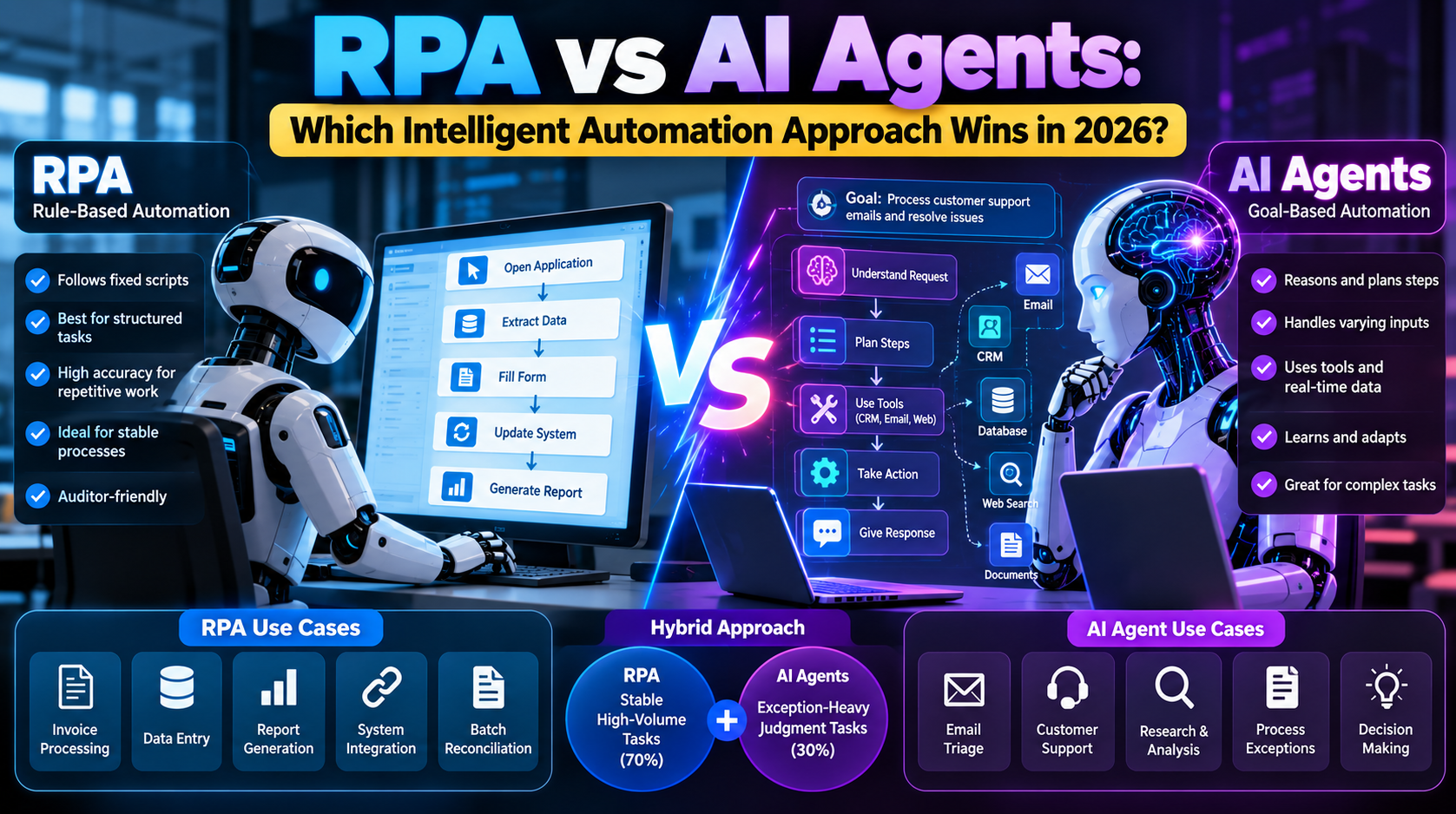
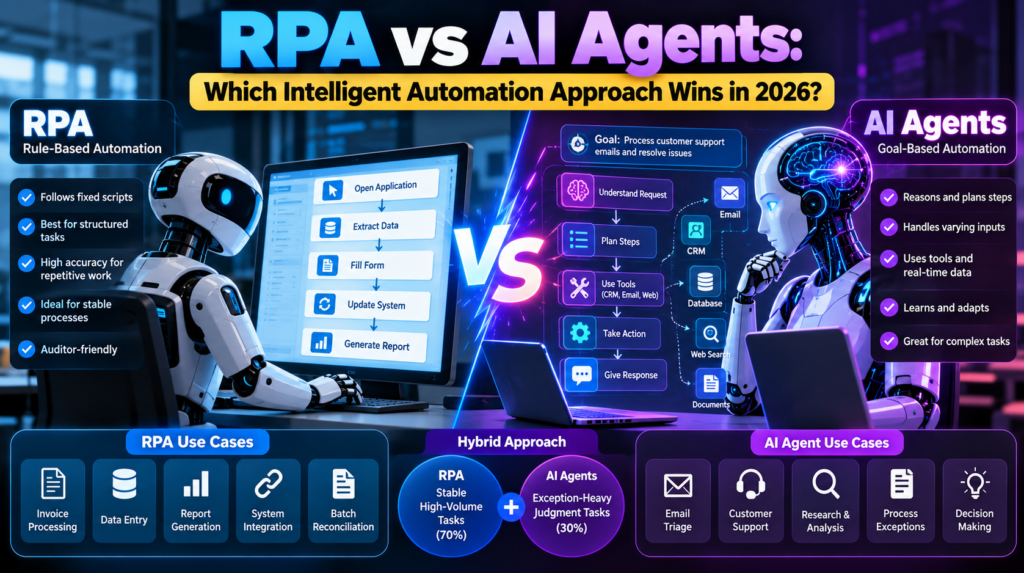
Put simply, RPA records deterministic steps against known interfaces. An AI agent gets a goal, a set of tools, and permission to decide the steps itself. As a result, RPA breaks when the input changes. Agents handle ambiguity and variation. That is the heart of the intelligent automation shift.
- Logic: RPA uses fixed scripts. Agents use model-driven reasoning.
- Tolerance: RPA breaks on variation. Agents adapt to it.
- Failure mode: RPA fails loudly with an alert. Agents can fail quietly with a plausible but wrong answer.
- Maintenance: RPA needs fixes when interfaces change. Agents need monitoring for model and prompt drift.
When RPA Is Still the Better Choice
In practice, RPA excels at structured, high-volume, stable work. For instance, think batch reconciliations, form filling between systems, and scheduled report pulls. Moreover, determinism also suits regulated settings, because auditors prefer explicit scripts. Additionally, invoice processing and records migration are classic examples.
When AI Agents Win in the RPA vs AI Agents Debate
Agents shine when inputs vary and judgment is needed. For example, triaging inbound email, reconciling exceptions, and multi-step research. These cases make up roughly 40 to 60% of process volume that teams historically kept manual. In other words, agents unlock work that RPA never could.
RPA vs AI Agents: Cost Comparison
Costs differ in shape, not just size. An unattended RPA bot runs about $10,000 to $25,000 per year in licensing. Yet licensing is only 25 to 30% of total cost. Maintenance often adds three to four times the license fee annually. Meanwhile, AI automation has lower fixed fees but variable per-token costs.
- RPA break-even: about 6 to 18 months.
- AI automation break-even: about 2 to 8 months.
- Hybrid break-even: about 4 to 10 months.
The Hybrid Approach Most Teams Choose
Most mature programs layer both. RPA handles the stable backbone, roughly 70% of volume. Agents handle the exception-heavy 30% and decide which flows to trigger. Overall, this combines judgment with safety. Furthermore, it keeps the number of RPA bots low.
Risks to Manage With AI Agents
However, agents can confidently do the wrong thing without triggering an alarm. Therefore, they need action-level evaluation. That means sampled review of decisions, guardrails on tool calls, and rollback paths. Specifically, budget about 10 to 20% of agent run cost for this oversight.
How to Choose Between RPA vs AI Agents
- List your processes and mark each as stable or variable.
- Keep stable, high-volume rule-based tasks on RPA or simple workflow tools.
- Give variable, unstructured, judgment-heavy tasks to agents.
- Add human approval on any high-impact agent action.
- Measure cost per task and exception rates, then rebalance quarterly.
Next Steps
Fortunately, startups rarely need enterprise RPA licenses. Instead, lightweight tools like n8n cover the deterministic layer well. See our n8n automation ideas for startups and agentic AI workflows guides. For more cost detail, Techsy’s RPA vs AI automation comparison is a useful reference. Overall, the winning setup is usually a hybrid.
FAQ: RPA vs AI Agents
Will AI agents replace RPA?
Not entirely. RPA stays useful for stable, auditable, high-volume tasks. Agents take over the variable work, and most teams run both.
Which is cheaper for a startup?
AI automation usually has the lower upfront cost and faster break-even. RPA licenses and maintenance add up quickly for small teams.
Is RPA vs AI agents an either-or choice?
No. A hybrid model, with RPA for the deterministic backbone and agents for exceptions, is the most common mature setup.