



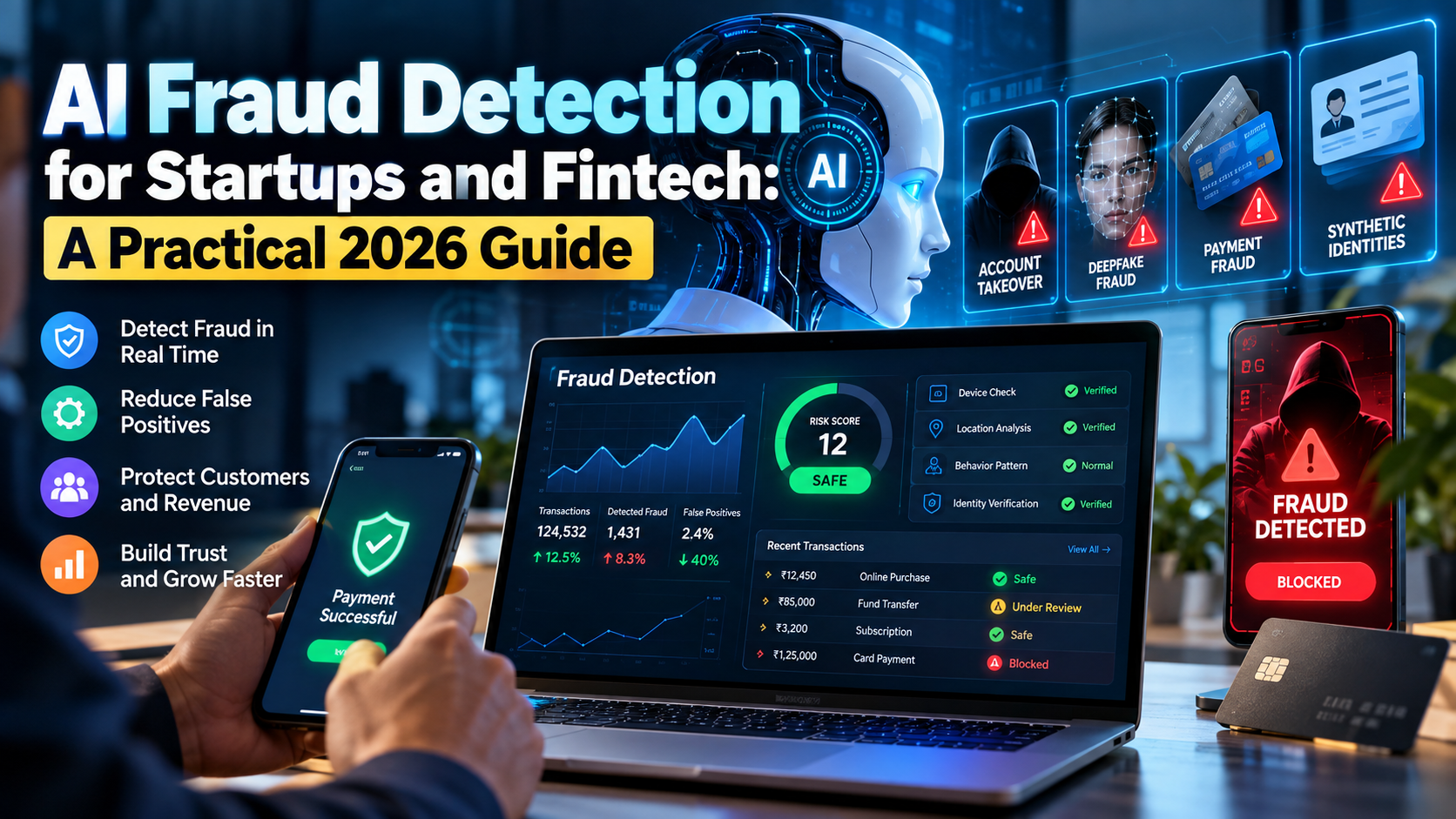
AI fraud detection for startups is no longer a nice-to-have. Fraudsters now use AI too, so rule-based filters fall behind fast. More than 80% of leading banks already run AI fraud detection. Fintech startups need the same protection, without a bank-sized budget. This guide explains how it works, what it costs, and whether to build or buy.
Why AI Fraud Detection for Startups Matters Now
Legacy rule systems generate 70 to 80% false positives. That means real customers get blocked while fraud still slips through. In contrast, machine learning models catch two to three times more fraud at the same false positive rate, according to McKinsey. Deepfakes add a new layer of risk. Gartner found that 62% of organizations faced a deepfake-enabled attack in the past year. Humans spot fakes only about 55% of the time, which is close to chance.
How AI Fraud Detection Works
A fraud model scores every transaction in real time. It looks at device, location, amount, timing, and past behavior. Then it returns a risk score within a few hundred milliseconds. Low scores pass through. High scores get blocked or sent to review.
- Supervised models learn from labeled past fraud and flag similar patterns.
- Anomaly detection spots behavior that differs from a user’s normal pattern, including brand-new fraud types.
- Graph models link accounts, devices, and cards to uncover fraud rings.
- Behavioral analytics catch account takeover, with about 91% accuracy and under 5% false positives in published benchmarks.
AI Fraud Detection for Startups: Build vs Buy
This is the biggest decision you will make. Most early-stage teams should buy first. Specifically, a SaaS platform reaches production in 60 to 90 days. It also needs far less data science staff.
- Buy if you process under 1 million transactions a month, face standard fraud patterns, and need to launch within 90 days.
- Build if you exceed 1 million monthly transactions, need sub-300ms scoring, or must keep data inside your own infrastructure.
- Build if you face niche fraud, such as BNPL bust-out or crypto wash trading, where your own data is the moat.
What AI Fraud Detection for Startups Costs
Costs vary widely by approach. A proof of concept runs roughly $15,000 to $30,000 over two to four weeks. A single production model costs $50,000 to $150,000. Enterprise multi-layer systems start above $150,000. Meanwhile, year-one SaaS licensing typically lands between $60,000 and $180,000. Payback is often fast. High-volume BNPL lenders can recover costs in under 60 days.
Steps to Launch AI Fraud Detection for Startups
- Map your fraud risks: card testing, account takeover, synthetic identities, and payment fraud.
- Collect clean data: transactions, device signals, and confirmed fraud labels.
- Pick a vendor or build a baseline model, aiming for at least 94% accuracy.
- Run in shadow mode first, so the model scores traffic without blocking anyone.
- Turn on blocking gradually, with human review for borderline scores.
- Retrain regularly, because fraud patterns shift constantly.
Common Mistakes to Avoid
The first mistake is chasing fraud while ignoring false positives. Blocking good customers costs revenue too. Another is skipping human review. Instead, keep analysts in the loop for edge cases. Teams also forget deepfake risk in onboarding. Add liveness checks to your KYC flow. Finally, many startups never retrain. Models decay quickly as fraudsters adapt.
Next Steps for AI Fraud Detection for Startups
Start small and measure everything. For a wider view of automation options, see our AI automation projects guide and our AI workflow automation guide. For a deeper look at costs, GroovyWeb’s build vs buy breakdown is a useful reference. Overall, startups that act early protect both revenue and customer trust.
FAQ: AI Fraud Detection for Startups
How accurate is AI fraud detection?
Production models typically reach 93 to 97% precision and recall. Rule-based systems usually reach only 60 to 70% at acceptable recall.
Can a small fintech afford it?
Yes. SaaS platforms let small teams launch in 60 to 90 days without building models in-house. Many vendors scale pricing with transaction volume.
Does AI help against deepfake fraud?
Yes. Humans detect deepfakes only about 55% of the time, so automated liveness and document checks are essential in onboarding.