


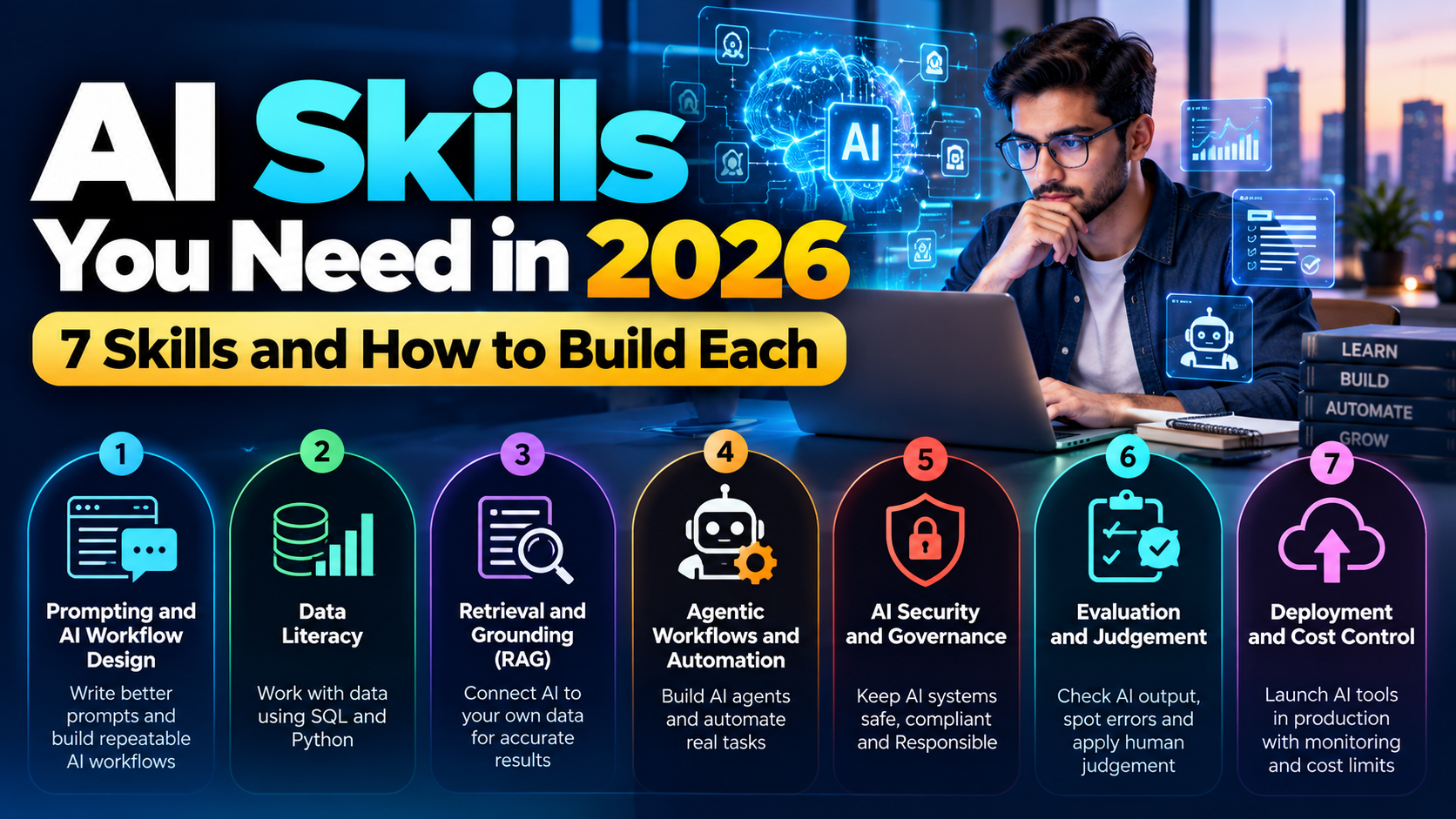
The AI skills you need in 2026 are not all technical. Employers pay for people who can use AI, check its output and put it into real work. This guide names seven skills and shows how to build each one.
The numbers explain the urgency. PwC’s 2026 Global AI Jobs Barometer found that jobs requiring specific AI skills grew 69%, against 9% for the overall job market. It also reports an average wage premium of 62% for AI skills, up from 57% a year earlier.
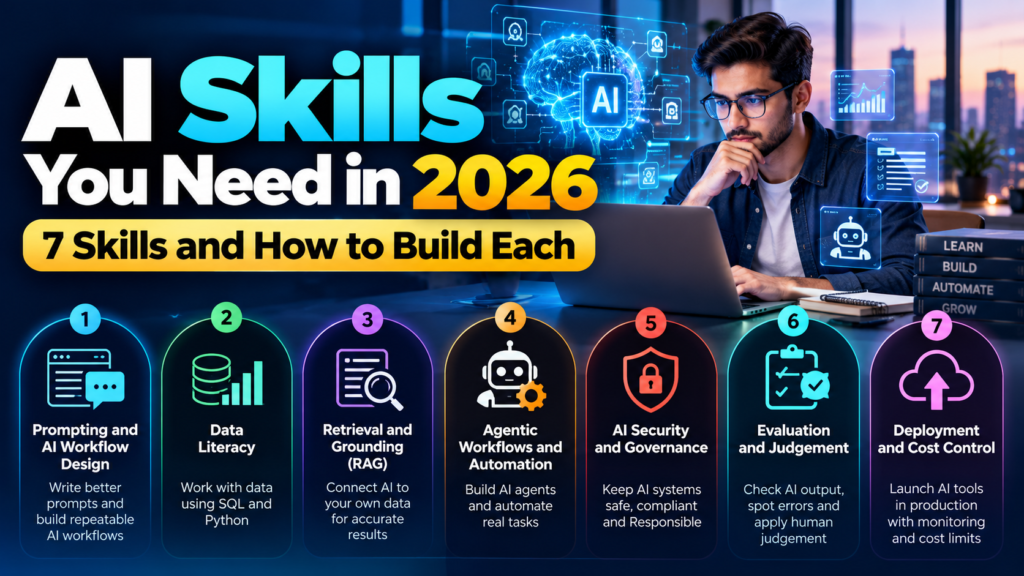
Why the AI Skills You Need in 2026 Go Beyond Coding
Importantly, AI skills are spreading across every function. Lightcast data, cited by TripleTen, shows that 51% of job postings requiring AI skills sit outside IT. Those postings also advertise salaries about 28% higher.
PwC adds a second finding. Entry-level roles most exposed to AI are seven times more likely to ask for senior-level human skills, such as judgement and adaptability. Therefore, the list below mixes technical and human skills on purpose.
Skill 1: Prompting and AI Workflow Design
First, prompting is the entry point. It means giving a model clear context, a task and a format. Beyond that, workflow design chains several prompts into a repeatable process.
- Write prompts with a goal, constraints and an example of good output.
- Save the prompts that work as reusable templates.
- Break big tasks into steps a model can check.
Skill 2: Data Literacy
In short, models are only as good as the data behind them. Basic SQL and Python let you pull, clean and question data yourself. As a result, you spot bad inputs before they reach a model.
Gartner analysts predict that 60% of AI projects will fail in 2026 because of poor data readiness, as cited by TripleTen. Data skills are a direct hedge against that risk.
Skill 3: Retrieval and Grounding (RAG)
Next, retrieval-augmented generation connects a model to your own documents. This makes answers more accurate and easier to trace. For most business use cases, it matters more than fine-tuning.
To begin, start small. Index one folder of documents, ask ten real questions and note where answers fail.
Skill 4: Agentic Workflows and Automation
Similarly, agents plan steps and use tools without being told each move. Building them well is now a hiring signal. For a hands-on start, see our guide to building AI agents from scratch.
Automation tools help here as well. Our n8n vs Zapier vs Make comparison shows which one fits which team.
Skill 5: AI Security and Governance
Finally, every new AI tool adds risk. Prompt injection, data leaks and shadow AI are common examples. Consequently, security and governance skills are moving from specialist to expected.
Our post on AI in cybersecurity enterprise trends covers the numbers behind this shift.
Skill 6: Evaluation and Judgement
Meanwhile, AI output looks confident even when it is wrong. The skill is checking it. That means testing against known answers, spotting weak reasoning and knowing when to override the model.
Notably, this is the human skill PwC points to. Judgement is hard to automate, so it grows in value as AI spreads.
Skill 7: Deployment and Cost Control
Lastly, shipping an AI feature is different from demoing one. You need monitoring, cost limits and a plan for model drift. TripleTen cites a survey in which 78% of executives who experienced drift reported a significant negative business impact.
Our production checklist gives a practical list of what to test before launch.
Build the AI Skills You Need in 2026 in 90 Days
- Days 1–30: Practise prompting daily and learn basic SQL.
- Days 31–60: Build one RAG project and one small automation.
- Days 61–90: Add evaluation tests, then deploy the project with monitoring.
Above all, keep the project small and real. A working tool for your own job teaches more than a dozen tutorials.
Final Thoughts on the AI Skills You Need in 2026
Overall, the seven skills fit together. Prompting and data get you started. Retrieval and agents give you power. Security, evaluation and deployment keep that power safe. Pick the weakest one and begin there.
Sources: PwC 2026 Global AI Jobs Barometer; TripleTen: AI skills to learn in 2026 (which cites Lightcast, Gartner and other surveys).