



Artificial General Intelligence (AGI) is one of the biggest questions in the world of technology. Many people want to know when machines will become smart enough to perform almost any intellectual task that humans can do. Some technology leaders believe AGI could arrive within the next few years, while others think it may take much longer. But who is right, and how close are we really to this major change?
In 2026, AI tools can write articles, create images, answer questions, write computer code, and help people complete many daily tasks. However, these abilities do not automatically mean that AGI has arrived. Scientists still disagree about what AGI should be able to do and how we should measure it.
This article explains when AGI might arrive, what experts predict, what current AI can and cannot do, and which challenges remain. You will also learn how AGI could affect jobs, businesses, education, and everyday life. By the end, you will have a clearer understanding of the AGI timeline and what it may mean for your future.
1. What Is AGI and Why Is Everyone Talking About It?
Artificial General Intelligence, also called AGI, is a type of artificial intelligence that could learn, understand, reason, and solve problems across a wide range of tasks at a level comparable to humans or better.
Today, many AI tools are designed to perform particular tasks. They can answer questions, write computer programs, summarize documents, analyze information, or create pictures. AGI would be different because it would be able to handle many different kinds of intellectual work without needing a separate system for every task.
For example, imagine an AI system that can learn a new language, understand a business problem, develop a scientific idea, create a software application, and improve its approach after making mistakes. It could use its knowledge from one area to solve problems in another.
That is the broad idea behind AGI.
However, there is no single definition of AGI accepted by every researcher. OpenAI describes its goal in terms of highly autonomous systems that outperform humans at most economically valuable work, while other researchers use broader measures of human-level cognitive ability.
This difference matters because experts may give different arrival dates simply because they are talking about different levels of AI capability.
2. When Will AGI Arrive? The Short Answer for 2026
AGI could arrive within the next few years, but there is no confirmed date. Some technology leaders believe human-level AI could emerge around 2027–2030. Other researchers expect a longer development period and question whether today’s AI methods are enough to achieve full general intelligence.
For example, Google DeepMind CEO Demis Hassabis said in 2026 that AGI might arrive around 2030, plus or minus a year. In contrast, other AI researchers argue that today’s language-model technology still has important limitations.
Here is a simple overview of the possible timeline.
| Possible period | What could happen |
|---|---|
| 2026–2027 | AI agents may become more capable at coding, research, and completing longer tasks. |
| 2028–2030 | Some forecasts place early forms of general-purpose AI in this period. |
| 2030–2035 | More capable systems may perform a broader range of complex professional tasks. |
| After 2035 | AGI could arrive later if important technical problems remain unsolved. |
| No predictable date | AGI may take much longer than expected, or current approaches may not achieve it. |
These periods are possible scenarios, not confirmed milestones. They also refer to different definitions of AGI, so they should not be treated as directly comparable predictions.
The important point is that AI is advancing quickly, but progress in individual skills does not prove that a machine has achieved general intelligence.
3. What Do Experts Predict About the AGI Timeline in 2026?
Experts disagree about the arrival of AGI because they have different views about current AI systems, future research, and the meaning of human-level intelligence.
Some expect improvements to continue quickly as companies build larger and more capable models. Others believe that new scientific discoveries will be necessary before machines can reason and learn as flexibly as humans.
The following opinions help explain the range of possible outcomes.
3.1 Demis Hassabis: AGI Could Arrive Around 2030
Organization: Google DeepMind
Demis Hassabis leads Google DeepMind, a major AI research organization. He has spoken about the possibility of AGI arriving within the next several years.
In a 2026 discussion at Stanford Graduate School of Business, Hassabis suggested that AGI could arrive around 2030, plus or minus a year.
His forecast reflects the belief that continued AI research may produce systems with much broader intellectual abilities than current tools.
However, a forecast is not a guarantee. Even leading researchers cannot know exactly how quickly future discoveries will happen.
3.2 Dario Amodei: AI Progress Could Be Very Fast
Organization: Anthropic
Dario Amodei, the CEO of Anthropic, has expressed a more aggressive view of AI progress. He has discussed the possibility of AI systems reaching very high levels of scientific and professional performance within a short period.
At the World Economic Forum in January 2026, Amodei made strong predictions about AI’s ability to perform software development and advanced scientific work. Other leaders at the same event expressed more cautious views.
His position highlights an important possibility: AI may improve quickly enough to change many industries before society fully understands its long-term effects.
Still, strong predictions should not be confused with proof that AGI is already here or that it must arrive by a particular year.
3.3 Sam Altman: AGI Could Transform Work
Organization: OpenAI
Sam Altman, CEO of OpenAI, has discussed AGI as a major technological development that could change how people work, conduct research, and create new products.
OpenAI’s stated definition focuses on highly autonomous systems that outperform humans at most economically valuable work.
This definition places considerable importance on practical ability. An AI system would not need to look or behave exactly like a human to qualify under this approach. What matters is whether it can perform a broad range of valuable tasks with a high level of independence.
However, the exact date when such a system will become available remains uncertain. Predictions about AI capabilities also depend on how researchers define and test AGI.
3.4 Yann LeCun: Current AI Methods May Not Be Enough
AI researcher and deep learning pioneer
Yann LeCun has challenged the idea that simply making today’s large language models bigger will automatically produce human-level intelligence.
At the January 2026 World Economic Forum, LeCun argued that current language-model approaches would not be sufficient on their own to create human-like general intelligence. Hassabis also expressed concerns about how far current systems are from full AGI.
This view suggests that future AI research may need different methods for understanding the physical world, learning from experience, planning, and reasoning.
If major technical changes are required, AGI could take longer than optimistic forecasts suggest.
3.5 Ben Goertzel: AGI Could Be Closer Than Expected
Role: AI researcher and SingularityNET CEO
Ben Goertzel has also expressed an optimistic view. In an August 2026 interview with IBM, he said recent progress in AI agents had increased his estimate that an AGI breakthrough could occur within the next nine to twelve months. He also acknowledged that this outcome was uncertain.
His view shows how quickly individual forecasts can change when new AI capabilities appear.
Nevertheless, an optimistic estimate from one researcher does not establish a scientific consensus. Different researchers use different tests, assumptions, and definitions when forecasting AGI.
What can we learn from these expert opinions?
The opinions above show that there is no agreement on a single arrival year. Some experts expect progress within a few years, while others question whether the current technical path will be enough.
A useful way to read these predictions is to separate three questions:
- When will AI perform most intellectual tasks at a human level?
- When will AI complete valuable professional work reliably without close supervision?
- When will AI demonstrate broad, flexible intelligence across unfamiliar situations?
These are related questions, but they are not identical. A system might perform extremely well in one area long before it achieves general intelligence.
4. Why Do Experts Disagree About When AGI Will Arrive?
It may seem strange that experts working in the same industry cannot agree on a timeline. However, AGI is a difficult problem, and several important questions remain unanswered.
4.1 There Is No Universal Definition of AGI
The first problem is deciding what counts as AGI.
Some people define AGI as AI that can perform almost every intellectual task a human can perform. Others focus on whether AI can complete most economically valuable jobs independently.
For example, an AI system might be excellent at writing code and solving mathematics problems but still struggle to manage an unfamiliar real-world situation. Would that system qualify as AGI? Different researchers might give different answers.
Until there is a widely accepted definition and testing method, predictions will remain difficult to compare.
4.2 AI Progress May Continue Quickly
AI models have become useful for writing, programming, information analysis, and other tasks. Researchers are also developing AI agents that can work through several steps instead of responding to only one instruction.
If these improvements continue, AI systems could become capable of handling longer and more complex tasks.
However, past progress does not guarantee that future improvements will happen at the same speed. Some problems may become harder as AI systems approach the limits of current methods.
4.3 Current AI Still Has Important Weaknesses
Modern AI systems can produce impressive answers and still make mistakes. They may misunderstand instructions, invent information, overlook important details, or fail when a task differs from their training examples.
AGI would need to handle unfamiliar problems much more reliably.
Researchers must also improve areas such as long-term planning, memory, learning from new experiences, and checking whether a solution is correct.
4.4 Computing Power and Data Have Limits
Developing advanced AI requires computing equipment, electricity, high-quality data, research, and money.
Building more powerful systems can become increasingly expensive. Researchers must also find ways to improve performance without relying only on larger models and greater computing resources.
Some experts believe that future breakthroughs will allow continued progress. Others believe current approaches may reach important limits.
4.5 Real-World Intelligence Is Difficult to Measure
A machine might pass an examination and still struggle with a practical task that requires judgment, changing plans, or dealing with unexpected problems.
Human intelligence includes many abilities, such as learning from experience, understanding context, adapting to change, and working with other people.
Testing AGI will require more than checking whether an AI can answer difficult questions. Researchers will need to evaluate its performance across many tasks and situations.
5. What Is the Difference Between Today’s AI and AGI?
To understand the AGI timeline, it helps to compare current AI systems with the kind of general intelligence researchers are trying to develop.
Today’s AI can perform many useful tasks, but its capabilities are uneven. It can be excellent at one problem and unreliable at another.
| Feature | Today’s AI | AGI goal |
|---|---|---|
| Writing | Can produce articles, emails, and reports | Could handle a wide range of writing tasks with flexible understanding |
| Coding | Can write, explain, and debug code | Could independently manage many unfamiliar software projects |
| Learning | Often depends on training and available context | Could learn new skills more flexibly from experience |
| Reasoning | Can solve many problems but may make mistakes | Could reason reliably across a broad range of situations |
| Planning | Can create plans and use tools, with limitations | Could manage complex, long-term goals more independently |
| Adaptability | Performance varies across tasks | Could transfer knowledge between unfamiliar tasks |
| Reliability | May produce incorrect information | Would need much stronger reliability and error checking |
This comparison describes a general goal, not a guarantee that every AGI system will have identical abilities.
It is also important to understand that AGI does not necessarily mean consciousness. A system could potentially demonstrate broad intellectual abilities without proving that it has feelings, self-awareness, or human-like experiences.
6. Could AGI Arrive in 2026?
This is one of the most common questions people ask when researching AGI predictions.
AGI arriving in 2026 is a possibility discussed by some forecasters, but it is not an established fact or a confirmed scientific milestone.
In August 2026, Ben Goertzel said that recent AI progress had increased his estimate of an AGI breakthrough within nine to twelve months. That is one person’s forecast, not proof that AGI will arrive within that period.
To assess whether AGI is approaching, it is useful to look for evidence of broad and reliable capabilities rather than relying on announcements or impressive demonstrations.
Researchers would need to examine whether an AI system can:
- Learn unfamiliar intellectual tasks without extensive task-specific training.
- Apply knowledge from one field to another.
- Complete complex tasks over long periods.
- Identify and correct its own errors.
- Work reliably with limited human supervision.
- Perform across a broad range of tasks rather than only a selected set of tests.
These capabilities would provide useful evidence of progress. However, no single item on this list automatically proves that a system is AGI.
The distinction is important because AI companies may use different definitions of AGI when describing their products or future goals.
7. What Could Happen Between 2026 and 2030?
The years between 2026 and 2030 could be important for AI development, even if AGI does not arrive during this period.
Rather than assuming that one particular year will change everything, it is more useful to consider several possible scenarios.
Scenario 1: Rapid Progress
In this scenario, AI models become much better at reasoning, coding, research, and using digital tools. AI agents handle more complicated tasks with less supervision.
If these improvements combine with better memory and planning, some systems might begin to meet certain definitions of early AGI.
However, rapid progress in professional tasks would not automatically establish that AI can handle every important area of human intelligence.
Scenario 2: Steady but Uneven Progress
In this scenario, AI continues to improve, but its abilities remain uneven.
It might become excellent at analyzing information and writing software while still struggling with complex judgment, unusual situations, or tasks requiring dependable long-term action.
Businesses could benefit greatly from these systems even if they do not qualify as AGI.
This is an important possibility because AI does not need to reach human-level intelligence in every area to become economically valuable.
Scenario 3: Progress Slows Down
In this scenario, researchers encounter difficult problems that cannot be solved simply by increasing computing power or training models on more data.
New approaches may be needed for learning, reasoning, planning, or understanding the physical world.
If these challenges take a long time to solve, AGI could arrive much later than some current forecasts suggest.
Which scenario is most likely?
There is not enough evidence to assign a dependable answer to every scenario. The safest approach is to prepare for continued AI progress while recognizing that the exact AGI timeline remains uncertain.
For individuals and businesses, the practical effects of increasingly capable AI may matter more in the short term than the date on which experts officially declare AGI has arrived.
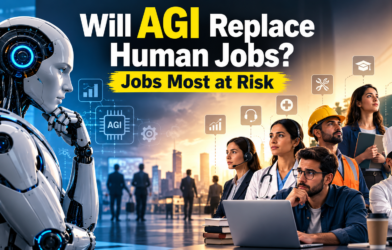
8. How Will AGI Affect Jobs and Careers?
One reason people want to know when AGI will arrive is that it could change the way people work.
AI already helps with tasks such as writing, customer support, data analysis, software development, and document preparation. More capable systems could take on a larger share of these activities.
However, the effects on employment will depend on how capable AI becomes, how quickly businesses adopt it, and how organizations choose to use it. It would be misleading to claim that every job will disappear when AGI arrives.
Jobs that could experience major changes
Some occupations involve many digital tasks that AI systems may increasingly assist with or automate.
Examples include:
- Content writing: AI may help prepare first drafts, research topics, and organize articles.
- Digital marketing: AI may assist with keyword research, campaign planning, and performance analysis.
- Software development: AI may write code, test applications, and help find errors.
- Customer support: AI agents may answer common questions and handle routine requests.
- Data analysis: AI may summarize reports, identify patterns, and explain business results.
- Administrative work: AI may help prepare documents, organize information, and manage repetitive tasks.
These examples describe possible changes, not guaranteed job losses. Many roles include responsibilities that go beyond the tasks AI can perform.
What should workers do to prepare?
People do not need to wait for AGI before preparing for changes in technology.
The following steps can help workers remain adaptable as AI becomes more capable.
- Learn to use AI tools. Understand how AI can support your daily work and where it makes mistakes.
- Build strong communication skills. Clear communication helps people work with customers, teams, and AI systems.
- Develop problem-solving skills. Learn to identify problems, evaluate possible solutions, and make informed decisions.
- Improve your industry knowledge. Understanding your field helps you judge whether AI-generated information is useful and accurate.
- Keep learning. Technology changes quickly, so regularly updating your skills can help you respond to new opportunities.
The main lesson is simple: learning how to work effectively with AI can be valuable whether AGI arrives in 2027, 2030, or much later.
9. How Could AGI Change Businesses and the Economy?
AGI could have a significant economic impact if it becomes capable of completing a broad range of valuable tasks independently.
Businesses might use advanced AI to reduce repetitive work, improve decision-making, develop products, and serve customers more efficiently.
For small businesses, this could create opportunities to compete with larger organizations by using AI for research, content production, customer communication, and data analysis.
For example, a small online business might use AI to analyze customer questions, prepare product descriptions, identify common complaints, and help organize marketing campaigns. More advanced systems could potentially coordinate several of these activities.
However, the benefits would not be automatic. Companies would still need to consider costs, security, accuracy, customer trust, and legal responsibilities.
There are also economic risks. If AI systems automate a large share of certain tasks, some workers may need to change roles or learn new skills. The benefits of increased productivity may also be distributed unevenly between businesses, workers, and countries.
The economic effect of AGI will therefore depend not only on the technology itself but also on education, business decisions, public policy, and access to the systems.
10. What Are the Benefits and Risks of AGI?
AGI could provide important benefits if it becomes reliable and is developed responsibly. However, greater capability could also create new risks.
Understanding both sides gives a more balanced view of why researchers are working on AGI and why its development requires care.
Potential benefits of AGI
Some possible benefits include the following.
- Scientific research: Advanced AI could help researchers analyze evidence, develop hypotheses, and explore possible solutions to difficult scientific problems.
- Healthcare: AI could assist medical researchers with drug discovery, medical data analysis, and the development of new treatments.
- Education: More capable systems could provide personalized explanations and learning support for students.
- Business productivity: AI could help organizations complete complex tasks more quickly and reduce repetitive work.
- Accessibility: AI could make information and digital services easier to use for people with different needs.
- Engineering: Advanced AI could assist with designing materials, improving energy systems, and solving technical problems.
These are potential outcomes rather than guaranteed results. Real benefits would depend on scientific progress, responsible deployment, and human oversight.
Potential risks of AGI
The same capabilities could also create serious challenges.
- Job disruption: Automation could reduce demand for some types of work or change how certain professions operate.
- Incorrect decisions: AI systems could make mistakes that have serious consequences if people trust them without checking.
- Cybersecurity threats: Powerful AI could help malicious users develop more effective attacks.
- Privacy problems: Poorly managed systems could expose confidential or personal information.
- Concentration of power: A small number of organizations could gain significant influence if access to advanced AI is limited.
- Loss of control: Highly autonomous systems could behave in unexpected ways if their actions are not properly constrained.
Researchers and policymakers will need to address these risks as AI capabilities grow. OpenAI, for example, describes safety as an important part of developing increasingly capable AI systems and recognizes that the path to AGI involves multiple stages rather than one sudden leap.
11. How Can We Tell Whether AGI Has Arrived?
A major challenge in predicting AGI is deciding what evidence would prove that it has arrived.
A company announcement alone is not enough. A system might perform extremely well on selected tests without demonstrating broad intelligence in everyday situations.
A stronger assessment would examine performance across many different tasks, including unfamiliar problems, long-term planning, and independent work.
Here are several useful signs researchers may look for.
Broad capability: The system can perform a wide range of intellectual tasks rather than specializing in only a few areas.
Transfer of learning: It can use knowledge from one task to solve a different problem.
Reliable reasoning: It can explain its approach, check results, and correct errors when necessary.
Long-term task completion: It can work toward complex goals over extended periods without repeatedly requiring human intervention.
Adaptability: It can respond effectively when instructions, conditions, or available information change.
Independent evaluation: Its performance can be tested by researchers who are not relying only on the developer’s claims.
Even these signs would need careful interpretation. There is no universally accepted test that every AI system must pass before it can be called AGI.
This is why AGI predictions should always be considered alongside the definition being used and the evidence available at the time.
12. What Can You Do Today to Prepare for AGI?
You do not need to know the exact AGI arrival date to make sensible decisions today.
AI is already useful in many fields, and learning how to use it responsibly can help people prepare for a future in which these tools become more capable.
Here are practical steps that individuals, students, creators, and business owners can take.
- Explore useful AI applications. Try tools that help with writing, research, analysis, design, or other tasks relevant to your work.
- Check AI-generated information. Verify important facts instead of accepting every answer as correct.
- Strengthen your professional skills. Develop expertise that helps you make decisions, understand customers, and solve real problems.
- Automate repetitive work carefully. Start with simple, low-risk tasks and check the results before expanding automation.
- Protect private information. Avoid sharing confidential business data or personal details with tools unless their data policies and settings are suitable.
- Follow credible research. Pay attention to technical evidence and independent evaluations instead of relying only on dramatic headlines.
- Stay flexible. Be prepared to update your knowledge as technology, business practices, and job requirements change.
For businesses, a useful strategy is to identify where AI already saves time, measure the results, and introduce additional automation when it is reliable and appropriate.
For students and workers, the goal should be to combine technical knowledge with human judgment, communication, creativity, and practical experience.
These steps are useful even if AGI takes longer to arrive than expected.
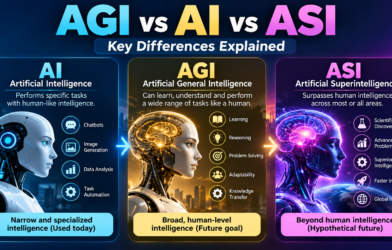
13. AGI vs. AI vs. ASI: What Is the Difference?
People often use AI, AGI, and ASI when discussing the future of artificial intelligence. However, these terms describe different levels or concepts.
| Term | Full form | Simple meaning |
|---|---|---|
| AI | Artificial Intelligence | Technology that performs tasks requiring abilities such as language processing, prediction, or problem-solving. |
| AGI | Artificial General Intelligence | AI that can perform a broad range of intellectual tasks at a human-comparable level or better, depending on the definition. |
| ASI | Artificial Superintelligence | A hypothetical form of AI that would surpass human intellectual abilities across a very wide range of areas. |
Today’s AI systems can already perform many tasks that once required human effort. AGI refers to a broader level of capability, while ASI describes a possible future stage beyond human-level intelligence.
However, these categories are not defined by a single universal test. Researchers may disagree about exactly when a system moves from one category to another.
It is also important to remember that AGI would not automatically lead to ASI. Superintelligence remains a separate possibility, and its timeline is even more uncertain.
14. Is AGI Inevitable?
Many researchers expect AI capabilities to continue improving, but it is difficult to say that AGI is inevitable by a specific date.
Future progress will depend on several factors, including scientific discoveries, computing resources, training methods, and the ability to solve current limitations.
There are at least three possible outcomes.
- AGI through continued progress: Current AI methods improve enough to produce broadly capable systems.
- AGI through new discoveries: Researchers develop new approaches that overcome limitations in today’s technology.
- A longer or different path: Progress slows, important obstacles remain, or today’s approaches fail to achieve the general intelligence researchers want.
These possibilities explain why experts can agree that AI is advancing while disagreeing about when AGI will arrive.
The most reasonable position is to take the possibility seriously without treating any particular forecast as a guaranteed outcome.
15. Final Prediction: When Will AGI Arrive?
So, when will AGI arrive?
Based on the range of expert opinions available in 2026, the late 2020s to early 2030s is one important period to watch, but it is not a confirmed AGI deadline.
Some researchers expect a breakthrough within the next few years. Demis Hassabis has suggested a timeline around 2030, while Ben Goertzel has expressed a more optimistic possibility of an earlier breakthrough. Other researchers remain skeptical that scaling current AI approaches will be enough.
The disagreement exists because AGI is difficult to define, measure, and predict. AI may become much more capable in certain areas without achieving the flexible and reliable intelligence associated with AGI.
For ordinary people, students, professionals, and business owners, the most useful approach is to prepare for continued AI development instead of waiting for a single announcement.
Learn how AI works, develop valuable skills, verify the information it produces, and pay attention to reliable research.
AGI could become one of the most important technological developments in human history. But the real question is not only when it will arrive. It is also whether people can develop, manage, and use it in ways that benefit society.
AI in Cybersecurity: 6 Enterprise Trends for 2026
Frequently Asked Questions About AGI
These frequently asked questions answer common search queries about the AGI arrival date, expert forecasts, and the possible future of artificial intelligence.
1. When will AGI arrive?
AGI could arrive within the next several years, according to some technology leaders, but no exact date is confirmed. Forecasts vary because experts disagree about the definition of AGI and the technical progress still required.
2. Will AGI arrive in 2026?
AGI arriving in 2026 is a possibility raised by some optimistic researchers, but there is no confirmed evidence that it will happen this year. A forecast should not be treated as a guarantee.
3. What year do experts predict for AGI?
Some experts expect AGI around 2027–2030, while others anticipate a longer timeline. The late 2020s and early 2030s are important periods to watch, but later dates remain possible.
4. What does AGI stand for?
AGI stands for Artificial General Intelligence. It describes an AI system designed or expected to perform a broad range of intellectual tasks rather than being limited to a narrow set of activities.
5. Has AGI already been created?
There is no universally accepted, independently verified declaration that settles whether AGI has been achieved. Current AI systems have impressive capabilities, but their performance and limitations must be evaluated against a clear definition of AGI.
6. Who predicts that AGI will arrive around 2030?
Google DeepMind CEO Demis Hassabis suggested in 2026 that AGI could arrive around 2030, plus or minus a year. This is an expert forecast, not a confirmed deadline.
7. Will AGI replace human jobs?
AGI could automate many tasks and change numerous professions. However, the impact will depend on its capabilities, business adoption, regulation, and the types of work involved. It is not possible to say that every job will disappear.
8. What is the difference between AGI and current AI?
Current AI systems can perform many useful tasks but may struggle with unfamiliar problems or reliable long-term work. AGI generally refers to broader, more flexible intellectual abilities across different kinds of tasks.
9. Can AGI become smarter than humans?
AGI could match or exceed human abilities in many intellectual tasks, depending on its definition. An AI that surpasses human intelligence across nearly all relevant areas is more commonly described as artificial superintelligence, or ASI.
10. Will AGI be dangerous?
AGI could introduce risks involving cybersecurity, misinformation, privacy, employment, and control over autonomous systems. These risks are not inevitable, but they require careful research, testing, oversight, and responsible development.
11. Will AGI help humanity?
AGI could help accelerate scientific research, improve education, support medical discoveries, and increase productivity. Whether these benefits are achieved will depend on how the technology is developed, distributed, and governed.
12. What should I learn before AGI arrives?
Learning to use AI tools, evaluate information, solve problems, communicate clearly, and understand your industry can help you prepare. You should also continue building practical skills that remain useful as technology changes.
13. Is AGI the same as artificial superintelligence?
No. AGI refers to broad intellectual abilities comparable to human abilities under a given definition. Artificial superintelligence refers to a hypothetical system that surpasses humans across a much wider range of intellectual activities.
14. Why is it difficult to predict the AGI timeline?
Experts disagree about what AGI means, how to measure it, and whether current AI methods can achieve it. Scientific breakthroughs, computing limits, data quality, and the reliability of future systems also affect the timeline.
15. How will I know when AGI has arrived?
Look for clear definitions, independent evaluations, broad performance across different tasks, reliable reasoning, and the ability to complete complex work with limited supervision. A dramatic product launch or company announcement alone is not sufficient proof.