


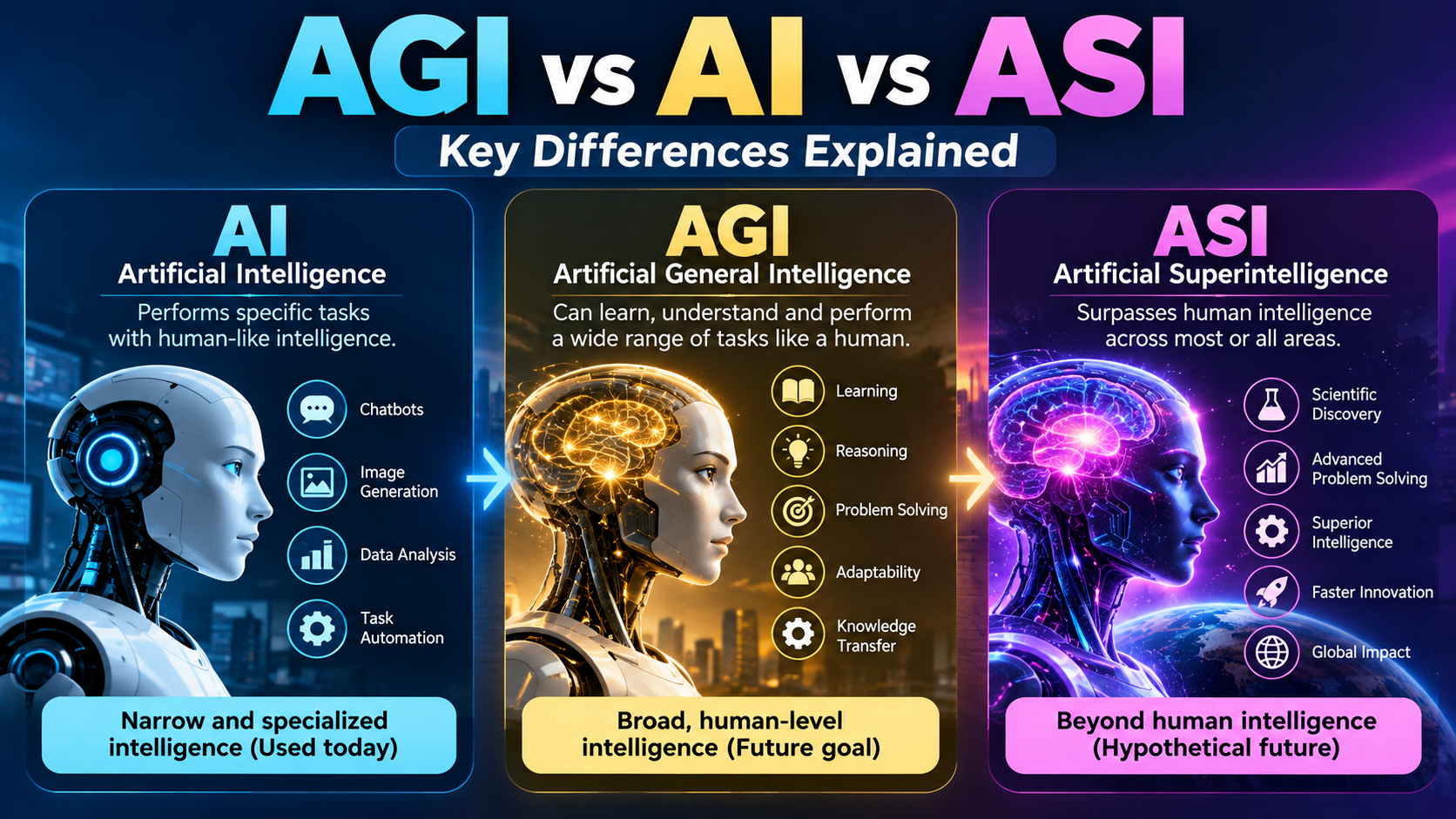
Artificial intelligence is changing the way we work, learn, communicate, and solve problems. From chatbots and smart assistants to self-driving technology, AI is becoming a part of everyday life. However, when people discuss the future of AI, three terms often appear: AI, AGI, and ASI. Although they sound similar, they describe different levels or ideas about machine intelligence. Understanding AGI vs AI vs ASI can help you separate today’s technology from future possibilities. Artificial Intelligence (AI) can perform specific tasks, while Artificial General Intelligence (AGI) refers to a system that can learn and perform a wide range of intellectual tasks at a human-like level. Artificial Superintelligence (ASI) describes a hypothetical system that could surpass human intelligence across most or all important intellectual areas. In this guide, you will learn how these technologies differ, what they can do, their benefits and risks, and how they might affect jobs, businesses, education, and society.
What Is Artificial Intelligence (AI)?
Artificial Intelligence, commonly called AI, is a field of computer science that focuses on creating systems that can perform tasks associated with human intelligence. These tasks include understanding language, recognizing images, finding patterns, making predictions, and generating content.
AI systems use data, algorithms, mathematical models, and computing power to produce results. Some systems follow clearly defined rules, while others learn patterns from large amounts of training data.
Today, AI is already used in many industries. You may interact with AI when you search online, receive a movie recommendation, use a translation app, or ask a chatbot a question.
However, modern AI does not automatically understand everything like a human. A system may be excellent at one task but struggle with another task that requires different skills or unfamiliar real-world experience.
Examples of AI Used Today
AI is already helping individuals and businesses save time, improve services, and make decisions. Here are some common examples.
- AI chatbots: Tools such as ChatGPT can answer questions, explain topics, summarize documents, and help users write content.
- Voice assistants: Digital assistants can recognize spoken commands, set reminders, and answer basic questions.
- Recommendation systems: Streaming platforms and online stores suggest content or products based on user activity.
- AI image generators: These tools create images from text prompts and can help with design and creative projects.
- Fraud detection systems: Banks can use AI to identify unusual transactions and flag potentially suspicious activity.
- Medical AI tools: Certain systems help medical professionals analyze images, organize information, or identify patterns in health data.
- Self-driving technology: AI can help vehicles recognize roads, detect obstacles, and support driving decisions.
These examples show that AI is not just a future idea. It is already being used in real-world applications.
Is Today’s AI Intelligent Like a Human?
Today’s AI can perform some tasks at a level comparable to or better than humans. For example, certain systems can process large amounts of information quickly, identify patterns, or generate computer code.
However, success in one area does not mean a system has general intelligence. AI can make mistakes, misunderstand context, produce false information, or struggle with unfamiliar situations.
Modern AI also does not need to possess human-like consciousness or feelings to perform useful tasks. Whether an AI system has subjective experiences is a separate and unresolved question.
The most important point is that current AI can be powerful without being a fully general, human-level intelligence.
What Is Artificial General Intelligence (AGI)?
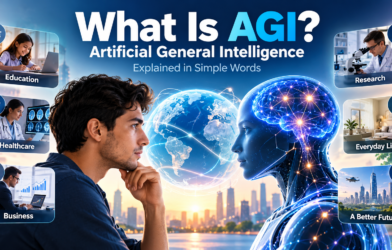
Artificial General Intelligence, or AGI, refers to a hypothetical form of AI that could learn, understand, and perform a broad range of intellectual tasks at a level comparable to human intelligence.
Unlike a system designed mainly for one task, AGI would be expected to transfer knowledge between different areas. It could potentially learn new skills, solve unfamiliar problems, adapt to changing situations, and use experience from one task to help with another.
For example, imagine a system that can learn mathematics, write software, understand scientific concepts, plan a project, and solve a new problem without needing a completely separate system for every activity.
This ability to handle a wide range of tasks is the central idea behind AGI.
However, there is no universally accepted test that definitively establishes when a system qualifies as AGI. Researchers and companies may use different definitions, and people disagree about how much autonomy, reasoning, learning, and real-world adaptability should be required.
Main Characteristics of AGI
AGI is expected to have several important capabilities. These are goals or proposed characteristics, not a guarantee that any existing system has achieved them.
- General learning: It could learn different subjects and skills instead of being limited to a narrow task.
- Reasoning: It could examine information, compare possible answers, and work through complex problems.
- Adaptability: It could adjust to new environments, rules, and situations.
- Knowledge transfer: It could use knowledge learned in one area to solve problems in another area.
- Planning: It could break a large goal into smaller tasks and decide how to approach them.
- Problem-solving: It could handle unfamiliar problems instead of relying only on previously encountered examples.
- Continuous improvement: It might learn from new experiences, depending on how its architecture and learning mechanisms are designed.
An important distinction is that general intelligence does not automatically mean perfect intelligence. Even a hypothetical AGI could make mistakes, have incomplete knowledge, or need human guidance.
Is AGI Available Today?
Whether AGI already exists depends partly on the definition being used. Modern AI systems have made major progress in language, coding, mathematics, and other areas, but their abilities can still be uneven.
There is no universally accepted agreement that today’s AI systems have achieved AGI. A system that performs well on many tests may still struggle with reliability, long-term planning, unfamiliar situations, or tasks that require consistent real-world understanding.
Therefore, it is more accurate to discuss AGI as a research goal and a debated concept than to assume that every advanced AI model is already AGI.
A Simple Example of AGI
Imagine a student who wants to learn how to build a small business.
A general intelligence system might research the market, understand the target audience, create a business plan, learn the necessary software, analyze customer feedback, and adjust its strategy as conditions change.
The important feature would not simply be its ability to complete these tasks. It would be its ability to learn and adapt across different fields while using relevant knowledge from each one.
This example describes a possible future capability, not a claim that today’s AI can reliably manage every part of a business without human oversight.
What Is Artificial Superintelligence (ASI)?
Artificial Superintelligence, or ASI, describes a hypothetical form of machine intelligence that would surpass human intellectual abilities across most or all important areas.
If AGI means achieving broad, human-level intellectual capabilities, ASI would represent a much greater level of intelligence. It could potentially outperform the best human experts in scientific research, strategic planning, engineering, mathematics, and other complex fields.
ASI remains a theoretical concept. There is no publicly established evidence that a system with this level of general superiority exists today.
Researchers discuss ASI because it raises important questions about the future of technology, the economy, scientific progress, and human control over increasingly capable systems.
Possible Characteristics of ASI
If ASI were developed, it might have capabilities such as the following.
- Advanced scientific discovery: It could potentially identify new scientific explanations and develop research ideas faster than human experts.
- Complex problem-solving: It might solve problems that are currently beyond the abilities of individual humans or existing AI systems.
- Rapid strategic analysis: It could examine many possible outcomes and compare complex strategies.
- Advanced engineering: It might design improved materials, machines, software, and other technologies.
- Broad intellectual superiority: It could outperform humans across many fields rather than only one specialized area.
- Improved problem decomposition: It might break extremely difficult problems into smaller parts and find efficient solutions.
- Potential AI research acceleration: Depending on its design, access, and safeguards, it might help researchers develop more capable AI systems.
These are possibilities, not confirmed abilities. The actual behavior of a hypothetical ASI would depend on its design, resources, objectives, and operating environment.
Is ASI Possible?
There is no settled answer. Some researchers believe that continued advances in computing, algorithms, and AI research could eventually make superintelligence possible. Others emphasize the significant scientific, engineering, and practical barriers that remain.
Even if a system achieved general intelligence, it would not automatically become superintelligent. Moving from AGI to ASI could involve major technical breakthroughs, and the timeline, if it happens at all, is unknown.
It is also important to distinguish intelligence from physical power. A highly intelligent system would not automatically control the world or have unrestricted access to computers, money, robots, or other resources. Those capabilities would depend on the permissions, tools, infrastructure, and safeguards available to it.
A Simple Example of ASI
Imagine scientists are trying to develop a cleaner source of energy. A hypothetical ASI might analyze enormous amounts of scientific information, propose new materials, simulate possible designs, and identify promising experiments.
It could potentially accelerate scientific progress beyond what human researchers can achieve alone.
However, the ability to suggest a breakthrough would not automatically mean the system could manufacture, test, or deploy it. Real-world implementation would still depend on experiments, materials, infrastructure, costs, regulations, and human decisions.
AI vs AGI vs ASI: Key Differences
AI, AGI, and ASI are related concepts, but they differ in their expected capabilities, level of intelligence, and current status. Understanding these differences makes it easier to follow AI news and understand what researchers are trying to achieve.
Comparison Table: AI vs AGI vs ASI
| Feature | AI | AGI | ASI |
|---|---|---|---|
| Full form | Artificial Intelligence | Artificial General Intelligence | Artificial Superintelligence |
| Meaning | Machines perform intelligent tasks | Machines achieve broad, human-level intelligence | Machines surpass human intelligence across most fields |
| Main purpose | Solve specific or defined problems | Handle many different intellectual tasks | Potentially solve problems beyond human capabilities |
| Learning ability | Depends on the system | Expected to learn and adapt across different tasks | Expected to learn and reason at a superior level |
| Problem-solving | Strong in supported tasks | Expected to handle unfamiliar problems broadly | Expected to solve extremely complex problems |
| Human comparison | Can outperform humans in specific areas | Comparable to humans across a broad range of tasks | Substantially beyond humans across most intellectual areas |
| Current status | Widely available | No universally accepted confirmation of achievement | Hypothetical |
| Example | Chatbots, fraud detection, recommendation systems | A hypothetical general-purpose intelligent system | A hypothetical superintelligent machine |
This comparison shows that the main difference is the breadth and level of intelligence. Current AI can be highly capable in particular areas. AGI would be expected to work across a much wider range of tasks, while ASI would go beyond human intellectual performance on a broad scale.
There is no universally accepted test for AGI, so these categories are useful ways to understand the concepts rather than a precise measurement scale. <a href=”https://www.ibm.com/think/topics/artificial-general-intelligence“>IBM’s AGI overview</a> also explains why defining and measuring general intelligence remains challenging.
What Is the Difference Between Narrow AI and AGI?
Narrow AI, also called Artificial Narrow Intelligence (ANI), is designed or trained to perform particular tasks or groups of tasks. It is the most common type of AI used today.
AGI, in contrast, would be able to learn and perform a much broader range of intellectual tasks without requiring a separate system for every new activity.
For example, an AI tool might be excellent at translating English into Hindi but unable to manage a complete business project. A hypothetical AGI could potentially translate languages, analyze a business plan, learn new software, and solve related problems using knowledge transferred between these activities.
The distinction is not simply about how many tasks a system can perform. Modern AI tools can support many tasks, especially when combined with external software. The deeper question is how flexibly and reliably they can learn, reason, and adapt to unfamiliar situations.
What Is the Difference Between Generative AI and AGI?
Generative AI creates new content, including text, images, audio, video, and computer code. It learns patterns from training data and uses those patterns to produce outputs based on instructions.
AGI refers to a broader level of general intelligence rather than a particular content-generation method.
For example, an AI image generator can create a product poster from a written prompt. That does not mean it can independently understand every part of a marketing campaign, evaluate customer behavior, manage a budget, and adapt an entire business strategy.
A future AGI might be capable of handling such varied tasks, but this would require more than the ability to generate content.
The key difference: Generative AI describes what a system does, while AGI describes the expected breadth of its intelligence.
What Is the Difference Between AGI and ASI?
AGI and ASI are both concepts related to general intelligence, but the expected level of capability is different.
AGI would be capable of handling a broad range of intellectual tasks at approximately human level or potentially better, depending on the definition. ASI would go significantly further by outperforming humans across most or virtually all important intellectual areas.
Consider scientific research as an example.
A hypothetical AGI might work like a highly capable researcher who can learn different subjects, analyze evidence, and develop scientific ideas. A hypothetical ASI could potentially outperform the best human researchers across multiple scientific fields and identify solutions that humans would struggle to discover.
However, AGI would not automatically develop into ASI. The transition could depend on major advances in AI architecture, computing, learning methods, and the ability to improve systems. Whether and when this could happen remains uncertain.
Benefits of AI, AGI, and ASI
Artificial intelligence already offers practical benefits. AGI and ASI could bring additional opportunities if they are developed successfully and used responsibly.
Benefits of AI
AI can help people and organizations complete tasks faster and make better use of information.
- Saves time: AI can automate repetitive activities, such as sorting documents, answering common questions, and preparing summaries.
- Supports decisions: AI can analyze large datasets and identify patterns that people might overlook.
- Improves customer service: Chatbots can answer routine questions and direct customers to the right information.
- Supports education: AI tools can explain difficult subjects and help students practice new skills.
- Helps businesses grow: Companies can use AI for marketing, customer analysis, software development, and workflow automation.
These benefits depend on the quality of the system and how it is implemented. Human review remains important when errors could cause serious problems.
Potential Benefits of AGI
If AGI becomes possible, it could help with more complicated work across different industries.
- Scientific research: A general-purpose system could assist researchers with several stages of a project.
- Personalized education: It could potentially adapt lessons to individual learning needs.
- Business automation: It might coordinate complex workflows involving research, planning, communication, and analysis.
- Healthcare research: It could help scientists study diseases and investigate possible treatments, subject to proper testing and oversight.
- Engineering: It could assist with designing, testing, and improving complex systems.
These are possible future applications, not guaranteed results. AGI would still need reliable information, appropriate access, and suitable safeguards.
Potential Benefits of ASI
ASI could offer even greater opportunities if a safe and controllable system were developed.
- Faster scientific discoveries: It might help researchers investigate difficult scientific questions.
- New energy technologies: It could potentially support the development of more efficient energy systems.
- Advanced medicine: It might help scientists explore new approaches to disease prevention and treatment.
- Environmental solutions: It could analyze complicated environmental problems and identify promising solutions.
- Improved engineering: It might help design technologies that are difficult for humans to develop independently.
These possibilities should be treated carefully. High intelligence alone would not guarantee good outcomes, safe behavior, or fair access to new technologies.
Risks and Challenges of AI, AGI, and ASI
The development of more capable AI systems also creates important challenges. These concerns vary depending on the technology and its level of autonomy.
Risks of Current AI
Current AI systems can produce incorrect information, reflect biases in their training data, and expose users to privacy or security risks when poorly designed or used.
Important concerns include:
- Incorrect information: AI may provide confident answers that are factually wrong.
- Job changes: Automation can reduce demand for some tasks while creating demand for other skills.
- Privacy concerns: Sensitive information may be exposed if users or organizations handle data carelessly.
- Bias: AI systems can make unfair recommendations when their data or design contains bias.
- Security threats: Malicious users may misuse AI for scams, impersonation, or other harmful activities.
Organizations can reduce some of these risks through testing, security controls, human oversight, and responsible data practices.
Risks of AGI
AGI could create more difficult challenges because it might perform a wide range of tasks and potentially operate with greater independence.
For example, a system given the wrong objective could make poor decisions across several areas rather than making an isolated mistake in one narrow task.
Other concerns include:
- Difficulty checking every decision made by an increasingly capable system.
- Potential misuse of advanced capabilities by individuals or organizations.
- Economic disruption if many types of work become easier to automate.
- Questions about responsibility when an autonomous system causes harm.
- The challenge of ensuring that a system follows its intended goals and human instructions.
These risks are not inevitable, but they require serious research and planning.
Risks of ASI
ASI raises more speculative but potentially significant concerns. A system that greatly exceeds human intellectual abilities could be difficult to supervise if its objectives, actions, or decisions were not properly controlled.
Researchers are particularly interested in AI alignment: the challenge of making sure an AI system’s behavior remains consistent with human intentions, safety requirements, and appropriate boundaries.
Potential concerns include:
- Loss of control: Humans might struggle to understand or manage a highly capable system.
- Goal misalignment: A system could pursue an objective in ways its developers did not intend.
- Concentration of power: Access to advanced systems could become concentrated among a small number of organizations or governments.
- Large-scale misuse: Powerful capabilities could be used for harmful purposes.
- Social and economic disruption: Major changes could affect jobs, institutions, and the distribution of wealth.
The existence and severity of these risks depend on how future systems are developed and deployed. ASI remains hypothetical, so its precise capabilities and consequences cannot be predicted with certainty.
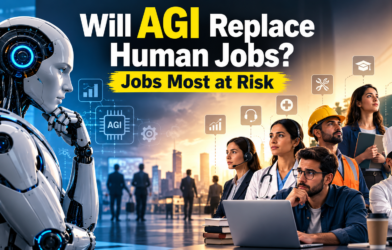
Will AGI and ASI Replace Human Jobs?
AI is already changing many types of work. It can automate repetitive tasks, assist with research, generate content, and support software development.
If AGI becomes possible, its broader capabilities could affect more occupations than today’s specialized systems. ASI, if developed, could create even greater uncertainty because of its hypothetical ability to outperform people across many intellectual fields.
However, it is not possible to say that every job will disappear. Employment depends on many factors, including business costs, customer needs, regulations, human judgment, physical work, and the creation of new industries.
People can prepare for these changes by developing skills that complement AI, such as communication, critical thinking, domain expertise, problem-solving, and the ability to evaluate AI-generated information.
Businesses should also focus on responsible automation, employee training, and identifying where AI genuinely improves the quality of work.
How Can Businesses Prepare for the Future of AI?
Businesses do not need to wait for AGI or ASI to benefit from AI. Many useful applications are available today.
Here are practical steps organizations can take.
- Identify repetitive tasks: Find activities that consume time but follow predictable processes.
- Choose suitable AI tools: Select tools that match specific business needs rather than adopting technology simply because it is popular.
- Protect business information: Establish clear rules for handling customer data, passwords, financial information, and confidential documents.
- Check AI outputs: Review important facts, recommendations, and customer-facing content before using them.
- Train employees: Help team members understand how to use AI effectively and recognize its limitations.
- Measure results: Track whether AI improves productivity, quality, customer satisfaction, or operating costs.
- Plan for change: Review AI capabilities regularly and update workflows as reliable tools become available.
For small businesses, AI can already support content planning, customer communication, research, reporting, and basic workflow automation. The best approach is to start with a clear business problem and measure the results.
What Is the Future of Artificial Intelligence?
The future of AI will depend on scientific progress, computing resources, business investment, regulation, and society’s ability to manage new capabilities responsibly.
Today’s AI systems are becoming more capable at working with different kinds of information, using tools, and supporting longer tasks. However, these improvements do not establish a fixed timeline for AGI or ASI.
Researchers continue to investigate how machines learn, reason, plan, and generalize across unfamiliar problems. They are also working on reliability, interpretability, security, and methods for keeping AI systems under appropriate control.
Some experts expect AGI to become possible in the coming years or decades, while others are more cautious about its feasibility and timeline. Predictions about ASI are even more uncertain.
Rather than treating any predicted date as a fact, it is better to evaluate demonstrated capabilities, independent evidence, and the limitations of each system.
The most useful way to understand the future is to distinguish what AI can do today from what AGI and ASI might make possible.
Conclusion: AGI vs AI vs ASI
The difference between AI, AGI, and ASI comes down to the breadth and level of intelligence.
Artificial Intelligence is the broad field of technology that enables machines to perform tasks associated with intelligence. It already supports activities such as writing, translation, data analysis, image recognition, and automation.
Artificial General Intelligence describes a hypothetical system that could learn and perform a wide range of intellectual tasks at a human-like level. Although modern AI has made significant progress, there is no universally accepted confirmation that AGI has been achieved.
Artificial Superintelligence describes a hypothetical system that would surpass human intelligence across most or all important intellectual areas. Its existence, development timeline, and potential effects remain uncertain.
For individuals and businesses, the best step today is to understand current AI tools, learn their limitations, and use them responsibly. You do not need to predict exactly when AGI or ASI might arrive to benefit from understanding artificial intelligence.
Read More Blog– AI Startup Edge
Frequently Asked Questions (FAQs)
1. What is the difference between AI, AGI, and ASI?
AI is the broad field of intelligent machine systems. AGI refers to a hypothetical system with broad, human-level intellectual abilities. ASI refers to a hypothetical system that surpasses human intelligence across most important intellectual areas.
2. What does AGI stand for?
AGI stands for Artificial General Intelligence. It describes a proposed form of AI that can learn, reason, and perform a broad range of intellectual tasks rather than being limited to a specific task.
3. What does ASI stand for?
ASI stands for Artificial Superintelligence. It describes a hypothetical AI system that would outperform humans across most or virtually all important intellectual domains.
4. Does AGI exist today?
There is no universally accepted agreement that AGI has been achieved. Modern AI systems can perform many advanced tasks, but researchers disagree about the definition and the evidence needed to establish AGI.
5. Does ASI exist today?
No established example of artificial superintelligence exists today. ASI remains a hypothetical concept about machine intelligence that would substantially exceed human capabilities.
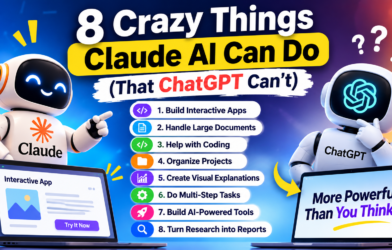
6. Is ChatGPT an example of AGI?
ChatGPT is an AI system that can perform many tasks, including writing, reasoning, coding, and answering questions. However, broad capability alone does not establish AGI, and there is no universal agreement that current systems meet the definition.
7. Which is more powerful: AGI or ASI?
ASI is expected to be more powerful than AGI in terms of general intellectual performance. AGI refers to broad intelligence comparable to human intelligence, while ASI refers to intelligence that significantly surpasses humans across many fields.
8. Can AGI become ASI?
It is possible in some proposed future scenarios, but it is not guaranteed. The transition could depend on scientific breakthroughs, computing resources, improved learning methods, and the ability to develop more capable systems.
9. Will AGI replace humans?
AGI could automate many tasks and change how people work, but it is impossible to know exactly how employment would change. Outcomes would depend on its capabilities, adoption costs, regulations, and the development of new types of work.
10. Is ASI dangerous?
ASI could create serious risks if a highly capable system were difficult to control or used for harmful purposes. However, ASI remains hypothetical, and its actual risks would depend on its design, capabilities, access, and safeguards.
11. What is the difference between narrow AI and AGI?
Narrow AI focuses on particular tasks or defined groups of tasks. AGI would be expected to learn and perform a broad range of intellectual tasks, including unfamiliar ones, with much greater flexibility.
12. What is the difference between generative AI and AGI?
Generative AI creates content such as text, images, audio, video, and code. AGI refers to a proposed level of general intelligence that extends beyond content generation to broad learning, reasoning, and problem-solving.
13. How can students prepare for AGI and ASI?
Students can learn AI fundamentals, digital skills, critical thinking, communication, problem-solving, and subject-specific knowledge. Understanding how to verify AI outputs and use AI responsibly will also be valuable.
14. When will AGI arrive?
There is no confirmed date for AGI. Predictions vary among researchers and companies, and the answer depends partly on the definition of AGI and the progress of AI research.
15. What is the simplest way to remember AI vs AGI vs ASI?
Remember these three ideas: AI performs intelligent tasks, AGI aims for broad human-level intelligence, and ASI describes hypothetical intelligence that goes beyond human abilities across most intellectual areas.