



Artificial General Intelligence (AGI) is one of the most exciting topics in the world of technology. Many people want to know when AGI will arrive, whether it will happen by 2030, and how it could change our daily lives. Some technology leaders believe that human-level AI could become a reality within the next few years. Other researchers think it may take decades to develop safe and reliable AGI. As of October 2026, there is still no universally accepted proof that AGI has arrived. This makes it important to understand the facts instead of believing every prediction we see online. In this article, we will explore AGI predictions for 2026, opinions from leading AI experts, possible arrival dates, and the challenges that remain. We will also explain how AGI could affect jobs, businesses, education, and society. By the end, you will have a clearer idea of when AGI might arrive and what its future could mean for you.
1. What Is Artificial General Intelligence (AGI)?
Artificial General Intelligence, commonly called AGI, is a type of artificial intelligence that could learn, understand, and solve problems across many different areas, much like a capable human being.
Today’s AI systems can perform many impressive tasks. They can write articles, create images, answer questions, generate computer code, summarize documents, and help people analyze information. However, their abilities can vary greatly depending on the task, available tools, and the information they receive.
AGI aims to go further. It would be able to learn new skills, apply knowledge to unfamiliar situations, solve different kinds of problems, and adapt without needing a separate system for every task.
How would AGI be different from today’s AI?
The main difference is the ability to work across a broad range of tasks with flexibility and reliability.
For example, imagine an AI system that can learn how to manage a business, understand customer needs, develop a marketing strategy, write software, conduct scientific research, and learn new subjects with little human guidance.
Such a system would represent a major step toward AGI if it could perform these tasks reliably and adapt to new situations.
However, performing many tasks does not automatically mean that a system is AGI. Researchers would also need to examine its reasoning, learning ability, independence, and performance on unfamiliar problems.
2. When Will AGI Arrive?
The honest answer is that nobody knows the exact date.
As of October 2026, predictions about AGI range from the next few years to several decades. The difference comes from the way people define AGI, their expectations about technological progress, and their opinions about the remaining scientific challenges.
Some AI company leaders believe powerful AI systems could reach human-level capabilities around the end of this decade. Other researchers believe that current AI methods may need major improvements before they can achieve general intelligence.
The following three periods help explain the main possibilities.
AGI between 2026 and 2028
Some technology leaders and optimistic forecasters believe that AI could reach AGI-like capabilities before the end of 2028.
This prediction is based on rapid improvements in AI reasoning, programming, research assistance, and autonomous agents. If AI systems become much better at completing complicated tasks independently, progress could accelerate.
However, this is an optimistic forecast, not a confirmed arrival date. Strong performance in selected tasks does not prove that AI can handle every kind of real-world problem.
AGI between 2029 and 2035
Another possibility is that AGI will emerge during the late 2020s or early 2030s.
This period allows more time for improvements in reasoning, memory, planning, computer use, and learning. It also recognizes that building a powerful demonstration is different from creating a reliable system that works in everyday conditions.
For many readers, this is a useful period to watch without assuming that AGI is guaranteed to arrive during those years.
AGI after 2035
Some researchers expect a longer timeline because human intelligence involves abilities that remain difficult for AI systems.
These include learning from limited experience, adapting to unexpected situations, understanding the physical world, and consistently checking whether an answer is correct.
If major technical challenges remain unresolved, AGI could arrive much later than current industry leaders expect. It is also possible that researchers will need approaches different from today’s dominant AI methods.
The key point: AGI may arrive within a few years, but the evidence does not support treating any particular year as certain.
3. What Do AI Experts Predict About AGI in 2026?
AI experts do not agree on a single timeline. Their predictions depend on their understanding of current AI progress and the level of intelligence they expect future systems to achieve.
Some focus on systems that can automate most valuable intellectual work. Others use a stricter definition that requires reliable performance across almost all human tasks.
Here are several important viewpoints.
Sam Altman and OpenAI
Sam Altman, the CEO of OpenAI, has helped popularize the idea that highly capable AI could arrive relatively soon.
OpenAI’s approach focuses on building increasingly capable systems that can reason, use tools, perform complex tasks, and assist with AI research.
The important question is not simply whether an AI model can answer difficult questions. It is whether the system can complete meaningful work independently, learn from feedback, and maintain reliable performance over long tasks.
OpenAI’s ambitious goals are relevant to AGI predictions, but company goals should not be confused with independently verified scientific results.
Dario Amodei and Anthropic
Dario Amodei, the CEO of Anthropic, has expressed an optimistic view about the arrival of highly capable AI.
His forecasts have emphasized the possibility that AI systems could become extremely capable across science, programming, engineering, and other intellectual fields within a relatively short period.
Anthropic’s research also highlights questions about AI safety, model behavior, and the risks of deploying increasingly powerful systems.
A system capable of helping experts in many fields could have enormous benefits. However, the arrival of such a system would not automatically settle whether it meets every definition of AGI.
Demis Hassabis and Google DeepMind
Demis Hassabis, the CEO of Google DeepMind, has discussed AGI as a major long-term objective of AI research.
His approach places importance on scientific discovery, reasoning, planning, and the ability to learn beyond familiar examples.
Google DeepMind’s work demonstrates how AI can support complex scientific and technical tasks. However, dependable general intelligence requires more than success in a few specialized areas.
This viewpoint is important because it emphasizes both the speed of recent progress and the difficult problems that remain.
Shane Legg and early AGI forecasts
Shane Legg, a co-founder of Google DeepMind, has discussed the possibility of AGI arriving within the 2020s.
His historical forecasts illustrate that some researchers have considered relatively early arrival dates plausible for many years.
However, a forecast made years in advance is not proof that the event will happen on schedule. Predictions should be reviewed against actual capabilities as new evidence becomes available.
Yann LeCun and more cautious views
Yann LeCun, a prominent AI researcher, has argued that current approaches based heavily on large language models may not be enough to produce human-level intelligence.
His perspective highlights the importance of learning about the physical world, developing more advanced reasoning, and building systems that can learn and plan effectively.
This view suggests that AGI may require important scientific breakthroughs rather than simply making existing models larger.
Taken together, these opinions show why AGI predictions vary so widely. Experts may agree that AI is advancing quickly while disagreeing about what remains necessary for general intelligence.
4. What Does the Latest AI Research Say About AGI Timelines?
Expert opinions are useful, but research surveys provide another way to understand the possible arrival of AGI.
A major source is the Expert Survey on Progress in AI, conducted by AI Impacts. Its 2024 survey collected responses from 1,580 researchers who had published in leading AI research venues. The results were published in September 2026.
The survey estimated a 50% chance of high-level machine intelligence by 2042 under its specific definition. This is a probability estimate, not a promise that AGI will arrive in that year. The survey also reflects researchers’ opinions collected in December 2024, so it cannot fully represent every development that happened during 2025 and 2026. Source: AI Impacts
What does this research mean for ordinary people?
It shows that even AI researchers remain uncertain about the timeline.
Some experts expect major progress before 2030. Others believe it will take longer to build machines that can perform almost every intellectual task reliably.
There are three important lessons to understand.
- AGI could arrive sooner than expected. Improvements in computing, training methods, and AI-assisted research may accelerate development.
- AGI could take longer than expected. Current systems still make mistakes and struggle with some unfamiliar tasks.
- Predictions can change. New discoveries can make an earlier timeline more realistic or reveal challenges that delay progress.
The best way to understand AGI is to compare predictions with measurable improvements rather than focusing on one expert’s statement.
5. Will AGI Arrive by 2030?
Many people search for the answer to one important question: Will AGI arrive by 2030?
The answer is that it is possible, but it is not guaranteed.
The late 2020s could bring AI systems that perform a large amount of knowledge work, operate computer applications, write software, assist researchers, and complete complicated tasks with less human supervision.
However, there is a difference between an AI system that performs many valuable jobs and one that demonstrates reliable, general intelligence across almost every area.
Why could AGI arrive before 2030?
Several developments could make rapid progress possible.
- AI models may become better at reasoning and solving unfamiliar problems.
- AI agents may learn to complete longer tasks with fewer instructions.
- AI systems may help researchers discover improved training methods.
- Better computing infrastructure may support more capable models.
- Improvements in memory and planning may help AI handle complex projects.
These developments could bring us closer to AGI, particularly if several improvements happen together.
Why might AGI not arrive by 2030?
There are also important reasons to remain cautious.
- Today’s AI systems can still produce incorrect information.
- They may struggle when a problem differs from their training examples.
- Long tasks can fail because of small mistakes.
- Reliable learning from limited real-world experience remains challenging.
- Safety, cost, energy use, and computing limitations may slow deployment.
Therefore, 2030 should be treated as a possible milestone, not a confirmed deadline.
6. What Are the Biggest Challenges in Developing AGI?
Building AGI is not simply a matter of making AI models larger. Researchers need systems that can understand problems, learn new skills, plan effectively, and behave reliably in changing situations.
The following challenges help explain why the arrival date remains uncertain.
1. Human-like reasoning
AI can solve many difficult problems, but strong performance on a test does not always translate into reliable reasoning in everyday situations.
An AGI system would need to recognize when information is missing, compare possible answers, identify errors, and change its approach when necessary.
2. Learning new skills
People can often learn a new task from a small number of examples. AI systems may need large amounts of training or carefully prepared instructions to achieve similar results.
Better learning from limited experience would help AI adapt to situations it has never encountered.
3. Memory and long-term planning
Many real-world projects take weeks or months. They require people to remember earlier decisions, manage changing priorities, and correct mistakes.
AGI would need dependable memory and planning abilities to manage these tasks without constant human supervision.
4. Understanding the physical world
Human intelligence develops through interactions with the physical world. People learn about objects, movement, cause and effect, and the results of their actions.
AI systems that work mainly with text and digital information may need additional capabilities to develop a similarly flexible understanding of the world.
5. Reliability and safety
An AI system may be highly capable but still make serious mistakes.
Researchers need ways to test its behavior, prevent harmful actions, protect private information, and keep important decisions under appropriate human control.
6. Independent scientific progress
One possible route to faster AI development is a system that helps researchers build better AI systems.
However, assisting with research is not the same as independently improving itself. Researchers must determine whether these systems can produce genuine, measurable improvements without creating new technical or safety problems.
Solving these challenges will help determine when AGI becomes technically possible and practically useful.
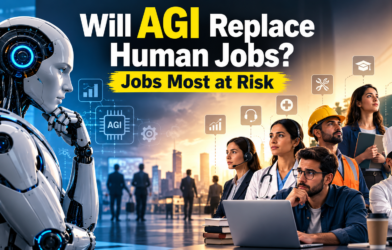
7. How Could AGI Change Jobs and Employment?
AGI could have a major effect on employment if it becomes capable of performing a wide range of intellectual tasks.
Some jobs may change significantly, while others may become easier to perform. New roles could also emerge as businesses adopt new technology.
The overall impact will depend on how capable AGI becomes, how quickly companies adopt it, and how governments and workers respond.
Jobs that could be affected
Work involving repetitive digital tasks may be affected early.
Examples include:
- Data entry and document processing.
- Basic customer support.
- Routine content production.
- Certain software development tasks.
- Research and information summarization.
- Standard administrative work.
These changes do not mean every job in these areas will disappear. Many roles include communication, responsibility, personal judgment, and real-world activities that are difficult to automate completely.
Could AGI replace human workers?
It could replace some tasks and possibly entire roles if systems become sufficiently capable and affordable.
However, the timing and scale of job losses remain uncertain. Some businesses may use AI to support existing workers rather than replace them. Other businesses may redesign their operations around automation.
New work could also emerge in AI supervision, safety, system integration, technical support, and fields that do not yet exist.
How can workers prepare?
People can prepare by learning how to use current AI tools and strengthening skills that remain valuable when routine work becomes automated.
- Learn to use AI tools for research, writing, analysis, and productivity.
- Improve communication and problem-solving skills.
- Develop knowledge of your industry.
- Learn to check AI-generated information rather than trusting every answer.
- Continue learning as tools and job requirements change.
The most practical approach is to prepare for changing work rather than assume that all jobs will disappear when AGI arrives.
8. How Could AGI Affect Businesses and Small Business Owners?
AGI could create new opportunities for businesses by making advanced digital assistance more widely available.
Small businesses may benefit because they often have limited budgets and small teams. More capable AI systems could help them complete tasks that previously required several employees or outside service providers.
Possible benefits for businesses
Marketing: AI could help businesses research customers, prepare campaign ideas, create content, and analyze marketing results.
Customer service: Advanced systems could answer common questions, manage requests, and provide support outside normal business hours.
Data analysis: Businesses could use AI to understand sales, identify customer trends, and compare business performance.
Administration: AI agents could help organize documents, prepare reports, manage routine workflows, and assist with scheduling.
Product development: Businesses could use AI to research customer needs, develop prototypes, and improve existing products.
However, these benefits will depend on accuracy, cost, privacy, and how well AI tools connect with existing business systems.
Business owners should not wait for AGI before improving their operations. Learning to use today’s AI tools can provide practical benefits even if AGI takes many more years to arrive.
9. How Could AGI Change Education and Healthcare?
Education and healthcare are two important areas where advanced AI could create major benefits.
AGI in education
A highly capable AI tutor could adapt lessons to each student’s needs, explain difficult subjects in simple language, and provide additional practice.
It could also help teachers prepare educational materials and identify areas where students need more support.
However, schools would still need human teachers to guide students, develop social skills, support emotional needs, and evaluate learning fairly.
AGI in healthcare
Advanced AI could assist medical researchers, help analyze medical information, support drug discovery, and improve some administrative processes.
It might also help doctors compare possible diagnoses and understand complex research.
However, medical decisions require reliable evidence, appropriate testing, privacy protection, and professional responsibility. AGI should not automatically be treated as a replacement for qualified healthcare professionals.
The benefits will depend on whether these systems are tested carefully and used under suitable supervision.
10. What Are the Risks of AGI?
AGI could offer major benefits, but its risks deserve equal attention.
The more capable and independent an AI system becomes, the more important it is to understand its behavior and control what it can do.
Major AGI risks
Incorrect information: AI could provide convincing but false answers that lead to poor decisions.
Cybersecurity threats: Powerful AI could make certain cyberattacks easier, especially if safeguards are weak.
Privacy concerns: Systems that process large amounts of personal information could expose sensitive data if not designed carefully.
Job disruption: Rapid automation could put pressure on workers, wages, and existing business models.
Concentration of power: A small number of companies or governments could gain significant advantages if access to advanced AI is limited.
Loss of human control: Highly autonomous systems could create serious problems if their actions do not match human intentions.
These risks do not mean AGI will necessarily cause harm. They mean that safety research, independent evaluation, responsible deployment, and suitable regulation should develop alongside AI capabilities.
11. What Is the Difference Between AGI and ASI?
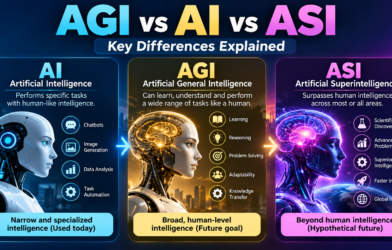
AGI and Artificial Superintelligence (ASI) are related but different concepts.
AGI refers to a system with broad intellectual abilities comparable to those of humans across many kinds of tasks. ASI refers to a hypothetical system that surpasses human intelligence by a very large margin across most or all relevant intellectual areas.
The difference becomes clearer when we compare their possible abilities.
| Feature | AGI | ASI |
|---|---|---|
| Intelligence | Broad, human-level capabilities | Far beyond human capabilities |
| Problem-solving | Can handle many different tasks | Could solve problems far better than humans |
| Scientific research | Could support or conduct complex research | Could potentially accelerate discoveries dramatically |
| Human performance | Comparable to capable humans across broad tasks | Substantially exceeds human performance |
| Current status | No universally accepted confirmation of arrival | Hypothetical future possibility |
AGI does not automatically lead to ASI. A system might reach human-level intelligence without progressing to superintelligence, and the timing of any further progress is highly uncertain.
12. Will AGI Be Available to Everyone?
If AGI is developed, its availability will depend on how companies and governments choose to distribute it.
Some systems may be available through online services, while others may be restricted to businesses, researchers, or organizations with special security requirements.
Several factors could influence access.
- Cost: Advanced AI may require expensive computing resources.
- Safety: Certain capabilities may need restrictions to prevent misuse.
- Business models: Companies may charge subscription or usage fees.
- Government policies: Laws may affect which systems can be used and where.
- Infrastructure: Access may depend on internet connectivity, electricity, and computing facilities.
It is possible that many people will use AGI through familiar applications rather than operate a powerful system themselves.
However, nobody can yet say exactly how AGI products will be priced, regulated, or distributed.
13. How Can You Prepare for AGI in 2026?
You do not need to know the exact arrival date of AGI to prepare for changes in artificial intelligence.
The most useful approach is to build practical skills, understand the technology, and remain flexible.
Steps you can take today
1. Learn current AI tools. Explore AI assistants, research tools, writing applications, and data-analysis systems relevant to your work.
2. Improve your digital skills. Learn how to use online platforms, automation tools, and digital business applications.
3. Build critical thinking. Check facts, compare sources, and understand the limitations of AI-generated information.
4. Strengthen human skills. Communication, creativity, teamwork, and responsible decision-making remain important.
5. Follow credible research. Read reports from established AI research organizations and compare their claims with independent evaluations.
6. Protect your information. Avoid uploading confidential business information or personal data to tools without understanding their privacy policies.
7. Experiment carefully. Use AI to improve small tasks first, measure the results, and expand only when the system proves useful.
These steps can help you benefit from AI whether AGI arrives in 2028, 2035, or much later.
14. Final Prediction: When Will AGI Arrive?
There is no scientifically confirmed date for the arrival of AGI.
The most optimistic forecasts suggest that highly capable AI systems could emerge during the second half of the 2020s. Other estimates place the arrival of human-level machine intelligence in the 2030s or 2040s. Some researchers expect a longer wait or believe that major breakthroughs are still needed.
The distinction between powerful AI and true AGI is essential. A system may write excellent articles, solve advanced mathematical problems, generate software, or support scientific discoveries without demonstrating reliable intelligence across every major area.
For that reason, the arrival of AGI should be judged through clear definitions, independent testing, and real-world performance rather than announcements alone.
My practical conclusion: AGI within the next decade is a possibility worth preparing for, but it is not a guaranteed outcome. The best strategy is to understand AI, develop useful skills, and follow reliable evidence as the technology improves.
The future of artificial general intelligence could be transformative. Preparing responsibly is more useful than trying to predict one exact year.
Gemini 4 Argon
Frequently Asked Questions About AGI
1. When will AGI arrive?
Nobody knows the exact date. Some technology leaders expect highly capable AI within the next few years, while many AI researchers expect human-level machine intelligence later. The answer depends partly on how AGI is defined.
2. Will AGI arrive in 2026?
AGI-like capabilities may advance during 2026, but there is no universally accepted evidence that true AGI has arrived. Predictions should not be treated as confirmed results.
3. Will AGI arrive by 2030?
Yes, it is possible, but not guaranteed. Some AI leaders expect major advances before 2030, while other researchers believe general intelligence will take longer to develop.
4. Who predicts AGI will arrive first?
Some AI industry leaders, including Sam Altman, Dario Amodei, and Shane Legg, have expressed relatively optimistic timelines. Their predictions differ in definition and should not be interpreted as guarantees.
5. What is the difference between AI and AGI?
AI is a broad term for computer systems that perform tasks associated with intelligence. AGI describes a more advanced form of AI that can learn and perform a broad range of tasks with general-purpose abilities.
6. Is ChatGPT an AGI?
ChatGPT is an advanced AI assistant, but its capabilities and limitations do not establish that it meets every reasonable definition of AGI. It can perform many intellectual tasks while still making errors and struggling in certain situations.
7. Can AGI replace human jobs?
AGI could automate many tasks and potentially replace some jobs. It could also support workers and create new roles. The actual impact will depend on its capabilities, adoption, and economic conditions.
8. Will AGI be smarter than humans?
AGI is generally intended to describe broad intelligence comparable to human capabilities. A system that substantially exceeds human performance across nearly all intellectual tasks is more commonly described as artificial superintelligence.
9. What is the biggest challenge in developing AGI?
There is no single agreed-upon biggest challenge. Important problems include reliable reasoning, learning new skills, long-term planning, adapting to unfamiliar situations, and ensuring safe behavior.
10. Will AGI help humanity?
AGI could help with scientific research, education, healthcare, productivity, and other fields. Its overall effect will depend on how it is developed, controlled, and used.
11. Is AGI dangerous?
AGI could introduce serious risks if powerful systems behave unpredictably, are misused, or operate without adequate safeguards. Careful testing, security, oversight, and responsible development can help reduce these risks.
12. What should people learn before AGI arrives?
People can benefit from learning AI tools, digital skills, critical thinking, communication, and problem-solving. These abilities can help them adapt as technology changes.
13. Will AGI be free?
Nobody knows. Some AI services may offer free access with limitations, while advanced capabilities may require subscriptions or paid computing resources.
14. What is the difference between AGI and ASI?
AGI refers to broad, human-level intelligence. ASI refers to hypothetical intelligence that greatly exceeds human capabilities across most intellectual tasks.
15. How will we know when AGI has arrived?
Researchers will need clear definitions and reliable evaluations. Strong evidence would include broad performance across unfamiliar tasks, dependable learning, effective problem-solving, and the ability to work with limited human intervention. There is currently no universally accepted test that settles every disagreement about AGI.
16. Is AGI the same as artificial consciousness?
No. Intelligence and consciousness are different concepts. A system could perform many intelligent tasks without scientists establishing that it has subjective experiences or feelings.
17. Can AGI improve itself?
An advanced AI system might help researchers improve models, software, or training methods. However, genuine autonomous self-improvement is a more demanding capability and should not be assumed merely because AI helps with development work.
18. Why do AGI predictions differ so much?
Experts use different definitions, assumptions, and forecasting methods. Some focus on automating economically valuable work, while others require broader and more reliable capabilities. Their views about future scientific breakthroughs also differ.
19. Will AGI change the world?
If systems achieve reliable general intelligence and become widely available, they could transform many industries. The scale and speed of the changes remain uncertain.
20. Should I be worried about AGI?
It is reasonable to take both the opportunities and risks seriously. Staying informed, learning useful skills, protecting personal information, and supporting responsible AI development are practical ways to prepare.