


Artificial intelligence is changing how companies work, but it is also creating new cybersecurity challenges. Businesses need professionals who can protect AI models, applications, data, and automated systems from cyberattacks.
An AI Security Engineer is one of the emerging technology roles that combines artificial intelligence, machine learning, software security, and cybersecurity. This career is especially relevant as organizations move from simple AI chatbots to AI agents that can access business data and perform actions.
In this guide, you will learn how to become an AI Security Engineer in 2027, even if you are starting with basic programming or cybersecurity knowledge.
What Is an AI Security Engineer?
An AI Security Engineer is a technology professional who protects artificial intelligence systems from security threats and attacks.
Traditional cybersecurity focuses on protecting websites, networks, servers, applications, and databases. AI security goes further by protecting machine learning models, training data, AI agents, prompts, model APIs, and the systems connected to AI applications.
For example, imagine a company develops an AI assistant that can read customer information, answer questions, and update business records. If an attacker finds a way to manipulate the assistant, they might access private information or make the AI perform an unauthorized action.
An AI Security Engineer works to prevent these problems.
The main responsibilities of an AI security professional include:
- Protecting AI applications from prompt injection attacks.
- Securing sensitive information used by AI models.
- Testing AI systems for weaknesses.
- Protecting machine learning models from data poisoning.
- Securing AI agents and their connected tools.
- Monitoring AI systems for unusual activity.
- Building security controls for AI applications.
- Helping development teams follow AI security standards.
In simple words, an AI Security Engineer makes sure that AI systems work safely, protect private information, and cannot easily be misused by attackers.
Why Is AI Security Important in 2027?
AI security is becoming important because businesses are using AI in more areas of their operations.
Companies are no longer using AI only to generate text or answer simple questions. AI agents can connect with databases, access documents, use external tools, process payments, and perform automated tasks.
These capabilities create new security challenges.
For example, an AI agent connected to a company’s internal database could expose confidential information if its permissions are not properly controlled.
Similarly, an AI chatbot connected to a knowledge base could receive malicious instructions hidden inside an uploaded document.
Several important factors are increasing the need for AI security professionals.
1. Growth of AI Agents
AI agents can make decisions and perform actions with limited human involvement. Security engineers must make sure these agents have the correct permissions and cannot perform unauthorized activities.
2. Increasing Data Privacy Risks
AI applications often process customer information, business documents, financial records, and personal data. Protecting this information is essential.
3. More Advanced Cyberattacks
Attackers are finding new ways to manipulate AI applications, extract sensitive information, and exploit weaknesses in AI infrastructure.
4. Enterprise AI Adoption
Businesses need secure AI systems before using them for important operations. Security testing, access controls, monitoring, and risk management are becoming important parts of AI development.
5. AI Governance and Compliance
Organizations need processes to understand, measure, and manage AI-related risks. Frameworks such as the NIST AI Risk Management Framework help organizations approach these responsibilities.
For these reasons, learning AI security can be a valuable career investment in 2027.
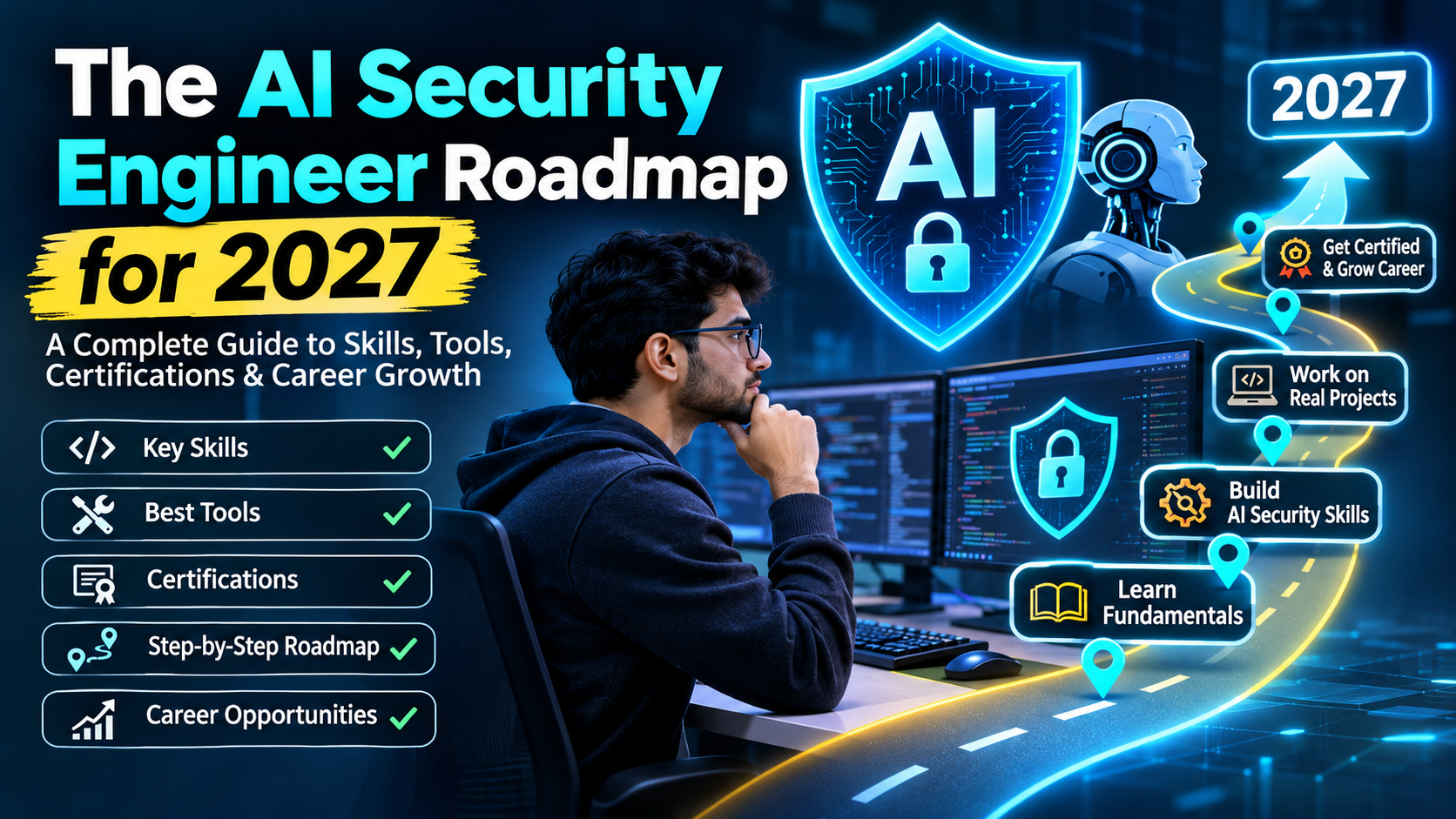
AI Security Engineer Roadmap for 2027
Becoming an AI Security Engineer requires a combination of programming, cybersecurity, artificial intelligence, and practical security testing skills.
You do not need to learn everything in one month. The best approach is to build your knowledge step by step.
Here is a practical learning roadmap that beginners and experienced IT professionals can follow.
Step 1: Learn the Basics of Programming
Programming is one of the first skills you should develop because AI security engineers work with code, applications, APIs, and automation systems.
Python is a good starting language because it is widely used in artificial intelligence, machine learning, automation, and cybersecurity.
Start by learning the following Python concepts:
- Variables and data types.
- Lists, dictionaries, and functions.
- Loops and conditional statements.
- File handling.
- Error handling.
- Classes and object-oriented programming.
- Working with APIs.
- Basic automation scripts.
After learning Python, understand basic JavaScript because many AI applications use JavaScript or TypeScript for their web interfaces and backend services.
You should also understand how HTTP requests, JSON data, authentication, and REST APIs work.
Practice project: Create a simple Python application that accepts user input, communicates with an AI API, and stores responses securely.
This project will help you understand how an AI application works before you start testing its security.
Step 2: Understand Cybersecurity Fundamentals
AI security is built on traditional cybersecurity knowledge. If you do not understand basic security concepts, it will be difficult to identify vulnerabilities in AI applications.
Start by learning how attackers access systems and how security professionals prevent unauthorized activities.
Important cybersecurity topics include:
- Network security.
- Operating system security.
- Linux fundamentals.
- Web application security.
- Authentication and authorization.
- Encryption and hashing.
- Firewalls and network monitoring.
- Vulnerability assessment.
- Penetration testing.
- Security logging and monitoring.
You should also understand common web application attacks, such as SQL injection, cross-site scripting (XSS), cross-site request forgery (CSRF), and server-side request forgery (SSRF).
These attacks can affect AI applications when their surrounding software is not properly secured.
Practice project: Build a basic web application and test it for common security weaknesses in a controlled environment.
Learn how to identify vulnerabilities and fix them instead of focusing only on finding attacks.
Step 3: Learn Artificial Intelligence and Machine Learning
Once you understand programming and cybersecurity, move towards artificial intelligence and machine learning.
You do not need to become a research scientist. However, you should understand how AI models work and how they process information.
Start with these important concepts:
- Artificial intelligence fundamentals.
- Machine learning basics.
- Supervised and unsupervised learning.
- Neural networks.
- Deep learning.
- Natural language processing.
- Large language models.
- Model training and fine-tuning.
- Model inference.
- Embeddings and vector databases.
Learn how a machine learning model receives input, processes information, and generates output.
You should also understand the difference between training data and inference data.
Training data is used to teach a model. Inference data is the information provided when the model is being used.
Both can introduce security risks if they are not handled correctly.
Practice project: Train a basic machine learning model using a public dataset and explore how changing or manipulating the input data affects its results.
Step 4: Understand Large Language Model Security
Large language models are widely used in chatbots, content generation platforms, business assistants, and AI-powered applications.
However, LLMs introduce security risks that traditional application security testing may not fully cover.
An AI Security Engineer should understand how these models process prompts, context, documents, and generated responses.
Focus on these important topics:
- Prompt injection.
- Jailbreaking.
- Sensitive information disclosure.
- System prompt leakage.
- Model extraction.
- Data poisoning.
- Insecure output handling.
- Hallucination and misinformation.
- Model denial of service.
- Unbounded resource consumption.
The OWASP Top 10 for LLM Applications 2025 is an excellent resource for understanding these risks.
It highlights important security problems, including prompt injection, supply chain weaknesses, excessive agency, vector and embedding weaknesses, and sensitive information disclosure.
Practice project: Build a simple AI chatbot and test whether malicious user instructions can change its intended behavior.
Then add input validation, output checks, access controls, and monitoring to improve its security.
Step 5: Learn AI Agent Security
AI agents are becoming an important part of modern AI applications.
Unlike a basic chatbot, an AI agent can use tools, access external information, interact with APIs, and perform tasks.
For example, an AI agent may read emails, search company documents, update a CRM, or create reports.
These abilities create additional security risks because an attacker may try to manipulate the agent into performing unauthorized actions.
An AI Security Engineer should understand:
- AI agent architecture.
- Tool calling and function calling.
- Agent permissions.
- Memory security.
- Multi-agent communication.
- Human approval workflows.
- API access control.
- Agent identity and authentication.
- Secure tool integration.
- Monitoring agent activities.
You should also learn about Model Context Protocol (MCP), which allows AI applications to connect with external tools and data sources.
MCP servers must be secured because they can expose important business capabilities and information.
A secure AI agent should have limited permissions, clearly defined responsibilities, and approval requirements for sensitive operations.
Practice project: Build a basic AI agent that can search documents and summarize information. Then test whether it can be manipulated into accessing documents outside its authorized permissions.
Step 6: Learn AI Red Teaming and Security Testing
AI red teaming is the process of testing AI systems to discover weaknesses before attackers can exploit them.
It involves using different attack methods to understand how an AI model or application behaves under unusual or malicious conditions.
AI security engineers should learn how to test:
- Direct prompt injection.
- Indirect prompt injection.
- Jailbreak attempts.
- Sensitive information extraction.
- Unauthorized tool execution.
- Retrieval-Augmented Generation (RAG) attacks.
- Malicious document uploads.
- Model output manipulation.
- Excessive API usage.
- Data leakage between users.
You should perform these tests only on systems you own or have permission to assess.
Useful tools and resources include:
1. Garak: An open-source LLM vulnerability scanner that helps identify weaknesses in language models.
2. PyRIT: Microsoft’s Python Risk Identification Toolkit for generative AI security testing.
3. Promptfoo: A testing framework that can evaluate AI prompts, models, and application behavior.
4. Giskard: A platform for testing and evaluating machine learning and LLM applications.
5. OWASP Resources: Security guidance and testing recommendations for LLM and generative AI applications.
Practice project: Perform an authorized security assessment of your own chatbot. Document the vulnerabilities, explain their impact, and demonstrate how you fixed them.
Step 7: Learn RAG Security and Vector Database Protection
Retrieval-Augmented Generation, commonly called RAG, allows AI applications to retrieve relevant information from external documents or databases before generating answers.
Businesses use RAG to create AI assistants that can answer questions using internal company information.
However, RAG systems can introduce security weaknesses.
For example, an attacker might upload a malicious document that influences the AI’s response. Another problem occurs when a user retrieves documents that belong to a different customer or department.
To secure RAG applications, learn about:
- Document access control.
- Vector database security.
- Embedding protection.
- Data validation.
- Retrieval filtering.
- Tenant isolation.
- Document permission management.
- Secure indexing.
- Data poisoning prevention.
- Source verification.
You should understand vector databases such as Chroma, FAISS, and Pinecone.
The goal is not simply to protect the language model. You must also secure the information that the model retrieves.
Practice project: Build a RAG chatbot using sample company documents. Create different user roles and verify that each user can only access authorized documents.
Step 8: Learn Cloud Security and AI Infrastructure
Most modern AI applications run on cloud platforms.
Therefore, AI Security Engineers should understand how to protect cloud infrastructure, model endpoints, storage systems, and deployment environments.
Start with one major cloud platform:
- Amazon Web Services (AWS).
- Microsoft Azure.
- Google Cloud Platform (GCP).
Learn the following cloud security concepts:
- Identity and Access Management (IAM).
- Network security.
- Encryption at rest and in transit.
- Secret management.
- Container security.
- Kubernetes fundamentals.
- Cloud logging and monitoring.
- API security.
- Infrastructure security.
- Secure deployment practices.
You should also understand Docker and basic CI/CD pipelines.
An AI application may be secure during development but become vulnerable after deployment because of exposed API keys, incorrect permissions, or insecure configurations.
Practice project: Deploy a small AI application in a cloud environment. Secure its API keys, restrict access, enable logging, and monitor unusual requests.
Step 9: Understand AI Security Frameworks and Governance
Technical knowledge is important, but organizations also need professionals who understand security standards and risk management.
AI security frameworks help businesses identify risks, define security responsibilities, and build safer AI systems.
Some important resources include:
1. NIST AI Risk Management Framework (AI RMF)
NIST provides guidance for identifying, assessing, and managing AI-related risks. Its Generative AI Profile, NIST AI 600-1, provides additional guidance for generative AI systems.
2. OWASP Top 10 for LLM Applications
This resource explains major security risks affecting large language model applications and provides a useful starting point for security reviews.
3. MITRE ATLAS
MITRE ATLAS is a knowledge base of adversary tactics and techniques related to artificial intelligence systems. It helps security professionals understand how attackers target AI technologies.
4. ISO/IEC 42001
This international standard focuses on establishing and improving an AI management system within an organization.
5. ISO/IEC 27001
This standard provides requirements for an information security management system and is useful for understanding broader organizational security practices.
Learn how to use these frameworks during AI system development, security assessments, and enterprise risk reviews.
Step 10: Build a Strong AI Security Portfolio
Learning theory is important, but practical experience makes your knowledge more valuable.
A portfolio helps employers understand what you can actually build, test, and secure.
Instead of collecting certificates without practical experience, create projects that demonstrate your abilities.
Here are some useful AI security portfolio projects:
1. Secure AI Chatbot
Build a chatbot that uses an LLM API. Add input validation, output filtering, authentication, and rate limiting.
2. Prompt Injection Testing Lab
Create a controlled testing environment to demonstrate direct and indirect prompt injection attacks and their possible impact.
3. Secure RAG Application
Build a document-based AI assistant with role-based access control and tenant-level data isolation.
4. AI Agent Permission System
Develop an AI agent that uses external tools with restricted permissions and human approval for sensitive actions.
5. LLM Security Scanner
Create a Python-based tool that runs predefined security tests against an AI application and generates a vulnerability report.
6. AI Security Monitoring Dashboard
Build a dashboard that records suspicious requests, unusual API usage, failed authentication attempts, and possible data leakage events.
For every project, explain the problem, the security risk, the testing method, the results, and the improvements you implemented.
Keep your project code and documentation in a GitHub repository. Never upload real credentials, private customer data, or confidential company information.
Best Tools to Learn for AI Security Engineers in 2027
AI Security Engineers use different tools depending on the systems they protect.
You do not need to master every tool. Start with a few important tools and gradually expand your knowledge.
| Tool | Main Purpose |
|---|---|
| Python | Security automation and scripting |
| Burp Suite | Web application security testing |
| OWASP ZAP | Web vulnerability testing |
| Garak | LLM vulnerability scanning |
| PyRIT | Generative AI red teaming |
| Promptfoo | LLM security and behavior testing |
| Giskard | AI model and application testing |
| Docker | Container management |
| Kubernetes | Container orchestration |
| Wireshark | Network traffic analysis |
| Nmap | Network discovery and scanning |
| GitHub | Code management and collaboration |
The best way to learn these tools is to use them in practical projects rather than simply memorizing their features.
Best Certifications for AI Security Engineers
Certifications can help demonstrate your knowledge, especially when you are applying for cybersecurity or cloud security positions.
However, there is no single certification that guarantees a job as an AI Security Engineer.
You can consider the following certifications based on your experience and career direction.
1. CompTIA Security+
A useful starting certification for learning general cybersecurity concepts, security operations, and risk management.
2. Certified Ethical Hacker (CEH)
Can help you understand ethical hacking, vulnerability assessment, and penetration testing.
3. Certified Information Systems Security Professional (CISSP)
A well-known advanced security certification for experienced professionals with the required experience.
4. AWS Certified Security – Specialty
Useful for professionals who want to focus on securing cloud environments on AWS. Check the current certification status and exam requirements before planning your preparation.
5. Microsoft Certified: Azure Security Engineer Associate
Relevant for people working with Microsoft Azure infrastructure and cloud security.
6. Google Cloud Security Certifications
Useful for professionals who want to develop cloud security skills in the Google Cloud ecosystem. Check Google’s current certification catalogue for available exams.
For an AI security career, combine general cybersecurity certifications with hands-on LLM security and AI red teaming projects.
How Long Does It Take to Become an AI Security Engineer?
The time required depends on your existing knowledge, learning speed, and practical experience.
A person with programming and cybersecurity experience may progress faster than someone starting from zero.
Here is an example of a 12-month learning plan.
| Timeline | What to Learn |
|---|---|
| Months 1–2 | Python, Linux, networking, and cybersecurity basics |
| Months 3–4 | Web security, APIs, and cloud fundamentals |
| Months 5–6 | AI, machine learning, LLMs, and embeddings |
| Months 7–8 | Prompt injection, RAG security, and AI agent security |
| Months 9–10 | AI red teaming and security tools |
| Month 11 | Cloud AI security and governance frameworks |
| Month 12 | Portfolio projects, documentation, and interview preparation |
This is a suggested study plan, not a guaranteed job timeline. Some people may need more time, especially if they have no previous programming or IT experience.
The important thing is to learn consistently and build projects as you progress.
AI Security Engineer Salary and Career Opportunities in 2027
AI security is a specialized area that combines cybersecurity and artificial intelligence. Professionals may work in different roles depending on their skills and experience.
Potential job titles include:
- AI Security Engineer.
- LLM Security Engineer.
- AI Red Team Engineer.
- Machine Learning Security Engineer.
- AI Application Security Engineer.
- Product Security Engineer – AI.
- Cloud AI Security Engineer.
- AI Risk and Governance Specialist.
Salary depends on location, company, experience, technical ability, and job responsibilities.
In the United States, specialized AI security positions may offer higher compensation than many general entry-level IT roles. In India, opportunities may be available in cybersecurity companies, IT services firms, cloud companies, AI startups, and enterprise technology teams.
However, there is no reliable universal salary figure for this relatively specialized job title. Compare current job listings in your target location rather than depending on broad salary predictions for 2027.
When evaluating opportunities, look at the actual responsibilities. Some positions focus on application security, while others focus on AI red teaming, model security, cloud infrastructure, or governance.
Skills Required to Become an AI Security Engineer
A successful AI Security Engineer needs both technical and problem-solving abilities.
The following skills are particularly useful:
- Python programming.
- Cybersecurity fundamentals.
- Linux and networking.
- Machine learning fundamentals.
- LLM architecture.
- Prompt injection testing.
- AI red teaming.
- RAG security.
- AI agent security.
- Cloud security.
- API security.
- Vulnerability assessment.
- Security automation.
- Risk assessment and documentation.
Communication is also important. You must be able to explain technical vulnerabilities to developers, security managers, and business teams.
An engineer who can identify a problem and clearly explain how to fix it can provide significant value to an organization.
Common Mistakes to Avoid While Learning AI Security
Many beginners spend too much time learning individual tools without understanding the security concepts behind them.
To make better progress, avoid these common mistakes.
1. Learning Only AI Tools
Knowing how to use an AI model does not automatically make you an AI security professional. You also need cybersecurity fundamentals.
2. Ignoring Programming
Python, APIs, and basic software development knowledge are important for understanding and testing AI applications.
3. Focusing Only on Prompt Injection
Prompt injection is an important risk, but AI security also includes data protection, access control, model supply chains, cloud security, and agent permissions.
4. Skipping Practical Projects
Reading documentation is useful, but you should also build applications and test them in controlled environments.
5. Ignoring Traditional Application Security
An AI application can be vulnerable because of ordinary web security problems, even if its AI model is well protected.
6. Depending Only on Certifications
Certifications can improve your profile, but employers also want practical skills, problem-solving ability, and real project experience.
Final Thoughts
The AI Security Engineer roadmap for 2027 is a practical learning path for anyone interested in combining artificial intelligence with cybersecurity.
As AI chatbots, autonomous agents, and enterprise AI applications become more common, organizations need professionals who can protect these systems from new and traditional security threats.
Start with Python, Linux, networking, and cybersecurity fundamentals. Then learn machine learning, LLM security, prompt injection testing, AI agent protection, RAG security, and cloud infrastructure.
Most importantly, build real projects and document your work. You do not need to master every AI technology before starting your journey.
Focus on understanding how AI applications work, where security weaknesses can appear, and how to fix them.
With consistent learning and practical experience, you can prepare for opportunities in AI security engineering, LLM security, AI red teaming, and enterprise AI protection in 2027 and beyond.
Frequently Asked Questions About AI Security Engineers
1. What is an AI Security Engineer?
An AI Security Engineer is a professional who protects artificial intelligence systems, machine learning models, AI applications, and AI agents from cyberattacks, data leaks, and unauthorized access.
2. How can I become an AI Security Engineer in 2027?
Start by learning Python, Linux, networking, and cybersecurity fundamentals. Then study machine learning, LLM security, prompt injection, AI red teaming, RAG security, and cloud security. Build practical projects to demonstrate your skills.
3. Do I need a degree to become an AI Security Engineer?
A computer science, information technology, cybersecurity, or related degree can be helpful. However, practical experience, programming knowledge, security skills, and a strong project portfolio are also important.
4. Which programming language is best for AI security?
Python is one of the best programming languages to start with because it is widely used in machine learning, AI development, security automation, and vulnerability testing. JavaScript and SQL are also useful.
5. Which tools should an AI Security Engineer learn?
Important tools include Garak, PyRIT, Promptfoo, Giskard, Burp Suite, OWASP ZAP, Docker, Wireshark, and Nmap. Start with tools that match your learning goals.
6. How long does it take to become an AI Security Engineer?
A structured 12-month learning plan can help you develop foundational knowledge and build practical projects. However, the actual time depends on your previous experience, learning speed, and technical background.
7. Is AI security a good career in 2027?
AI security is a promising specialization because organizations need to protect LLMs, AI agents, sensitive data, and AI-powered business applications. Career opportunities depend on technical skills, experience, and market demand.
8. What is AI red teaming?
AI red teaming is the process of testing artificial intelligence systems to identify security weaknesses. It includes testing prompt injection, jailbreaks, data leakage, unauthorized tool access, and other potential attacks.
9. What certifications are useful for AI Security Engineers?
CompTIA Security+, CEH, CISSP, AWS Certified Security – Specialty, and relevant Microsoft or Google Cloud security certifications can help develop and demonstrate cybersecurity knowledge.
10. What is the difference between an AI Security Engineer and a Cybersecurity Engineer?
A Cybersecurity Engineer generally protects networks, applications, systems, and business data. An AI Security Engineer focuses on these areas while also addressing AI-specific risks such as prompt injection, model poisoning, LLM vulnerabilities, and AI agent security.
11. Can beginners learn AI security without machine learning experience?
Yes. Beginners can start with Python and cybersecurity fundamentals before learning machine learning and LLM security. A step-by-step learning approach makes the subject easier to understand.
12. What are the most important AI security risks in 2027?
Important risks include prompt injection, sensitive information disclosure, data and model poisoning, supply chain vulnerabilities, insecure AI agent permissions, vector database weaknesses, and excessive resource consumption.