


Artificial intelligence is changing how businesses work. Today, AI agents can answer customer questions, manage tasks, search for information, write reports, use tools, and complete complex workflows. However, there is one important question: How do we know that an AI agent is actually doing its job correctly? An agent may give a good answer but still make a mistake while using a tool, following instructions, or completing a task. This is where AI Agent Evals become important. They help developers and businesses measure how well an AI agent performs in real situations. Instead of simply checking whether an AI response looks correct, evaluations test the complete process, including decisions, actions, accuracy, safety, and final results. In this guide, you will learn what AI agent evaluations are, why they matter, how they work, which metrics to track, and how to build a reliable evaluation process.
1. What Are AI Agent Evals?
AI Agent Evals, also called AI agent evaluations, are testing methods used to measure the performance, accuracy, reliability, and safety of AI agents.
An AI agent is different from a normal chatbot. A chatbot mainly responds to user questions, while an AI agent can take actions to complete a task. It may use external tools, search databases, access APIs, remember information, and perform multiple steps without asking the user for instructions at every stage.
For example, imagine an AI customer support agent.
A customer asks, “Where is my order?”
The AI agent may need to:
- Understand the customer’s question.
- Find the customer’s order number.
- Access the order management system.
- Check the delivery status.
- Prepare an accurate response.
- Share the information with the customer.
AI agent evaluations test whether the agent completes all these steps correctly.
A response that sounds professional is not enough. The agent must also use the correct information, follow business rules, and complete the requested task.
In simple words, AI Agent Evals help answer one important question: Can we trust this AI agent to perform its assigned work?
2. Why Are AI Agent Evaluations Important?
AI agents are becoming part of business operations, software development, customer service, research, and automation. However, an incorrect action can create serious problems.
For example, an AI sales agent may send incorrect prices to customers. An AI finance assistant may use outdated information. A customer support agent may update the wrong order.
Without proper testing, these problems may remain hidden until the agent is used by real customers.
AI agent evaluations help identify these problems before they affect users.
Here are the main reasons why AI agent testing is important.
1. Improve Accuracy
Evaluations check whether an AI agent provides correct information and completes tasks according to the user’s instructions.
2. Reduce Errors
Testing helps developers discover mistakes in tool usage, decision-making, reasoning, and task execution.
3. Improve Reliability
An AI agent should produce consistent results when it receives similar requests. Evaluations help measure this consistency.
4. Protect Users and Business Data
AI agents may access private information and business systems. Evaluation tests help identify security risks, unauthorized actions, and privacy problems.
5. Reduce Business Costs
An unreliable AI agent may require human employees to correct its mistakes. Proper evaluation can reduce unnecessary rework and operational expenses.
6. Build User Trust
Customers are more likely to trust an AI-powered service when it provides accurate information and performs actions correctly.
3. How Do AI Agent Evals Work?
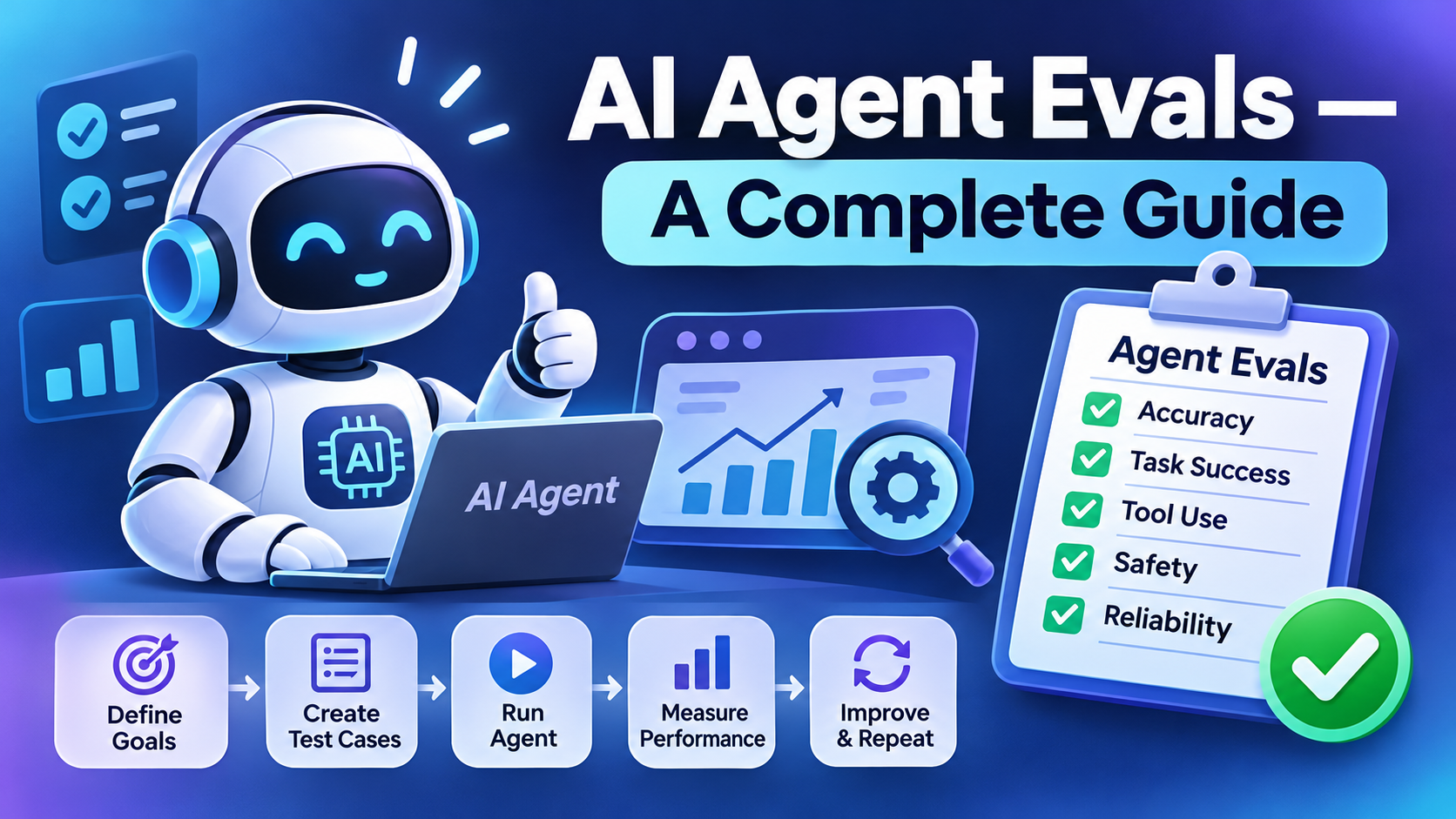
AI agent evaluations follow a testing process. Developers create test scenarios, run the AI agent, collect its actions, and compare the results with expected outcomes.
The evaluation process usually includes several stages.
Step 1: Define the Goal
First, decide what the AI agent is expected to do.
For example, an AI booking agent may need to find available appointments and schedule a booking after receiving user confirmation.
Step 2: Create Test Cases
Developers prepare different situations that the AI agent may face.
These situations should include normal requests, difficult questions, incomplete information, and unexpected problems.
Step 3: Run the AI Agent
The agent receives the test instructions and attempts to complete the task using its available tools and systems.
Step 4: Record Its Actions
The evaluation system records important information, such as:
- The agent’s initial response.
- Tools selected by the agent.
- API calls and their results.
- Decisions made during the task.
- Errors and retries.
- Final task outcome.
Step 5: Compare Results
The agent’s performance is compared with the expected result.
For example, if the task was to book an appointment, the evaluation checks whether the correct appointment was booked and whether the agent followed the required confirmation process.
Step 6: Calculate Performance
Developers use evaluation metrics to understand how accurately and efficiently the agent completed the task.
Step 7: Improve and Test Again
When a problem is discovered, developers improve the instructions, tools, workflows, or underlying model. They then run the evaluation again.
This process helps AI agents improve over time.
4. Important Metrics Used in AI Agent Evaluation
Choosing the right metrics is one of the most important parts of AI agent testing.
A simple chatbot may be evaluated based on its answers. However, an AI agent needs more detailed testing because it can perform actions and interact with external systems.
Here are the most important AI agent evaluation metrics.
1. Task Success Rate
Task success rate measures how often an AI agent successfully completes the assigned task.
For example, if an agent successfully completes 80 out of 100 booking requests, its task success rate is 80%.
Formula:
Task Success Rate = (Successful Tasks / Total Tasks) × 100
2. Accuracy
Accuracy measures whether the information or results produced by the agent are correct.
For example, a research agent should provide reliable information instead of creating unsupported facts.
3. Tool Calling Accuracy
AI agents often use tools such as search engines, databases, calculators, and APIs.
Tool calling accuracy measures whether the agent selects the correct tool and provides the correct inputs.
4. Instruction Following
This metric checks whether the agent follows user instructions and system rules.
For example, if a user asks for a report in 500 words, the agent should try to respect that requirement.
5. Response Quality
Response quality measures whether the agent’s answers are clear, relevant, useful, and easy to understand.
6. Latency
Latency measures how long the AI agent takes to complete a task.
Faster responses are useful, but speed should not come at the cost of accuracy or safety.
7. Cost Per Task
AI agents may use language models, APIs, databases, and external tools. Each operation can create a cost.
Cost per task measures how much money is spent to complete one task.
8. Safety and Compliance
This metric checks whether the agent follows security requirements, protects sensitive information, and avoids unauthorized actions.
9. Consistency
Consistency measures whether the agent produces reliable results across repeated tests and different versions of the same task.
10. Recovery Rate
Sometimes an AI agent encounters an error, unavailable tool, or incomplete response. Recovery rate measures how well it handles these situations and continues safely.
5. Different Types of AI Agent Evaluation
There is no single testing method that can measure every part of an AI agent. Developers use different evaluation methods depending on the agent’s purpose.
1. Functional Evaluation
Functional evaluation checks whether an AI agent can perform its basic responsibilities.
For example, a customer support agent should be able to answer questions, retrieve order information, and follow the correct support process.
2. Performance Evaluation
Performance evaluation measures speed, response time, resource usage, and cost.
It helps businesses understand whether the agent can handle real workloads.
3. Safety Evaluation
Safety evaluation checks whether an AI agent behaves responsibly and follows security rules.
It may test prompt injection, unauthorized tool access, harmful requests, and attempts to reveal private information.
4. Tool Use Evaluation
This method checks whether the agent selects the right tools, uses them correctly, and handles tool failures.
5. Reasoning Evaluation
Reasoning evaluation measures whether an agent can understand complex instructions, break tasks into smaller steps, and make appropriate decisions.
The focus should be on observable results and valid decision processes rather than assuming that a model’s internal reasoning is directly measurable.
6. End-to-End Evaluation
End-to-end evaluation tests the complete workflow from the initial user request to the final result.
For example, an AI travel agent may need to understand travel requirements, search for suitable options, compare results, and prepare a booking for user approval.
This method is particularly useful for agents that complete multi-step tasks.
6. Popular AI Agent Evaluation Tools and Frameworks
Several tools help developers test and monitor AI agents. Each tool offers different features, so the best choice depends on the project.
1. LangSmith
LangSmith is an evaluation and observability platform associated with the LangChain ecosystem.
It helps developers trace agent activities, inspect tool calls, create datasets, and evaluate application performance.
It is useful for teams building complex AI workflows.
2. Ragas
Ragas is an evaluation framework designed for AI applications, particularly retrieval-augmented generation (RAG).
It provides metrics for evaluating retrieval quality and generated answers. It can also support evaluation of agentic workflows.
3. DeepEval
DeepEval is an open-source evaluation framework for testing LLM applications.
It provides different evaluation metrics and testing methods that developers can use to check the quality and reliability of AI systems.
4. Braintrust
Braintrust helps teams evaluate AI applications, manage test datasets, and monitor performance.
It can be useful when developers need to compare different prompts, models, or application versions.
5. OpenAI Evals
OpenAI provides evaluation capabilities and tools for testing model and application performance.
Developers can create structured tests to understand how well their AI systems perform against defined requirements.
6. Arize Phoenix
Arize Phoenix is an open-source observability and evaluation platform for AI applications.
It helps developers inspect traces, understand failures, and evaluate LLM-based systems.
7. Inspect AI
Inspect AI is an evaluation framework developed by the UK AI Security Institute.
It supports the creation and execution of evaluations for measuring AI system capabilities and behavior, including security-related testing.
7. How to Build an AI Agent Evaluation Framework
If you are developing an AI agent for your business or application, you should create an evaluation framework before launching it.
A proper framework makes it easier to identify problems and measure improvements.
Follow these steps.
Step 1: Identify Important Use Cases
Start by understanding what your AI agent is supposed to accomplish.
For example, an AI marketing agent may need to research keywords, prepare content, and generate SEO recommendations.
Write down its main responsibilities.
Step 2: Create a Testing Dataset
Prepare a collection of realistic questions, instructions, and scenarios.
Your dataset should contain easy, medium, and difficult tasks.
Include unusual situations that may cause the agent to make mistakes.
Step 3: Define Success Criteria
Decide what a successful result looks like.
For example, a research agent may need to provide accurate information, use trusted sources, and include relevant references.
Step 4: Choose Evaluation Metrics
Select metrics that match the agent’s purpose.
A coding agent may need tests for code correctness, while a customer support agent may need tests for accuracy, policy compliance, and task completion.
Step 5: Run Automated Evaluations
Use an evaluation framework to run repeated tests.
Automated evaluations help developers compare different versions of an agent without manually checking every response.
Step 6: Include Human Review
Not every result can be judged accurately through automated scoring.
Human reviewers can check whether responses are useful, appropriate, safe, and aligned with business expectations.
Step 7: Monitor Real-World Performance
After deployment, monitor how the agent performs with actual users.
Collect feedback, identify common failures, and add new test cases.
Step 8: Repeat the Process
AI agent evaluation should not happen only once.
Every important update to the model, prompt, tools, or workflow should trigger relevant regression tests.
8. Real-World Examples of AI Agent Evaluation
Understanding practical examples makes AI agent evaluations easier to understand.
Here are some common business applications.
Example 1: Customer Support AI Agent
A customer support agent answers questions about orders, refunds, payments, and deliveries.
Its evaluation should check whether it provides correct information, follows company policies, retrieves the right order, and transfers difficult cases to human employees.
Example 2: AI Research Agent
An AI research agent collects information from different sources and prepares reports.
Its evaluation should measure source quality, factual accuracy, relevance, citation correctness, and whether it clearly identifies missing information.
Example 3: AI Coding Agent
An AI coding agent writes, modifies, and tests software.
Its evaluation should check whether the code works, passes test cases, follows security requirements, and avoids introducing new errors.
Example 4: AI Sales Agent
An AI sales agent communicates with potential customers and helps manage leads.
Its evaluation should check whether it understands customer requirements, provides correct product information, follows communication rules, and updates the CRM correctly.
Example 5: AI Personal Assistant
An AI personal assistant can manage calendars, organize information, and prepare reminders.
Its evaluation should check whether it understands instructions, uses the correct calendar information, respects permissions, and asks for confirmation before important actions.
9. Common Challenges in AI Agent Evaluation
AI agent evaluation is important, but it also has some challenges.
Understanding these challenges helps developers create better testing systems.
1. Multiple Possible Correct Answers
Some tasks have more than one acceptable solution.
For example, a research agent may find different but equally useful sources.
Therefore, evaluation systems should not always depend on exact text matching.
2. Complex Workflows
AI agents may complete tasks using many tools and multiple steps.
A final answer may look correct even when the agent used an incorrect process.
Developers should evaluate both the final outcome and important actions along the way.
3. Changing AI Models
AI models are regularly updated. A change in the model may affect response quality, tool selection, speed, and cost.
This makes continuous evaluation important.
4. Expensive Testing
Running hundreds or thousands of tests can increase model and infrastructure costs.
Developers should prioritize important scenarios and use smaller tests during regular development.
5. Measuring Safety
Safety is difficult to measure with a single score.
Different types of agents have different risks, so security testing must match the agent’s permissions and responsibilities.
6. Real-World Unpredictability
Users may provide incomplete instructions, unexpected questions, or conflicting information.
Testing should include these situations instead of focusing only on perfect examples.
10. Best Practices for Reliable AI Agent Evals
A strong evaluation strategy requires regular testing and clear performance standards.
Here are some practical best practices.
- Test realistic scenarios: Use examples based on actual user requirements and business workflows.
- Evaluate complete tasks: Do not judge an agent only by its final response. Check whether it completed the requested action correctly.
- Test tool interactions: Verify API calls, database access, tool selection, and returned results.
- Include failure scenarios: Test unavailable tools, incorrect inputs, incomplete information, and unexpected user requests.
- Use human and automated evaluation: Combine automated metrics with human feedback for better results.
- Maintain evaluation datasets: Keep a record of important test cases and update them when new problems appear.
- Run regression tests: Check whether a new update has damaged features that previously worked correctly.
- Measure cost and speed: A successful AI agent should also be affordable and efficient.
- Apply security testing: Check permissions, data access, prompt injection risks, and unauthorized actions.
- Keep monitoring after deployment: Real-world monitoring helps discover problems that were not included in the original testing dataset.
11. The Future of AI Agent Evaluation
AI agents are moving from simple question-answering systems to more advanced autonomous systems.
In the future, businesses may use multiple AI agents that work together to complete complex tasks.
This will make evaluation even more important.
Some important developments are likely to shape the future of AI agent testing.
1. Multi-Agent Evaluation
Developers will need to test how multiple agents communicate, share information, and complete tasks together.
2. Continuous Evaluation
Evaluation will become a regular part of AI development and deployment instead of a final testing activity.
3. Better Safety Testing
As AI agents receive access to more tools and business systems, security and permission testing will become essential.
4. Real-World Task Benchmarks
More evaluation systems will focus on practical tasks instead of testing only general knowledge and language ability.
5. Automated Evaluation Workflows
AI-powered evaluation systems may help developers create test cases, analyze failures, and identify areas for improvement.
However, automated evaluators will also need to be tested because they can make incorrect judgments.
6. Business-Focused Evaluation
Businesses will increasingly measure AI agents based on useful outcomes such as completed tasks, customer satisfaction, reduced errors, and operational efficiency.
12. Conclusion
AI Agent Evals are an important part of building reliable and useful AI systems. As AI agents become capable of using tools, accessing information, and completing complex tasks, simply checking their answers is no longer enough.
Businesses and developers need to evaluate the complete process, including task success, accuracy, tool usage, safety, response time, and cost.
A good evaluation framework helps identify problems before they affect real users. It also makes it easier to compare models, improve workflows, and maintain consistent performance.
Whether you are building a customer support agent, research assistant, coding agent, or business automation system, regular evaluation should be part of your development process.
The main goal is simple: Do not just build an AI agent that can perform tasks. Build one that can perform them correctly, safely, consistently, and efficiently.
Building Dynamic Workflows: A New Agentic System
Frequently Asked Questions (FAQs)
1. What are AI Agent Evals?
AI Agent Evals are testing methods used to measure the accuracy, reliability, safety, and performance of AI agents. They help developers understand whether an agent can complete tasks correctly.
2. Why are AI agent evaluations important?
AI agent evaluations help identify errors, improve task completion, reduce security risks, and make AI systems more reliable before they are used by real customers.
3. How do you evaluate an AI agent?
You can evaluate an AI agent by creating test cases, running different scenarios, checking its tool usage, measuring task success, reviewing its final results, and identifying errors.
4. What are the most important AI agent evaluation metrics?
Important metrics include task success rate, accuracy, tool calling accuracy, instruction following, latency, cost per task, safety, consistency, and recovery rate.
5. Which tools are used for AI agent evaluation?
Popular tools and frameworks include LangSmith, Ragas, DeepEval, Braintrust, OpenAI Evals, Arize Phoenix, and Inspect AI.
6. What is the difference between LLM evaluation and AI agent evaluation?
LLM evaluation mainly measures a language model’s ability to generate accurate and relevant responses. AI agent evaluation measures the complete workflow, including planning, tool usage, decision-making, actions, and task completion.
7. Can AI agent evaluation be automated?
Yes. Developers can use evaluation frameworks to run automated tests, compare results, identify errors, and measure performance. Human reviews are also useful for checking complex results.
8. What is task success rate in AI agent evaluation?
Task success rate measures the percentage of assigned tasks an AI agent completes successfully. It is calculated by dividing successful tasks by total tasks and multiplying the result by 100.
9. How often should AI agents be evaluated?
AI agents should be evaluated during development, before deployment, and after important updates. Regular monitoring and regression testing also help maintain performance.
10. What are the biggest challenges in AI agent evaluation?
The main challenges include complex workflows, unpredictable user requests, multiple possible correct answers, changing AI models, testing costs, and measuring safety.
11. What is an AI agent benchmark?
An AI agent benchmark is a standardized collection of tasks and evaluation methods used to compare the capabilities and performance of different AI agents.
12. Is AI agent evaluation necessary for small businesses?
Yes. Small businesses also need to test AI agents to ensure they provide correct information, protect customer data, follow business rules, and complete automated tasks reliably.