


Artificial intelligence is changing how businesses build software, manage information, and complete everyday tasks. Traditional software systems usually follow fixed instructions and predefined workflows. However, modern AI systems need more flexibility, better communication, and the ability to make decisions based on different situations. This is where Topic-Agent-First Architecture becomes an interesting approach. It focuses on organizing AI systems around specific topics and intelligent agents that can understand requests, perform tasks, and communicate with other components. Instead of building one large AI system that handles everything, developers can create smaller, specialized agents that work together. This approach can make AI applications easier to manage, expand, and improve. In this guide, you will learn what Topic-Agent-First Architecture means, how it works, its main components, benefits, challenges, real-world applications, and how businesses can use it to build smarter AI-powered solutions.
1. What Is Topic-Agent-First Architecture?
Topic-Agent-First Architecture is an approach to designing AI-powered systems where topics and specialized AI agents play an important role in organizing information and completing tasks.
In simple words, it means creating an AI system in which different agents focus on specific subjects, responsibilities, or areas of work.
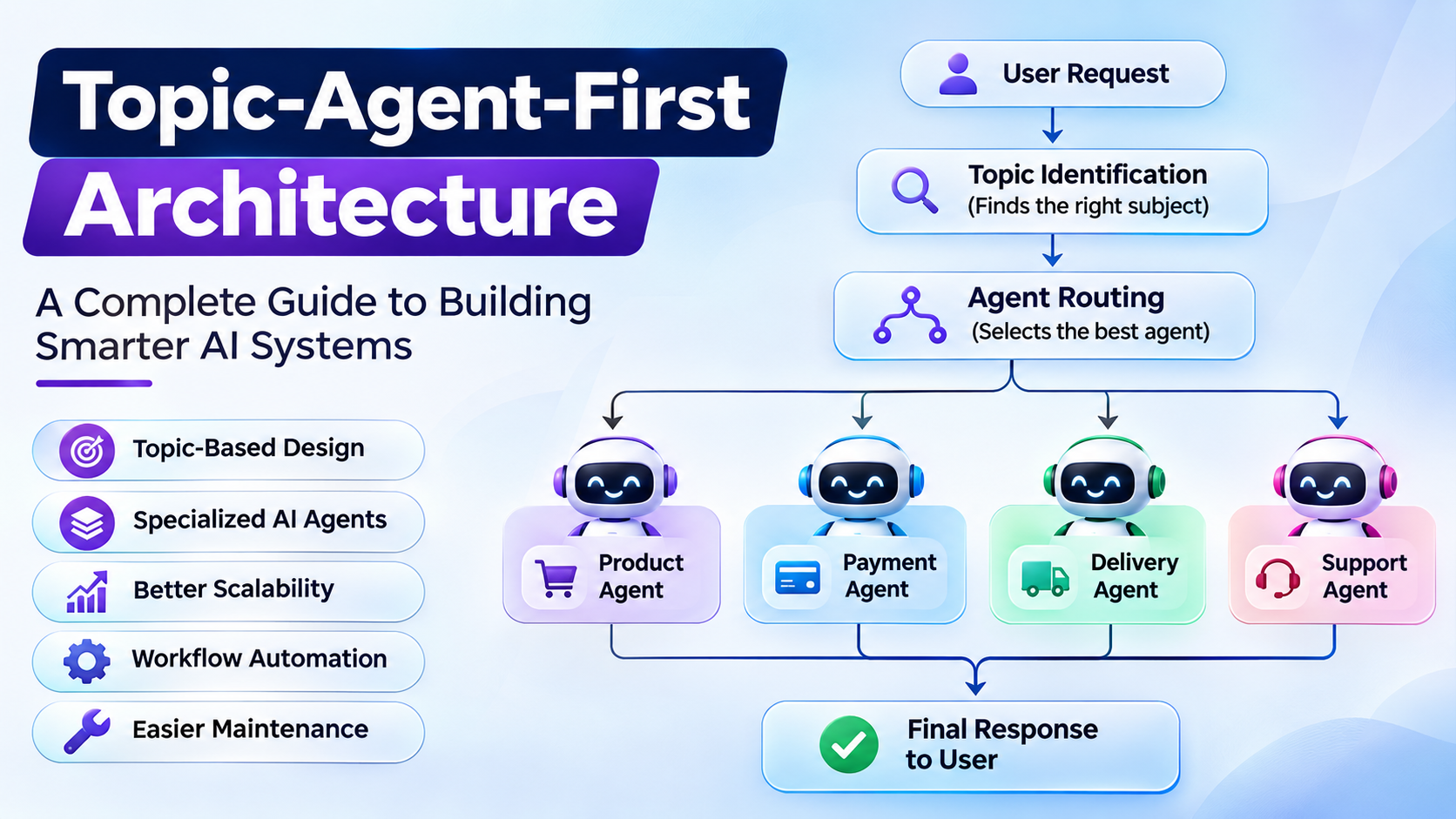
For example, imagine an AI assistant built for an online shopping company. Customers may ask questions about products, payments, delivery, and returns.
Instead of using one agent to manage every request, the system can use different specialized agents.
- Product Agent handles product-related questions.
- Payment Agent handles payment problems.
- Delivery Agent checks shipping information.
- Customer Support Agent manages complaints and general questions.
- Return Agent handles refund and return requests.
Each agent works within its assigned area and can communicate with other agents when required.
The topic-based structure helps the system understand what kind of information or task is involved before selecting the appropriate agent.
Important: Topic-Agent-First Architecture is a descriptive architectural approach rather than a universally standardized technical specification. Its exact implementation can differ between projects.
This distinction is important because developers should select an architecture based on their actual requirements instead of assuming that every AI system needs multiple agents.
2. Why Is Topic-Agent-First Architecture Important?
Traditional applications are often built around fixed workflows. They work well when users follow predictable steps.
However, AI applications face different challenges.
Users can ask unexpected questions, change their requirements, provide incomplete information, or request several tasks in one conversation.
A traditional workflow may struggle when a request does not match its predefined instructions.
Topic-Agent-First Architecture offers a way to organize these complex tasks into smaller responsibilities.
For example, consider a business that receives hundreds of customer enquiries every day.
A single AI assistant may need to understand products, marketing, payments, complaints, and technical problems.
As the system grows, managing all these responsibilities becomes difficult.
A topic-agent-based approach can divide these responsibilities between specialized agents.
This makes it easier to:
- Organize information by topic.
- Assign tasks to the right AI agent.
- Reduce unnecessary communication.
- Manage complex workflows.
- Improve system maintenance.
- Add new capabilities without rebuilding everything.
The main idea is simple: give each agent a clear responsibility and allow the system to coordinate their work.
3. How Does Topic-Agent-First Architecture Work?
Topic-Agent-First Architecture works by dividing an AI application into different topics and assigning responsibilities to suitable agents.
When a user sends a request, the system first understands the request and identifies its main topic. After that, it selects the agent responsible for handling that topic.
The selected agent processes the request, uses the available tools or information, and returns a response.
A typical workflow includes the following steps.
1. User sends a request
The process begins when a user enters a question, command, or task into an AI application.
For example:
“Can you check my order status and tell me when it will arrive?”
2. Topic identification
The system analyzes the request and identifies the main topic.
In this example, the topic is order tracking and delivery information.
3. Agent selection
The system selects the appropriate agent based on the identified topic.
The Delivery Agent receives the request because it is responsible for shipping information.
4. Information processing
The selected agent checks the available information, such as order details, shipping records, and delivery updates.
5. Agent response
The agent prepares an answer using the information it has collected.
6. Final response
The system sends the response to the user in simple and understandable language.
If the request involves multiple topics, the system can send different parts of the task to different agents and combine their results.
This process makes AI applications more organized and flexible.
4. Main Components of Topic-Agent-First Architecture
A successful architecture needs different components that work together. Each component has a specific responsibility.
Here are the important components developers should understand.
4.1 Topic Classification Layer
The topic classification layer identifies what the user wants to discuss or accomplish.
It analyzes the user’s message and places the request into an appropriate category.
For example, an AI banking assistant may recognize these topics:
- Account information.
- Credit card services.
- Loan enquiries.
- Payment problems.
- Transaction history.
- Customer complaints.
Topic classification can use large language models (LLMs), machine learning models, keyword matching, or a combination of these methods.
Its main purpose is to help the system understand the user’s intention before assigning the task.
4.2 Agent Registry
An agent registry stores information about the available agents in the system.
It helps the system understand which agents are available and what responsibilities they can perform.
For example:
| AI Agent | Main Responsibility |
|---|---|
| Research Agent | Collects information |
| Writing Agent | Creates content |
| SEO Agent | Analyzes SEO requirements |
| Coding Agent | Writes and reviews code |
| Data Agent | Analyzes business data |
| Support Agent | Handles customer queries |
The registry can also store agent capabilities, tool permissions, supported topics, and other configuration details.
This makes it easier to manage a growing multi-agent system.
4.3 Agent Routing System
The routing system connects incoming requests with the correct agents.
It uses topic information, task requirements, and agent capabilities to decide where a request should go.
For example, when a user asks for an SEO-friendly blog, the system may send the request to a content agent and then involve an SEO review agent.
Routing can follow predefined rules or use an AI model to select the appropriate agent.
4.4 Specialized AI Agents
Specialized agents are the working units of the architecture.
Each agent has a specific role, instructions, and access to selected tools.
For example, a research agent can search information, while a writing agent can prepare an article using the research results.
Specialization helps prevent one agent from handling too many unrelated responsibilities.
However, agents should not be divided into unnecessary small tasks. Every additional agent can increase system complexity and communication costs.
4.5 Shared Memory and Context Management
Memory allows an AI system to use relevant information from previous interactions or earlier steps in a workflow.
For example, a customer support agent may need to know:
- The customer’s previous question.
- The order number.
- The problem already reported.
- The actions taken by another agent.
Shared context helps agents work together without asking users to repeat the same information.
However, sensitive information should only be shared when necessary and with appropriate access controls.
4.6 Communication Layer
The communication layer allows different agents and system components to exchange information.
Agents may communicate through direct API calls, message queues, shared state, or event-based systems.
For example, a research agent can send its findings to a writing agent. The writing agent can then send the completed draft to an editing agent.
This communication layer helps coordinate different responsibilities.
4.7 Monitoring and Security Layer
Every production AI system needs monitoring and security.
This component tracks agent activities, errors, tool usage, response quality, and system performance.
It also helps enforce permissions and prevents agents from accessing information or performing actions outside their responsibilities.
For business applications, monitoring and security are essential for building reliable AI systems.
5. Topic-Agent-First Architecture vs Traditional AI Architecture
Traditional AI applications often use one main model or a predefined workflow to complete different tasks.
Topic-Agent-First Architecture uses topic identification and specialized agents to organize complex responsibilities.
Both approaches have advantages, and the right choice depends on the application.
| Feature | Traditional AI Architecture | Topic-Agent-First Architecture |
|---|---|---|
| Task management | Often centralized | Divided by responsibility |
| Specialization | Limited or model-based | Dedicated agents |
| Task routing | Fixed or predefined | Topic and capability-based |
| Flexibility | Depends on workflow | Can support dynamic routing |
| Maintenance | Can become difficult as features grow | Responsibilities can be managed separately |
| Communication | Often centralized | Multiple components may communicate |
| Scalability | Depends on system design | Supports modular expansion |
One important point is that a traditional AI system is not always less flexible. Modern traditional architectures can also support modular components, advanced routing, and intelligent workflows.
The real difference is how responsibilities are organized and coordinated.
6. Benefits of Topic-Agent-First Architecture
Topic-Agent-First Architecture can provide several benefits when an application handles multiple subjects and complex tasks.
6.1 Better Task Organization
Dividing work by topics makes it easier to understand which agent is responsible for each task.
Developers can manage different capabilities without placing every instruction inside one large AI prompt.
6.2 Improved Scalability
Businesses can add new agents when they introduce new services or features.
For example, an e-commerce company can initially create product, payment, and delivery agents.
Later, it can add recommendation, returns, and customer feedback agents.
This allows the application to grow gradually.
6.3 Easier Maintenance
When every agent has a defined responsibility, developers can update individual components without changing the entire application.
For example, a company can improve its payment agent without completely rebuilding its customer support system.
6.4 Better Task Specialization
Specialized agents can receive instructions and tools that match their responsibilities.
A coding agent can focus on programming, while a research agent can focus on collecting and verifying information.
This can improve task quality when agents are properly designed and evaluated.
6.5 Improved Workflow Automation
Different agents can complete different stages of a business process.
For example, an AI marketing system can:
- Research a business topic.
- Identify target keywords.
- Prepare a blog article.
- Create social media content.
- Review SEO requirements.
- Prepare a publishing draft.
This reduces repetitive manual work and helps teams manage their daily activities.
6.6 Easier Expansion Across Departments
A business can use different agents for marketing, finance, sales, customer support, and operations.
Each department can have its own agents while following common security and communication rules.
6.7 More Flexible User Experiences
Users do not need to understand the internal structure of the AI system.
They can simply describe their requirements, while the system identifies the relevant topics and agents.
This creates a more natural way to interact with complex software.
7. Real-World Applications of Topic-Agent-First Architecture
This architecture can be useful in many industries where applications need to manage multiple types of information and tasks.
7.1 E-commerce and Online Shopping
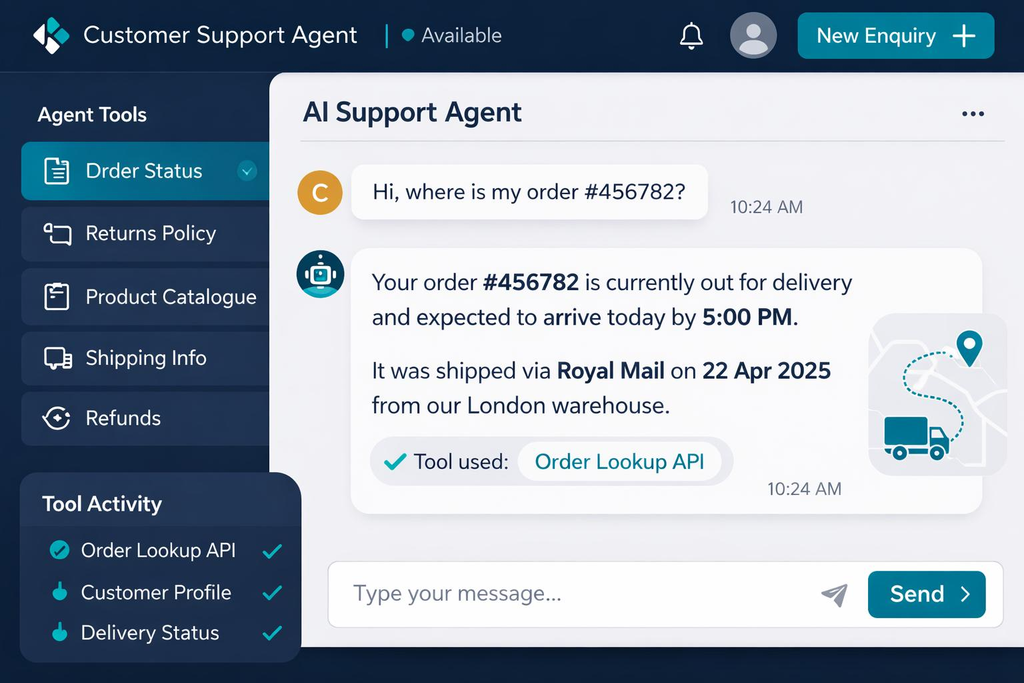
E-commerce companies receive different types of customer enquiries every day.
An AI system can use separate agents for products, payments, delivery, returns, and customer complaints.
For example, a customer can ask about a product and then request delivery information in the same conversation.
The system can involve the Product Agent and Delivery Agent to provide a complete response.
7.2 Digital Marketing and SEO
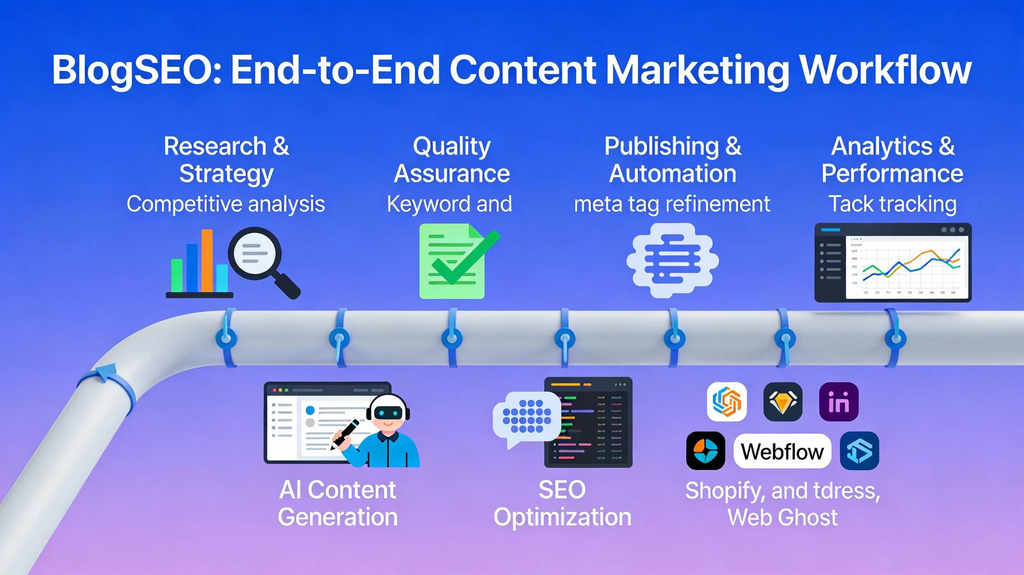
Digital marketing agencies manage several activities, including keyword research, content creation, social media management, competitor analysis, and SEO reporting.
A topic-agent-based system can assign these responsibilities to different agents.
For example, a keyword research agent can identify search terms, a content agent can write articles, and an SEO agent can review titles, descriptions, and keyword placement.
This can help marketing teams organize repetitive activities and improve workflow efficiency.
7.3 Healthcare Information Systems
Healthcare platforms can use specialized agents for appointment information, general health education, medical records, and administrative support.
For example, an appointment agent can help users understand booking procedures, while an administrative agent can provide information about available services.
Such systems must follow strict privacy, security, and clinical safety requirements. An AI agent should not replace qualified medical professionals or make unsupported medical decisions.
7.4 Banking and Financial Services
Banks can organize AI agents around account support, card services, transactions, loan information, and fraud reporting.
For example, if a customer reports an unfamiliar transaction, the system can route the request to a transaction support agent.
Any sensitive financial action should require appropriate authentication and authorization.
7.5 Education and Online Learning
Educational platforms can use different agents for mathematics, science, programming, language learning, and student support.
A student asking a programming question can be connected to a coding tutor agent.
A separate learning progress agent can help organize study activities and track completed lessons.
This can support more personalized learning experiences.
8. How to Build a Topic-Agent-First Architecture
Building this type of AI system requires proper planning. Developers should begin with business requirements instead of immediately creating multiple AI agents.
Here is a practical development process.
Step 1: Identify the main business requirements
Understand what the application needs to accomplish.
List the common user requests, important tasks, and expected outcomes.
For example, an online shopping platform may need to handle product questions, payment support, order tracking, and returns.
Step 2: Create topic categories
Group similar requests into clear topics.
Avoid creating too many categories because unnecessary topics can make classification and routing more complicated.
Step 3: Define agent responsibilities
Decide which tasks each agent will handle.
Every agent should have a clear purpose, defined inputs, expected outputs, and suitable permissions.
Step 4: Select the AI model
Choose an appropriate large language model based on accuracy, cost, speed, privacy, and tool-calling requirements.
Different agents do not always need different models. Several specialized agents can use the same underlying model with different instructions.
Step 5: Develop the topic classifier
Build a component that understands user requests and identifies the appropriate topic.
Start with simple rules for predictable requests. Use an LLM-based classifier when natural language understanding is required.
Step 6: Build the agent routing system
Connect the topic classifier with the agent registry.
The routing system should select an agent based on the topic, capabilities, permissions, and task requirements.
Step 7: Connect tools and databases
Give agents access to the tools they actually need.
These may include APIs, databases, search systems, CRM platforms, document storage, or internal business applications.
Use restricted permissions rather than giving every agent access to every resource.
Step 8: Implement memory and communication
Create a context management system so agents can share relevant task information.
Use structured messages and clearly defined outputs to reduce misunderstandings between agents.
Step 9: Test the complete workflow
Test simple requests, complex requests, incorrect classifications, missing information, and agent failures.
Check whether the system selects the right agent and provides accurate results.
Step 10: Monitor and improve performance
Track response accuracy, task completion rates, latency, cost, security issues, and user satisfaction.
Use these results to improve prompts, routing rules, tools, and agent responsibilities.
9. Best Tools and Technologies for Building Agent-First Systems
Developers can use different AI frameworks and technologies to build topic-based multi-agent applications.
The choice depends on the complexity of the project, the number of agents, and the required integrations.
Here are some useful technologies.
9.1 LangChain
LangChain is a framework for developing applications powered by large language models.
It provides tools for connecting models with external services, retrieving information, and building AI workflows.
Developers can use it to create agents that interact with APIs, databases, and other tools.
9.2 LangGraph
LangGraph is useful for building stateful, multi-step AI workflows.
It allows developers to define nodes, connections, conditional routing, and shared state.
This makes it useful when different agents need to complete tasks in a particular order or when a workflow requires human approval.
9.3 CrewAI
CrewAI helps developers create teams of specialized AI agents.
Developers can assign different roles and responsibilities to agents and coordinate their work.
For example, a research agent can collect information while a writing agent prepares an article.
9.4 AutoGen
Microsoft AutoGen is an open-source framework for developing applications involving multiple AI agents.
It supports agent communication and collaborative workflows.
It can be useful for experimenting with systems where different agents need to exchange information and complete tasks together.
9.5 n8n
n8n is a workflow automation platform that can connect AI models, APIs, databases, and business applications.
It can help businesses automate repetitive processes without writing every integration from scratch.
For example, an automated marketing workflow can collect information, generate content, prepare social media drafts, and send notifications.
9.6 OpenAI API
The OpenAI API allows developers to integrate language models into their applications.
It can be used for topic classification, text generation, reasoning, structured outputs, and tool-based interactions.
Developers can use these capabilities to build specialized agents for different business requirements.
Which tool should you choose?
For a simple automation project, n8n may be a practical starting point. For more advanced agent coordination, developers can explore LangGraph, CrewAI, or AutoGen. The OpenAI API can provide the underlying model capabilities.
The best technology is the one that solves the actual problem without adding unnecessary complexity.
10. Challenges of Topic-Agent-First Architecture
Although this architecture offers several advantages, it also introduces challenges that developers must understand before using it in production.
10.1 Incorrect Topic Classification
Sometimes the system may misunderstand a user’s request.
For example, a customer asking about a payment refund may be incorrectly connected to the general payment information agent instead of the refund agent.
This can lead to incomplete answers.
Solution: Use clear topic definitions, test different user queries, and provide fallback routing when the system is uncertain.
10.2 Agent Communication Problems
Different agents may produce information in different formats.
One agent may return a short summary, while another may expect structured data.
This can create problems during communication.
Solution: Define standard input and output formats. Use structured JSON schemas where appropriate and validate information before passing it between agents.
10.3 Higher Development Costs
Every additional agent may require separate instructions, testing, monitoring, and tool integrations.
More agents can also increase model usage and infrastructure costs.
Solution: Start with a small number of agents. Add new agents only when there is a clear need for separate responsibilities.
10.4 Security and Data Privacy
Agents may access sensitive information through connected databases, APIs, or business applications.
Poor permission management can expose private information.
Solution: Apply role-based access controls, restrict tool permissions, protect sensitive data, and maintain activity logs.
10.5 Difficulties in Debugging
When multiple agents work together, identifying the reason behind an incorrect response can become difficult.
The problem may come from classification, routing, memory, tool execution, or communication.
Solution: Maintain traceable logs for every workflow step and monitor individual agent performance.
10.6 Unreliable AI Responses
AI models can generate incorrect information or misunderstand instructions.
An agent may also use outdated information from an external source.
Solution: Use trusted data sources, validate important outputs, introduce human approval for high-risk actions, and evaluate results regularly.
11. Best Practices for Designing Topic-Agent-First Architecture
A well-designed architecture should focus on simplicity, reliability, and clear responsibilities.
Follow these practices when developing an agent-based system.
1. Start with business requirements: Understand the real problem before selecting technologies or designing agents.
2. Keep agents specialized: Give every agent a clear role instead of asking one agent to handle unrelated responsibilities.
3. Use clear topic definitions: Make sure topics are understandable and do not overlap unnecessarily.
4. Build reliable routing: Select agents based on their capabilities, permissions, and task requirements.
5. Share only relevant context: Avoid sending unnecessary customer or business information between agents.
6. Use structured communication: Standardize agent inputs and outputs to reduce errors.
7. Add human supervision: Important financial, legal, medical, and business decisions may require human approval.
8. Monitor performance: Measure accuracy, response time, completion rates, and operational costs.
9. Plan for failures: Create fallback mechanisms when an agent, model, or external tool becomes unavailable.
10. Improve continuously: Use testing and real-world feedback to improve the complete system.
These practices can help developers create more dependable AI applications.
12. Topic-Agent-First Architecture vs Multi-Agent Architecture
These two terms are closely related, but they are not exactly the same.
Multi-agent architecture is a broader approach in which multiple AI agents collaborate to complete tasks.
Topic-Agent-First Architecture is a way of organizing such a system around topics and assigning suitable agents to those topics.
For example, a multi-agent system may use a researcher, writer, and editor.
A topic-agent-based design may first identify whether a request is about research, writing, editing, or another subject and then select the appropriate agent.
| Comparison | Topic-Agent-First | General Multi-Agent |
|---|---|---|
| Main focus | Topics and agent responsibilities | Agent collaboration |
| Organization | Topic-oriented | Task or role-oriented |
| Routing | Based on topics and capabilities | Can use different coordination methods |
| Structure | Topic-driven | Flexible |
| Best suited for | Systems with clear subject areas | Complex collaborative tasks |
A system can use both approaches together. Topic identification can decide which agents should participate, while multi-agent coordination manages their collaboration.
13. Future of Topic-Agent-First Architecture
AI systems are moving beyond simple question-and-answer interactions.
Modern applications increasingly use AI agents to perform research, access business tools, analyze information, and complete multi-step tasks.
Topic-oriented agent design may become useful as businesses manage larger numbers of AI capabilities.
Several developments are worth watching.
More Specialized AI Agents
Businesses may develop agents for individual departments, services, and business processes.
This can help organizations create systems that understand specific operational requirements.
Better Agent Coordination
Improved communication protocols and workflow frameworks can make it easier for agents to exchange information and complete complex tasks.
More Intelligent Topic Routing
AI models may become better at understanding requests that involve multiple topics.
For example, a business owner may ask an AI assistant to analyze sales data, identify marketing opportunities, and prepare a campaign.
The system may involve several agents to complete the complete workflow.
Human and AI Collaboration
Future systems will increasingly combine AI automation with human supervision.
Agents can complete repetitive activities, while people review important decisions and handle situations that require judgment.
Improved Security and Governance
As AI agents receive access to more business tools, organizations will need better permission management, monitoring, audit trails, and approval systems.
The future of agent-first architecture will not depend only on creating more agents. It will depend on making them reliable, secure, useful, and easy to manage.
14. Is Topic-Agent-First Architecture Right for Your Business?
Not every business needs a multi-agent system.
If an application performs one simple task, a single AI model or traditional workflow may be enough.
However, topic-agent-based design can be useful when an application handles many different subjects, business processes, or user requirements.
Consider this approach when:
- Your AI application handles several unrelated topics.
- Different tasks require different tools and permissions.
- You need to expand your AI capabilities over time.
- Your workflows involve multiple specialized responsibilities.
- You want better control over task routing and monitoring.
For small projects, start with a simple architecture. Test whether specialization improves performance before introducing more agents.
The goal should always be to solve a real business problem, not to make the system unnecessarily complicated.
Conclusion
Topic-Agent-First Architecture provides a useful way to organize modern AI applications around topics, specialized agents, and clear responsibilities. Instead of asking one AI system to manage every task, developers can create focused agents that work together through a structured communication and routing system.
This approach can support better task organization, workflow automation, system expansion, and easier maintenance. It also introduces challenges involving security, communication, development costs, and reliability.
The best way to implement it is to start small, identify the most important topics, assign clear agent responsibilities, and test the complete workflow before expanding it.
As agentic AI continues to develop, topic-oriented design can become a valuable approach for businesses that want to build practical, scalable, and intelligent AI-powered applications.
The AI Security Engineer Roadmap for 2027
Frequently Asked Questions (FAQs)
1. What is Topic-Agent-First Architecture?
Topic-Agent-First Architecture is an approach to designing AI systems where tasks are organized around specific topics and handled by specialized AI agents. It helps applications manage different responsibilities through structured routing and communication.
2. How does Topic-Agent-First Architecture work?
It works by identifying the user’s request, classifying its topic, selecting the appropriate AI agent, processing the task, and delivering the final response. Multiple agents can collaborate when a request involves different topics.
3. What is the difference between Agent-First Architecture and traditional AI architecture?
Traditional AI architecture often uses centralized models or predefined workflows. Agent-First Architecture focuses on specialized agents that handle specific responsibilities and collaborate to complete complex tasks.
4. What are the main components of Topic-Agent-First Architecture?
The main components include topic classification, agent registry, agent routing, specialized AI agents, shared memory, communication systems, and monitoring and security layers.
5. Can Topic-Agent-First Architecture improve business automation?
Yes. It can help businesses automate customer support, marketing, research, sales, reporting, and other repetitive activities by assigning tasks to specialized AI agents.
6. Which tools are used to build Topic-Agent-First Architecture?
Developers can use LangChain, LangGraph, CrewAI, Microsoft AutoGen, n8n, and OpenAI API to build AI agents, connect tools, and coordinate workflows.
7. Is Topic-Agent-First Architecture suitable for small businesses?
Yes, but small businesses should start with a simple implementation. They can introduce a few specialized agents for customer support, content creation, or lead management and expand when necessary.
8. What are the biggest challenges of Topic-Agent-First Architecture?
Common challenges include incorrect topic classification, agent communication problems, higher development costs, data privacy concerns, debugging difficulties, and unreliable AI-generated responses.
9. Is Topic-Agent-First Architecture related to Agentic AI?
Yes. It can be used as a design approach for Agentic AI systems. Agentic AI focuses on systems that can plan and perform tasks with some level of autonomy, while topic-agent-based design helps organize their responsibilities.
10. What is the future of Topic-Agent-First Architecture?
Its potential future includes more specialized agents, intelligent task routing, improved agent communication, better workflow automation, and stronger security and governance.