


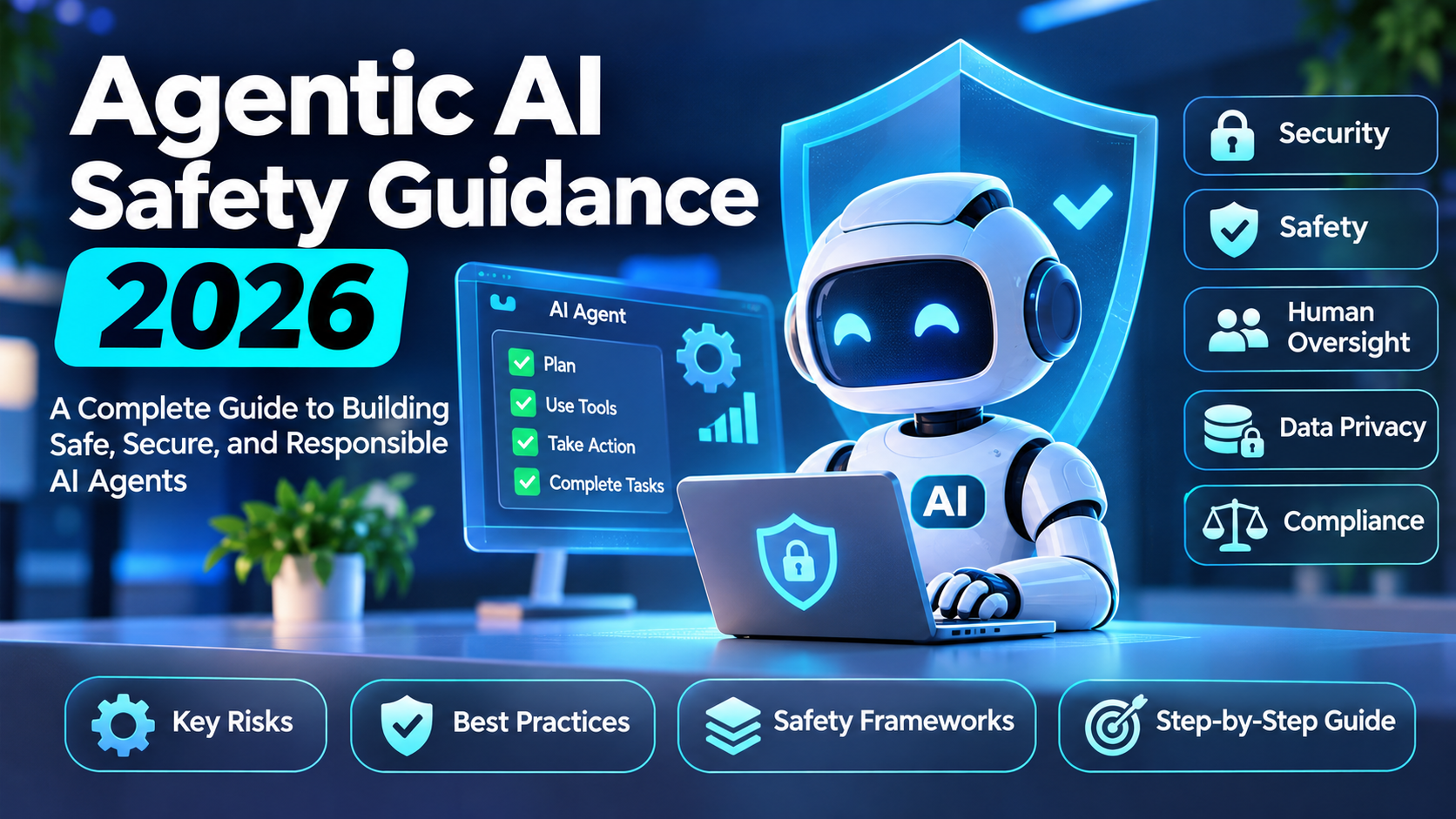
Artificial intelligence is changing the way businesses work. Today, AI is no longer limited to answering questions or generating content. With Agentic AI, businesses can build intelligent systems that understand goals, make decisions, use tools, access information, and complete tasks with less human involvement. These systems can manage customer support, automate business operations, analyse data, write reports, and even interact with other software.
However, greater independence also brings greater risks. An AI agent can make incorrect decisions, expose private information, follow malicious instructions, or perform actions that were never intended by its developers. This makes Agentic AI Safety Guidance 2026 an important topic for business owners, developers, startups, and technology professionals.
In this guide, you will learn how to build safer AI agents, protect sensitive information, control automated actions, reduce security risks, and follow responsible AI practices. Whether you are developing your first AI agent or managing an advanced agentic AI system, these practical safety guidelines will help you use AI more confidently and responsibly.
What Is Agentic AI Safety?
Agentic AI safety refers to the methods, rules, technologies, and security practices used to make autonomous AI agents safe, reliable, controlled, and responsible.
Unlike traditional AI tools that mainly respond to user instructions, agentic AI systems can perform multiple steps to achieve a particular goal. They may connect with external applications, use APIs, search databases, write files, send emails, and make decisions based on the information they receive.
For example, imagine an AI agent designed to manage customer support. It can read customer messages, understand their problems, check order information, prepare responses, and update customer records.
If the agent has poor safety controls, it might share private customer information, provide incorrect details, or update the wrong account.
This is why AI agent safety is not just about making AI produce accurate answers. It is also about controlling what an AI agent can access, what actions it can perform, and when it needs human approval.
Why Is Agentic AI Safety Important in 2026?
Agentic AI adoption is growing because businesses want to automate repetitive work and improve productivity. However, giving AI systems access to real business tools creates new security and operational challenges.
A simple chatbot may provide a wrong answer. An autonomous AI agent with access to business systems could take an incorrect action.
For example, an AI agent connected to an email account might send an incorrect message. An agent connected to a payment system might approve an unauthorised transaction if its permissions are not properly controlled.
Businesses must therefore treat AI agents as systems that need security, monitoring, testing, and clear operating rules.
Here are some important reasons why agentic AI safety matters:
1. Protecting sensitive information: AI agents may access customer records, business documents, passwords, and confidential data. Strong security controls help prevent unauthorised access.
2. Preventing unwanted actions: Agents can interact with external tools. Proper permissions help prevent them from deleting files, sending unauthorised emails, or changing important records.
3. Reducing incorrect decisions: AI systems can misunderstand instructions or work with incomplete information. Safety checks help reduce the impact of mistakes.
4. Building customer trust: Customers are more likely to trust businesses that protect their information and use AI responsibly.
5. Following regulations: Businesses need to understand applicable privacy, cybersecurity, and AI regulations when developing and using AI agents.
6. Maintaining business operations: Monitoring and recovery systems help businesses manage unexpected agent behaviour without stopping all operations.
Top Agentic AI Security Risks You Should Know in 2026
Before creating safety rules, it is important to understand the risks associated with autonomous AI systems.
Agentic AI security involves more than protecting the AI model. Developers must also secure the tools, databases, memory systems, external connections, and permissions used by the agent.
The following are some major risks.
1. Prompt Injection Attacks
Prompt injection is one of the most important security risks for AI agents.
It happens when an attacker places malicious instructions inside content that an AI system reads. This content might appear in an email, website, document, customer message, or database record.
For example, an AI research agent may visit a website containing hidden instructions telling it to reveal confidential information.
If the agent follows those instructions instead of its original safety rules, sensitive information could be exposed.
How to reduce this risk:
- Treat external content as untrusted information.
- Separate system instructions from user-provided content.
- Never allow website instructions to override security rules.
- Restrict access to sensitive information.
- Test agents using prompt injection scenarios.
- Require approval before important external actions.
Developers should remember that an AI agent must understand external content without automatically treating it as a trusted command.
2. Excessive Permissions
AI agents often need access to external tools to complete tasks. However, giving an agent unnecessary permissions can create serious security problems.
For example, a content-writing agent may only need permission to create draft articles. It does not need permission to delete website pages or change payment settings.
How to reduce this risk:
- Give agents only the permissions required for their tasks.
- Use separate accounts and credentials for different agents.
- Avoid sharing administrator access unnecessarily.
- Restrict access to sensitive databases.
- Review permissions regularly.
- Remove access when an agent is no longer required.
This approach is known as the principle of least privilege.
3. Data Leakage and Privacy Problems
Agentic AI systems may process personal information, financial records, business documents, and customer conversations.
If these systems are not designed properly, sensitive information may appear in responses, logs, external services, or unintended tool outputs.
For example, a customer support agent might accidentally include another customer’s personal details in a response.
How to reduce this risk:
- Encrypt sensitive information during storage and transmission.
- Use access controls for customer records.
- Remove unnecessary personal information.
- Avoid storing sensitive information in agent memory without a clear reason.
- Monitor information shared with external tools.
- Apply data retention and deletion policies.
Businesses should collect only the information needed to complete a particular task.
4. Uncontrolled Autonomous Actions
An autonomous AI agent may perform several actions without asking a human for permission.
This is useful for simple tasks but dangerous when an action has financial, legal, or operational consequences.
For example, an AI agent managing an online store might automatically issue refunds. Without proper restrictions, it could approve refunds incorrectly.
How to reduce this risk:
- Set limits on financial transactions.
- Require human approval for high-impact actions.
- Define which tasks can be automated.
- Maintain a record of important actions.
- Add confirmation steps before irreversible operations.
The goal is not to stop automation. It is to ensure that automation operates within clearly defined limits.
5. Tool and API Security Risks
AI agents frequently use APIs and external applications. These connections allow them to access information and perform tasks.
However, an insecure API or poorly protected integration can become an entry point for attackers.
How to reduce this risk:
- Use secure authentication methods.
- Store API keys in protected secret-management systems.
- Apply rate limits.
- Validate tool inputs and outputs.
- Monitor unusual API activity.
- Disable unnecessary integrations.
Every tool connected to an AI agent should have a clear purpose and security policy.
6. Memory Poisoning
Some agentic AI systems use memory to remember previous conversations, instructions, or important information.
Memory poisoning happens when incorrect or malicious information enters this memory and influences future decisions.
For example, an AI assistant may remember a false instruction that tells it to share confidential reports with an unauthorised person.
How to reduce this risk:
- Validate information before saving it.
- Separate trusted instructions from temporary conversation data.
- Allow users to review important stored information.
- Set clear memory retention rules.
- Monitor changes to important agent memory.
- Avoid allowing untrusted content to modify permanent instructions.
Memory should improve an agent’s performance without becoming an uncontrolled source of instructions.
7. Multi-Agent Communication Risks
In some systems, multiple AI agents work together. One agent may collect information, another may analyse it, and a third may complete the final task.
Although this approach improves productivity, it also creates additional security risks. If one agent receives incorrect or malicious information, other agents may use that information and continue making mistakes.
How to reduce this risk:
- Give every agent a specific responsibility.
- Verify information before passing it to another agent.
- Restrict communication between agents.
- Maintain logs of agent-to-agent activities.
- Prevent one agent from changing another agent’s security settings.
- Use human approval for important decisions.
8. Incorrect or Hallucinated Information
AI hallucination happens when an AI system produces information that sounds correct but is actually false or unsupported.
For example, an AI financial assistant might provide an incorrect calculation or an AI customer support agent might share an outdated company policy.
How to reduce this risk:
- Connect agents to reliable information sources.
- Verify important facts before taking action.
- Use structured data where possible.
- Set confidence limits for high-impact tasks.
- Ask agents to report uncertainty.
- Require human review for sensitive decisions.
An AI agent should be allowed to say that it does not know something instead of creating an answer.
10 Essential Agentic AI Safety Guidelines for 2026
Understanding security risks is the first step. The next step is creating practical safety rules that developers and businesses can follow.
These guidelines can help organisations build secure AI agents without unnecessarily limiting their usefulness.
1. Define Clear Rules for Every AI Agent
Every AI agent should have a clearly defined purpose. Developers should decide what the agent can do, what it cannot do, and which situations require human involvement.
For example, a marketing AI agent may research keywords, prepare blog drafts, and create social media captions. However, publishing content directly should require approval if the business wants editorial control.
Recommended practices:
- Write clear agent instructions.
- Define the agent’s responsibilities.
- Set limits on its activities.
- Prevent unrelated tasks.
- Define conditions for stopping execution.
2. Apply Human-in-the-Loop Security
Human-in-the-loop means keeping a human involved in important AI decisions.
Even highly capable AI systems can make mistakes. Human approval provides an additional layer of protection before an agent performs an important action.
For example, an AI agent can prepare a payment request, but a human employee should approve the transaction before the money is transferred.
Recommended practices:
- Require approval for financial transactions.
- Review important customer communications.
- Approve sensitive data changes.
- Check legal or business decisions.
- Allow employees to stop an agent immediately.
Human oversight should focus on actions that can create serious consequences rather than slowing down every simple task.
3. Use Role-Based Access Control
Role-based access control, also known as RBAC, allows organisations to provide permissions based on an agent’s responsibilities.
For example, a customer support agent should access customer support records but should not automatically receive access to employee salary information.
Recommended practices:
- Create separate access roles.
- Limit database permissions.
- Use temporary access where possible.
- Protect administrator accounts.
- Review agent permissions regularly.
This makes it easier to control what each AI agent can access.
4. Secure API Keys and Authentication
AI agents often require API keys to connect with applications and services. These keys can provide access to important business resources.
If an API key is exposed, an attacker may use it to access services or perform unauthorised actions.
Recommended practices:
- Store API keys in secure secret managers.
- Never include passwords in public prompts.
- Use strong authentication.
- Rotate credentials when required.
- Monitor unusual API requests.
- Revoke compromised credentials immediately.
Developers should also avoid giving an agent permanent access when temporary access is sufficient.
5. Protect Agent Memory and Data
Memory allows an AI agent to use previous information and maintain context. However, memory should be managed carefully.
Not every conversation or document needs to become permanent memory.
Recommended practices:
- Store only useful information.
- Avoid saving unnecessary personal data.
- Validate information before storing it.
- Separate temporary and long-term memory.
- Apply data retention policies.
- Protect stored information from unauthorised changes.
A well-managed memory system makes AI agents more useful while reducing privacy and security risks.
6. Monitor AI Agent Activities
Monitoring helps developers understand what an AI agent is doing and identify unexpected behaviour.
For example, if an agent suddenly makes hundreds of API requests or attempts to access restricted files, the monitoring system should identify the unusual activity.
Recommended practices:
- Record important agent actions.
- Monitor API usage.
- Track tool calls.
- Detect unusual behaviour.
- Set alerts for suspicious activities.
- Review logs regularly.
Monitoring should also protect sensitive information. Logs should not unnecessarily contain passwords, authentication tokens, or complete private customer records.
7. Test AI Agents Before Deployment
Testing is essential before connecting an AI agent to real business systems.
An agent that works correctly during a simple demonstration may behave differently when it encounters unexpected instructions, incorrect data, or unusual situations.
Recommended practices:
- Test different user instructions.
- Simulate malicious prompt injection.
- Test restricted access.
- Check incorrect data handling.
- Test failure and recovery conditions.
- Evaluate the agent under realistic workloads.
Security testing should continue after deployment because threats and system behaviour can change over time.
8. Create Emergency Stop Mechanisms
Every autonomous AI system should have a way to stop its activities when something goes wrong.
For example, if an AI agent starts sending incorrect emails or making unexpected changes, administrators should be able to disable its access quickly.
Recommended practices:
- Create an emergency shutdown process.
- Allow administrators to disable tool access.
- Set limits on repeated actions.
- Create backup and recovery procedures.
- Maintain manual control over important operations.
An emergency stop mechanism can reduce the impact of unexpected agent behaviour.
9. Keep AI Systems Updated
AI security threats continue to change. New vulnerabilities may appear in models, APIs, frameworks, and external integrations.
Using outdated software can expose AI agents to known security problems.
Recommended practices:
- Update AI frameworks regularly.
- Review third-party integrations.
- Monitor security advisories.
- Remove unused tools.
- Test updates before production deployment.
- Maintain an inventory of AI components.
Updates should be tested in a controlled environment before being applied to important production systems.
10. Establish an AI Governance Policy
AI governance means creating policies that explain how an organisation develops, deploys, monitors, and manages AI systems.
A proper governance policy helps employees understand their responsibilities and makes AI operations more transparent.
Recommended practices:
- Define AI usage policies.
- Assign responsibility to specific teams.
- Document agent capabilities.
- Maintain risk assessments.
- Establish incident reporting procedures.
- Review compliance requirements.
Good AI governance should be part of the complete AI development lifecycle.
Agentic AI Safety Frameworks and Standards to Follow in 2026
Businesses do not need to create every safety rule from the beginning. Several established frameworks and security resources can help organisations understand and manage AI risks.
Here are some important resources worth studying.
1. OWASP Top 10 for Agentic Applications 2026
OWASP has published the Top 10 for Agentic Applications 2026 to help developers understand the major security risks associated with autonomous AI systems.
It provides a practical starting point for identifying threats, reviewing agent architecture, and improving security controls.
Developers should use it when building AI agents that connect with external tools, databases, and applications.
Reference: OWASP Top 10 for Agentic Applications 2026.
2. NIST AI Risk Management Framework
The NIST AI Risk Management Framework provides guidance for identifying, assessing, and managing risks throughout the AI lifecycle.
Its four main functions are:
- Govern: Establish responsibilities, policies, and accountability.
- Map: Understand the context and possible risks of an AI system.
- Measure: Evaluate and assess identified risks.
- Manage: Take action to reduce and monitor risks.
This framework can help organisations build trustworthy AI systems and improve their risk management processes.
Reference: NIST AI Risk Management Framework.
3. CISA Guidance for Careful Adoption of Agentic AI
In May 2026, the US Cybersecurity and Infrastructure Security Agency (CISA), together with international cybersecurity partners, released guidance on the careful adoption of agentic AI services.
The guidance highlights the importance of limiting agent autonomy, managing permissions, applying layered security, and continuously monitoring AI systems.
It is particularly useful for organisations planning to use AI agents in important business operations and critical infrastructure.
Reference: Careful Adoption of Agentic AI Services. content.govdelivery.com+1
4. EU AI Act
The European Union AI Act introduces a risk-based approach to AI regulation. It establishes different requirements depending on the type of AI system and its potential impact.
As of November 2026, most of its rules are applicable, with certain provisions following separate implementation timelines. Some high-risk AI system requirements have later application dates.
Businesses operating in or serving the European market should review the rules that apply to their particular AI use cases.
Reference: European Commission: Navigating the AI Act. AI Act Service Desk+1
These frameworks are useful starting points, but using a framework does not automatically make an AI system legally compliant or completely secure.
Step-by-Step Guide to Building a Safe AI Agent
Businesses and developers can follow a structured process to develop safer agentic AI applications.
Here is a practical approach that can be used for small projects as well as larger enterprise systems.
Step 1: Identify the Purpose
Start by deciding what problem the AI agent will solve.
For example, a customer support agent may answer common questions, check order information, and prepare customer responses.
Avoid giving an agent too many unrelated responsibilities during the initial development stage.
Step 2: Identify Possible Risks
Before development, identify what could go wrong.
Think about data exposure, incorrect decisions, unauthorised access, malicious instructions, and unexpected tool usage.
Create a risk list and decide which risks need the strongest protection.
Step 3: Select a Suitable AI Model
Choose an AI model based on the task, performance requirements, privacy needs, and available security controls.
Do not select a model only because it is popular or powerful. Evaluate how well it performs in the actual business environment.
Step 4: Connect Only Necessary Tools
Connect the minimum number of tools required for the agent to complete its task.
For example, a research agent may need web search and document access. It may not need payment permissions or administrator access.
Step 5: Build Security Controls
Add authentication, permission management, input validation, output checking, and action restrictions.
Use approval systems for sensitive actions.
Step 6: Test Different Scenarios
Test normal tasks as well as unexpected situations.
Check how the agent behaves when it receives malicious instructions, incomplete information, or requests outside its responsibilities.
Step 7: Deploy With Limited Access
Start with a controlled environment. Give the agent limited access and gradually increase its responsibilities after successful testing.
Step 8: Monitor and Improve
After deployment, monitor its performance, review security logs, investigate incidents, and update the system when necessary.
This process helps organisations reduce risks while developing more capable AI agents.
Best Practices for Agentic AI Safety in Business
Businesses should introduce safety practices according to their size, industry, and the type of automation they use.
For example, a small marketing agency may need to protect customer information and control social media publishing. A financial organisation may need stronger identity checks, transaction approvals, and regulatory controls.
The following practices can help businesses use AI agents responsibly:
| Business area | Recommended safety practice |
|---|---|
| Customer support | Protect customer records and review sensitive responses |
| Marketing automation | Approve content before publishing |
| Finance | Require approval for payments and refunds |
| Human resources | Restrict access to employee information |
| Software development | Review AI-generated code before deployment |
| Data analysis | Validate data and protect confidential reports |
| E-commerce | Limit access to customer orders and payment systems |
The most important principle is to match the level of security with the possible impact of an AI agent’s actions.
How to Secure Multi-Agent AI Systems in 2026
Multi-agent AI systems use multiple specialised agents to complete complex tasks. Instead of relying on one AI agent, businesses can divide a large task into smaller responsibilities.
For example, an AI marketing workflow might contain:
- Research Agent: Collects information about a topic.
- SEO Agent: Identifies relevant keywords.
- Content Agent: Creates the article.
- Review Agent: Checks quality and accuracy.
- Publishing Agent: Prepares the content for publication.
This architecture can improve productivity, but every additional agent creates another point that needs protection.
To secure multi-agent systems, developers should follow these practices:
1. Create separate identities: Every agent should have its own identity and permissions.
2. Control agent communication: Agents should exchange only the information required for their tasks.
3. Verify instructions: Information received from another agent should not automatically become a trusted instruction.
4. Limit shared memory: Avoid giving every agent access to all stored information.
5. Monitor agent activities: Maintain records of important decisions, messages, and tool calls.
6. Create a central control layer: Use a central policy system to manage permissions and important actions.
7. Prevent unlimited execution: Set limits on task duration, API calls, and the number of agent interactions.
A secure multi-agent architecture should make it possible to identify which agent performed an action and why it was allowed to perform that action.
Agentic AI Safety and Model Context Protocol (MCP)
Model Context Protocol, commonly known as MCP, is used to connect AI applications with external tools and data sources.
For example, an AI agent may use an MCP server to access files, search information, interact with databases, or connect with other applications.
These connections make AI agents more useful, but they also create additional security responsibilities.
Developers should pay attention to the following areas:
- Verify the identity and trustworthiness of MCP servers.
- Review the permissions requested by each integration.
- Avoid connecting unknown or untrusted servers.
- Protect authentication credentials.
- Validate information returned by external tools.
- Monitor tool calls and unexpected activity.
- Require approval for sensitive operations.
An MCP connection should never receive unlimited access simply because an AI agent needs to use an external service.
The security of the complete system depends on the AI model, the application connecting it to tools, and the tools themselves.
For additional guidance, developers can review the NSA security considerations for MCP-based AI automation.
Common Agentic AI Safety Mistakes to Avoid
Many AI security problems happen because organisations focus on automation speed instead of security.
Avoiding a few common mistakes can make AI systems much safer.
1. Giving complete system access: Never provide administrator permissions when limited access is sufficient.
2. Trusting every AI response: AI-generated information should be checked before important decisions.
3. Ignoring prompt injection: External documents, websites, and emails can contain malicious instructions.
4. Skipping security testing: Always test agents before connecting them to real business systems.
5. Ignoring human oversight: Keep human approval for important and irreversible actions.
6. Storing unnecessary information: Do not save sensitive data without a clear business reason.
7. Forgetting regular monitoring: Security is an ongoing process, not a one-time development activity.
8. Using unverified integrations: Review third-party tools and services before connecting them to AI agents.
Future of Agentic AI Safety Beyond 2026
Agentic AI will continue to become more capable. Future AI systems are expected to handle more complex workflows, work with multiple applications, and collaborate with other agents.
As these capabilities grow, safety will become an essential part of AI development.
Some important areas are likely to receive greater attention.
1. Autonomous AI governance: Businesses will need stronger policies to manage independent AI systems and their responsibilities.
2. AI agent identity management: Organisations will need better ways to identify, authenticate, and authorise individual agents.
3. Advanced AI monitoring: Security systems will increasingly focus on detecting unusual agent behaviour and suspicious tool usage.
4. Secure agent communication: Multi-agent systems will require stronger methods for verifying information and controlling interactions.
5. AI security testing: Developers will need to test agents against increasingly complex attacks and unexpected situations.
6. Responsible AI regulations: Organisations will need to follow applicable AI, data protection, and cybersecurity requirements.
The future of agentic AI will not depend only on building smarter systems. It will also depend on making those systems safe, understandable, and accountable.
Conclusion
Agentic AI is creating new opportunities for businesses, startups, developers, and technology professionals. AI agents can save time, automate repetitive work, and manage complex tasks with less manual effort. However, their ability to access tools, process information, and perform independent actions also introduces new security challenges.
Following proper Agentic AI Safety Guidance 2026 can help organisations reduce these risks. Businesses should focus on limited permissions, human oversight, secure APIs, data privacy, prompt injection protection, continuous monitoring, and regular security testing.
Frameworks such as OWASP’s Top 10 for Agentic Applications, the NIST AI Risk Management Framework, and CISA’s agentic AI guidance provide useful starting points.
Remember that a powerful AI agent is not necessarily a safe AI agent. Real success comes from building systems that can complete tasks efficiently while respecting security rules, protecting information, and keeping humans in control of important decisions.
As agentic AI continues to develop, safety should not be treated as an additional feature. It should be a fundamental part of every AI agent’s design.
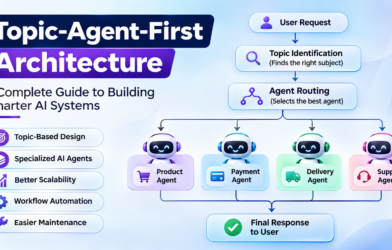
Topic-Agent-First Architecture
Frequently Asked Questions (FAQs) About Agentic AI Safety 2026
1. What is Agentic AI safety?
Agentic AI safety refers to the practices and technologies used to make autonomous AI agents secure, reliable, and responsible. It includes permission management, data protection, human oversight, security testing, and monitoring.
2. Why is Agentic AI safety important in 2026?
Agentic AI systems can independently interact with tools, databases, and external applications. Without proper controls, they may expose private information, follow malicious instructions, or perform incorrect actions. Safety measures help reduce these risks.
3. What are the biggest security risks of Agentic AI?
Some major risks include prompt injection, excessive permissions, data leakage, memory poisoning, insecure APIs, incorrect decisions, uncontrolled actions, and multi-agent communication attacks.
4. How can businesses protect AI agents from prompt injection?
Businesses should treat external content as untrusted information, separate instructions from retrieved content, restrict sensitive data access, validate tool inputs, and test agents against malicious instructions.
5. What is human-in-the-loop in Agentic AI?
Human-in-the-loop is a safety approach in which a human reviews or approves important AI decisions before an agent completes certain actions. It is particularly useful for financial transactions, sensitive communications, and important business operations.
6. What is the principle of least privilege in AI agents?
The principle of least privilege means giving an AI agent only the permissions required to complete its assigned task. For example, a content-writing agent should not receive access to financial databases if it does not need them.
7. Which frameworks help improve Agentic AI security?
Important resources include OWASP Top 10 for Agentic Applications 2026, NIST AI Risk Management Framework, NIST Generative AI Profile, and CISA’s Careful Adoption of Agentic AI Services guidance.
8. How do you secure a multi-agent AI system?
Secure multi-agent systems by assigning individual identities, restricting communication, limiting shared memory, monitoring activities, validating agent instructions, and requiring human approval for high-impact actions.
9. Is Agentic AI safe for business automation?
Agentic AI can be used safely for business automation when appropriate security controls are implemented. Businesses should start with limited permissions, test workflows, monitor activities, and maintain human oversight for sensitive operations.
10. What is the role of AI governance in Agentic AI safety?
AI governance establishes rules, responsibilities, and processes for developing and managing AI systems. It helps businesses maintain accountability, manage risks, protect information, and meet applicable regulatory requirements.
11. How often should AI agents be tested for security?
AI agents should be tested before deployment and regularly throughout their operation. Testing should also take place after significant changes to models, tools, integrations, permissions, or workflows.
12. Can Agentic AI make decisions without human approval?
Yes. Agentic AI can perform certain tasks without human approval when its permissions and operating rules allow it. However, high-impact or irreversible actions should generally include appropriate human review and approval.
13. What is the difference between AI safety and AI security?
AI safety focuses on preventing harmful, unreliable, or unintended AI behaviour. AI security focuses on protecting AI systems against attacks, unauthorised access, and data theft. Both are necessary for trustworthy agentic AI.
14. What should developers do before launching an AI agent?
Developers should define the agent’s purpose, identify risks, select appropriate models, restrict permissions, secure API connections, test malicious inputs, establish monitoring, and create an emergency shutdown process.
15. Will Agentic AI safety become more important in the future?
Yes. As AI agents become more autonomous and connect with more business systems, security, governance, privacy, and accountability will become increasingly important.