


Artificial Intelligence is changing how we search, work, and interact with technology. Earlier, we used search engines to find information. Now, AI answer engines directly give us answers. At the same time, AI user agents are becoming like digital employees that can perform tasks automatically. These technologies are growing very fast in 2026.
If you are a startup founder, business owner, or student, understanding AI answer engines and AI user agents is very important. These tools can save time, automate work, and improve productivity. Many businesses are already using them to grow faster.
In this guide, you will learn everything in very simple language. We will explain what AI answer engines are, what AI user agents are, how they work, their differences, use cases, benefits, and future trends. This article will solve all your questions clearly.
What Are AI Answer Engines?
Before going deeper, let us understand the basic meaning.
AI answer engines are systems that provide direct answers instead of showing a list of links.
Traditional search engines show websites.
AI answer engines give final answers.
These systems use advanced AI models to understand questions and generate responses.
For example, when you ask a question, instead of showing 10 links, it gives one clear answer.
This saves time and improves user experience.
How AI Answer Engines Work
AI answer engines work using advanced technologies.
Working Process
To understand this simply, follow this flow.
User asks a question
AI understands the intent
AI searches data sources
AI generates a response
AI delivers a final answer
These systems use:
Natural language processing
Machine learning
Large language models
Data retrieval systems
They combine all these to give accurate answers.
Features of AI Answer Engines
AI answer engines are powerful because of their features.
Key Features
They provide direct answers
They understand natural language
They give personalized responses
They reduce search time
They improve accuracy
This makes them better than traditional search engines in many cases.
What Are AI User Agents?
Now let us understand AI user agents.
AI user agents are intelligent systems that can perform tasks on behalf of users.
They are like digital assistants, but more advanced.
They can:
Think
Decide
Act
Learn
In simple words, AI user agents are like digital employees.
How AI User Agents Work
AI user agents follow a complete action cycle.
Working Process
They work in steps.
Observe environment
Analyze data
Make decisions
Take action
Learn from results
This makes them autonomous systems.
Types of AI User Agents
AI user agents are of different types.
Common Types
Simple reactive agents
Model-based agents
Goal-based agents
Utility-based agents
Learning agents
Each type works differently based on complexity.
Difference Between AI Answer Engines and AI User Agents
Many people confuse these two.
Let us understand clearly.
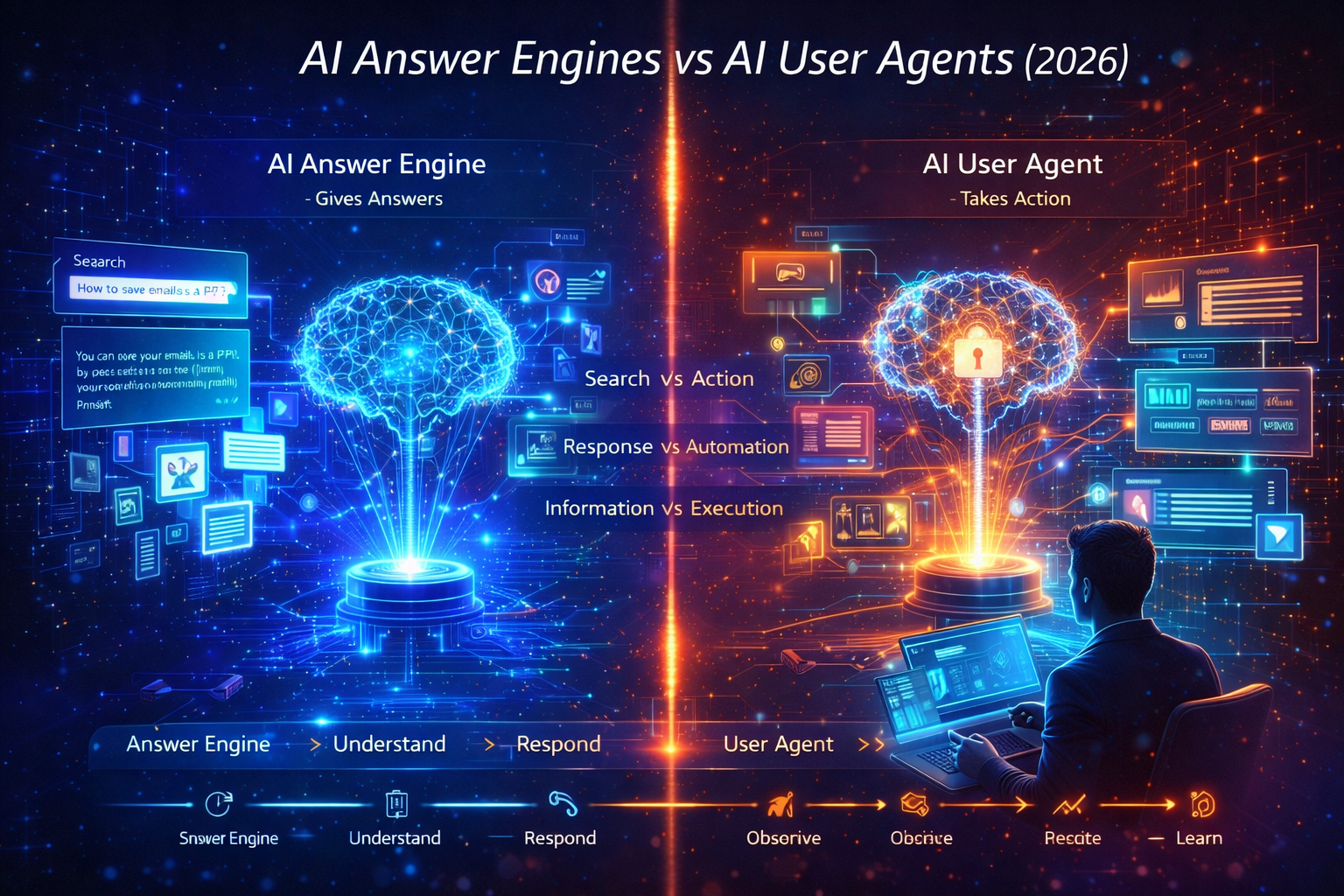
AI answer engines focus on giving answers.
AI user agents focus on performing tasks.
Answer engines respond.
User agents act.
Answer engines are used for information.
User agents are used for automation.
Both are important but serve different purposes.
Why These Technologies Are Important in 2026
These technologies are growing because businesses need automation and speed.
Key Importance
They save time
They reduce manual work
They improve efficiency
They increase productivity
They provide better user experience
Companies are moving from search to answers and from tools to automation.
Use Cases of AI Answer Engines
AI answer engines are used in many areas.
Common Use Cases
Customer support
Education and learning
Content research
Technical assistance
Healthcare queries
They help users get quick and clear answers.
Use Cases of AI User Agents
AI user agents are more powerful and action-based.
Common Use Cases
Lead generation
Email automation
Customer follow-ups
Task management
Business operations
Data analysis
They help businesses automate workflows.
AI Answer Engines in Business
Businesses use answer engines to improve communication.
Business Applications
Chat support systems
Knowledge base automation
Internal company tools
Customer query handling
They improve customer experience.
AI User Agents in Business
AI user agents are transforming operations.
Business Applications
Sales automation
Marketing automation
HR automation
Finance management
Customer engagement
They act like a team of digital workers.
Benefits of AI Answer Engines
AI answer engines provide many benefits.
Key Benefits
Faster information access
Improved user experience
Reduced search effort
Accurate responses
Time saving
Benefits of AI User Agents
AI user agents offer deeper benefits.
Key Benefits
Automation of tasks
24/7 working capability
Cost reduction
Scalability
Improved productivity
Challenges of AI Answer Engines
AI answer engines also have limitations.
Common Challenges
May give incorrect answers
Depend on data quality
Limited action capability
Bias in responses
Challenges of AI User Agents
AI user agents face different challenges.
Common Challenges
Complex setup
High cost
Data privacy concerns
Need for monitoring
AI Answer Engines vs Search Engines
Let us compare them.
Search engines show links.
Answer engines give direct answers.
Search engines need manual reading.
Answer engines save time.
Answer engines are the future of search.
AI User Agents vs Chatbots
Many people think they are same.
Chatbots respond to messages.
AI agents perform tasks.
Chatbots are limited.
AI agents are powerful.
Future of AI Answer Engines
AI answer engines will become more advanced.
Future Trends
More accurate answers
Voice-based interactions
Personalized responses
Integration with apps
Real-time data usage
Future of AI User Agents
AI user agents will grow faster.
Future Trends
Autonomous business systems
Multi-agent collaboration
AI employees
Decision-making systems
End-to-end automation
How Startups Can Use These Technologies
Startup founders can use both systems.
Practical Strategy
Use answer engines for support
Use agents for automation
Combine both for growth
Focus on real problems
Scale gradually
This gives better results.
Business Opportunities in This Space
There are many opportunities.
Opportunities
Build AI answer platforms
Create AI agent tools
Develop automation services
Start AI consulting business
Build SaaS products
This is a high-growth market.
Step-by-Step Guide to Get Started
If you want to use AI, follow these steps.
Step 1: Identify Needs
Understand what you want to automate.
Step 2: Choose Tools
Select AI tools based on your needs.
Step 3: Start Small
Test with small tasks.
Step 4: Automate Workflows
Connect systems and automate processes.
Step 5: Monitor Results
Track performance and improve.
Common Mistakes to Avoid
Avoid these mistakes.
Mistakes
Using AI without strategy
Ignoring data quality
Over-automation
Not monitoring results
Choosing wrong tools
Why You Should Learn This Now
AI is growing fast.
Key Reasons
Early advantage
Better opportunities
Business growth
Future readiness
Competitive edge
Learning now gives you an advantage.
Conclusion
AI answer engines and AI user agents are changing how we interact with technology in 2026. Answer engines provide instant information, while user agents automate tasks and operations.
For businesses and startups, these tools offer huge opportunities. They save time, reduce cost, and improve efficiency.
Understanding both technologies helps you stay ahead in the digital world.
The future belongs to intelligent systems that can answer and act.
Read More Blog-AI Agent Startup Opportunities in 2026
Frequently Asked Questions (FAQs)
1. What is an AI answer engine?
It is a system that provides direct answers instead of showing links.
2. What is an AI user agent?
It is an intelligent system that performs tasks automatically.
3. What is the main difference?
Answer engines give answers, while user agents perform actions.
4. Are AI agents better than chatbots?
Yes, they are more advanced and can automate tasks.
5. Can startups use AI agents?
Yes, they can use them for automation and growth.
6. Are AI answer engines accurate?
They are accurate but depend on data quality.
7. What is the future of AI systems?
They will become more autonomous and powerful.