

Introduction
Artificial Intelligence is evolving faster than ever before. Businesses are no longer looking for AI tools that simply answer questions or generate content. They want intelligent systems that can think, plan, coordinate, and execute tasks with minimal human involvement. This is where Claude Agentic Orchestration becomes important.
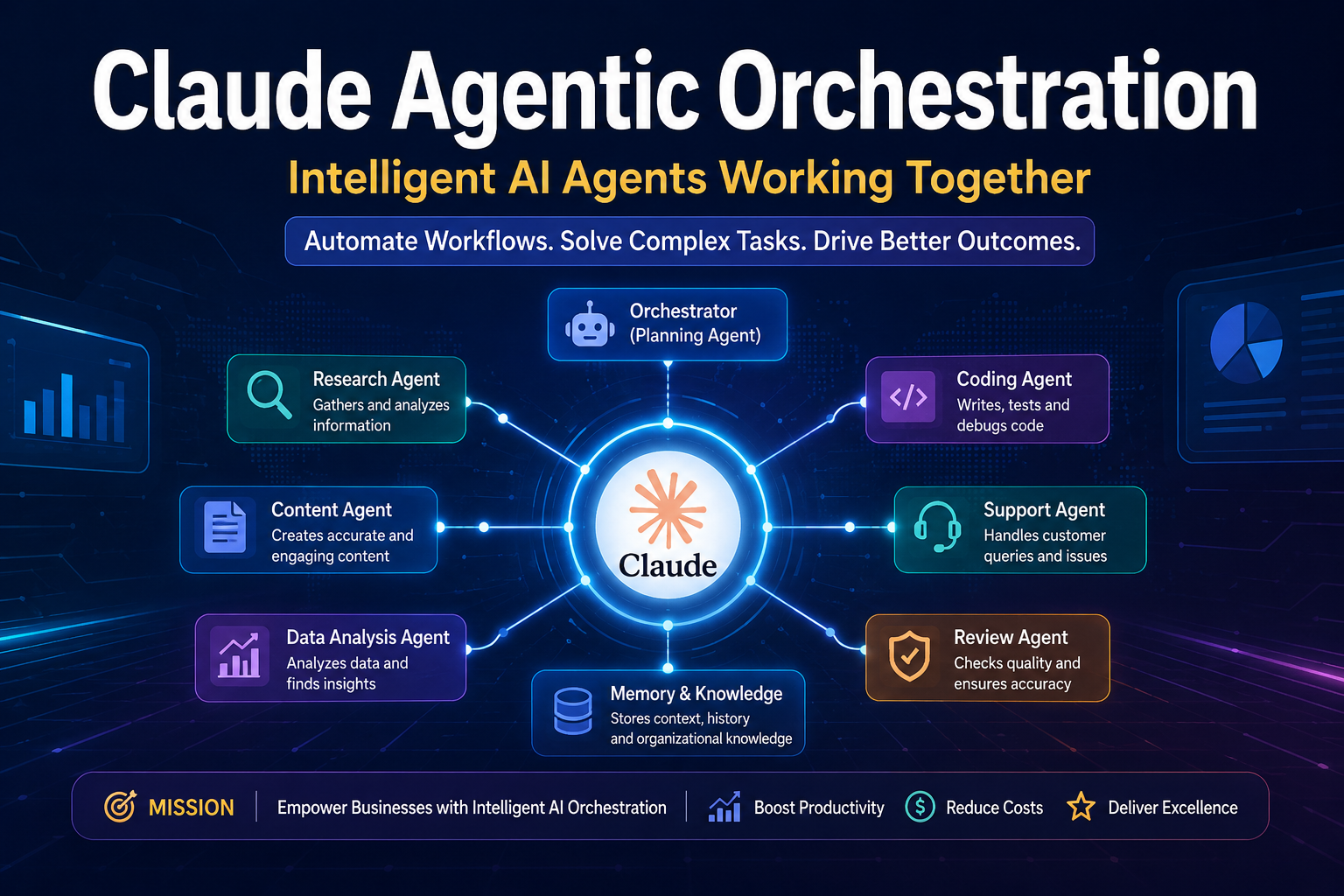
Claude Agentic Orchestration is a modern approach that allows multiple AI agents to work together, manage workflows, make decisions, and complete complex tasks efficiently. Instead of relying on a single AI model, organizations can use coordinated AI agents that communicate with each other and perform specialized functions.
From customer service and software development to research, marketing, healthcare, and finance, Claude Agentic Orchestration is helping businesses improve productivity, reduce operational costs, and automate repetitive work. Understanding this technology is important because it represents the future of AI-driven business operations. In this guide, you will learn everything about Claude Agentic Orchestration, including its architecture, benefits, use cases, implementation strategies, challenges, and future opportunities.
What is Claude Agentic Orchestration?
Claude Agentic Orchestration refers to the process of coordinating multiple AI agents powered by Claude models to perform complex tasks through collaboration and structured workflows.
Traditional AI systems usually work independently. A user asks a question, and the AI provides a response. However, modern business tasks often require planning, reasoning, execution, monitoring, and decision-making across multiple steps.
Agentic orchestration enables AI agents to:
Understand objectives.
Break large tasks into smaller tasks.
Assign responsibilities.
Communicate with other agents.
Monitor progress.
Make decisions based on available information.
Deliver final outcomes.
This creates a system that behaves more like a team of specialists rather than a single assistant.
Understanding Agentic AI
Agentic AI refers to AI systems that can act independently toward achieving specific goals.
Unlike traditional AI tools that only respond to prompts, agentic AI can:
Analyze situations.
Create plans.
Take actions.
Evaluate results.
Adjust strategies.
Continue working until objectives are completed.
Claude Agentic Orchestration combines these agentic capabilities with workflow coordination, creating highly intelligent automation systems.
Why Claude Agentic Orchestration Matters
Organizations face growing complexity every day. Teams manage huge amounts of data, customer requests, projects, compliance requirements, and operational tasks.
Claude Agentic Orchestration helps solve these challenges by:
Reducing manual work.
Improving operational efficiency.
Accelerating decision-making.
Enhancing accuracy.
Supporting scalable business operations.
Enabling intelligent automation.
The result is higher productivity and better business outcomes.
Core Components of Claude Agentic Orchestration
Claude Agentic Orchestration consists of several interconnected components.
Goal Definition Layer
Every workflow begins with a clearly defined objective.
Examples include:
Generate a market research report.
Analyze customer feedback.
Create a marketing campaign.
Review legal contracts.
Develop software features.
The system first understands what needs to be accomplished.
Planning Agent
The planning agent creates a strategy for completing the task.
Its responsibilities include:
Breaking tasks into steps.
Identifying dependencies.
Determining resource requirements.
Creating execution plans.
This agent acts like a project manager.
Execution Agents
Execution agents perform specialized activities.
Examples include:
Research agents.
Content creation agents.
Data analysis agents.
Coding agents.
Customer support agents.
Compliance agents.
Each agent focuses on a specific responsibility.
Communication Layer
Agents need to exchange information efficiently.
The communication layer enables:
Data sharing.
Task coordination.
Status updates.
Knowledge transfer.
Decision support.
This keeps workflows organized and synchronized.
Monitoring Agent
The monitoring agent oversees the entire process.
Responsibilities include:
Tracking progress.
Identifying issues.
Measuring performance.
Ensuring quality standards.
Triggering corrective actions.
This improves reliability and consistency.
Memory System
Memory allows agents to retain context.
The memory system stores:
Historical interactions.
Workflow progress.
Business knowledge.
User preferences.
Previous outcomes.
This improves decision quality and continuity.
How Claude Agentic Orchestration Works
A typical orchestration workflow follows several stages.
Stage 1: Receive Objective
The user submits a request.
For example:
“Create a competitive analysis report for the AI software market.”
Stage 2: Task Planning
The planning agent analyzes the objective.
It identifies:
Research requirements.
Data sources.
Analysis methods.
Reporting structure.
Timeline.
Stage 3: Task Distribution
Work is assigned to specialized agents.
Research Agent gathers market information.
Data Agent analyzes industry trends.
Content Agent drafts the report.
Review Agent verifies accuracy.
Stage 4: Collaboration
Agents exchange information throughout execution.
Research findings are sent to analysts.
Analysis results are shared with content creators.
Review feedback is incorporated into final outputs.
Stage 5: Quality Review
The monitoring agent validates results.
Errors are identified.
Missing information is corrected.
Quality standards are enforced.
Stage 6: Final Delivery
The completed report is delivered to the user.
The entire process occurs with minimal human intervention.
Key Features of Claude Agentic Orchestration
Several advanced capabilities make this approach powerful.
Autonomous Decision-Making
Agents can make informed decisions without constant supervision.
Dynamic Workflow Management
Workflows can adapt to changing requirements.
Multi-Agent Collaboration
Specialized agents work together toward shared objectives.
Long-Term Context Retention
Agents maintain awareness of historical information.
Continuous Improvement
Systems learn from previous experiences and outcomes.
Scalable Operations
Organizations can handle larger workloads efficiently.
Benefits of Claude Agentic Orchestration
Businesses are adopting agentic orchestration because of its significant advantages.
Improved Productivity
Multiple tasks can be completed simultaneously.
Teams spend less time on repetitive activities.
Faster Decision-Making
AI agents process information rapidly.
Insights become available faster.
Cost Reduction
Automation reduces operational expenses.
Organizations require fewer manual interventions.
Better Accuracy
Agents follow structured workflows and validation processes.
Human errors decrease significantly.
Increased Scalability
Workloads can grow without proportional increases in staffing.
Enhanced Customer Experience
Customers receive faster and more personalized responses.
Claude Agentic Orchestration Architecture
A modern architecture typically includes multiple layers.
User Interaction Layer
Handles user requests and communication.
Orchestration Layer
Coordinates workflows and agent activities.
Agent Layer
Contains specialized AI agents.
Knowledge Layer
Provides access to organizational knowledge and data.
Integration Layer
Connects external tools and systems.
Security Layer
Protects data and ensures compliance.
This layered architecture creates a robust and scalable AI ecosystem.
Business Use Cases of Claude Agentic Orchestration
Organizations across industries are implementing agentic orchestration.
Customer Service Automation
AI agents can:
Handle inquiries.
Resolve common issues.
Escalate complex cases.
Track customer satisfaction.
This improves service quality while reducing support costs.
Marketing Automation
Marketing teams can automate:
Campaign planning.
Content creation.
Audience analysis.
Performance reporting.
Lead nurturing.
This increases efficiency and campaign effectiveness.
Software Development
Development teams use orchestration for:
Code generation.
Testing.
Bug detection.
Documentation.
Deployment monitoring.
This accelerates software delivery.
Financial Services
Financial organizations automate:
Risk analysis.
Fraud detection.
Compliance monitoring.
Portfolio analysis.
Customer onboarding.
This improves operational efficiency and regulatory compliance.
Healthcare Operations
Healthcare providers use agentic systems for:
Patient scheduling.
Medical documentation.
Treatment recommendations.
Research assistance.
Administrative automation.
This allows professionals to focus more on patient care.
Human Resources
HR teams can automate:
Resume screening.
Candidate matching.
Employee onboarding.
Performance tracking.
Training recommendations.
This improves hiring efficiency and workforce management.
Claude Agentic Orchestration for Enterprises
Large organizations benefit significantly from orchestration.
Enterprise applications include:
Cross-department coordination.
Global operations management.
Knowledge management.
Strategic planning.
Executive reporting.
Compliance monitoring.
These systems create intelligent digital workforces.
Claude Agentic Orchestration vs Traditional Automation
Traditional automation follows predefined rules.
Agentic orchestration offers intelligent adaptability.
Traditional Automation:
Rule-based execution.
Limited flexibility.
Requires manual updates.
Static workflows.
Agentic Orchestration:
Goal-driven execution.
Adaptive decision-making.
Continuous learning.
Dynamic workflows.
Higher autonomy.
This makes agentic systems more suitable for complex environments.
Challenges of Claude Agentic Orchestration
Despite its advantages, several challenges exist.
Governance
Organizations must establish clear oversight mechanisms.
Security
Sensitive information requires strong protection.
Data Quality
Poor data leads to poor decisions.
System Complexity
Managing multiple agents can be challenging.
Compliance Requirements
Regulated industries must ensure legal compliance.
Human Trust
Employees need confidence in AI-generated decisions.
Addressing these challenges is essential for successful deployment.
Best Practices for Implementation
Organizations should follow proven strategies.
Start Small
Begin with focused pilot projects.
Define Clear Objectives
Establish measurable business outcomes.
Build Strong Governance
Create policies and accountability frameworks.
Monitor Performance
Track key performance indicators continuously.
Maintain Human Oversight
Keep humans involved in critical decisions.
Optimize Continuously
Improve workflows based on results and feedback.
Future of Claude Agentic Orchestration
The future of agentic orchestration looks extremely promising.
Emerging trends include:
Advanced multi-agent ecosystems.
Real-time decision intelligence.
Self-improving AI networks.
Industry-specific AI agents.
Fully autonomous business workflows.
Human-AI collaborative teams.
Organizations that adopt these technologies early may gain significant competitive advantages.
Why Businesses Should Prepare Now
The shift toward agentic AI is accelerating.
Companies that prepare early can:
Increase productivity.
Reduce operational costs.
Improve customer experiences.
Enhance innovation.
Scale more effectively.
Build competitive advantages.
Agentic orchestration is expected to become a core component of modern digital transformation strategies.
Conclusion
Claude Agentic Orchestration represents a major step forward in artificial intelligence and business automation. Instead of relying on isolated AI tools, organizations can create coordinated systems of intelligent agents that collaborate, plan, execute, monitor, and optimize complex workflows.
From customer service and marketing to software development, finance, healthcare, and enterprise operations, agentic orchestration is transforming how work gets done. It improves productivity, reduces costs, enhances decision-making, and enables organizations to scale more efficiently.
As AI technology continues to advance, Claude Agentic Orchestration will play a critical role in building intelligent digital workforces capable of handling increasingly sophisticated business challenges. Organizations that understand and adopt this technology today will be better positioned to lead in the AI-powered future.
Read More Blogs– AI Startup Edge
Frequently Asked Questions (FAQs)
1. What is Claude Agentic Orchestration?
Claude Agentic Orchestration is a framework that coordinates multiple AI agents to collaborate, automate workflows, make decisions, and complete complex business tasks.
2. How is Agentic Orchestration different from traditional AI?
Traditional AI mainly responds to prompts, while agentic orchestration enables autonomous planning, execution, collaboration, monitoring, and decision-making.
3. What are AI agents in Claude Agentic Orchestration?
AI agents are specialized systems designed to perform specific tasks such as research, analysis, content generation, coding, customer support, or monitoring.
4. What industries can benefit from Claude Agentic Orchestration?
Industries including healthcare, finance, retail, manufacturing, education, marketing, software development, logistics, and customer service can benefit significantly.
5. Is Claude Agentic Orchestration suitable for small businesses?
Yes. Small businesses can use agentic orchestration to automate repetitive tasks, improve productivity, reduce costs, and scale operations efficiently.
6. What are the biggest benefits of Claude Agentic Orchestration?
Major benefits include improved efficiency, faster decision-making, cost savings, better accuracy, scalability, and enhanced customer experiences.
7. Does Claude Agentic Orchestration require human supervision?
Human oversight is recommended, especially for sensitive decisions, compliance requirements, and strategic business activities.
8. What is the future of Claude Agentic Orchestration?
The future includes autonomous business workflows, advanced multi-agent collaboration, intelligent digital workforces, and self-improving AI ecosystems that support enterprise-wide automation.