

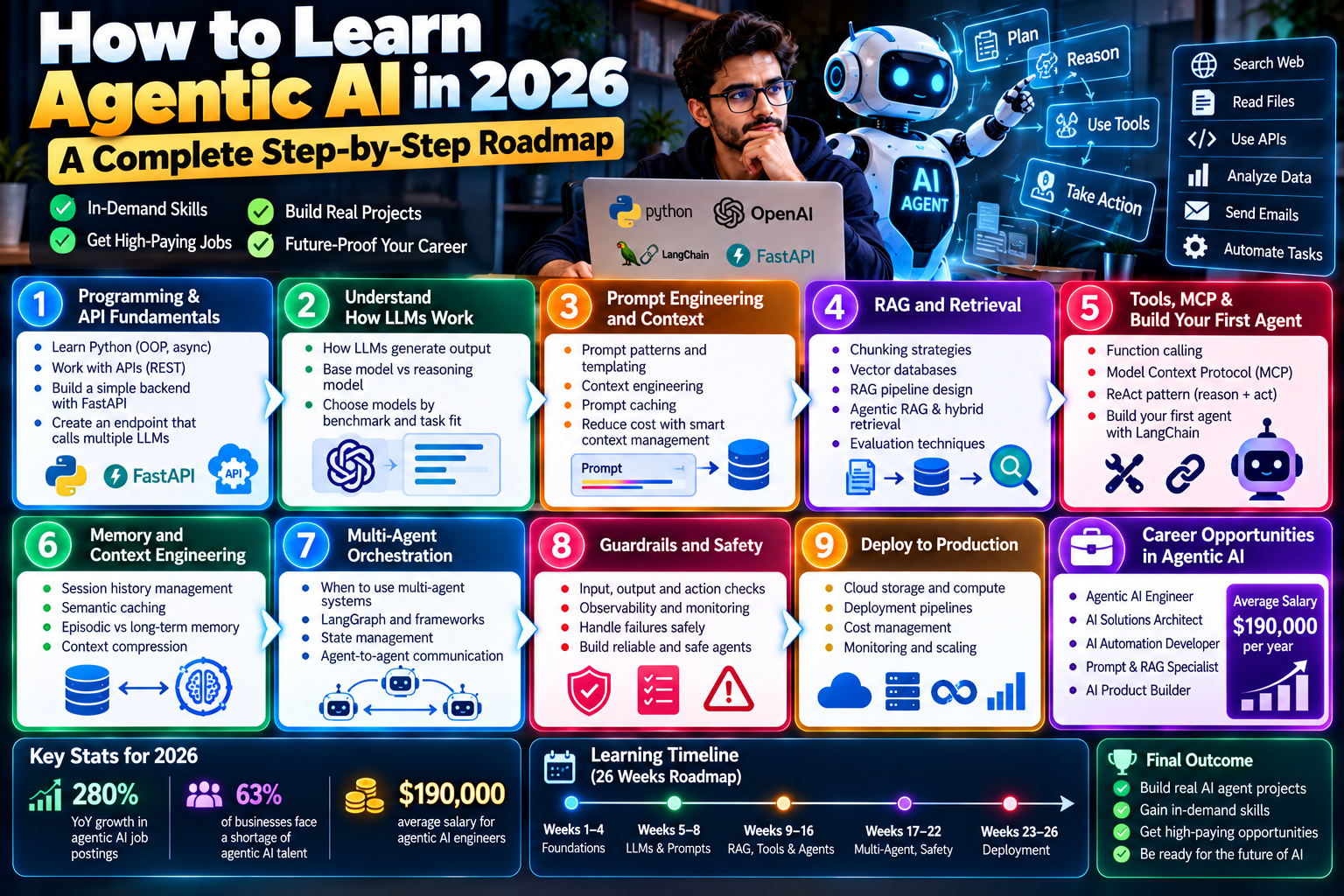
Agentic AI job postings grew 280% year over year in 2026, and the average agentic AI engineer now earns around $190,000. Meanwhile, 63% of businesses report a real shortage of people who actually know this material. If you want to learn agentic AI in 2026, the hard part isn’t motivation. It’s knowing which skills matter and in what order. This roadmap to learn agentic AI in 2026 breaks it down into stages you can actually follow.

Step 1 to Learn Agentic AI in 2026: Programming and API Fundamentals
Agentic AI work is still software engineering underneath. You need solid Python, including object-oriented basics and asynchronous code. You also need to be comfortable calling HTTP APIs and building a simple backend with something like FastAPI. A good early goal: build an endpoint that calls multiple language models in parallel without blocking. That single exercise touches most of what you’ll reuse later.
Understand How LLMs Actually Work
Before building agents, learn the mental model behind the model. Specifically, understand that an LLM generates output probabilistically, token by token. Learn the difference between a base model and a reasoning model. Notably, pick models by benchmark performance and task fit, not by marketing claims. This step is short, but it prevents a lot of confused debugging later.
Master Prompt Engineering and Context
Once you’re calling models through an API instead of a chat window, prompting becomes an engineering discipline. Learn prompt patterns, templating, and context engineering, meaning what information you actually feed the model and when. Prompt caching also matters here. It cuts cost significantly once you’re making repeated calls with similar context.
Learn Agentic AI in 2026: RAG and Retrieval
This is usually the longest stage, and it’s worth the time. Cover chunking strategies, vector databases, and basic RAG pipeline design. Then go further: agentic RAG, hybrid retrieval, and graph-augmented approaches. Critically, learn how to evaluate a RAG pipeline. A retrieval system that looks fine in a demo can quietly return wrong context in production, and evaluation is how you catch that before users do.
Add Tools, MCP, and Build Your First Agent
This is where an LLM becomes an agent. Learn function calling, the Model Context Protocol (MCP), and the ReAct pattern for reasoning plus acting in a loop. Build a single agent with a framework like LangChain before reaching for anything more complex. For a deeper breakdown of what goes into that scaffolding, see our complete guide to agent harnesses.
Handle Memory and Context Engineering
A long-running agent needs more than a single context window. Learn session history management, semantic caching, and the difference between episodic and long-term memory. Context compression matters here too. Without it, an agent on a long task effectively forgets what it was doing partway through.
Move to Multi-Agent Orchestration, Carefully
Multi-agent systems get a lot of attention, but they’re not always the right answer. In fact, a single agent with good tools outperforms a multi-agent setup for roughly 80% of real tasks. Learn the fundamentals anyway: frameworks like LangGraph, state management, and agent-to-agent communication. Save the added complexity for the specific tasks that genuinely need it.
Add Guardrails Before You Add Users
Production agents need a three-layer guardrail approach: checks on input, checks on output, and checks on the actions an agent is about to take. Add observability so you can see what an agent actually did, not just what it reported. The goal is an agent that fails safely, not one that quietly does the wrong thing.
Deploy to Production
The final stage is infrastructure: cloud storage, compute, networking, and deployment pipelines. Cost management belongs here too, since agent workloads can run up API and compute bills fast if nobody’s watching. This stage turns a working prototype into something your team can actually depend on.
How Long It Takes to Learn Agentic AI in 2026
Full roadmaps built around this structure typically run about 26 weeks, covering nine stages end to end. However, you don’t need to finish every stage before building something real. Learn enough of each stage to be dangerous, start building around the tools-and-agents stage, and circle back for depth once a real project forces the issue.
Frequently Asked Questions
Do you need a machine learning background to learn agentic AI in 2026?
Not a deep one. Most agentic AI work sits on top of existing models through APIs, so strong software engineering skills matter more than training your own models. A basic understanding of how LLMs work is enough to start.
What’s the fastest way to get a job in agentic AI?
Build something real and show it. A working agent project, even a small one, demonstrates more than certificates alone. Pair that with the fundamentals: APIs, RAG, tool use, and at least one framework like LangChain, since nearly every roadmap and job posting touches those same four areas.
Learning agentic AI in 2026 isn’t about memorizing one framework. It’s about understanding the stack from API calls up through guardrails and deployment, since the tools underneath will keep changing. Start at the foundations, build something small early, and let real projects pull you toward the deeper stages.