


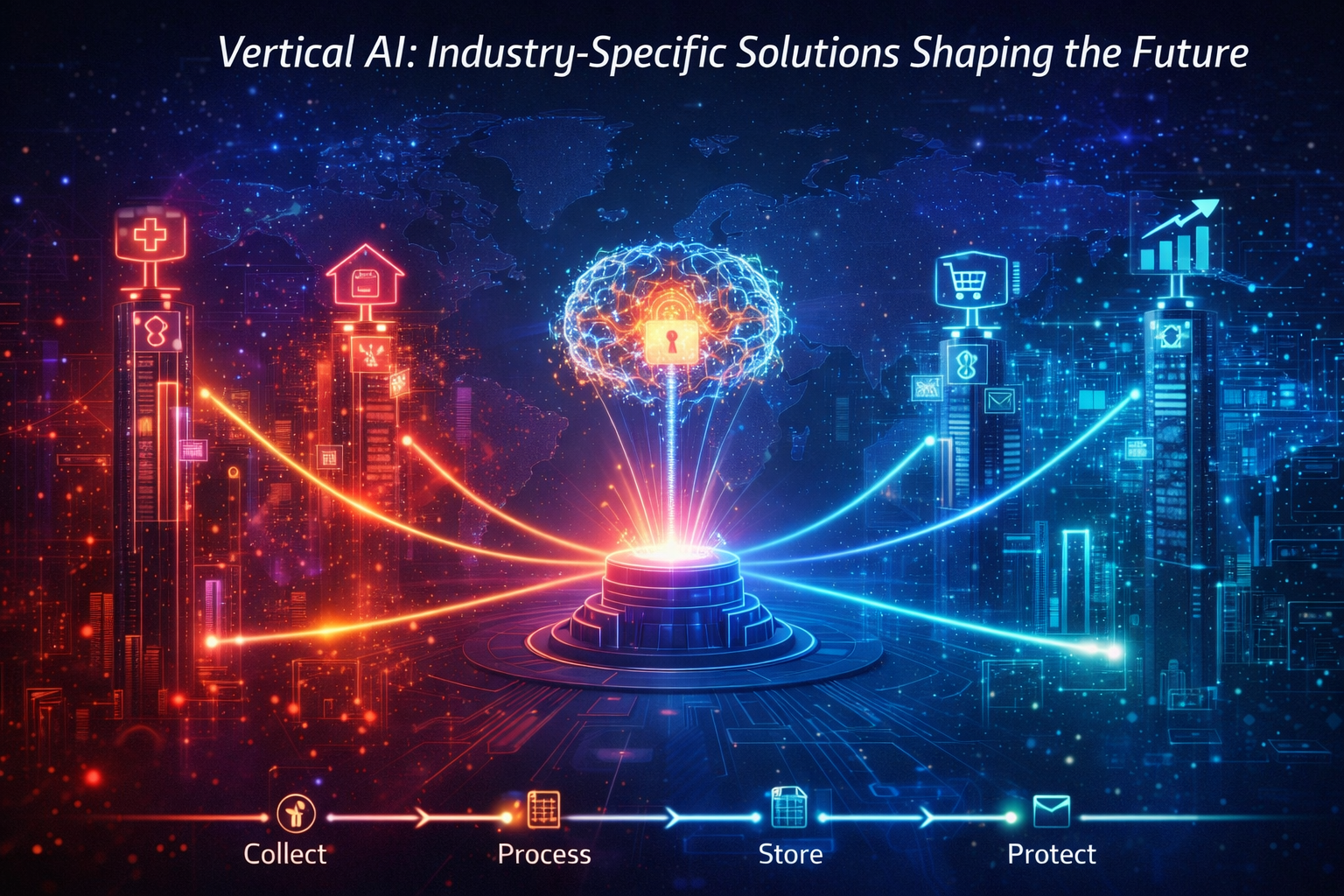
Artificial Intelligence is growing very fast. But not all AI solutions are useful for every business. Many companies are now moving from general AI tools to more focused and powerful systems. This is where vertical AI comes into the picture. Vertical AI means AI solutions designed for specific industries like healthcare, real estate, finance, and e-commerce.
In 2026, vertical AI is becoming one of the biggest trends in the business world. It helps companies solve real problems with better accuracy and efficiency. Instead of using one general tool, businesses now prefer AI that understands their industry deeply.
If you are a startup founder, entrepreneur, or business owner, this topic is very important for you. In this guide, you will learn what vertical AI is, how it works, its benefits, real-world examples, and how it is shaping the future.
What Is Vertical AI?
Before going deeper, let us understand the meaning of vertical AI in simple words.
Vertical AI refers to artificial intelligence solutions that are built for a specific industry or niche.
Unlike general AI tools that work for everyone, vertical AI focuses on solving problems in one industry.
For example:
AI for healthcare
AI for real estate
AI for finance
AI for education
These systems are trained with industry-specific data.
Vertical AI vs Horizontal AI
To understand vertical AI better, we must compare it with horizontal AI.
Horizontal AI is general-purpose AI. It can be used in many industries.
Vertical AI is specialized AI. It is designed for one industry.
Horizontal AI is broad.
Vertical AI is focused.
Horizontal AI gives general solutions.
Vertical AI gives deep solutions.
For example:
A general chatbot is horizontal AI.
A medical diagnosis AI is vertical AI.
Why Vertical AI Is Growing in 2026
Vertical AI is growing because businesses need better solutions.
Key Reasons for Growth
Businesses want accuracy, not just automation.
Vertical AI provides:
Better results
Industry knowledge
Faster decisions
Higher efficiency
General AI tools cannot solve complex industry problems.
That is why companies are shifting toward vertical AI solutions.
How Vertical AI Works
Vertical AI works by using industry-specific data and models.
Working Process of Vertical AI
To understand how it works, follow this simple flow.
Data collection from a specific industry
Training AI models using this data
Building specialized algorithms
Testing with real-world scenarios
Continuous improvement
For example, AI for healthcare is trained with medical records, not general data.
Benefits of Vertical AI Solutions
Vertical AI offers many advantages for businesses.
Key Benefits
Vertical AI improves accuracy and performance.
It reduces errors
It saves time
It increases productivity
It provides better insights
It improves decision-making
For startups, this means faster growth and better results.
Top Industries Using Vertical AI
Vertical AI is transforming many industries.
1. Healthcare
Healthcare is one of the biggest users of vertical AI.
AI helps in:
Disease detection
Medical diagnosis
Patient data analysis
Drug discovery
Vertical AI in healthcare saves lives and improves treatment.
2. Real Estate
Real estate businesses use AI for smarter decisions.
AI helps in:
Property recommendations
Price prediction
Lead generation
Customer analysis
This improves sales and customer experience.
3. Finance
Finance industry depends on data.
AI helps in:
Fraud detection
Risk analysis
Investment decisions
Customer support
Vertical AI makes financial systems smarter and safer.
4. E-commerce
E-commerce companies use AI to increase sales.
AI helps in:
Product recommendations
Inventory management
Customer behavior analysis
Pricing optimization
This improves conversions and revenue.
5. Education
AI is changing education.
AI helps in:
Personalized learning
Student performance tracking
Content generation
Online tutoring
Vertical AI improves learning outcomes.
6. Marketing
Marketing is becoming AI-driven.
AI helps in:
Ad optimization
Customer targeting
Content creation
Campaign analysis
This increases ROI.
Real-World Examples of Vertical AI
Let us understand with practical examples.
Example 1: Healthcare AI
An AI system analyzes patient reports and suggests possible diseases.
Doctors use it to make faster decisions.
Example 2: Real Estate AI
An AI agent suggests the best property based on user preferences.
This improves customer experience.
Example 3: Finance AI
An AI system detects unusual transactions and prevents fraud.
This increases security.
Vertical AI for Startups
Vertical AI is a big opportunity for startups.
Why Startups Should Focus on Vertical AI
Startups can compete by focusing on niche markets.
Vertical AI allows:
Less competition
Better positioning
Higher value
Faster growth
Instead of building general tools, startups can solve specific problems.
Popular Vertical AI Startup Ideas
Here are some high-demand startup ideas.
AI for Healthcare Diagnostics
Build AI tools for disease detection.
AI for Real Estate Lead Generation
Create AI systems to find buyers and sellers.
AI for Financial Analysis
Develop tools for investment and risk analysis.
AI for Legal Services
Automate document analysis and case research.
AI for HR Automation
Create AI systems for hiring and employee management.
Challenges of Vertical AI
Vertical AI is powerful, but it has challenges.
Common Challenges
High development cost
Need for industry data
Complex regulations
Technical expertise required
Data privacy issues
Startups must handle these carefully.
How to Build a Vertical AI Startup
Let us understand the process step by step.
Step 1: Choose a Niche
Select one industry.
Focus on a specific problem.
Step 2: Understand the Industry
Study how the industry works.
Talk to experts.
Step 3: Collect Data
Data is the foundation of AI.
Collect high-quality data.
Step 4: Build AI Model
Use AI tools to create your solution.
Step 5: Test and Improve
Test your product with real users.
Improve based on feedback.
Step 6: Launch and Scale
Start small.
Then expand your business.
Vertical AI vs SaaS
Many people compare vertical AI with SaaS.
Vertical AI is smarter than traditional SaaS.
SaaS provides tools.
Vertical AI provides intelligent solutions.
SaaS requires manual input.
AI automates tasks.
This is why vertical AI startups are growing faster.
Future of Vertical AI
Vertical AI is the future of business.
Future Trends
More industry-specific solutions
AI-driven decision-making
Automation of complex tasks
Growth of AI startups
Integration with business systems
Vertical AI will become a standard in every industry.
Why Vertical AI Matters for You
Whether you are a founder or a professional, vertical AI is important.
Key Impact
Better business performance
Higher efficiency
Competitive advantage
Future-ready skills
Learning vertical AI gives you an advantage.
Common Mistakes to Avoid
Many people make mistakes while building AI solutions.
Mistakes
Choosing a broad market
Ignoring data quality
Overcomplicating the product
Not validating the idea
Ignoring customer needs
Focus on solving real problems.
Conclusion
Vertical AI is transforming industries in 2026. It provides industry-specific solutions that are more accurate, efficient, and powerful than general AI tools.
From healthcare to finance, from real estate to marketing, vertical AI is shaping the future.
For startups, this is a golden opportunity. By focusing on niche markets, you can build high-value businesses.
The future belongs to those who understand and use vertical AI.
Read More Blog-AI Agent Startup Opportunities in 2026
Frequently Asked Questions (FAQs)
1. What is vertical AI?
Vertical AI is AI designed for a specific industry.
2. How is vertical AI different from general AI?
Vertical AI is specialized, while general AI is broad.
3. Which industries use vertical AI?
Healthcare, finance, real estate, education, and e-commerce.
4. Is vertical AI profitable?
Yes, it offers high-value solutions and strong business opportunities.
5. Can startups build vertical AI?
Yes, startups can build niche AI solutions.
6. What are examples of vertical AI?
Medical diagnosis AI, financial fraud detection AI, real estate AI.
7. What is the future of vertical AI?
It will become a core part of all industries.