


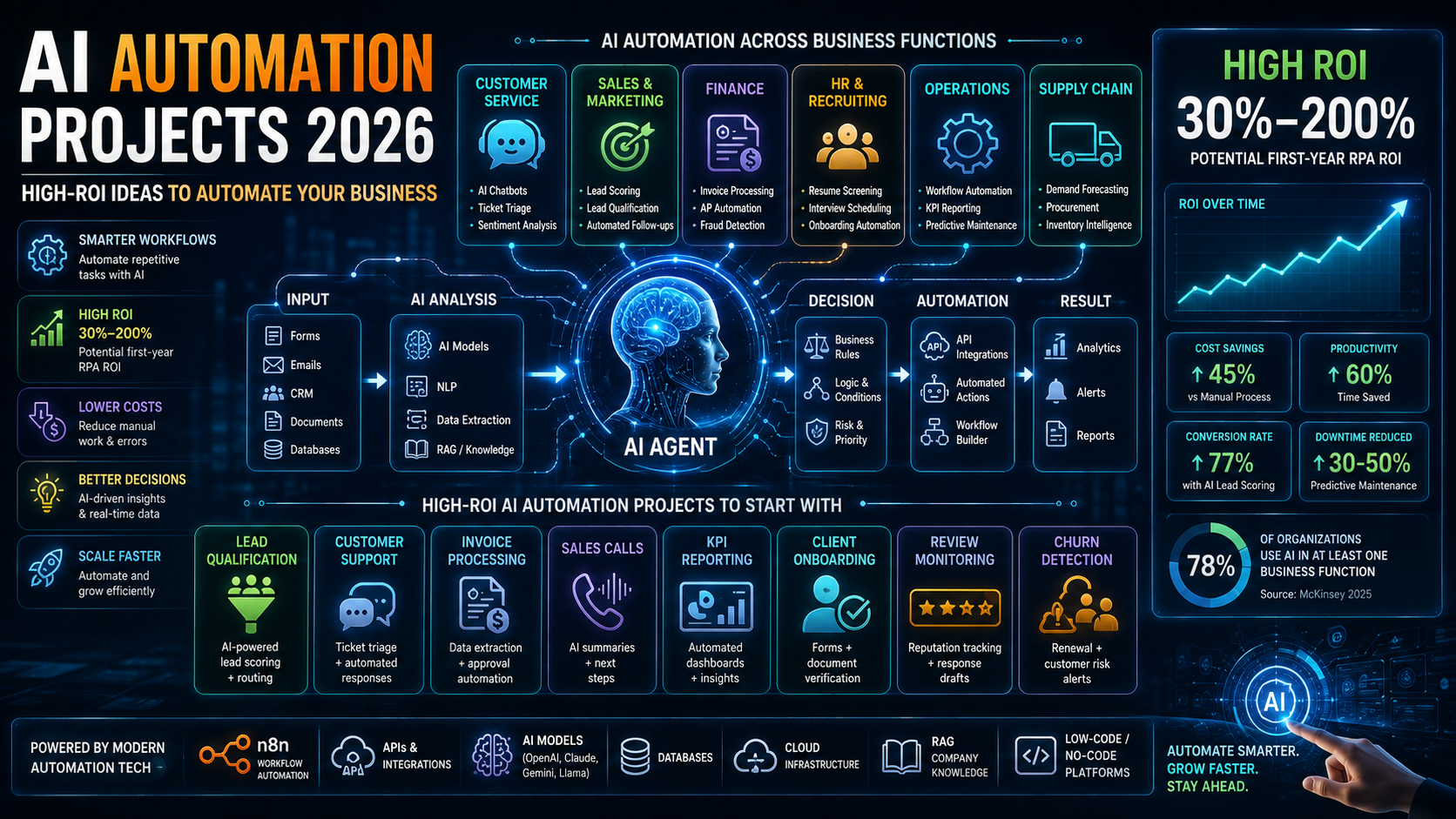
Most businesses no longer ask whether to automate. They ask which process to automate first. By 2025, roughly 78% of organizations had already put AI to work in at least one business function, according to McKinsey. This guide walks through the best AI automation projects for 2026, organized by business function, with real ROI figures and a simple framework for picking your first project.
Why AI Automation Projects Matter in 2026
The numbers behind AI automation projects are hard to ignore. AI-powered customer service teams cut response times by up to 75%. Companies using predictive lead scoring see conversion rates jump 77%. Meanwhile, predictive maintenance programs reduce equipment downtime by 30% to 50%. Likewise, robotic process automation alone generates 30% to 200% ROI in its first year.
These are not experimental numbers anymore. They come from companies running these automation efforts in production today. As a result, the gap between early adopters and everyone else keeps widening.
AI Automation Projects by Business Function
The best AI automation projects rarely start with the flashiest technology. They start with the function that wastes the most hours. Here is where most businesses find their first win.
Customer Service
Customer support generates some of the highest-value AI automation projects. For example, chatbots handle routine questions around the clock. In addition, sentiment analysis flags frustrated customers before they escalate. As a result, ticket triage routes issues to the right team automatically, cutting first-response time dramatically.
Sales and Marketing
Sales teams use AI automation projects to qualify leads, score urgency, and draft follow-up emails. Similarly, marketing teams automate content calendars, ad copy, and SEO research. In fact, predictive lead scoring alone drives some of the strongest ROI on this list.
Finance and Accounting
Finance teams automate invoice processing, expense management, and fraud detection. In fact, AI can generate profit and loss statements, cash flow reports, and executive dashboards without manual spreadsheet work. Meanwhile, accounts payable automation also flags anomalies before they become costly errors.
HR and Recruiting
HR teams use AI automation projects to screen resumes, schedule interviews, and personalize onboarding. In addition, automated onboarding assistants answer new-hire questions and assemble role-specific materials. As a result, this frees recruiters to focus on candidates instead of paperwork.
Operations and Supply Chain
Operations teams automate demand forecasting, procurement, and internal reporting. First, AI pulls data from multiple systems, normalizes it, and alerts leadership when a metric drifts off target. Similarly, manufacturers use predictive maintenance to catch equipment failures before they happen.
High-ROI AI Automation Projects to Start With
Not every automation initiative delivers equal value. These consistently rank among the highest-impact starting points.
- Lead intake and qualification: extracts details from forms, calls, and chat, then scores and routes leads automatically.
- Customer support triage: categorizes tickets, detects sentiment, and drafts replies before a human ever opens the ticket.
- Invoice and accounts payable processing: extracts vendor and amount data, flags anomalies, and routes approvals without manual entry.
- Sales call summaries: turns call recordings into summaries, objections, and next steps automatically.
- Internal reporting and KPI updates: pulls data from scattered systems and generates a single, current dashboard.
- Client onboarding: reads submitted forms, flags missing documents, and keeps every new client on the same track.
- Review monitoring and reputation response: tracks reviews across platforms and drafts responses before a bad pattern spreads.
- Renewal and churn-risk detection: watches usage and billing signals to flag accounts before they cancel.
Each of these projects shares a pattern. They replace repetitive, rules-based work rather than judgment calls, which is exactly where this kind of automation performs best.
How to Choose Your First AI Automation Project
Picking the right starting project matters more than picking the most advanced one. Use this framework instead of guessing.
Step 1: Find the Bottleneck
Look for the task your team complains about most. As a result, that complaint usually points to real time savings once you automate it.
Step 2: Check for Structure
AI automation projects work best on structured, repeatable processes. For example, a task with clear inputs and outputs, like invoice processing or lead routing, automates far more easily than a task requiring constant judgment calls.
Step 3: Pilot Before You Scale
First, run a small pilot. Measure the metric that matters, whether that is response time, conversion rate, or processing cost, before rolling the project out company-wide.
Step 4: Build With the Right Tools
Most AI automation projects today get built on visual workflow platforms rather than custom code. Tools like n8n workflow automation let teams connect apps, AI models, and business logic without a full engineering build. As a result, that approach also makes it far easier to launch a pilot fast, then expand it once it proves out.
Common Pitfalls in AI Automation Projects
Even strong automation initiatives fail for predictable reasons. Watch for these before you commit budget.
- Automating a broken process: automation speeds up a bad workflow just as fast as a good one. So, fix the process first.
- Skipping the pilot phase: instead of testing first, teams that jump straight to a company-wide rollout lose the chance to catch problems early.
- Ignoring data quality: an AI automation project is only as good as the data feeding it. In other words, messy inputs produce messy outputs.
- No clear owner: overall, every project needs someone accountable for monitoring results and fixing issues as they come up.
- Chasing every idea at once: teams that try to automate everything simultaneously rarely finish any of it well.
Frequently Asked Questions About AI Automation Projects
What is the best AI automation project to start with?
Lead qualification and customer support triage are usually the strongest starting points. That is because both run on structured, repeatable processes with measurable results.
How much ROI can AI automation projects deliver?
Robotic process automation alone generates 30% to 200% ROI in the first year, according to industry data. However, results vary by process and how well the pilot is measured.
What tools do businesses use to build AI automation projects?
For example, many teams use visual workflow platforms like n8n, which connect apps and AI models without requiring custom code for every integration.
Do AI automation projects require a technical team?
Not always. Instead, visual, no-code and low-code platforms let non-technical teams build simple automations, though more complex projects still benefit from developer support.
What is the biggest risk in AI automation projects?
Automating a broken process is the most common mistake. Instead, fixing the underlying workflow first prevents automation from simply making bad processes faster.
Key Takeaways
AI automation projects work best when they target structured, repetitive tasks with a clear owner and a measurable pilot. Start with the bottleneck your team complains about most, not the most advanced technology available. For instance, for most businesses, that means starting in customer service, sales, or finance, where the ROI data is already proven. Overall, scale only after the pilot shows real results.
This guide reflects AI automation adoption data and ROI benchmarks as of August 2026. Results vary by industry, process maturity, and implementation quality.