

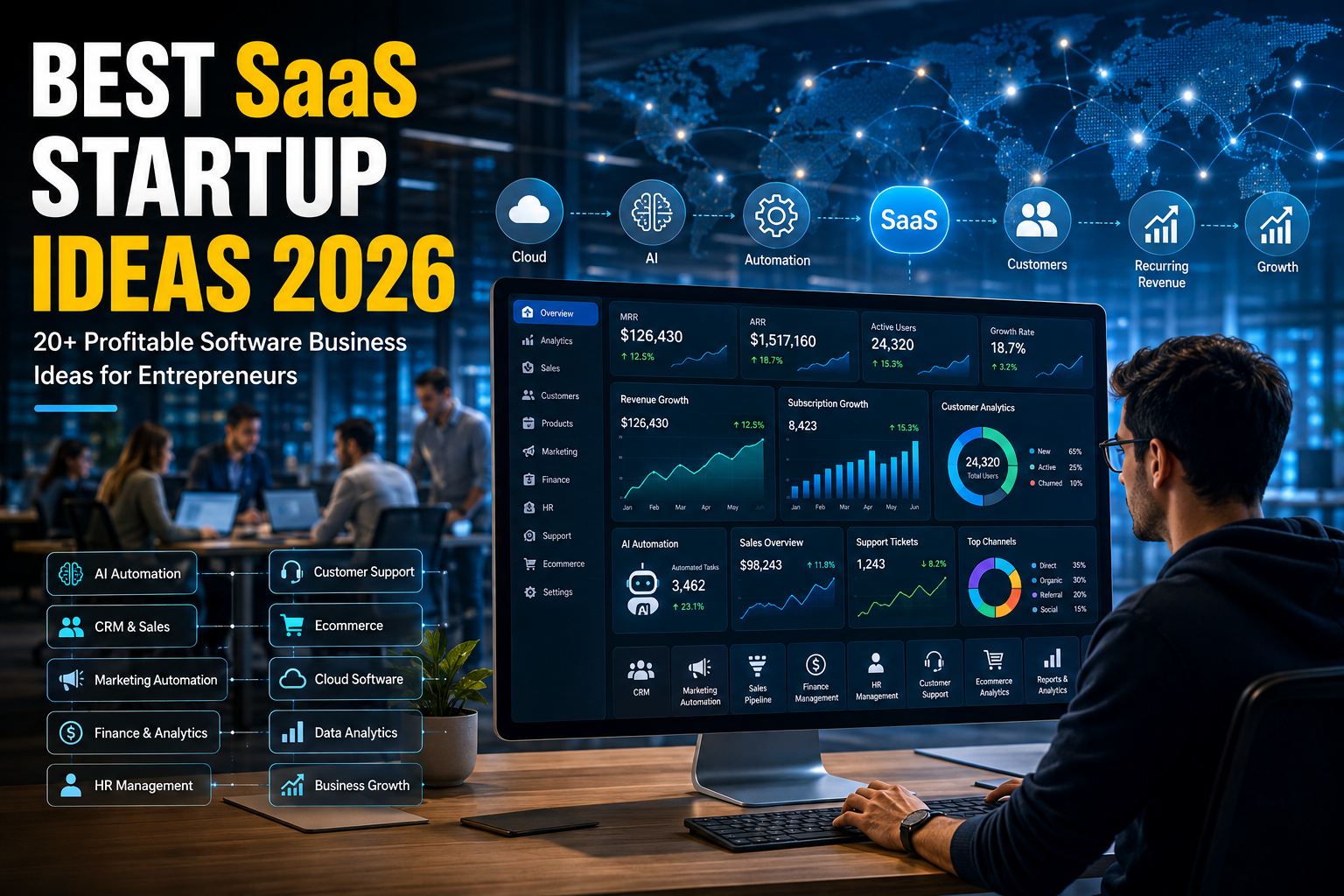
Finding one of the best SaaS startup ideas can be easier today than it was a few years ago. You do not always need a large office, a big development team, or millions of dollars to build a useful software product. Instead, with cloud computing, no-code tools, AI, APIs, and subscription-based business models, a small team can build and sell a SaaS product to customers around the world.
However, finding the right idea is often harder than building the software. Many entrepreneurs ask: what are the best SaaS startup ideas for 2026? Others wonder which software problem people will actually pay to solve, whether AI SaaS is still a good opportunity, or if they can start a SaaS business with a small budget.
Similarly, this guide explains the best SaaS startup ideas for 2026 in simple language. In fact, it covers AI SaaS, marketing software, finance tools, HR platforms, productivity products, industry-specific software, and other opportunities. It also explains how to choose an idea, validate demand, price your product, and turn a simple idea into a profitable SaaS business.
What Is a SaaS Startup?
As a result, saaS stands for Software as a Service. A SaaS company provides software through the internet instead of requiring customers to install and maintain the software on their own computers or servers.
Similarly, customers normally pay a monthly or yearly subscription to use the product.
Meanwhile, examples of SaaS products include tools for project management, accounting, customer relationship management, email marketing, communication, analytics, design, and artificial intelligence.
The basic SaaS model is simple:
- Build a software product.
- Host it online.
- Allow customers to create an account.
- Charge customers monthly or annually.
- Continue improving the product.
- Similarly, keep customers using the software for a long time.
In fact, the recurring subscription model is one of the biggest reasons entrepreneurs are interested in SaaS businesses.
Why Start a SaaS Business in 2026?
The SaaS market continues to create opportunities because businesses and individuals increasingly depend on online software. In fact, gartner projects global software spending will reach $1.44 trillion in 2026, growing more than 15% year over year.
Several changes are making SaaS startups attractive:
- Artificial intelligence is creating new software opportunities.
- In fact, small businesses need affordable digital tools.
- Companies also want to automate repetitive work.
- In practice, remote and hybrid teams need collaboration software.
- As a result, businesses need better customer data and analytics.
- Similarly, industry-specific software can solve highly focused problems.
- Meanwhile, APIs make it easier to connect different services.
- In short, no-code and low-code tools can reduce development time.
However, entrepreneurs should not build software simply because a technology is popular. As a result, A successful SaaS startup should solve a real problem. Instead, if you are still weighing options, our broader guide to AI startup ideas covers non-SaaS categories worth considering too.
The best SaaS idea is usually not the most complicated idea. Meanwhile, it is the idea that solves an important problem for a specific group of customers.
Best SaaS Startup Ideas
Overall, below are some of the most promising SaaS startup ideas for entrepreneurs who want to build a software business.
Best SaaS Startup Idea #1: AI Content Marketing SaaS
As a result, businesses need content for websites, social media, email, advertisements, and other channels.
Likewise, an AI content marketing platform could help businesses create, organize, optimize, and publish content from one dashboard.
The platform could include:
- AI blog writing
- Social media captions
- SEO suggestions
- Content calendars
- Email copy
- Product descriptions
- Keyword ideas
- Content repurposing
- Content performance tracking
Instead of creating another general AI writer, a startup could target a specific audience such as real estate companies, restaurants, ecommerce businesses, agencies, or local businesses.
Business opportunity: Charge customers monthly based on the number of users, content projects, or AI usage.
Best SaaS Startup Idea #2: AI Customer Support SaaS
However, customer support is a major expense for many businesses.
An AI customer support platform can answer common questions, search company knowledge bases, collect customer information, and transfer difficult conversations to human agents.
A strong product could connect with:
- Websites
- Live chat
- Help desks
- CRM systems
- Ecommerce platforms
The key is to make the AI useful rather than simply adding a chatbot.
For example, a SaaS product for ecommerce stores could answer questions about orders, returns, shipping, products, and payments.
Meanwhile, Potential customers: Ecommerce stores, SaaS companies, agencies, education companies, and service businesses.
Best SaaS Startup Idea #3: AI Sales Lead Qualification Software
Moreover, sales teams receive many leads, but not every lead is valuable.
Instead, A lead qualification SaaS can automatically collect information, score leads, ask qualifying questions, and send important leads to salespeople.
Useful features could include:
- Lead scoring
- AI conversations
- CRM integration
- Email automation
- Lead enrichment
- Appointment booking
- Sales notifications
- Conversion analytics
Additionally, this can be especially useful for companies that receive hundreds or thousands of enquiries every month.
Best SaaS Startup Idea #4: Local SEO SaaS for Small Businesses
Instead, local businesses need customers from nearby locations, but many owners do not understand SEO.
Overall, A simple local SEO SaaS could help businesses manage their online presence.
Features could include:
- Local keyword tracking
- Business profile monitoring
- Review management
- Citation monitoring
- Local ranking reports
- Competitor analysis
- SEO recommendations
- Review response generation
Instead of targeting every business, a startup could specialize in one industry.
For example, a platform could focus only on dentists, restaurants, lawyers, clinics, real estate agents, or home service companies.
A focused SaaS product can be easier to market because the message is clear.
Best SaaS Startup Idea #5: AI Social Media Management SaaS
Social media management is another strong SaaS opportunity.
Overall, many small businesses struggle to create posts consistently.
Consequently, an AI social media platform could help users plan, create, schedule, and analyze social media content.
Possible features include:
- AI post generation
- Social media calendars
- Image suggestions
- Short-video ideas
- Hashtag suggestions
- Automatic scheduling
- Performance analytics
- Content repurposing
Likewise, the product could generate a complete monthly social media plan based on a business type, target audience, location, and marketing goal.
Best SaaS Startup Idea #6: Small Business Finance SaaS
Furthermore, small businesses often need simple financial tools.
Likewise, traditional accounting software can sometimes feel complicated for small business owners.
A SaaS startup could create a simple financial dashboard that helps business owners understand:
- Revenue
- Expenses
- Profit
- Cash flow
- Invoices
- Recurring payments
- Outstanding payments
- Business expenses
For example, the product should not try to replace every accounting system.
Instead, it could focus on making financial information easier to understand.
For example, a dashboard could tell a business owner:
“Your expenses increased by 18% this month, mainly because of advertising and software subscriptions.”
However, that type of insight can be more valuable than simply displaying numbers.
Best SaaS Startup Idea #7: AI Meeting Assistant
In addition, businesses have many online meetings every day.
However, an AI meeting assistant can record meetings, create transcripts, summarize conversations, identify action items, and organize important information.
A useful product could offer:
- Meeting transcription
- AI summaries
- Action items
- Speaker identification
- Follow-up email generation
- Meeting search
- CRM updates
- Task creation
Similarly, to compete in this crowded market, the startup should focus on a particular group.
For example, an AI meeting tool designed specifically for sales teams could automatically identify customer objections, buying signals, competitors, and follow-up tasks.
Best SaaS Startup Idea #8: Employee Onboarding SaaS
Hiring a new employee involves many tasks.
In fact, an employee onboarding SaaS could help companies manage the entire process.
The platform could include:
- Employee documents
- Onboarding checklists
- Training material
- Company policies
- Task assignments
- Team introductions
- Progress tracking
- Automated reminders
The software could automatically create a customized onboarding plan when a new employee joins.
This is a good example of a B2B SaaS startup idea because companies may pay recurring subscriptions to manage their employees.
Best SaaS Startup Idea #9: SaaS for Recruitment Agencies
Moreover, recruitment agencies handle resumes, candidates, clients, interviews, and job openings.
Moreover, A specialized recruitment SaaS could make these processes easier.
Potential features include:
- Candidate database
- Resume parsing
- AI candidate matching
- Job management
- Interview scheduling
- Client management
- Candidate communication
- Recruitment analytics
As a result, AI could compare job requirements with candidate profiles and create a shortlist.
Additionally, the startup could charge based on recruiters, active jobs, or candidate volume.
Best SaaS Startup Idea #10: Property Management SaaS
Meanwhile, real estate owners and property managers need software to manage properties and tenants.
Additionally, A property management SaaS could provide:
- Tenant management
- Rent reminders
- Maintenance requests
- Lease management
- Property expenses
- Payment tracking
- Owner reports
- Communication tools
Consequently, A startup could target a specific market such as small landlords, property managers, commercial properties, or vacation rentals.
Best SaaS Startup Idea #11: SaaS for Freelancers
Instead, millions of freelancers work independently, but many use several different tools to manage their businesses.
A freelancer-focused SaaS could combine:
- Client management
- Proposals
- Contracts
- Invoices
- Time tracking
- Project management
- Payment reminders
- Income reports
The goal should be simplicity.
Freelancers may prefer one affordable tool rather than five complicated platforms.
Best SaaS Startup Idea #12: AI Proposal and Quotation Software
Businesses regularly prepare proposals and quotations for customers.
This process can take a lot of time.
Consequently, an AI proposal SaaS could allow a user to enter basic project information and automatically create a professional proposal.
Features could include:
- Proposal templates
- AI writing
- Pricing tables
- Electronic signatures
- Customer tracking
- Proposal analytics
- Follow-up reminders
- PDF generation
The software could also tell businesses when a customer has opened a proposal.
Best SaaS Startup Idea #13: Cybersecurity Compliance SaaS
Furthermore, small businesses increasingly need help with security and compliance.
Overall, A SaaS platform could help businesses manage security policies, employee training, compliance checklists, risk assessments, and documentation.
Potential customers include:
- SaaS companies
- Financial businesses
- Healthcare organizations
- Agencies
- Professional service companies
This type of SaaS can have strong B2B potential because businesses may pay for ongoing compliance management.
Best SaaS Startup Idea #14: Ecommerce Operations SaaS
Online stores manage products, orders, inventory, customers, marketing, returns, and support.
A specialized ecommerce SaaS could solve one difficult problem instead of trying to manage the entire store.
Ideas include:
- Inventory forecasting
- Return management
- Product description optimization
- Customer retention
- Review management
- Profit analysis
- Competitor price tracking
- Order management
Furthermore, A focused ecommerce SaaS can integrate with popular ecommerce platforms and provide additional functionality.
Best SaaS Startup Idea #15: AI Personal Productivity SaaS
Likewise, consumers and professionals want to save time.
An AI productivity platform could work like a personal digital assistant.
It could help users:
- Organize tasks
- Summarize documents
- Plan schedules
- Write emails
- Create reminders
- Prioritize work
- Search personal information
- Prepare daily plans
For instance, the important challenge is making the product useful without making it confusing.
However, A narrow productivity problem is often easier to solve than trying to create an AI assistant that does everything.
Best SaaS Startup Idea #16: Customer Feedback SaaS
For instance, customer feedback is valuable for SaaS companies and online businesses.
Moreover, A customer feedback platform could collect feedback from multiple channels and turn it into useful insights.
Features might include:
- Feedback collection
- Surveys
- Feature requests
- Customer voting
- Sentiment analysis
- Feedback categorization
- Product roadmaps
- Customer notifications
In practice, AI could group thousands of feedback messages into common problems.
This can help product teams understand what customers actually want.
Best SaaS Startup Idea #17: Appointment Booking SaaS
Additionally, appointment-based businesses need simple scheduling software.
A booking SaaS could target:
- Salons
- Clinics
- Consultants
- Coaches
- Tutors
- Fitness trainers
- Repair services
- Legal professionals
Features could include online booking, reminders, payments, staff schedules, customer management, and automated notifications.
The best opportunity may come from creating a booking platform for a specific industry rather than competing with general appointment software.
Best SaaS Startup Idea #18: Document Automation SaaS
Rather than that, businesses create many documents every day.
In short, A document automation platform could generate invoices, contracts, proposals, reports, certificates, forms, and other documents automatically.
Consequently, users could create templates and connect them with customer or business data.
For example:
For example, Customer information → Template → Automatically generated document → Email
Furthermore, this can save businesses many hours of manual work.
Best SaaS Startup Idea #19: AI Research SaaS
Research takes time because users need to collect information from different sources.
In addition, an AI research platform could help users search, organize, summarize, compare, and cite information.
Potential customers include:
- Researchers
- Students
- Consultants
- Journalists
- Marketing teams
- Business analysts
- Startup founders
A strong research SaaS should focus on reliable information and transparent sources rather than only generating text.
Best SaaS Startup Idea #20: Industry-Specific AI SaaS
One of the biggest opportunities is creating AI software for a specific industry.
Instead of building:
“AI software for everyone”
build:
For example, “AI software for one specific business problem.”
Examples include:
- AI for real estate agents
- AI for recruitment agencies
- AI for lawyers
- AI for accountants
- AI for insurance agencies
- AI for restaurants
- AI for construction companies
- AI for ecommerce sellers
- AI for marketing agencies
- AI for education businesses
Industry-specific SaaS products can have a strong advantage because they understand the customer’s workflow.
How to Choose the Best SaaS Startup Idea
Generally, choosing an idea is more important than simply starting development.
In addition, before building your product, answer a few important questions.
1. What problem does the product solve?
Do not start with technology.
Start with the problem.
For example, A strong SaaS idea solves a problem that customers already experience.
2. Who will pay for it?
Define your target customer clearly.
For example:
Similarly, “Small digital marketing agencies with 5–20 employees”
is much better than:
“Businesses.”
3. How serious is the problem?
Similarly, A problem that saves a company $10,000 or 50 employee hours every month is more valuable than a small inconvenience.
4. Are people already paying for solutions?
Competition is not always bad.
If companies already spend money solving the problem, it can prove that there is demand.
In fact, your goal is to create a better, cheaper, faster, simpler, or more specialized solution.
5. Can customers use the product repeatedly?
Recurring usage is important for SaaS.
In fact, A product that customers need every week or every day may have better retention than a product they use once a year.
How to Validate a SaaS Idea Before Building It
As a result, one of the biggest mistakes new founders make is developing software before confirming demand.
You can validate an idea with a simple process.
Step 1: Talk to Potential Customers
Speak with 10–30 potential customers.
As a result, ask about their current workflow and problems.
Do not simply ask:
“Would you buy this?”
Instead ask:
“How do you solve this problem today?”
Meanwhile, their current behavior is usually more useful than their hypothetical answer.
Step 2: Study Competitors
Look at existing products.
Study their:
- Pricing
- Features
- Customer reviews
- Complaints
- Target audience
- Strengths
- Weaknesses
Negative reviews can be especially useful because they show what customers want improved.
Step 3: Create a Landing Page
Instead, create a simple website explaining the product.
Include:
- Problem
- Solution
- Main benefits
- Screenshots or prototype
- Pricing
- Signup form
In addition, then measure whether people show interest.
Step 4: Build an MVP
MVP means Minimum Viable Product.
An MVP is the simplest version of your product that solves the main problem.
Do not build 50 features.
Start with one important workflow.
Step 5: Get Paying Customers
Overall, A SaaS idea becomes much more interesting when people are willing to pay for it.
Even a small number of paying customers can provide valuable feedback.
How Much Does It Cost to Start a SaaS Business?
Likewise, the cost depends on the product. Meanwhile, our guide to calculating startup costs walks through the main budget categories in more detail.
Similarly, A simple SaaS MVP can potentially be built with a small team and modern development tools. However, more complex products involving advanced AI, large databases, real-time communication, security requirements, or enterprise integrations can require significantly more investment.
Major cost areas include:
- Software development
- UI/UX design
- Cloud hosting
- AI/API usage
- Database infrastructure
- Security
- Payment processing
- Marketing
- Customer support
- Legal and business setup
Instead, the best approach for a new founder is to control costs until the product proves demand.
SaaS Pricing Models
Moreover, there are several common SaaS pricing strategies.
Freemium
In fact, users can use a limited version for free and pay for additional features.
Monthly Subscription
Customers pay every month.
For example:
- Basic: $9/month
- Professional: $29/month
- Business: $99/month
Annual Subscription
Overall, customers pay for an entire year, often at a discount.
Usage-Based Pricing
Customers pay based on usage.
For example, pricing could depend on API calls, AI credits, documents, or processed transactions.
Per-User Pricing
Businesses pay according to the number of users.
Additionally, the best pricing model depends on the value your software provides.
How to Make a SaaS Startup Profitable
Building software is only one part of the business.
You also need customer acquisition and retention.
Focus on:
Consequently, Product → Customers → Retention → Revenue → Growth
As a result, A SaaS company should monitor metrics such as:
- Monthly Recurring Revenue (MRR)
- Annual Recurring Revenue (ARR)
- Customer Acquisition Cost (CAC)
- Customer Lifetime Value (LTV)
- Churn rate
- Conversion rate
- Active users
For example, getting 1,000 users sounds impressive, but if only 10 customers pay, the business may not be healthy.
Likewise, A smaller SaaS with 100 loyal paying customers can sometimes be a better business.
Best SaaS Startup Ideas by Target Market
If you are still unsure which direction to choose, the following categories can help.
| Target Market | SaaS Idea |
|---|---|
| Small Businesses | Business management software |
| Marketing Agencies | AI marketing automation |
| Realtors | Real estate CRM |
| Ecommerce | Inventory and profit analytics |
| Recruiters | AI candidate matching |
| Freelancers | Client and invoice management |
| Restaurants | Restaurant operations software |
| Healthcare Businesses | Appointment and workflow management |
| Education | Student management software |
| Finance Teams | Financial reporting automation |
| Sales Teams | AI lead qualification |
| HR Teams | Employee onboarding |
| Content Creators | Content planning and analytics |
| Developers | Developer productivity tools |
Common SaaS Startup Mistakes to Avoid
Furthermore, new founders often make the same mistakes.
Building Too Many Features
However, more features do not automatically make a better product.
Start with one valuable problem.
Targeting Everyone
For example, A product designed for everyone often becomes difficult to market.
Choose a specific audience.
Ignoring Customer Feedback
Customers can tell you what is missing, confusing, or unnecessary.
Listen to them.
Competing Only on Price
Moreover, being cheaper is not always a strong strategy.
Try to provide better value.
Ignoring Marketing
In addition, A great product cannot grow if nobody knows it exists.
Start marketing early.
Focusing Only on New Customers
Meanwhile, customer retention is extremely important.
Similarly, A SaaS company should understand why customers cancel and continuously improve the product.
Future of SaaS Startups
Instead, the SaaS industry is moving toward more intelligent, automated, and specialized software.
AI will likely become a standard feature inside many SaaS products rather than remaining a separate category.
Instead of users manually completing every step, software will increasingly be able to understand goals, access business data, make recommendations, and complete certain tasks.
This creates opportunities for entrepreneurs to build AI-powered vertical SaaS products.
For example, instead of creating a general AI assistant, a startup could build an AI operations platform specifically for property managers.
Additionally, the software could understand property records, maintenance requests, tenant communications, payments, and scheduled tasks.
Overall, this type of specialization can create a stronger product than a general-purpose AI tool.
Frequently Asked Questions About SaaS Startup Ideas
Here are quick answers to common questions about the best SaaS startup ideas covered in this guide.
What is the best SaaS startup idea in 2026?
In fact, there is no single best SaaS idea for everyone. Consequently, AI-powered business software, vertical SaaS, workflow automation, customer support, marketing automation, and industry-specific software offer strong opportunities. As a result, the best idea is one that solves a real problem for a clearly defined customer.
Is SaaS still profitable in 2026?
Yes, SaaS can still be profitable, but profitability depends on the product, pricing, customer acquisition cost, retention, and operating expenses. Furthermore, simply launching a SaaS product does not guarantee success.
What is the easiest SaaS business to start?
Meanwhile, simple SaaS products that solve one specific business problem are generally easier to start than large platforms. Likewise, examples include appointment scheduling, reporting dashboards, proposal generation, review management, and niche workflow automation.
Can I start a SaaS business with a small budget?
Yes. However, you can start with a small MVP, cloud services, APIs, existing development frameworks, and a small team. The important goal is to validate customer demand before spending heavily on development.
Is AI SaaS a good startup opportunity?
Instead, AI SaaS can be a strong opportunity when AI solves a meaningful customer problem. Adding AI to a product without a clear benefit is unlikely to create a sustainable advantage.
Should I build B2B or B2C SaaS?
Overall, both models can work. B2B SaaS can often support higher subscription prices because the software directly helps businesses save money, increase revenue, or save time. Moreover, B2C SaaS can have a larger potential audience but may require different pricing and marketing strategies.
How do I find SaaS problems worth solving?
Likewise, look for repetitive, expensive, slow, confusing, or manual processes. For instance, talk to potential customers and learn how they currently solve the problem. However, existing complaints, spreadsheets, manual workflows, and multiple disconnected tools can reveal good SaaS opportunities.
How long does it take to build a SaaS MVP?
Additionally, it depends on the product. A simple SaaS MVP may take weeks or a few months, while a complex platform can take much longer. The goal should be to launch the smallest useful version rather than waiting until every feature is complete.
What is vertical SaaS?
Vertical SaaS is software designed specifically for one industry or niche. Moreover, examples include software for dentists, real estate companies, restaurants, recruiters, construction companies, or legal firms.
What makes a SaaS business successful?
A successful SaaS business normally combines a real customer problem, useful software, clear positioning, good pricing, effective customer acquisition, strong retention, and continuous product improvement.
Final Thoughts
Consequently, the best SaaS startup ideas are not necessarily the ideas with the most advanced technology. Additionally, A simple product that solves an expensive or frustrating problem can become a successful software business.
In 2026, entrepreneurs have many opportunities because AI, cloud computing, automation, APIs, and modern development tools make it easier to create software products. However, competition is also increasing, so revisit this list of best SaaS startup ideas often as you refine your own plan.
Rather than that, the smartest approach is to start narrow.
Choose one customer group. Consequently, find one important problem. For example, talk to potential users. Furthermore, study existing solutions. Build a small MVP. Get your first paying customers. For example, then improve the product based on real feedback.
Furthermore, AI-powered SaaS, vertical SaaS, business automation, marketing software, financial tools, customer support platforms, recruitment software, and industry-specific applications all offer potential opportunities.
In addition, the key question is not simply “What SaaS can I build?”
The better question is:
For instance, “What problem can I solve so well that customers are willing to pay for it every month?”
That question can help turn a simple software idea into a sustainable SaaS startup.