

The median startup landing page converts at 6.6 percent, but a genuinely good page reaches 10 percent or higher, according to recent industry data. That gap usually isn’t about traffic quality. It comes down to a handful of fixable page-level problems, most of which have nothing to do with your product. Here’s what actually moves that number.
What a High-Converting Startup Landing Page Needs Above the Fold
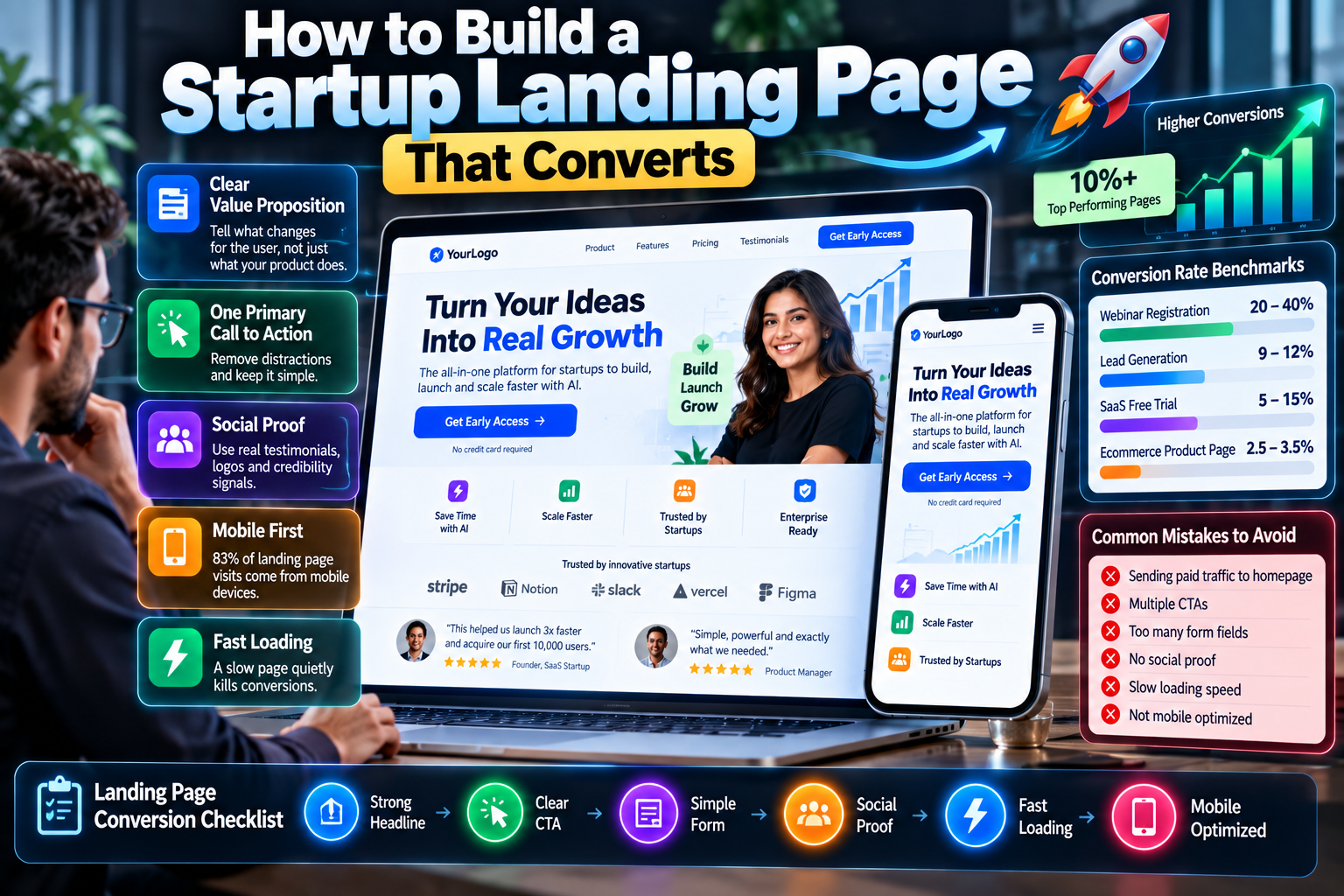
Roughly half of visitors leave a page without ever scrolling past the first screen. That makes the above-the-fold section the entire pitch, not just an introduction. It needs a clear value proposition, one primary call to action, and enough visual proof that a stranger understands what you do within five seconds. Mobile matters even more here. Mobile traffic now accounts for nearly 83 percent of landing page visits. The fold, in other words, is often a phone screen, not a desktop monitor.
Writing a Headline and Value Proposition That Actually Convert
A headline that leads with a feature loses to one that leads with a benefit almost every time. Instead of naming what your product does, name what changes for the visitor once they use it. Simpler language wins too. Copy written at a fifth to seventh grade reading level converts at 11.1 percent, noticeably above the industry median. That isn’t about talking down to visitors. Rather, it’s about removing friction from a page they’re scanning, not reading.
How Many Form Fields Should a Startup Landing Page Have
Every extra form field is a small tax on conversion. Pages built around a single, clear call to action convert at roughly 13.5 percent. By comparison, pages offering five or more competing links or options convert at only 10.5 percent. If you’re collecting an email for a waitlist, ask for the email and nothing else. Add fields later, once someone has already said yes once.
Using Social Proof Without Overdoing It
Testimonials, logos, and review counts reduce the perceived risk of trying an unknown product. Marketers credit imagery and social proof elements with meaningfully lifting conversion. Video ranks just above them, with 38.6 percent of marketers calling it their single highest-impact addition. The trap is treating social proof as decoration. Two specific, credible testimonials beat ten generic five-star quotes with no names attached.
Page Speed and Mobile: The Silent Conversion Killers
A slow-loading page quietly erodes conversion before a visitor reads a single word of copy. Since mobile accounts for the large majority of landing page traffic, a slow phone experience quietly costs conversions. You’ll never see it flagged in an analytics report. It just shows up as traffic that never converts. Compress images, cut unnecessary scripts, and test load time on an actual phone, not just a desktop browser.
What a Good Conversion Rate Actually Looks Like
Benchmarks vary a lot by goal. Ecommerce product pages typically convert around 2.5 to 3.5 percent. SaaS free trial sign-ups run higher, often 5 to 15 percent. Lead generation pages tend to land between 9 and 12 percent. Webinar registration pages can reach 20 to 40 percent. Compare your page against the right category, not a generic industry average, or you’ll misjudge whether it’s actually underperforming.
Common Mistakes That Sink a Startup Landing Page
The most common mistake is sending paid traffic to a homepage instead of a dedicated landing page built around one offer. A close second is burying the call to action below several paragraphs of copy nobody reads. Competing calls to action and a pricing table with no clear recommended option both quietly push the conversion rate down. For more on getting the right traffic to that page in the first place, see our guide to startup marketing strategies.
Frequently Asked Questions About Startup Landing Pages
What Is a Good Conversion Rate for a Startup Landing Page?
Anything above the 6.6 percent median is solid, and 10 percent or higher puts a page among the stronger performers. The right benchmark still depends on the goal. A webinar signup page should convert far higher than an ecommerce product page.
Should a Startup Landing Page Have More Than One CTA?
Generally, no. A single, clear call to action consistently outperforms a page offering several competing options. If you need to serve two audiences, build two landing pages instead of asking one page to do both jobs.
A startup landing page doesn’t need more traffic to convert better. It usually needs fewer distractions. Tighten the above-the-fold pitch and cut the form down to what you actually need. Add real social proof, and make sure the page loads fast on a phone. Those four changes account for most of the gap between a page converting at 3 percent and one converting at 12.