

Introduction
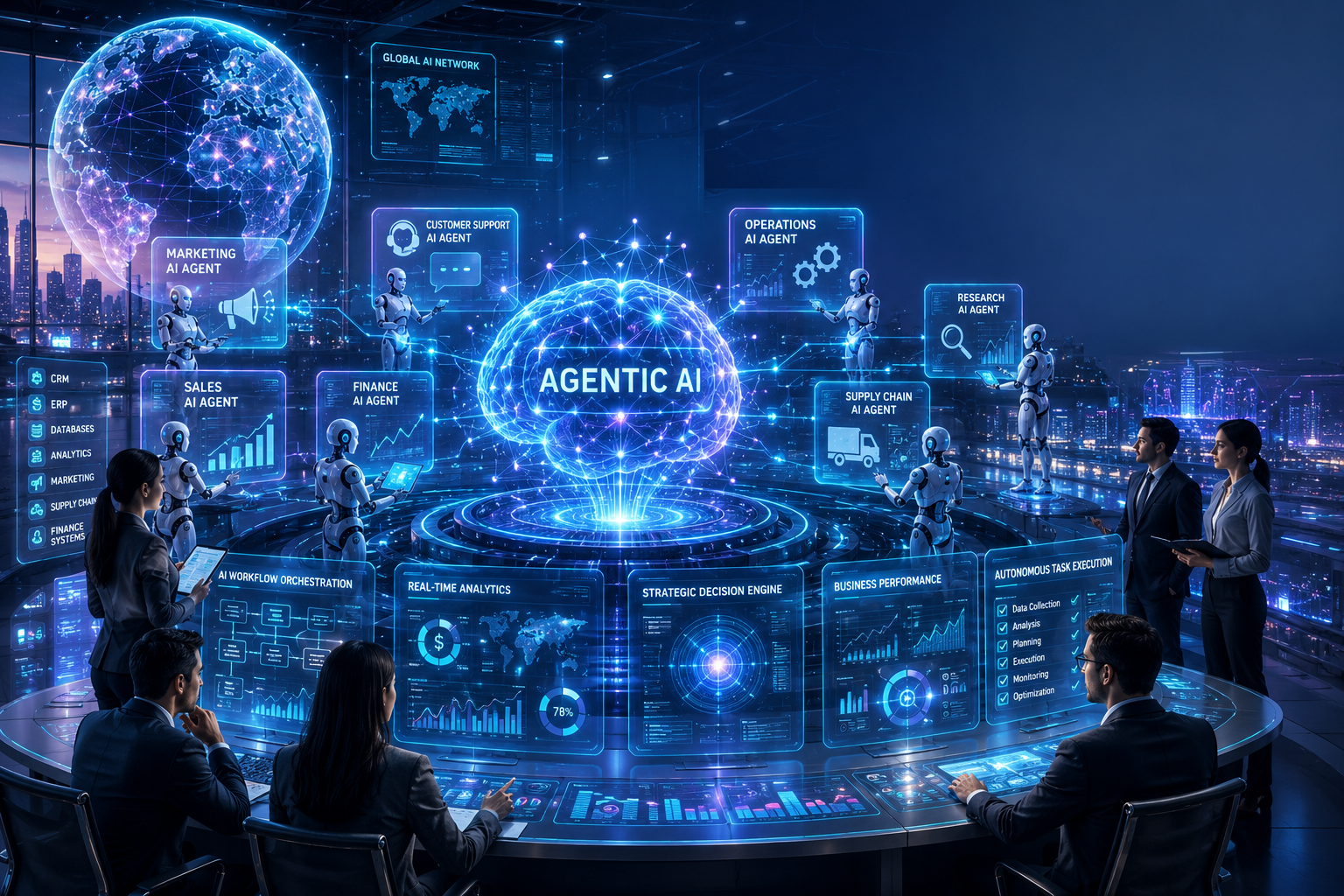
Artificial Intelligence is evolving faster than ever before. Just a few years ago, AI was mainly used to answer questions, create content, and automate simple tasks. Today, a new generation of AI is emerging that can think, plan, make decisions, and complete complex tasks with very little human involvement. This new approach is called Agentic AI.
The shift toward Agentic AI is changing how businesses operate, how employees work, and how customers interact with companies. Instead of simply responding to commands, AI agents can take actions, solve problems, coordinate workflows, and achieve goals independently. From customer service and marketing to healthcare and finance, Agentic AI is creating new opportunities for efficiency and innovation.
Understanding Agentic AI is important because it represents the next major step in digital transformation. Whether you are a business owner, startup founder, marketer, student, or technology enthusiast, learning about Agentic AI can help you prepare for the future and gain a competitive advantage in an increasingly automated world.
What Is Agentic AI?
Agentic AI refers to artificial intelligence systems that can act independently to achieve specific goals. Unlike traditional AI systems that wait for instructions, Agentic AI can analyze situations, make decisions, create plans, and execute tasks with minimal human intervention.
An AI agent behaves more like a digital employee than a software tool. It can understand objectives, break them into smaller tasks, gather information, and perform actions to achieve desired outcomes.
For example, instead of asking an AI chatbot to create a marketing report, an Agentic AI system can:
- Collect data from different sources
- Analyze customer behavior
- Generate insights
- Create visual reports
- Send recommendations to managers
- Schedule follow-up actions
This ability to work autonomously makes Agentic AI a major advancement in artificial intelligence.
Understanding the Evolution of AI
To understand the shift toward Agentic AI, it helps to see how AI has evolved over time.
Rule-Based Systems
Early AI systems followed predefined rules. They could only perform actions that were programmed by humans.
Machine Learning
Machine learning enabled systems to learn patterns from data and improve performance over time.
Generative AI
Generative AI introduced the ability to create content such as text, images, videos, and code.
Agentic AI
Agentic AI goes beyond content creation. It can reason, plan, decide, and execute tasks independently to achieve goals.
This evolution is moving AI from a passive assistant to an active problem solver.
Why Is the Shift Toward Agentic AI Happening?
Several factors are driving the rapid adoption of Agentic AI.
Improved AI Models
Modern large language models have become more capable of understanding complex instructions and reasoning through problems.
Increased Computing Power
Cloud computing and advanced hardware allow AI systems to process large amounts of information quickly.
Growing Business Demands
Organizations need faster decision-making, greater efficiency, and lower operational costs.
Better Integration Tools
Modern APIs, automation platforms, and software ecosystems make it easier for AI agents to interact with business systems.
Demand for Automation
Companies want solutions that can automate not just tasks but entire workflows.
These developments have created the perfect environment for Agentic AI to thrive.
Key Characteristics of Agentic AI
Agentic AI systems have several unique characteristics that separate them from traditional AI tools.
Goal-Oriented Behavior
Agentic AI focuses on achieving specific objectives rather than simply responding to commands.
Autonomous Decision-Making
The system can make decisions based on available information and changing circumstances.
Planning Capabilities
AI agents can create detailed plans and adjust strategies when needed.
Continuous Learning
Many Agentic AI systems improve through feedback and experience.
Multi-Step Execution
Agentic AI can complete a sequence of tasks without requiring constant human supervision.
Tool Usage
AI agents can interact with software applications, databases, websites, and digital tools.
These capabilities make Agentic AI far more powerful than traditional automation systems.
How Agentic AI Works
Agentic AI follows a structured process to achieve goals.
Goal Identification
The AI receives an objective from a user or business system.
Information Gathering
It collects relevant data from available sources.
Planning
The system creates a strategy to achieve the objective.
Execution
The AI performs required actions using connected tools and systems.
Monitoring
Progress is continuously tracked and evaluated.
Optimization
The AI adjusts actions based on outcomes and new information.
This cycle allows Agentic AI to work efficiently and independently.
Agentic AI vs Traditional AI
Many people confuse Agentic AI with traditional AI systems. However, there are important differences.
| Traditional AI | Agentic AI |
|---|---|
| Responds to commands | Pursues goals |
| Requires frequent human input | Operates autonomously |
| Focuses on individual tasks | Manages complete workflows |
| Limited decision-making | Advanced decision-making |
| Reactive behavior | Proactive behavior |
| Simple automation | Intelligent automation |
The shift toward Agentic AI represents a move from reactive systems to proactive digital agents.
Business Benefits of Agentic AI
Organizations are increasingly investing in Agentic AI because of its significant advantages.
Increased Productivity
Agentic AI can handle repetitive and time-consuming tasks, allowing employees to focus on higher-value work.
Faster Decision-Making
AI agents analyze information quickly and provide actionable insights.
Cost Reduction
Automation reduces labor costs and operational expenses.
Improved Customer Experience
AI agents provide faster responses and personalized interactions.
Better Resource Management
Businesses can allocate resources more effectively with intelligent automation.
Scalability
Agentic AI can manage increasing workloads without proportional increases in staffing.
These benefits are driving adoption across industries.
Agentic AI in Customer Service
Customer service is one of the most common applications of Agentic AI.
AI agents can:
- Answer customer questions
- Resolve support tickets
- Process refunds
- Schedule appointments
- Track orders
- Escalate complex issues
Unlike traditional chatbots, Agentic AI can understand customer goals and take actions to solve problems completely.
This improves customer satisfaction while reducing support costs.
Agentic AI in Marketing
Marketing teams are increasingly using Agentic AI to improve performance.
AI agents can:
- Conduct market research
- Analyze customer behavior
- Generate content
- Optimize campaigns
- Manage social media
- Monitor competitors
These capabilities help businesses create more effective marketing strategies and improve return on investment.
Agentic AI in Sales
Sales departments benefit significantly from AI-driven automation.
AI agents can:
- Identify qualified leads
- Analyze customer intent
- Send personalized messages
- Schedule meetings
- Follow up automatically
- Update CRM systems
This allows sales teams to focus on building relationships and closing deals.
Agentic AI in Human Resources
Human resource departments can automate many routine activities using AI agents.
Common applications include:
- Resume screening
- Candidate matching
- Interview scheduling
- Employee onboarding
- Training recommendations
- Performance tracking
These processes become faster and more efficient with Agentic AI.
Agentic AI in Healthcare
Healthcare organizations are exploring Agentic AI to improve patient care and operational efficiency.
Potential applications include:
- Appointment scheduling
- Medical record management
- Patient monitoring
- Treatment recommendations
- Administrative automation
Healthcare professionals can spend more time focusing on patient care while AI handles routine tasks.
Agentic AI in Finance
Financial institutions are adopting Agentic AI for a wide range of functions.
These include:
- Fraud detection
- Risk analysis
- Investment research
- Compliance monitoring
- Financial planning
- Customer support
AI agents can process large amounts of financial data quickly and accurately.
The Role of Agentic AI in Startups
Startups often operate with limited resources and small teams.
Agentic AI can help startups by:
- Automating business operations
- Managing customer support
- Conducting market research
- Generating content
- Tracking competitors
- Improving productivity
This enables startups to compete more effectively with larger organizations.
Agentic AI and the Future of Work
The rise of Agentic AI is transforming workplaces around the world.
Instead of replacing all jobs, Agentic AI is expected to change how work is performed.
Employees will increasingly collaborate with AI agents to:
- Improve productivity
- Reduce repetitive tasks
- Enhance decision-making
- Accelerate innovation
The future workforce will likely consist of humans and AI agents working together.
Challenges of Agentic AI
While Agentic AI offers many benefits, it also presents challenges.
Security Risks
Autonomous systems may become targets for cyberattacks.
Data Privacy Concerns
AI agents often require access to sensitive information.
Ethical Considerations
Organizations must ensure AI decisions remain fair and transparent.
Regulatory Compliance
Governments are developing regulations for AI usage.
Reliability Issues
AI agents can make mistakes if data quality is poor.
Businesses must address these challenges through proper governance and oversight.
Agentic AI Governance and Responsible Use
Responsible implementation is critical for long-term success.
Organizations should focus on:
- Human oversight
- Data protection
- Ethical guidelines
- Transparency
- Accountability
- Compliance management
Strong governance ensures that Agentic AI operates safely and effectively.
Emerging Trends in Agentic AI
Several trends are shaping the future of Agentic AI.
Multi-Agent Systems
Multiple AI agents work together to achieve complex objectives.
Autonomous Enterprises
Businesses increasingly automate complete workflows.
AI-Powered Decision Intelligence
Organizations use AI agents for strategic decision support.
Industry-Specific AI Agents
Specialized agents are being developed for healthcare, finance, education, and manufacturing.
Human-AI Collaboration
The future focuses on partnership rather than replacement.
These trends indicate rapid growth in Agentic AI adoption.
How Businesses Can Prepare for Agentic AI
Organizations should take proactive steps to prepare.
Assess Current Processes
Identify repetitive and time-consuming tasks suitable for automation.
Invest in AI Infrastructure
Develop the technical foundation needed for AI integration.
Train Employees
Help teams understand how to work effectively with AI agents.
Start Small
Begin with pilot projects before expanding adoption.
Focus on Governance
Create policies for responsible AI usage.
These steps can help businesses successfully navigate the transition.
The Long-Term Impact of Agentic AI
The shift toward Agentic AI will likely have a profound impact on society and business.
In the coming years, we may see:
- Fully autonomous business processes
- Intelligent digital workforces
- Faster innovation cycles
- Improved customer experiences
- Greater operational efficiency
- New business models powered by AI agents
Organizations that embrace this transformation early may gain significant competitive advantages.
Conclusion
The shift toward Agentic AI marks one of the most important developments in the history of artificial intelligence. Unlike traditional AI systems that simply respond to commands, Agentic AI can understand goals, make decisions, create plans, and execute tasks independently. This capability is transforming industries, improving productivity, reducing costs, and enabling new levels of automation.
From customer service and marketing to healthcare and finance, businesses are discovering powerful ways to use AI agents to streamline operations and improve outcomes. At the same time, organizations must address challenges related to security, privacy, ethics, and governance to ensure responsible adoption.
As technology continues to evolve, Agentic AI will become an essential part of modern business strategy. Companies, professionals, and entrepreneurs who understand and embrace this shift today will be better positioned to succeed in the increasingly intelligent and automated future ahead.
Read More Blog–Ai Startup Edge
Frequently Asked Questions (FAQs)
1. What is Agentic AI?
Agentic AI is an advanced form of artificial intelligence that can independently plan, make decisions, and perform tasks to achieve specific goals with minimal human intervention.
2. How is Agentic AI different from traditional AI?
Traditional AI mainly responds to user commands, while Agentic AI can proactively take actions, solve problems, and manage complete workflows.
3. Why is Agentic AI becoming popular?
Agentic AI is becoming popular because it improves productivity, reduces costs, automates complex processes, and enhances business efficiency.
4. Which industries can benefit from Agentic AI?
Industries such as healthcare, finance, marketing, customer service, manufacturing, education, and human resources can benefit significantly from Agentic AI.
5. Can Agentic AI replace human workers?
Agentic AI is more likely to augment human workers rather than completely replace them. It handles repetitive tasks while humans focus on creativity, strategy, and relationship-building.
6. What are the risks of Agentic AI?
Potential risks include security threats, privacy concerns, ethical challenges, regulatory issues, and decision-making errors.
7. How can startups use Agentic AI?
Startups can use Agentic AI for customer support, marketing automation, lead generation, content creation, market research, and business operations management.
8. What is a multi-agent system?
A multi-agent system consists of multiple AI agents working together to solve problems, complete tasks, and achieve complex objectives.
9. Is Agentic AI the future of business automation?
Yes, many experts believe Agentic AI will become a key driver of future business automation because it can manage entire workflows autonomously.
10. How can businesses prepare for Agentic AI adoption?
Businesses should evaluate processes, invest in AI infrastructure, train employees, start with pilot projects, and establish strong governance policies for responsible AI use.